
Do I Need a Whole House or Under Sink Filter? (2026)
Guide
Your shower water smells faintly like a swimming pool, and the glass you fill at the kitchen tap has a metallic edge. A plumber quotes you $2,000 for a whole-house system while your neighbor swears the $150 box under their sink solved everything. Same water, wildly different advice — so which one is actually right for your home?
Here is the honest answer we kept arriving at while researching and comparing both setups: a whole-house filter and an under-sink filter are not really competing products — they solve different problems in different places. A whole-house system treats water where it enters your home, so every tap benefits. An under-sink system treats water at one faucet, so your drinking water gets the deep cleanup. Most city-water households only ever need the under-sink side.
Check Current PriceTable of Contents
Quick verdict
The Real Problem: Two Different Water Jobs
Most buyers frame this as “which product is better?” — and that is the wrong question. Your water actually has two jobs. Job one is drinking and cooking water: health and taste at the glass. Job two is everything-else water: showers, laundry, appliances, and fixtures. Health-concern contaminants like lead and PFAS matter at the glass. Aesthetic problems like chlorine smell, sediment, and iron stains show up everywhere else.

Lead usually enters drinking water through service lines and household fixtures, not the water supply itself — which is why filtering at the tap you drink from is the more direct fix than treating the entire house for a lead-only concern:
| Where you notice it | Likely culprit | Start here |
|---|---|---|
| Chlorine smell in the shower | Chlorine or chloramine | Whole-house |
| Sediment or rust at several faucets | Sediment, iron | Whole-house |
| Bad taste at the kitchen tap only | Taste, odor, or a specific contaminant | Under-sink |
| Lead or PFAS concern in drinking water | Lead, PFAS | Under-sink (certified or RO) |
| White crust on fixtures, spots on dishes | Hard-water minerals | Neither — that is a softener problem |
What a Whole-House Filter Actually Does
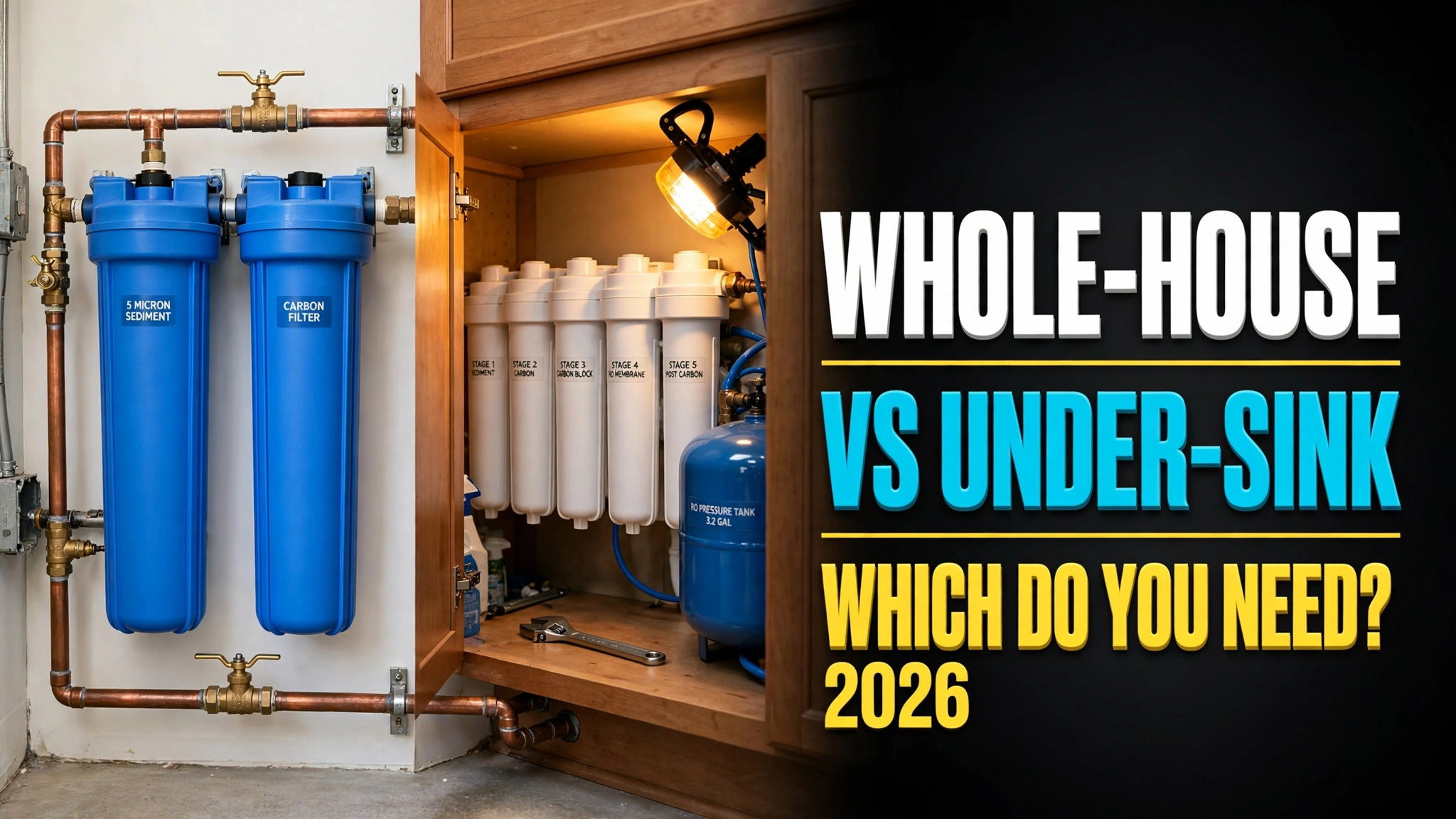
A whole-house system installs on the main water line where water enters your home — the point of entry — and treats everything downstream: showers, sinks, toilets, laundry, and appliances. Whole-house reverse osmosis exists, but plumbers generally advise against it: it is expensive, slow, and sends a lot of water to drain.
For the full category rundown — the best systems we found, with head-to-head picks — see our best whole-house water filter rankings.

The whole-house pick we keep coming back to
The Aquasana HealthShield is the standout for homeowners who want one system on the main line with serious drinking-adjacent certifications. Per Aquasana’s certification statements, it is WQA-certified to NSF/ANSI 53 and 401 — covering PFAS (99.9% reduction per the brand), VOCs, BPA, and ibuprofen. Caveats: brand-stated certification (we could not confirm the public listing); launched in 2026, so no long-term owner record yet; modest flow versus big media tanks; and it does not soften water.
Pros
- Every tap is filtered — showers, sinks, laundry, appliances, all of it.
- Protects plumbing and appliances — sediment filtration cuts the wear on water heaters, washers, and fixtures.
- Chlorine gone from showers — the fix for swimming-pool smell in the bath.
- One system to maintain — no per-faucet juggling.
Cons
- Filters water you never drink — toilets, hoses, and irrigation get the same treatment you paid for.
- Higher upfront and install cost — cutting into the main line usually means hiring a plumber.
- Whole-house RO is impractical — too slow, too expensive, too much wastewater for a whole home.
- Does not soften water — hardness and scale are a separate equipment problem.
What an Under-Sink Filter Actually Does
An under-sink system sits in the cabinet under your kitchen sink and feeds a dedicated faucet (or your main faucet). It treats one thing: the water you drink and cook with — the point of use. There are two flavors. Simple under-sink carbon filters handle taste, odor, and chlorine. Under-sink reverse osmosis goes deeper: it is the standard answer when your water report flags arsenic, fluoride, nitrate, or chromium-6, because standard carbon filters are not rated for those.

The under-sink picks we keep coming back to
For a tankless RO with a UV stage, the SimPure UV RO system (~$300–450 estimate) is the pick: RO membrane plus UV, no storage tank, compact cabinet footprint. Certification note: SimPure states this unit carries NSF/ANSI 58 certification through SGS — that is brand-stated, and we could not confirm the listing in a public certifier database at the time of writing.
For tight budgets, the Geekpure 5-stage RO (~$130–220 estimate) delivers the classic tanked-RO setup — sediment, carbon, membrane, tank — at roughly half the price. The tradeoff is honest: we could find no third-party certification to verify, so buy it for value and convenience, not for certified contaminant reduction.
Pros
- Targeted where it matters — the strongest certifications land at the glass you drink from.
- Lowest total cost — the cheapest path to genuinely clean drinking water.
- DIY-friendly installs — most units go in with basic tools; no plumber required.
- Easy cartridge swaps — everything is reachable under one cabinet.
Cons
- One tap only — showers, laundry, and appliances are untouched.
- RO needs space and a drain — the membrane sends some water to drain, and tanks take cabinet room.
- Slower than a tap — tanked RO refills slower than you pour, so very heavy use can outpace it.
- Won’t fix shower or laundry problems — the wrong tool for whole-home symptoms.
Whole-House vs Under-Sink: Side by Side
Here is the full comparison in one place — costs are third-party estimates from a 2026 cost breakdown (thehomewaterguide.com), and prices drift, so treat every dollar figure as an estimate:
| Whole-house | Under-sink | |
|---|---|---|
| Where it filters | Main line (point of entry) | One faucet (point of use) |
| What it covers | Every tap, shower, appliance | Drinking and cooking water only |
| Typical system cost | ~$400–1,500 unit + ~$200–500 install | ~$130–450 unit, often DIY |
| 5-year total (estimate) | ~$800–2,500 | ~$350–950 |
| Installation | Usually needs a plumber | DIY in most cases |
| Best for | Chlorine everywhere, sediment, iron, multi-fixture problems | Drinking-water quality, lead/PFAS at the glass, renters, tight budgets |
| Weak spot | Filters water you never drink; won’t soften hard water | Shower and laundry untouched |
If budget is what pushes you toward the whole-house side, our budget whole-house picks keep the main-line approach under control. And for a deeper model-by-model head-to-head, see our dedicated whole-house vs under-sink comparison.
The 5-year totals above come from thehomewaterguide.com’s 2026 cost breakdown — one third-party estimate. Whole-house systems and plumber rates vary enormously by region, so run your own numbers before committing.
Step-by-Step: Which One You Need

- Test your water first. US water suppliers publish an annual water quality report — start there. For well water or old plumbing, a certified lab test is the honest route. Never buy a $2,000 system blind.
- Map each problem to a location. Kitchen-glass problems point under the sink. Every-tap problems point to the main line.
- Check your housing situation. Renters cannot cut into the main line — under-sink (or a renter-friendly option) is the answer. Homeowners planning to stay can justify the whole-house investment.
- Match the tool to the contaminant. Lead or PFAS at the glass means certified under-sink or RO. Chlorine everywhere means whole-house carbon. White crust and spots mean hard-water minerals — that is a softener problem, not a filter problem.
- Decide: one, the other, or both. The layered combo — whole-house carbon or sediment for the house plus under-sink RO for the glass — is what water professionals recommend most for homes with both kinds of problems.
Mistakes to Avoid

- Buying whole-house for a lead-only concern. Lead enters through service lines and fixtures, so tap-side filtration is the more direct and far cheaper fix. A whole-house system for lead alone is money spent filtering toilet water.
- Buying a filter when you need a softener. Filters do not remove hardness minerals — no matter what the packaging implies. Scale, crust, and spots belong to a softener, and our filter vs softener guide sorts the two out.
- Buying before testing. The number-one money waster in water filtration. A $30 test (or your utility’s free annual report) can save you a four-figure mistake.
- Treating well water like city water. Well water usually needs broad treatment at the main line first — sediment, iron, sometimes bacteria — before any under-sink stage. See our whole-house picks for well water.
- Skipping the bypass valve. Without one, every future filter change means shutting off water to the entire house. Ask your installer for a bypass loop — it is cheap insurance you’ll use for years.
Conclusion
The choice was never which filter is better — it is which problem you have. Drinking-water concerns belong under the sink, where targeted filtration and strong certifications cost the least. Everywhere-else problems — chlorine in the shower, sediment at every faucet — belong to a whole-house system on the main line. Start with a water test, match the tool to the problem, and do not pay to filter water you never drink. Get that right, and either choice — or the combination — will serve you well for years.
FAQs
Do I need a whole-house filter if my water tastes fine?
Probably not. Taste is a drinking-water problem, and an under-sink filter handles it for far less money. A whole-house system earns its price when the problem shows up beyond the kitchen glass — chlorine smell in the shower, sediment or rust at several faucets, stained laundry. If the glass is your only complaint, start under the sink.
Can I install both a whole-house and an under-sink filter?
Yes — and for homes with both kinds of problems, it is the setup water professionals recommend most. The whole-house stage handles the broad stuff: sediment, chlorine, and general taste across every tap. The under-sink stage, usually reverse osmosis, handles the targeted stuff: lead, PFAS, and other drinking-water contaminants at the glass. It costs more than either alone, but each half does the job it is built for.
Is a whole-house filter better than reverse osmosis?
They are not the same category, so better misleads. A whole-house filter treats all the water entering your home for general quality — taste, odor, sediment, chlorine. Reverse osmosis is almost always a point-of-use system under the sink, built for deep drinking-water purification at one tap. Whole-house reverse osmosis exists, but plumbers generally advise against it: it is expensive, slow, and sends a lot of water to drain.
Does a whole-house filter remove lead?
A generic whole-house carbon or sediment filter is not the right tool for lead. Lead usually enters drinking water through service lines and household fixtures, so the most direct and affordable fix is certified filtration at the tap you drink from — an under-sink filter or RO system certified to NSF/ANSI 53 for lead. A whole-house system can help if your plumbing is old throughout, but for a lead-only concern it is overkill.
Does installing a whole-house filter need a plumber?
Usually yes. A whole-house system connects to the main water line, which means cutting into the pipe that feeds your home. Under-sink systems are the DIY-friendly side — most install with basic tools under the cabinet. If your plumbing or water pressure is unusual, a plumber’s assessment is worth it before either purchase.
Will an under-sink filter fix the chlorine smell in my shower?
No. An under-sink filter only treats water at one faucet, so your shower is untouched. Chlorine smell in the shower is a whole-house problem — a carbon system on the main line is the standard fix. That location mismatch is the single most common reason people buy the wrong system.
Do I need a water softener instead of a water filter?
If your problem is hard-water scale — white crust on faucets, spots on dishes, stiff laundry — you need a softener, not a filter. Filters do not remove hardness minerals. If your problem is taste, odor, or sediment, you need a filter. Some homes with both problems run both systems in sequence.