
Do Shower Filters Soften Water (2026): What Lab Tests Actually Show
Guide
Straw-like hair, chalky residue on your tiles — and listings promising “softens hard water” for thirty dollars instead of a two-thousand-dollar softener.
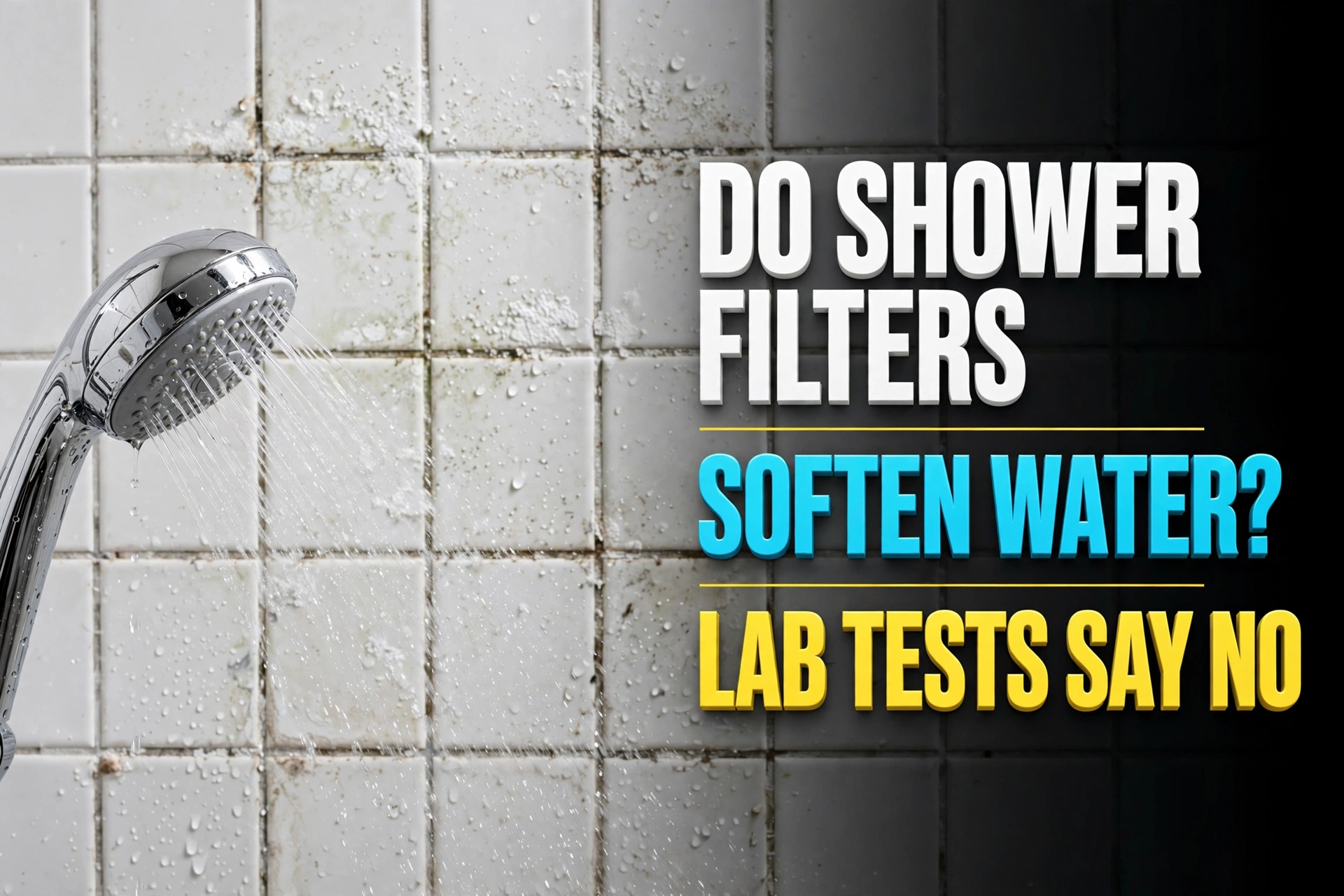
Short answer: no shower filter softens water — not in any lab test we could find, and not in the chemistry. Shower filters are chlorine-and-odor devices: carbon, KDF, or calcium sulfite media that neutralize chlorine as water rushes through. Softening means removing dissolved calcium and magnesium, which needs ion exchange resin plus a regeneration cycle. Neither fits inside a shower filter. A filter can make water feel gentler, but it cannot make hard water soft.
Check Current PriceTable of Contents
Quick verdict
The claim vs the chemistry

Hard water carries dissolved calcium and magnesium picked up from rock and soil — invisible at the molecular level, but your skin, hair, and tiles feel them. The US Geological Survey scale: soft (0–60 mg/L), moderately hard (61–120), hard (121–180), very hard (above 180).
True softening pulls those ions back out via ion exchange: resin beads swap calcium and magnesium for sodium, then get recharged by periodic salty-brine flushes. That regeneration cycle needs a brine tank, a drain, and a control valve.
A shower filter has none of that: a small pressure vessel with a bed of reactive media — activated carbon, KDF (a copper-and-zinc alloy), or calcium sulfite — and water shoots through in roughly half a second. No resin bed at softener scale, no brine tank, no regeneration. As guides from Fresh Water Systems and Culligan explain, the needed ion exchange cannot fit in a shower filter, cannot be regenerated, and cannot happen in a fraction of a second.
When listings say “softens,” they mean the filter neutralizes chlorine — which improves how skin and hair feel. “Removes calcium and magnesium” is marketing.
What published lab tests actually show

We searched for published lab tests showing hardness reduction from a shower filter — brand reports, independent bench tests, certification data — and found none showing meaningful calcium or magnesium reduction. What tests do show is chlorine performance, and it is mixed: AquaBliss’s own lab results for its SF100 show strong chlorine reduction in cool water but only about 41% at 110°F, while Canopy cites around 97% in cold water. Both numbers are brand-stated, not independent or NSF-verified.
There is also a standards gap: NSF/ANSI 177, the shower-head-specific certification, covers free available chlorine only (per filtration brand blu). No shower-filter certification exists for hardness reduction — because no certified shower filter does it. As our look at shower filter lab tests found, every verifiable result is about chlorine, odor, and sediment — never hardness.
Honest point-of-use filters sell themselves on what they are certified to remove. The EveryDrop EDR4RXD1 fridge cartridge (roughly $45–55, brand-stated NSF 42/53/401) claims chlorine, taste, odor, and specific contaminants — not hardness.
Honest summary: every mainstream shower filter medium targets chlorine, odor, or sediment. None is a mineral-removal medium. If hardness reduction is your goal, a shower filter is the wrong category of product.
Why water can feel softer anyway
So why do owners say hair feels silkier? Chlorine attacks hair keratin and strips skin oils — remove a good share of it and showers genuinely feel gentler.
But feeling softer is not being softer: your hardness number does not change, limescale keeps building, and soap still reacts with calcium. So the right fix depends on your complaint. Dry skin and brittle hair? A filter may genuinely help, because chlorine removal is what these filters are proven to do. Crusty tiles? It will not.
What shower filter owners actually report

Across owner reviews the pattern is consistent: filters bought for chlorine — dry skin, itchy scalp, chlorine smell — get the best feedback. Filters bought for hard water get the worst: “my water still spots,” “limescale came back in a week.”
Two more patterns: filters work best in cooler showers and less so in very hot ones, and exhausted cartridges fail quietly — media has finite capacity, so plan on a new cartridge every 3 to 6 months.
Test your own water first

Before buying anything, spend a minute on a test. A hardness strip (around $12–20 for a multi-pack) gives you a total hardness reading in under a minute — the number that decides everything. Soft or moderately hard (under 120 mg/L)? Your dry-skin complaints are probably chlorine, and a shower filter is a reasonable buy. Hard or very hard (above 120–180 mg/L)? A filter cannot touch your main problem. For the full picture — chlorine, lead, plus hardness — the Safe Home SELECT (around $25–40) pairs strips with lab confirmation.
What actually softens water
Two technologies genuinely remove dissolved calcium and magnesium: ion exchange — the whole-house softener with resin tank and brine regeneration cycle — and reverse osmosis, where under-sink systems like the Geekpure 5-stage unit (roughly $130–220) make genuinely soft water at a trickle, not at shower flow. No cheap middle ground exists (“salt-free conditioners” do not remove minerals). Our shower filter vs water softener comparison covers the real options side by side.
Who should still buy a shower filter
For the right household a shower filter is still a worthwhile purchase — our best shower filters roundup ranks the top options.
Conclusion
Shower filters do not soften water — not in the chemistry, and not in any published lab test we could find. They are chlorine and odor filters, good at that narrow job: less chlorine smell, calmer skin, easier-on-hair showers. The myth is buying one to fix hard water. Test your hardness first: soft means a filter is a smart cheap upgrade; hard means skip it and save for a softener.
FAQs
Can a shower filter soften hard water?
No. Removing dissolved calcium and magnesium needs ion exchange with regenerating resin — a shower filter has no resin bed, no regeneration cycle, and only a fraction of a second of contact time.
Why does my water feel softer after installing a shower filter?
Because it is less harsh, not softer. Chlorine roughens hair and strips skin oils; removing it makes water feel gentler — but your hardness number has not changed.
Will a shower filter stop limescale on my shower glass and tiles?
No. Limescale is calcium carbonate left behind when hard water evaporates. A shower filter does not remove those minerals; only ion exchange or reverse osmosis stops it.
How do I test if my water is hard?
Dip a hardness strip in tap water and compare the pad color to the chart — a reading in about a minute. Under 120 mg/L is soft to moderately hard; above 120–180 is hard to very hard. That number decides whether you need chlorine filtration or a real softener.
What actually softens shower water?
An ion-exchange softener (resin tank with brine regeneration, usually whole-house) is the real solution. Reverse osmosis also removes minerals but cannot keep up with shower flow.