Best Shower Filter (2026): Compared & Ranked
★ BEST SHOWER FILTER 2026Your shower smells faintly of a swimming pool, your skin feels tight the minute you towel off, and your hair color fades faster than it should. So you search for a shower filter — and drown in “15-stage” and “20-stage” claims, miracle mineral balls, and almost no proof any of it works.
Here is the short answer after researching and comparing six leading shower filters: the Weddell Duo is the best overall pick — it is the only filter in this roundup with an actual NSF/ANSI 177 certification for chlorine reduction, and its two cartridges sit behind clear windows so you can see when they are spent. On a budget, the AquaBliss SF100 does the core job for around $35. And if you want the full skin-and-hair routine, the Canopy pairs three-stage filtration with three spray settings. We did not run lab bench tests and will not pretend we did — every claim below traces to manufacturer spec sheets, public certification listings, independent reviewers, or documented owner feedback, and every price is an estimate. This roundup sits inside our wider shower filter coverage, where each finalist also gets its own full review.
Weddell Duo — our scores
Table of Contents
Quick picks
The bottom line: the Weddell Duo is the best shower filter for most people — genuinely NSF/ANSI 177 certified, with visible dual cartridges rated for 8,000 gallons. The AquaBliss SF100 is the budget buy at around $35. The Canopy is the pick for a skin-and-hair routine, and the Jolie is the one to buy when looks matter most.
Verdict: buy the Weddell for proof, the AquaBliss for price, the Canopy for the routine.
Top 3 quick picks
- Best overall — Weddell Duo (~$80–100). NSF/ANSI 177 certified for chlorine reduction, dual visible cartridges, 8,000-gallon rating.
- Best budget — AquaBliss SF100 (~$35–40). The best-selling inline filter on Amazon, multi-stage media, six-month cartridge rating.
- Best for skin & hair routines — Canopy (~$125–150). Three-stage filtration, three spray settings, optional aromatherapy, tool-free install.
The catch
- Almost no shower filter is certified. Of these six, only the Weddell Duo — and specific Sprite models — carry an NSF/ANSI 177 listing. Everything else runs on brand testing.
- “Stages” are marketing. A 20-stage filter is not automatically better than a 3-stage one — the media type and contact time matter, not the count.
- No shower filter softens water. These reduce chlorine; they do not remove the calcium and magnesium that make water hard.
How we researched
We did not run lab bench tests, so this guide will not pretend we did. What we did instead was research and comparison — and we can show our work:
- Compared six shower filters across both formats — inline filters that keep your existing showerhead (Weddell, AquaBliss, Sprite) and filtered showerheads that replace it (Canopy, Jolie, Cobbe).
- Checked certification claims against public listings. NSF/ANSI 177 is the only certification written for shower filters, and it covers one thing: reduction of free available chlorine. Where a brand says “tested to NSF standards” instead of “certified,” we say so — the two are not the same.
- Used independent lab-based reporting where it exists. Water Filter Guru’s data-driven analysis of the AquaBliss SF100 — including the brand’s 2026 removal of its old “certified” claims — is cited in that pick’s section.
- Read owner feedback for recurring patterns only — pressure loss, cartridges fading early, leaks at the arm — not cherry-picked five-star quotes.
- Did the running-cost math from real cartridge prices, so a $35 filter that eats $20 cartridges twice a year is compared fairly against a $90 filter that lasts six months. All prices are October 2026 estimates and move constantly.
Best overall: Weddell Duo

The Weddell Duo takes the top spot for a simple reason: it is the only filter here whose headline claim you do not have to take on faith. It is certified to NSF/ANSI 177 for chlorine reduction — the one standard written specifically for shower filtration — and independent coverage agrees it stands nearly alone in that: Water Filter Guru scored the Duo 9.19/10 in its shower filter testing. Every other pick in this roundup asks you to trust in-house brand testing instead.
The design helps too. Two cartridges sit side by side behind transparent windows, so instead of guessing from a calendar whether the filter still works, you watch the media change. Weddell rates the pair at 8,000 gallons — roughly five to six months for a couple showering daily. It installs inline on any standard arm in minutes and keeps your existing showerhead, which also means your spray pattern and pressure stay familiar. Our full Weddell Duo review digs into its flow rate and cartridge costs in more detail.
The trade-offs: at around $80–100 it is the priciest inline filter here, replacement cartridge pairs cost more than budget refills, and the unit adds a few inches below your shower arm — worth measuring if your stall is short or the arm sits low.
Pros
- Actually certified. NSF/ANSI 177 listing for chlorine reduction — the only one in this roundup.
- Visible cartridges. Clear windows show both filters, so changes are based on condition, not guesswork.
- Long rated life. 8,000 gallons per cartridge pair, around five to six months for two people.
- Keeps your showerhead. Inline install, standard fittings, no tools beyond hand-tightening and the included tape.
Cons
- ~$80–100 upfront. Two to three times the budget picks’ price.
- Refills cost more. Genuine cartridge pairs run well above AquaBliss-style refills.
- Adds length. Tall users in short stalls should measure first.
Best budget: AquaBliss SF100
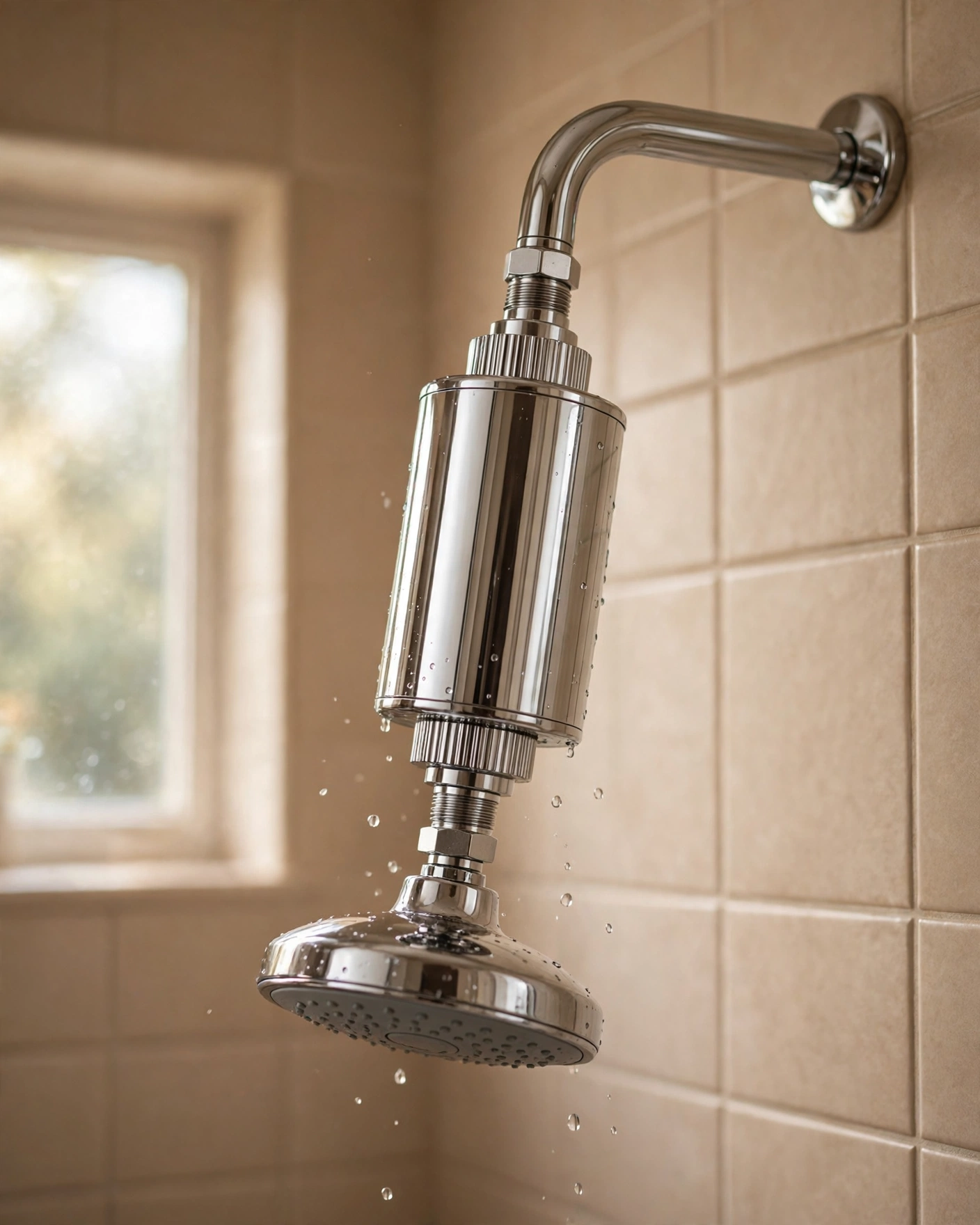
The AquaBliss SF100 is the filter most people actually buy: a chrome inline canister, a multi-stage cartridge (sediment layers, activated carbon, KDF and calcium sulfite, per the brand), and a price around $35–40 that makes it an easy experiment. For chlorine smell and that tight-skin feeling on city water, most owners report a clear improvement — it is one of the best-reviewed budget filters on Amazon, with a rating base in the tens of thousands.
Now the honesty part, because it matters more than the marketing: the SF100 is not NSF certified. Water Filter Guru’s lab-based review scored its performance certifications at the bottom of the category and noted that AquaBliss’s old “certified” product-page claims have since been removed — as of its 2026 update, the brand no longer makes them. Treat the SF100’s filtration numbers as brand-stated, not independently verified. Owner feedback also shows a pattern worth knowing: in hard-water homes, some cartridges clog or fade well before the six-month rating, and a minority of owners see a pressure drop. Our AquaBliss SF100 review walks through the complaint data.
At $35 with refills around $17–20, though, the math forgives a lot. If it fades at four months in your water, you are still spending less per year than any premium pick — which is exactly what a budget pick is for.
Pros
- ~$35–40 to start. The cheapest credible way to try shower filtration.
- Cheap refills. Replacement cartridges run about $17–20.
- Huge owner base. Years of reviews to judge real-world behavior from.
- Keeps your showerhead. Standard inline fit, one-minute install.
Cons
- No NSF certification. Performance claims are the brand’s own — full stop.
- Can fade early in hard water. Some owners replace well before six months.
- Occasional pressure drop. Most noticeable in already-weak showers.
Best for specific needs
Not everyone needs the certified all-rounder or the cheapest canister. These four picks each win on one specific strength: certified value that keeps your showerhead, a skin-and-hair routine, pure design, and a filtered handheld on a budget.
Best certified value: Sprite Slim-Line

Sprite is the quiet veteran of this category: its filters use Chlorgon — a calcium-sulfite-based media formulated for hot shower water — and Sprite offers models with genuine NSF/ANSI 177 certification for chlorine reduction, which is almost unheard of at this price. The Slim-Line housing runs around $30–45 with a cartridge, refills are inexpensive, and the brand rates cartridges at up to six months. One caution: certification applies model by model, so confirm the exact unit you are buying carries the listing — our Sprite shower filter review covers which models do.
Pros
- Certified models exist. NSF/ANSI 177 listings at a budget price.
- Slim and discreet. The least visible inline filter here.
- Cheap to run. Long-rated cartridges with low refill prices.
Cons
- Check the exact model. Not every Sprite variant carries the certification.
- Plain looks. White plastic will not dress up a renovated bathroom.
Best for skin & hair routines: Canopy

The Canopy is built for people whose shower is a routine, not a rinse. Its three-stage media (granular activated carbon, copper-zinc KDF-55, and calcium sulfite, per the brand) sits inside a wide, good-looking showerhead with three spray settings and an optional felt aroma diffuser. Canopy says the filter is tested to NSF-177 standards — note the wording: that is brand-commissioned testing against the standard, not an NSF certification, and we list it that way in the table below. Filters are rated at 90 days (about 3,000 gallons), install is tool-free, and replacements are genuinely quick. It is sold mostly direct from Canopy’s own store. Our Canopy shower filter review covers the subscription math.
Pros
- A complete routine. Three spray settings plus optional aromatherapy.
- Three-stage media. Carbon, KDF-55 and calcium sulfite per the brand.
- Easy cartridge swaps. Quick-release design, no wrestling with housings.
Cons
- “Tested to” is not “certified.” No NSF/ANSI 177 listing.
- 90-day filters. More frequent changes than the inline picks.
- Mostly direct-only. Sold through Canopy’s own store rather than Amazon.
Best design: Jolie
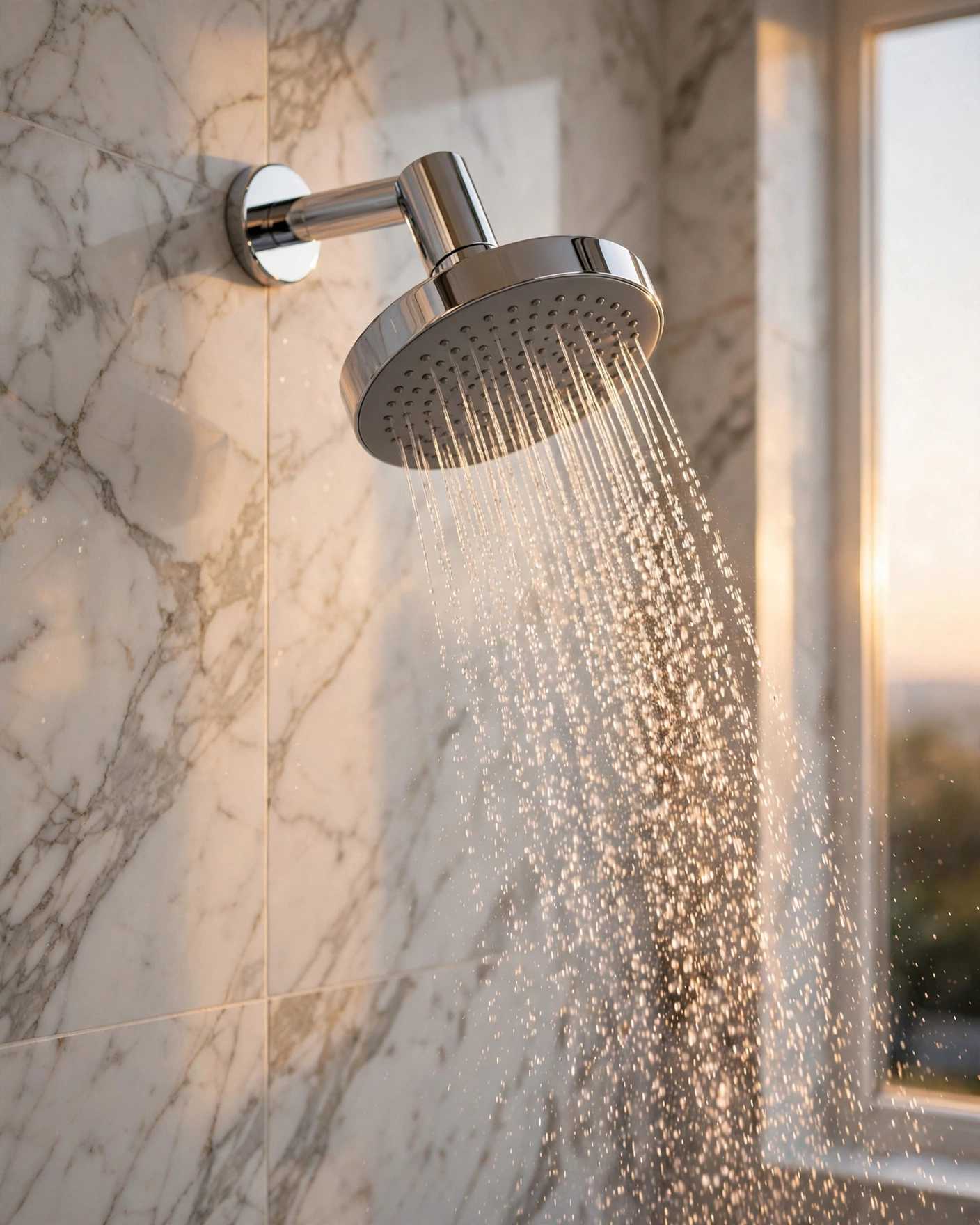
The Jolie exists because inline filters are, frankly, ugly — a plastic cylinder dangling in your eyeline every morning. Jolie packs its media (KDF-55 and calcium sulfite) inside a slim, beautifully finished showerhead, in chrome and a rotating cast of colors. The brand says its formulation exceeds NSF-177 requirements and cites third-party lab verification, but the Jolie holds no NSF/ANSI 177 certification — at $148–165 one-time (around $148 with a filter subscription), you are paying for design and brand experience, and the filtration claims rest on the company’s own testing. Cartridges are rated at 90 days and cost roughly $33–39; busy households report changing them sooner. Owner praise centers on looks and pressure; complaints center on price and filter life. See our Jolie shower head review for the full picture.
Pros
- The best-looking option here. Nothing hangs below the arm.
- Strong pressure. Owners with weak plumbing report a firm spray.
- Seconds-fast cartridge swaps. Pop the face, swap, close.
Cons
- $148–165 upfront. The most expensive pick in this roundup.
- No NSF certification. “Exceeds requirements” is a brand claim, not a listing.
- 90-day cartridges at ~$33–39. The priciest filter here to run, too.
Best budget handheld: Cobbe
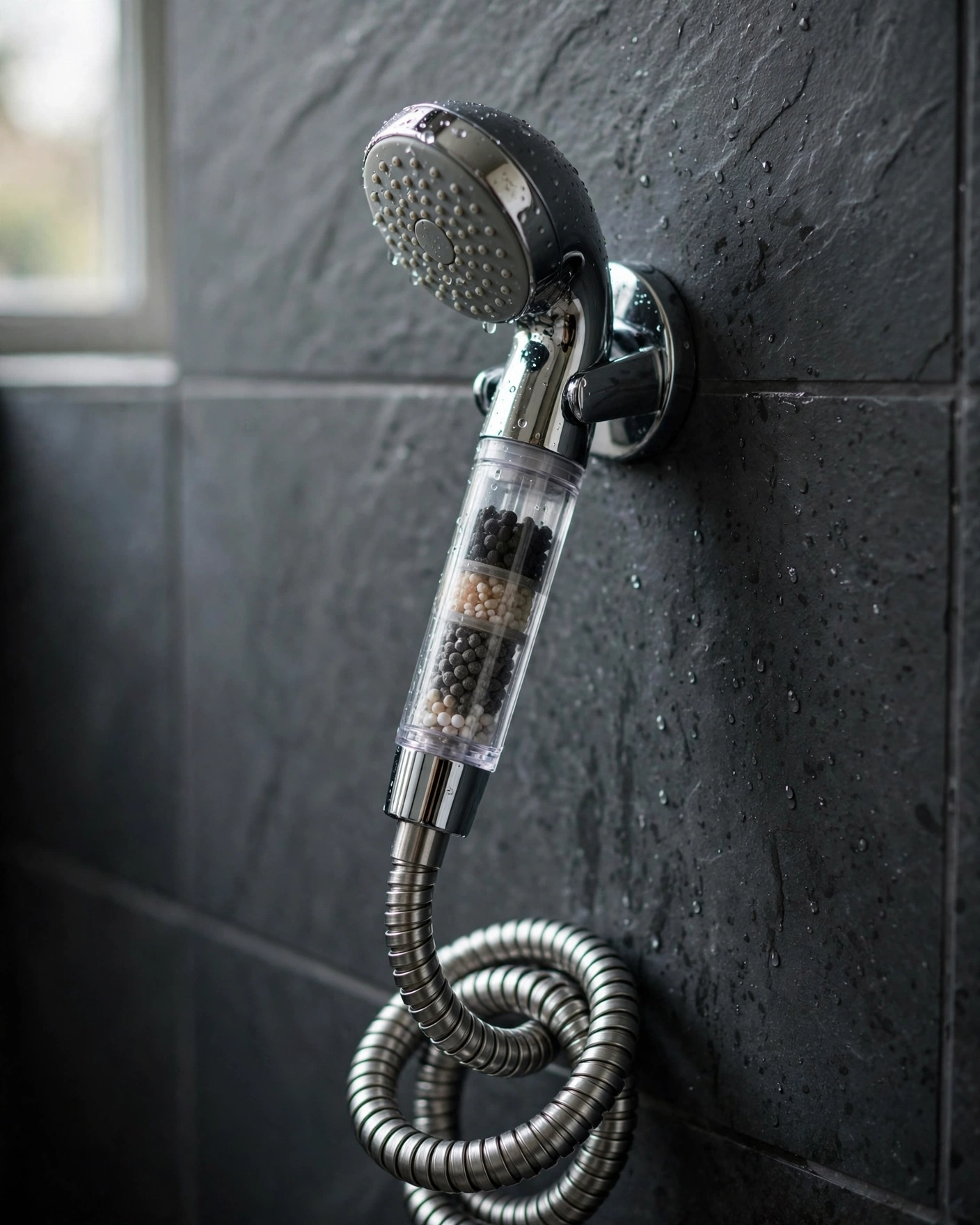
Inline filters keep your existing head — which is a problem if your existing head is a handheld you love, or if you need a handheld for kids, pets, or mobility. The Cobbe solves it by putting a multi-stage cartridge inside the handle of a handheld showerhead for around $20–30, holder and hose included. Treat the stage count and removal percentages as brand marketing: there is no certification behind them, and cartridge life is not independently verified, so plan on frequent — if cheap — cartridge swaps. As a low-cost way to find out whether filtered shower water helps your skin, it is a rational first step before spending Weddell or Jolie money.
Pros
- ~$20–30 complete. Handheld head, holder and hose in the box.
- Filtered handheld. The format inline filters cannot give you.
- Cheap experiment. Low risk before committing to a premium pick.
Cons
- Claims are brand-stated. No certification, stage counts are marketing.
- Short cartridge life. Expect frequent swaps; budget for refills.
Head-to-head comparison
Every number below comes from the primary sources cited in each pick’s section. Prices are approximate street estimates and move constantly.
| Filter | Best for | Format | Certification | Filter life (brand-rated) | Est. price |
|---|---|---|---|---|---|
| Weddell Duo | Best overall | Inline, keeps your head | NSF/ANSI 177 certified | 8,000 gal (~5–6 months) | ~$80–100 |
| AquaBliss SF100 | Best budget | Inline, keeps your head | None | ~6 months | ~$35–40 |
| Sprite Slim-Line | Certified value | Inline, keeps your head | NSF/ANSI 177 (specific models) | ~6 months | ~$30–45 |
| Canopy | Skin & hair routine | Filtered showerhead | Tested to NSF-177 (brand) | 90 days (~3,000 gal) | ~$125–150 |
| Jolie | Best design | Filtered showerhead | None (brand-tested) | 90 days | ~$148–165 |
| Cobbe | Budget handheld | Handheld, filter in handle | None | Short — see listing | ~$20–30 |
“Tested to NSF standards” and “NSF certified” are different claims. Certification means an independent body verified the product and lists it in a public database — look the model up at info.nsf.org before you pay a premium for any certification claim.
Buying guide
Inline filter or filtered showerhead?
Inline filters (Weddell, AquaBliss, Sprite) screw between your shower arm and your existing head. Buy one if you like your current spray, rent your home, or want the cheapest path. Filtered showerheads (Canopy, Jolie, Cobbe) replace the head entirely — buy one if your current head is tired anyway, or if the dangling-canister look bothers you. Performance-wise the format matters less than the media inside and how fresh the cartridge is.
The only certification that matters: NSF/ANSI 177
NSF/ANSI 177 is the sole standard written for shower filters, and it certifies exactly one thing: reduction of free available chlorine under test conditions. It says nothing about lead, PFAS, or hardness — no shower filter certification covers those, whatever the box implies. A certified product appears in a public listing (check info.nsf.org); a product “tested to” the standard was tested by a lab the brand chose, with results the brand published. Both can be fine products — but only one is proof.
Chlorine vs chloramine
Most cities disinfect with chlorine, which KDF-55, calcium sulfite and carbon all reduce well in hot water. A growing number use chloramine, which is harder to break down — vitamin C and catalytic carbon handle it best, and longer contact time helps. Check your water utility’s annual report to see which your city uses; if it is chloramine, weight your choice toward media blends that name it and keep cartridges fresh.
A shower filter will not soften your water
This is the category’s biggest misunderstanding, so plainly: shower filters reduce chlorine and some sediment and metals — they do not remove the calcium and magnesium that make water hard, and they will not stop limescale spots. Softening requires ion exchange sized for your whole home. We break down exactly what these filters can and cannot do in our guide: do shower filters soften water?
Replacement cost math
Sticker prices mislead in this category — the cartridge schedule is the real price. Estimates below use the brand-rated change intervals and October 2026 street prices for refills; a household of four showering daily will cycle cartridges faster than a couple.
- Weddell Duo: ~$90 to buy + one cartridge pair a year (~$35–45, estimate) → about $130 in year one, ~$40/year after.
- AquaBliss SF100: ~$35 to buy + refills at ~$18 twice a year → about $70 in year one, ~$36/year after — the cheapest credible running cost here.
- Sprite Slim-Line: ~$40 to buy + one refill a year (~$15–25, estimate) → about $60 in year one, ~$20/year after.
- Canopy: ~$140 to buy + 90-day filters (roughly $40–50 each, estimate) → about $260–290 in year one. The routine is the expensive part.
- Jolie: ~$165 to buy + 90-day cartridges at ~$33–39 → about $270–285 in year one, ~$140/year after — premium to buy, premium to run.
- Cobbe: ~$25 to buy + frequent budget cartridges → roughly $60–85/year all-in, depending on how often your water exhausts them.
The pattern: over three years, the certified Weddell costs about the same as the “cheap” premium-routine options cost in one — and the budget inline filters stay cheapest no matter how you slice it. Buy the filter whose yearly number you are comfortable with, not just the sticker.
FAQs
Do shower filters really work?
For chlorine, yes — that is the one job they are built and certified for. NSF/ANSI 177 exists specifically to verify chlorine reduction in shower filters, and media like KDF-55, calcium sulfite and activated carbon are well documented at reducing free chlorine in hot water. Where claims get shaky is everything beyond chlorine: stage counts, mineral balls and broad contaminant lists are mostly brand marketing unless a public certification listing backs them.
Will a shower filter soften hard water?
No. Shower filters reduce chlorine; they do not remove the calcium and magnesium that make water hard, and they will not prevent limescale. Softening needs an ion-exchange softener, usually a whole-house system. If hard water is your main problem, a shower filter can still help your skin feel less dry by cutting chlorine — just do not expect spot-free glass or softer laundry from it.
How often do I need to change a shower filter cartridge?
Follow the brand rating as a ceiling, not a promise: about six months for the inline picks here (the Weddell Duo is rated at 8,000 gallons) and 90 days for the Canopy and Jolie. In hard water or a busy household, expect less. The honest signal is your nose and skin — when the chlorine smell and tight-skin feeling return, the cartridge is done, whatever the calendar says.
Do shower filters reduce water pressure?
A fresh, quality filter should not noticeably change pressure — most are rated for standard 2.5 GPM flow. Pressure drop usually means the cartridge is loading up with sediment, which is common in older plumbing and hard water. If pressure falls within the first weeks, that is a cartridge problem, not a reason to abandon filtration: rinse or replace the cartridge, and consider a sediment pre-filter if it keeps happening.
Are shower filters worth it for hair and skin?
For many people, yes — chlorine is genuinely drying, and removing it is the main reason owners report softer-feeling hair, less itchy skin and slower color fade. The effect is real but modest: a shower filter is a comfort upgrade, not a medical treatment. Start with a budget inline filter if you are unsure; if your skin clearly improves, upgrading to a certified model like the Weddell Duo is money better spent than guessing at a premium brand first.
Conclusion
The best shower filter is the one whose claims you can verify and whose cartridge schedule you will actually keep up with. The Weddell Duo is the best overall — the only certified pick here, with visible cartridges and a long rated life. The AquaBliss SF100 is the smart budget buy: uncertified but cheap to buy and cheaper to run. The Sprite Slim-Line splits the difference with certified models at a budget price, the Canopy turns filtration into a full skin-and-hair routine, the Jolie wins on design alone, and the Cobbe gets a filtered handheld into almost any budget.
Whichever you choose, check the exact model’s certification listing at info.nsf.org, ignore stage counts, and budget the yearly cartridge cost — not just the sticker price. Do that, and your shower will smell less like a pool by this weekend.
Price checked at time of writing; it changes often — see the live price before you buy.
Update log
- Zulqarnain: Review published.