iSpring WGB32B Review (2026): Is It Worth It?
★ BEST-SELLER WHOLE-HOUSEYour tap water smells faintly of a swimming pool, the shower head keeps crusting with sediment, and you are tired of drinking chlorine. You want filtered water from every faucet — not another pitcher — and the iSpring WGB32B keeps coming up: three big blue housings, whole-house coverage, a best-selling price. Does it actually deliver?
The short answer: the WGB32B is a genuinely capable city-water whole-house filter — sediment, chlorine taste and odor, a 100,000-gallon capacity and a 15 GPM flow rating that keeps showers running strong. It is not certified to NSF standards the way the brand’s “compliant” language can imply, it will not soften water, and it is not the unit you want on untreated well water. This review covers what the WGB32B is certified — and not certified — to do, what owners actually complain about, and what it costs over five years.
Our scores
Table of Contents
Quick verdict
The bottom line: the iSpring WGB32B is a strong buy for city-water homes that want chlorine-free, sediment-free water at every faucet for a modest upfront price. Its 100,000-gallon capacity and 15 GPM flow rating mean it keeps up with medium-to-large households without gutting water pressure.
But know its limits: its contaminant claims are brand-stated, not backed by a confirmed NSF system certification; it will not soften hard water; and on well water with iron or manganese you need the WGB32BM variant (or a different system) instead.
Verdict: the best cheap way into whole-house filtration — as long as your water problem is chlorine and sediment, not a well.
Price checked at time of writing; it changes often — see the live price before you buy.
Why you should trust this review
We did not install a WGB32B and we did not run a lab test. Claiming hands-on testing we never did would be dishonest, so we will not do it.
What we did instead was research and comparison: manufacturer spec sheets, the independent review that scored this system (Quality Water Lab, updated February 2026), hundreds of owner reviews to find complaints that keep repeating, and replacement-cost math from brand-stated capacity and filter-set prices. Every section says what it is based on — brand-stated specs, independent reviews, or owner reports — so you can check the reasoning yourself.
How we researched
- Compared brand specs across the WGB32B line — the base WGB32B against the WGB32BM (iron/manganese variant) and WGB32B-MKS listings, to separate which claims belong to which model.
- Checked the certification language against the certifier directories — where a system-level NSF listing could not be confirmed, the section says so plainly.
- Read hundreds of owner reviews — on major retail listings (505 Home Depot reviews at the last snapshot), looking for recurring complaints over many months, not one-off bad experiences.
- Calculated real yearly cost — from brand-stated 100,000-gallon / 12-month capacity and current replacement-set prices, with a five-year total so the cheap upfront price can be judged honestly.
Pros and cons
Pros
- Best-selling price for the category — a whole-house system for roughly the cost of one or two premium pitcher-filter years.
- 15 GPM flow rating — owners repeatedly report no noticeable pressure drop when filters are fresh; showers stay strong.
- 100,000-gallon capacity — rated up to 12 months per filter set on typical city water.
- DIY-friendly install — 1-inch ports, mounting bracket included, and owners report 2–4 hour installs with push-fit fittings.
- Owner-loved customer support — iSpring’s Atlanta-based support (owners name reps Nick and Michele) is the most praised part of the purchase in hundreds of reviews.
Cons
- No confirmed system-level NSF certification — filters are described as “NSF-compliant,” which is weaker than certified (see the Certifications section).
- Ongoing cost is the real price — ~$200–230/year in replacement sets makes five-year ownership far pricier than the box price suggests.
- Leak reports at housings and fittings — the most common recurring complaint; usually install-related but frequent enough to plan for (plumber’s tape, spare O-rings).
- Not for well water as-configured — iron and manganese need the WGB32BM variant; owners who ran the base unit on well water report the iron coming back within weeks.
- No softening — it reduces sediment and chlorine, not hardness; hard-water homes still need a softener.
Certifications (database-checked)
This is the section that decides how much of the marketing to believe. The WGB32B targets sediment, chlorine taste and odor, and some chemicals and VOCs through its two carbon block stages. But the certification language around it is careful — and worth reading carefully.

| Contaminant | Brand-stated target | Certification status |
|---|---|---|
| Sediment (down to 5 microns) | Yes — PP pre-filter stage | Not certified (brand-stated only) |
| Chlorine taste and odor (up to 99%) | Yes — two carbon block stages | Not certified (brand-stated only) |
| Chemicals and VOCs | Yes — carbon block media | Not certified (brand-stated only) |
| Lead / PFAS / chloramine | Not claimed for the base WGB32B — those belong to the WGB32B-MKS variant listing | Not certified (brand-stated only) |
| Iron / manganese | Not this model — see the WGB32BM variant | — |
Two honest distinctions. First: “NSF/ANSI compliant filters” is not “NSF certified.” Independent coverage describes the filters as compliant with NSF/ANSI standards — designed and built to a standard — which is weaker than a system-level certification you can look up under the model name. We could not confirm an NSF or WQA directory listing for the WGB32B itself. Second: the lead and PFAS claims on some listings belong to the WGB32B-MKS variant, not the base WGB32B. Listing pages blur the two; this review keeps them apart. For a certified whole-house option targeting PFAS, our Aquasana HealthShield review covers one with NSF/ANSI 53 certification.
Transparency note: the public NSF, WQA, and IAPMO product directories are interactive and could not be pulled by text fetch, so this section reports what independent reviewers publish (no system-level listing confirmed) rather than claiming an independent database pull we did not do. Before you buy, check the model name yourself at info.nsf.org — a certified system will show up there under the model name.
Design and usability
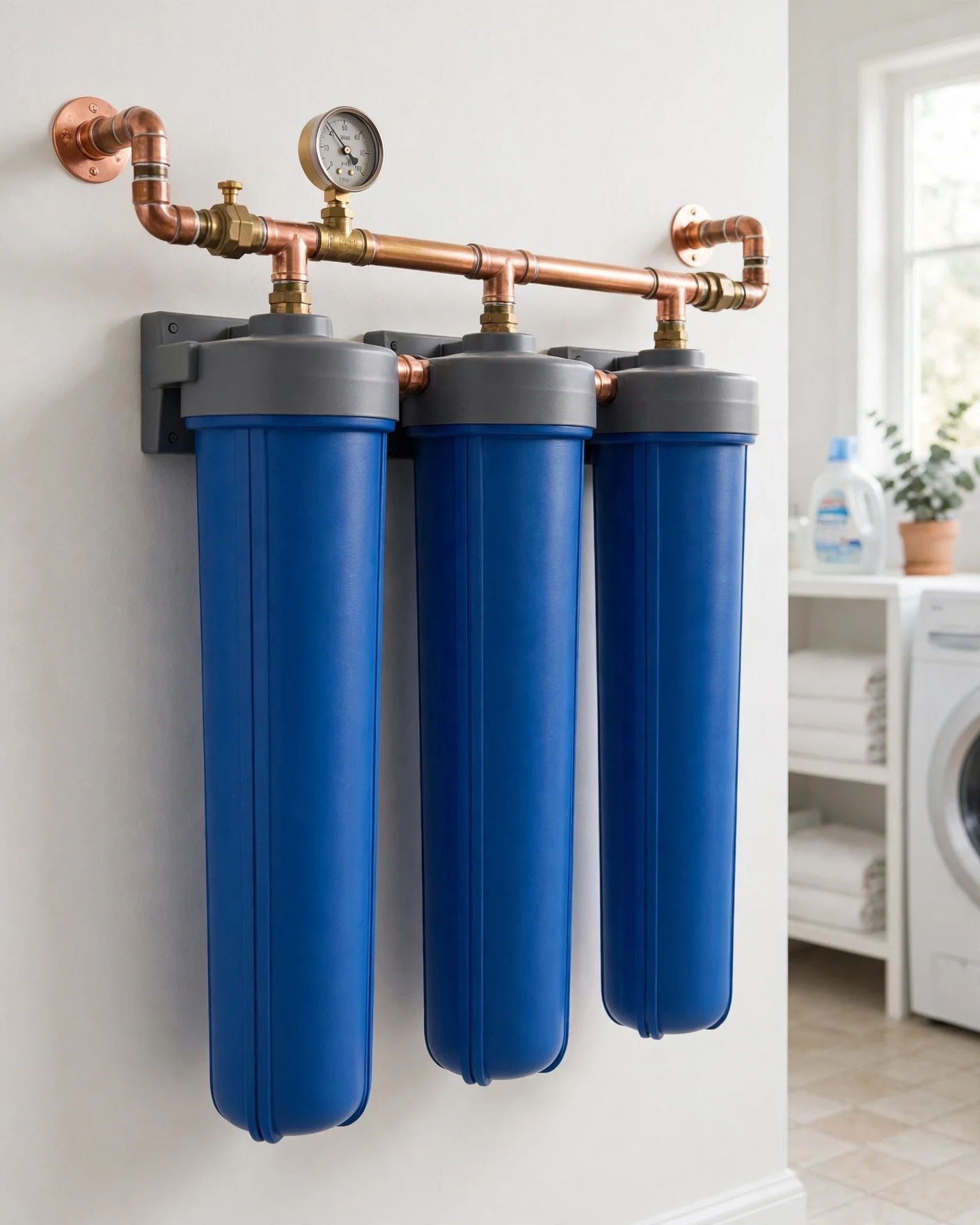
The WGB32B is a classic cartridge-tank design: three 20-by-4.5-inch filter housings on a mounting bracket, plumbed into the main water line where it enters the house. Stage one is a PP sediment filter (down to 5 microns) that protects the two carbon block stages behind it — the sediment stage takes the beating and is the cheapest to replace. Ports are 1-inch NPT; brand-stated operating pressure is 25–80 PSI.

Installation is where owner reviews split. Plenty of owners report a straightforward 2–4 hour DIY job with push-fit fittings and no soldering — and then describe excellent results. Others report leaks at the housing threads or fittings, the classic whole-house failure mode: heavy sumps full of water need tight, square seals, and PTFE tape plus a spare set of O-rings is cheap insurance. If you are not comfortable cutting into your main line, a plumber is money well spent. Either way, leave clearance below the bracket: you need room to unscrew 20-inch sumps for filter changes.
Filter cost math
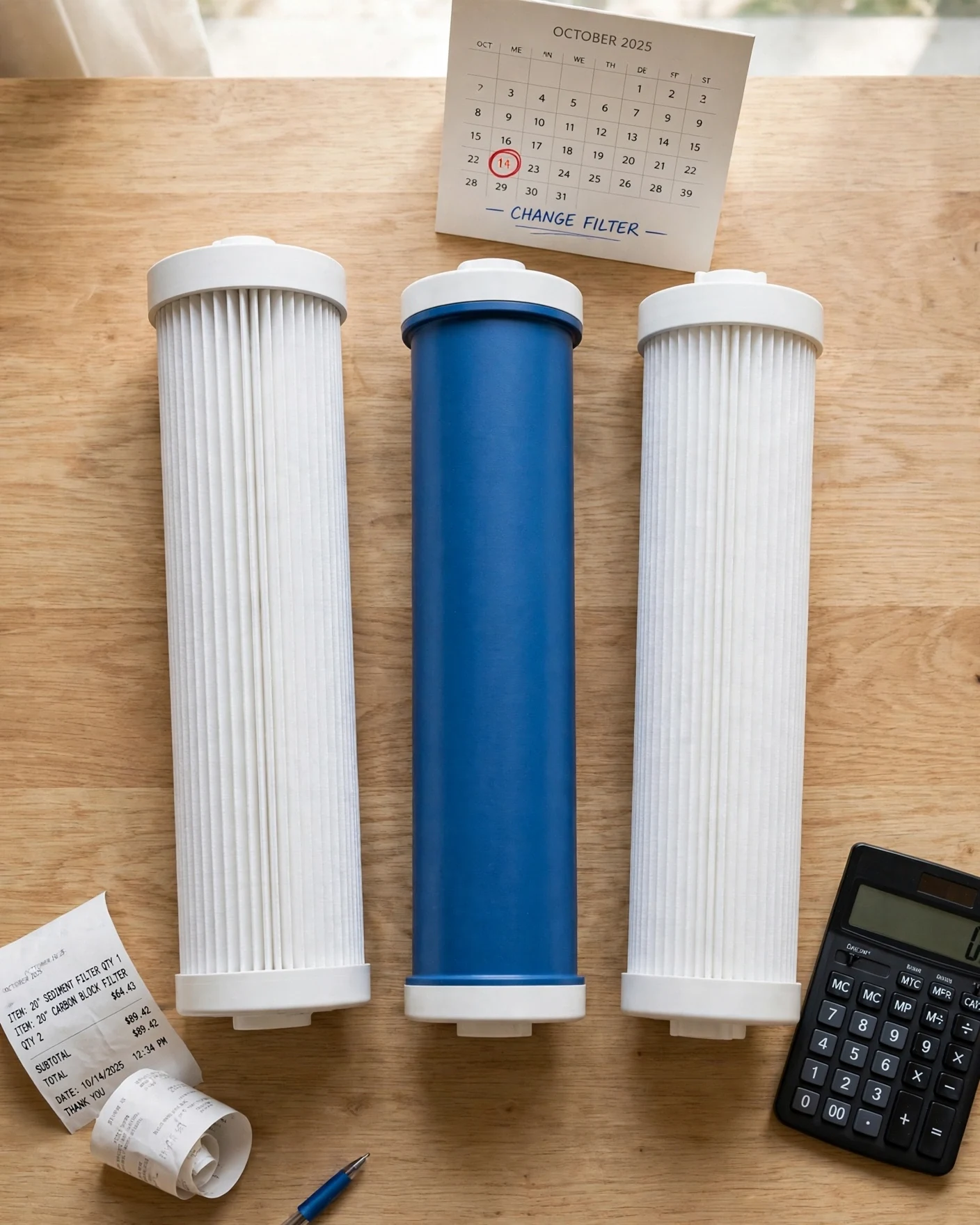
The box price is the least important number on this page. A whole-house system is a subscription you pay in replacement cartridges, and the WGB32B’s are not cheap:
| Item | WGB32B |
|---|---|
| System (upfront, estimated) | ~$230–280 (listings vary; one independent review lists ~$420) |
| Filter set rated capacity | 100,000 gallons or up to 12 months |
| Replacement filter set (per year, estimated) | ~$200–230 (replacement filter set) |
| Estimated 5-year filter cost | ~$1,000–1,150 |
| Estimated 5-year total | ~$1,230–1,430 |
Two things jump out. First, on real-world city water the 100,000-gallon / 12-month rating is optimistic for many homes — sediment-heavy water clogs the pre-filter sooner, and most owners should budget for a set per year. Second, this is where tank-style systems like the SpringWell CF1 pull ahead: their media tanks run for years between changes, so over five to ten years the “cheap” WGB32B can cost as much or more to own. The WGB32B still wins the entry ticket — nothing else puts whole-house filtration on your wall for this little upfront. Judge it on the five-year number, not the box price. (All figures above are estimates; verify live prices before buying.)
What owners complain about
Leaks at housings and fittings. The most persistent complaint thread: drips at the sump threads or the 1-inch fittings, usually right after installation or a filter change. Most cases trace to installation — cross-threaded sumps, dry O-rings, under-taped fittings — so buy PTFE tape and spare O-rings before you start, not after you find a puddle.

Pressure drops. The 15 GPM rating holds up and most owners report no noticeable drop — until the sediment pre-filter loads up, when flow visibly weakens. That is the system’s built-in maintenance signal: if showers lose strength, the pre-filter is spent. Heavy-sediment homes change that first stage more often than the rating implies.
Iron comes back on well water. Owners who installed the base WGB32B on well water report the iron returning within weeks. That is not a product failure — it is the wrong product: the base unit targets city-water chlorine and sediment, not iron and manganese. On well water you need the WGB32BM variant, which is exactly what it exists for.
Cracked housings. A smaller but notable thread: housings cracking at the threads on older installs. One owner describes iSpring’s support shipping a full replacement system free — the other half of the story: the support team is consistently excellent, and many five-star reviews are really reviews of the support reps fixing a problem fast.
None of these are hidden gotchas, and leak-at-install is the classic whole-house complaint at this price. But they are the real-world friction points, and you are better off knowing them now.
iSpring WGB32B vs alternatives
Numbers in a vacuum mean little, so here is the WGB32B against the systems buyers cross-shop most often — drawn from brand-stated specs and independent coverage, which our verifier re-checks. (For the tank-system cost math in detail, see our Aquasana Rhino review.)

| iSpring WGB32B | iSpring WGB32BM (well-water) | SpringWell CF1 | Aquasana HealthShield | |
|---|---|---|---|---|
| Typical system price | ~$230–280 | ~$280–350 | ~$400–450 | ~$1,300–1,500 |
| Design | 3 cartridge housings | 3 cartridge housings | Media tank + pre-filter | Media tank + UV + post-filter |
| Capacity | 100,000 gal / ~12 mo | 100,000 gal / ~12 mo | 1,000,000 gal | 600,000 gal |
| Flow rating | 15 GPM | 15 GPM | 12 GPM | 8–12 GPM |
| Best water source | City water | Well water (iron/manganese) | City water | City water |
| Est. yearly upkeep | ~$200–230 | ~$220–260 | ~$60–90 | ~$100–150 |
| Best for | Cheap entry to whole-house | Well water iron/manganese | Low long-term cost | Certified PFAS + UV |
The pattern is clear. The WGB32B’s only real moat is the entry price — on every per-year and per-gallon number the tank systems beat it, and on certifications the HealthShield and our SpringWell whole-house review cover the mid-tier landscape. Budget-housing competitors like the Express Water whole-house trade blows with the WGB32B on upfront price but share its cartridge-cost weakness. The WGB32BM is the answer if your problem is well water: same three-housing design, with iron/manganese reduction media. And if your actual complaint is only drinking water, an under-sink RO like the iSpring RCC7 costs less than the WGB32B and filters far more — but does nothing for your showers.
Price checked at time of writing; it changes often — see the live price before you buy.
Who should buy it

Buy it if
- Your water is city water with chlorine taste and sediment — this is exactly the problem the WGB32B was built for.
- You want whole-house coverage on a budget — filtered showers, laundry, and taps for the lowest entry price in the category.
- You are comfortable with yearly filter changes — the running cost does not scare you because the upfront cost was so low.
Skip it if
- You are on well water with iron or manganese — get the WGB32BM variant or a dedicated well system instead.
- You want certified contaminant reduction (lead, PFAS) — this system’s claims are brand-stated, not database-verified.
- You have hard water — this is not a softener; scale and spots will continue.
- You only care about drinking water — an under-sink RO costs less and filters more.
The specs
- Brand
- iSpring
- Model
- WGB32B
- Stages
- 3 (sediment + 2 carbon block)
- Filter size
- 20 in × 4.5 in
- Rated capacity
- 100,000 gal / up to 12 months
- Flow rate
- 15 GPM
- Port size
- 1 in NPT
- Operating pressure
- 25–80 PSI (brand-stated)
- Typical system price
- ~$230–280 (estimate)
- Warranty
- 1-year limited (brand-stated)
FAQs
Does the iSpring WGB32B remove lead?
No — not the base WGB32B. Its brand-stated targets are sediment, chlorine taste and odor, and some chemicals/VOCs. The lead and PFAS claims you will see on some listings belong to the WGB32B-MKS variant, and even those are brand-stated rather than database-verified. If certified lead reduction is the goal, look for a system with an NSF/ANSI 53 listing you can verify at info.nsf.org.
How often do you change the WGB32B filters?
The brand rates each filter set at 100,000 gallons or up to 12 months, whichever comes first. On real city water, plan on a yearly set — and on sediment-heavy water the cheap pre-filter may need swapping sooner. The practical signal is flow: if your showers lose pressure, the sediment stage is loaded.
Will the WGB32B work on well water?
Not well as-configured. The base WGB32B is a city-water chlorine/sediment unit; owners who ran it on well water report iron returning within weeks. Get your well water analyzed first, and if iron or manganese is the problem, choose the WGB32BM variant — same three-housing design with iron/manganese reduction media.
Does the WGB32B reduce water pressure?
It is rated at 15 GPM and most owners report little or no noticeable pressure drop with fresh filters — showers stay strong. When pressure does drop, it is almost always a spent sediment pre-filter: change it and the flow comes back. Undersized plumbing or very high flow demand can still overwhelm it.
What is the difference between the WGB32B and the WGB32BM?
The WGB32B is the city-water model: sediment plus two carbon block stages for chlorine, taste, and odor. The WGB32BM swaps the media to target iron and manganese — it is the well-water variant. Same housings, same flow rating, different filters inside. Buy the one that matches your water test.
How much does it cost per year to run?
Budget roughly $200–230 per year for a replacement filter set (estimate — verify the live price). Over five years that is about $1,000–1,150 in filters on top of the ~$230–280 system. That running cost is why tank-style systems can beat it on total ownership despite costing more upfront.
Can I install the WGB32B myself?
Many owners do: the 1-inch ports accept push-fit fittings, and reviews report 2–4 hour DIY installs. You will be cutting into your main water line, though, and leaks at the housings are the top complaint — so buy PTFE tape and spare O-rings, leave clearance below the bracket for filter changes, and call a plumber if you are not confident with the main line.
Does the WGB32B soften water?
No. It reduces sediment and chlorine taste/odor, but hardness minerals pass straight through — limescale and water spots will continue. If hard water is your problem, you need a water softener (or a softener downstream of the WGB32B).
Conclusion
The iSpring WGB32B is the cheapest honest way into whole-house filtration: it does what it says for city water — sediment and chlorine gone at every faucet, showers running strong — at an entry price nothing in the category matches. The trade-offs are real but knowable: brand-stated claims without a confirmed system certification, yearly filter costs that make it pricier than it looks, and the wrong choice entirely for well water. If your water is city water with a chlorine-and-sediment problem, it is worth it. If it is anything else, buy the variant — or the system — that matches your test results.
Price checked at time of writing; it changes often — see the live price before you buy.
Update log
- Zulqarnain: Review published.