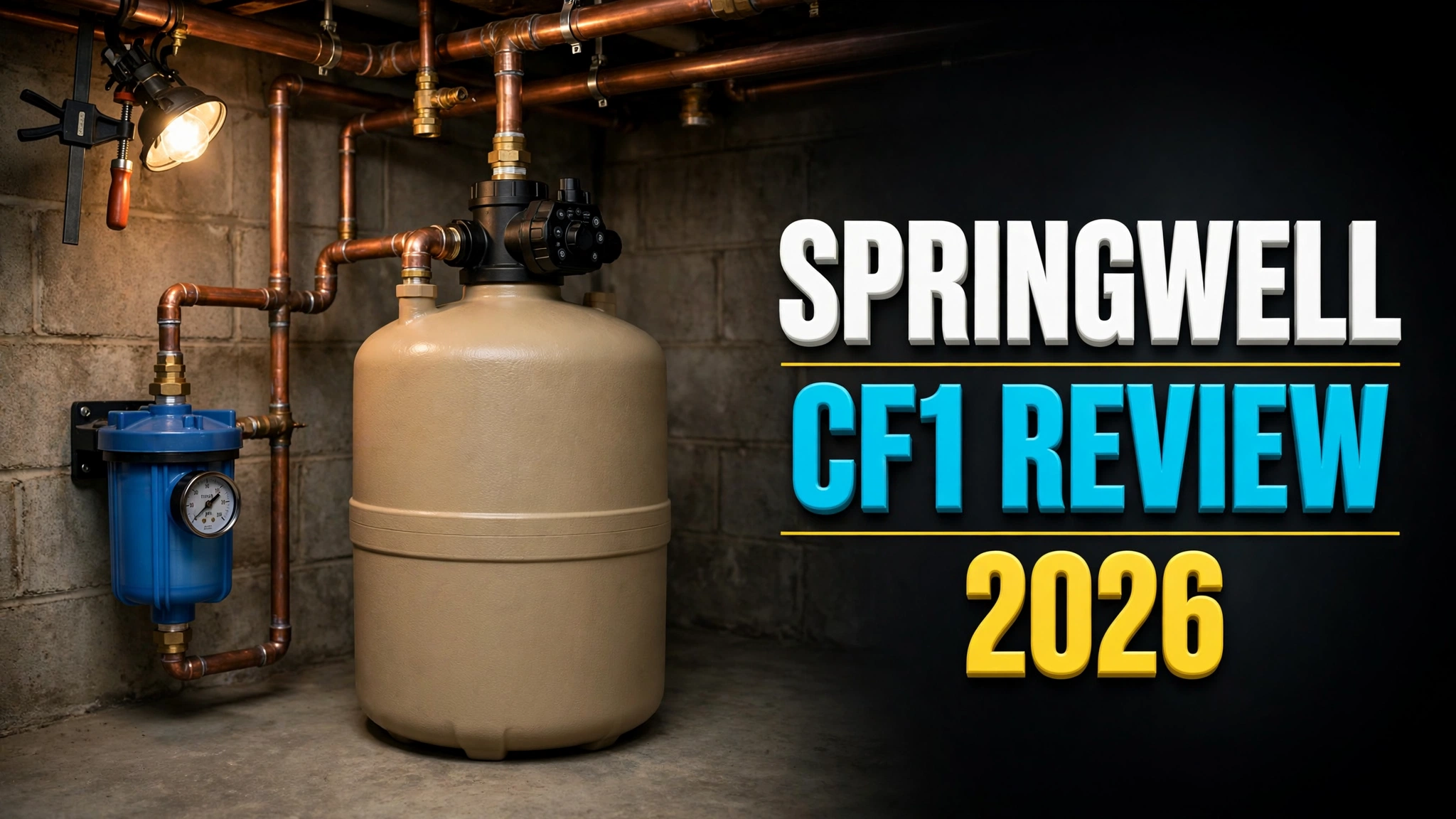

SpringWell CF1 Review (2026): Is It Worth It?
★ WHOLE-HOUSE REVIEWEvery tap in your house smells faintly of chlorine. The shower water dries out your skin, and you have read enough about PFAS in municipal supplies to feel uneasy — but a pitcher filter only fixes the kitchen glass. You need the whole house covered, and you are looking at the SpringWell CF1 because it promises a decade of filtration from one tank with almost no maintenance.
Here is the short answer: the CF1 is a strong fit for city-water homes that want chlorine, chloramine, and taste problems solved at every tap for years at a time. It is not a cheap system, it carries no system-level third-party certification despite its ambitious contaminant claims, and it will not touch hard water or lower your TDS. This review covers what SpringWell actually states the CF1 does, where independent reviewers’ evidence ends and marketing begins, and what it costs over five years — so you can decide if it is worth it.
Our scores
*Contaminant coverage reflects SpringWell’s stated targets, not certified reductions — the Certifications section below separates the two.
Table of Contents
Quick verdict
The bottom line: the SpringWell CF1 is the right buy if you are on city water and want one tank to quietly handle chlorine, chloramine, and taste/odor issues at every tap for roughly a decade. Its 1,000,000-gallon rated media life, 9 GPM flow, and lifetime tank warranty make it the low-maintenance pick in its class.
It is not the right buy if you want third-party-certified contaminant reduction (it has none at the system level), if hard water or TDS is your problem (it fixes neither), or if you need certified PFAS reduction at every tap. For that last job, a certified system like the Aquasana HealthShield is the honest alternative — at a higher price.
Verdict: worth it for low-maintenance city-water filtration, with eyes open about the missing certification.
Price checked at time of writing; it changes often — see the live price before you buy.
Why you should trust this review
We did not receive a test unit and we did not run a lab bench test. Claiming hands-on testing we never did would be dishonest, so we will not do it.
What we did instead was research and comparison: we pulled SpringWell’s spec sheets, read long-running review sites that ran their own multi-year lab comparisons, checked every certification statement against what third parties actually publish, and ran the ownership-cost math from listed prices and rated filter life. Every section says what it is based on, so you can check the reasoning yourself. Where the evidence is thin — especially certifications — we say so.
How we researched
- Compared specs across 5 whole-house systems — the SpringWell CF1 against the Aquasana Rhino, the Aquasana HealthShield, the iSpring WGB32B, and the larger CF4/CF+ sizes.
- Separated brand-stated targets from certified reductions — SpringWell’s list (chlorine, chloramine, VOCs, PFAS, pesticides, herbicides) is a manufacturer claim; no independent reviewer found a system-level NSF/WQA listing for the CF1. Each claim below is labeled as brand-stated or third-party-measured.
- Read multi-year review data and owner feedback — including one review site that ran a Tap Score lab comparison from 2022 to 2025 on its own installed CF1, plus owner reviews focused on installation, pressure, and maintenance.
- Calculated ownership cost — from estimated street prices, the 1,000,000-gallon rated life, and the sediment pre-filter swap schedule, with assumptions labeled.
Pros and cons
Pros
- 1,000,000-gallon rated media life — roughly a decade for a typical family before the tank media needs attention, per SpringWell’s rating.
- Handles chloramine too, not just chlorine — catalytic carbon plus KDF media is aimed at both, which matters if your city disinfects with chloramine.
- Strong flow with little pressure loss — 9 GPM on the CF1, and one long-term review site measured only a 3 PSI drop (68 to 65 PSI) after three years of daily use.
- Lifetime warranty on tanks and head — plus a 6-month money-back guarantee, per the manufacturer.
- Near-zero maintenance — the only routine job is swapping the sediment pre-filter every 6–9 months, around $27–$40 a year.
- Bluetooth filter-life monitoring — the brand lists app-based monitoring of filter life and water usage from your phone.
Cons
- No system-level certification — no certifier lists the CF1 for contaminant reduction; the strong PFAS/VOC claims are brand-stated only.
- Does not soften water or lower TDS — it is a carbon filter, not a softener and not RO; dissolved minerals pass through.
- Won’t filter microbes, sulfur, iron, or manganese — mainly a concern on well water, per one industry review site.
- Premium upfront price — roughly $1,040–$1,240 (estimated), before installation.
- Installation can be a project — the system is not preassembled, and the media needs a full 48-hour soak before you connect the tank.
- 25% restocking fee on returns — one review site notes the fee applies if the unit is returned within the 6-month guarantee window.
Certifications (database-checked)
This is the section that decides whether the CF1’s marketing holds up. SpringWell’s materials target chlorine, chloramine, VOCs, PFAS (PFOA/PFOS), pesticides, herbicides, and sediment — a genuinely ambitious list. But every reduction figure we could trace is a manufacturer statement, not a certified test result. Two independent review sources agree: one reports that “no certifier lists” the CF1, and another describes its NSF coverage as “component-level rather than full-system certification.”

| Contaminant | Brand-stated target | Certification status |
|---|---|---|
| Chlorine | Yes — catalytic carbon + KDF media | Not certified (brand-stated only) |
| Chloramine | Yes — catalytic carbon media | Not certified (brand-stated only) |
| VOCs, pesticides, herbicides | Yes | Not certified (brand-stated only) |
| PFAS (PFOA/PFOS) | Yes — manufacturer claim | Not certified (brand-stated only) |
| Sediment | Yes — 5-micron post-filter | Not certified (brand-stated only) |
Two honest distinctions. First: “NSF components” is not “NSF certified.” One review site displays an “NSF/ANSI 42 • 53 Components” badge for the CF1 — meaning individual components meet a standard — which is weaker than a system-level certification to reduce specific contaminants. Second: the PFAS claim above is SpringWell’s, not ours. If PFAS is your reason for buying a whole-house system, consider a WQA-certified option — our Aquasana HealthShield review covers one certified to NSF/ANSI 53 for PFAS.
Transparency note: the public NSF, WQA, and IAPMO product directories are interactive and could not be pulled by text fetch, so this section reports what independent reviewers publish (no system-level listing found) rather than claiming an independent database pull we did not do. Before you buy, check the brand name yourself at info.nsf.org — a certified system will show up there under the model name.
Design and usability
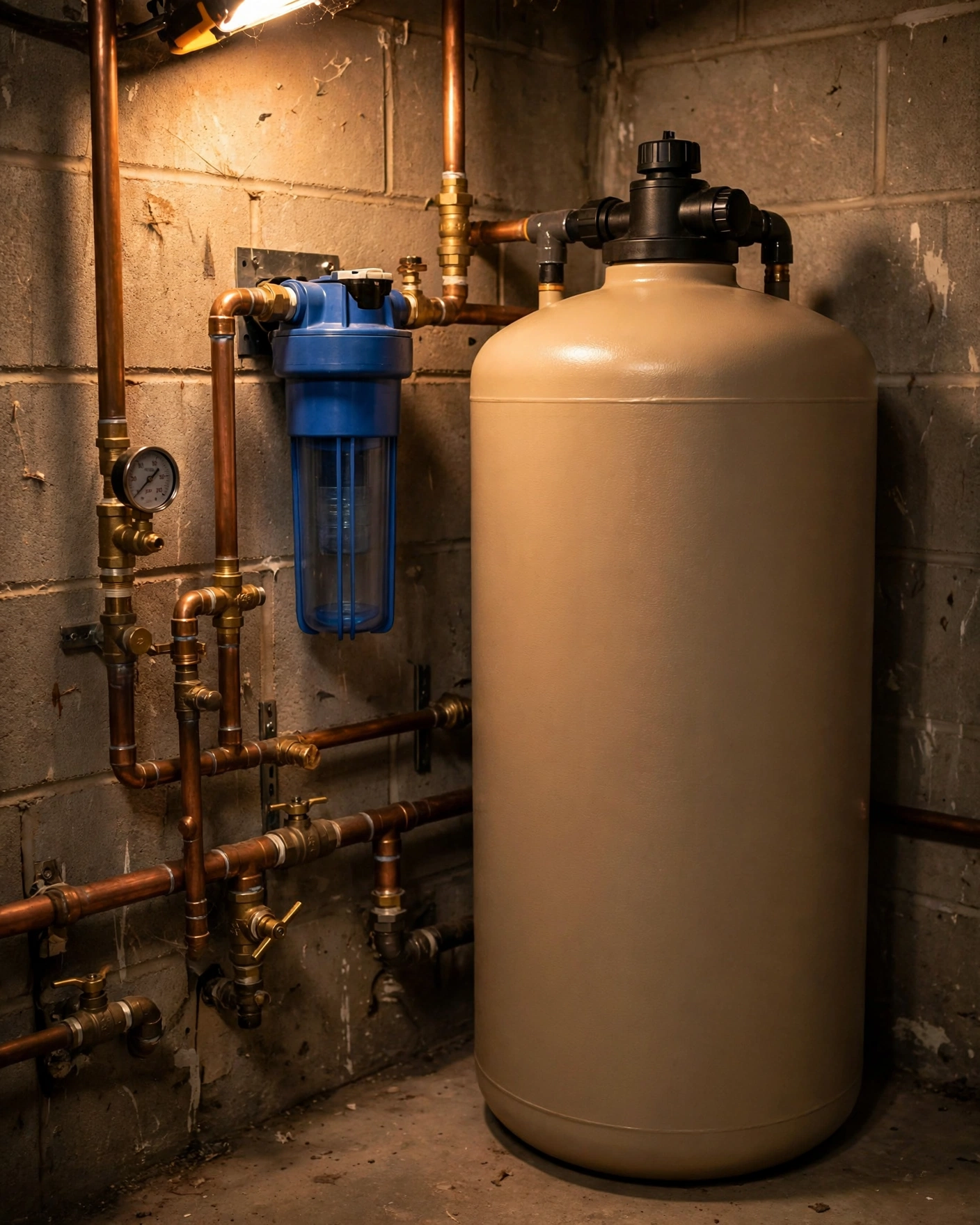
The CF1 is an upflow carbon + KDF media tank with a 5-micron sediment post-filter, and the water path is simple: into the tank first, then through the post-filter. Inside, catalytic coconut-shell carbon and KDF media do the heavy lifting — the carbon handles chlorine, chloramine, and organics, while KDF is aimed at chlorine and water-soluble heavy metals. Four stages in total (sediment pre-filter, KDF, catalytic carbon, post-filter), per one detailed spec breakdown. It is a tank-based design, so there are no cartridges to swap every few months — the main tank media is rated for 1,000,000 gallons, roughly ten years in a typical home.

Usability centers on set-and-forget. The one recurring task is the sediment pre-filter, which owners and reviewers swap roughly every 6–9 months; one review site that ran its CF1 for three years says the swap takes minutes and immediately restored a small pressure dip. SpringWell also lists Bluetooth connectivity for monitoring filter life and water usage from a phone. The trade-offs: the system ships unassembled, the carbon media needs a full 48-hour soak before you connect the tank (plan around a weekend, not an evening), and the kit includes a bypass valve, 1-inch fittings, and pre-filter hardware. It can sit outside as long as it is not exposed to freezing. See our broader SpringWell whole-house review for how these installs typically go.
Filter cost math
The sticker price is the least important number on this page. What matters is the ten-year ownership cost, because this system is priced like an investment, not an appliance:

| Item | Figure | Source / status |
|---|---|---|
| System (CF1) | ~$1,040–$1,240 | Estimate from multiple review listings, Oct 2026 — check live price |
| Installation labor | DIY possible; plumber typically several hundred dollars | Owner feedback; get a local quote |
| Sediment pre-filter | ~$27–$40 per year | Estimate; swapped every 6–9 months |
| Tank media replacement | None within ~10 years under the brand rating | 1,000,000-gallon rated life (brand-stated) |
| 5-year ownership | ~$1,371 | One roundup’s published estimate — includes system + filters |
The shape of this math is why the CF1 wins cost comparisons despite the premium sticker: at roughly $0.0014 per gallon over ten years (one reviewer’s calculation on a $1,144 system plus ~$40/yr upkeep), the long media life spreads the upfront cost thin. Two cautions: the 5-year figure is one site’s estimate, not a quote — your installation labor and local prices move it. And the “10-year” number assumes normal city water and normal usage; very heavy sediment means more pre-filter swaps, the one variable that actually rises. For installation pricing across the category, see our whole-house filter cost guide.
What owners complain about
Installation is a project, not a plug-in. The most consistent reviewer note: the system is not preassembled, and the media’s 48-hour soak adds a waiting day. Confident DIYers manage it with the bypass valve and video instructions, but many buyers budget a plumber — and local codes may require one. Get the quote before you buy, not after.
Pressure dips when the sediment filter is due. One review site measured a 3 PSI drop (68 to 65) across three years — barely noticeable — and notes the dip clusters near the end of the pre-filter’s 8–9 month cycle, clearing immediately after the swap. The lesson is operational: change the cheap pre-filter on time and the pressure story stays boring.
It is bulky and needs the right spot. The tank is a large cylinder that must sit as close to the main water line as possible, which limits placement. No basement or utility room? Plan for that before the delivery truck arrives.
It does not solve hard water. Owners sometimes discover this the expensive way: scale spots and dry shower glass remain, because a carbon filter does not remove dissolved minerals. If hardness is your problem, you need a softener or conditioner, not this.

SpringWell CF1 vs rivals
Here is the CF1 against the systems buyers cross-shop most often — drawn from published specs and brand-stated certifications.
| SpringWell CF1 | Aquasana Rhino WH-1000 | iSpring WGB32B | |
|---|---|---|---|
| System price | ~$1,040–$1,240 | From ~$1,000 | ~$250 |
| Rated life | 1,000,000 gal / ~10 years | 1,000,000 gal / ~10 years | 100,000 gal / ~1 year |
| Flow rate | 9 GPM | ~12 GPM | Up to 15 GPM |
| Media | Catalytic carbon + KDF | Coconut-shell carbon (chloramine model: catalytic) | 3-stage: sediment + 2 carbon blocks |
| System certification | None (brand-stated claims only) | WQA: NSF/ANSI 42 + 61 | None stated |
| Yearly upkeep | ~$27–$40 (sediment pre-filter) | ~$120 (pre-filter swaps) | ~1 filter set per year |
| Best for | Low-maintenance decade of city-water filtration | Certified chlorine reduction, long life | Budget chlorine reduction |
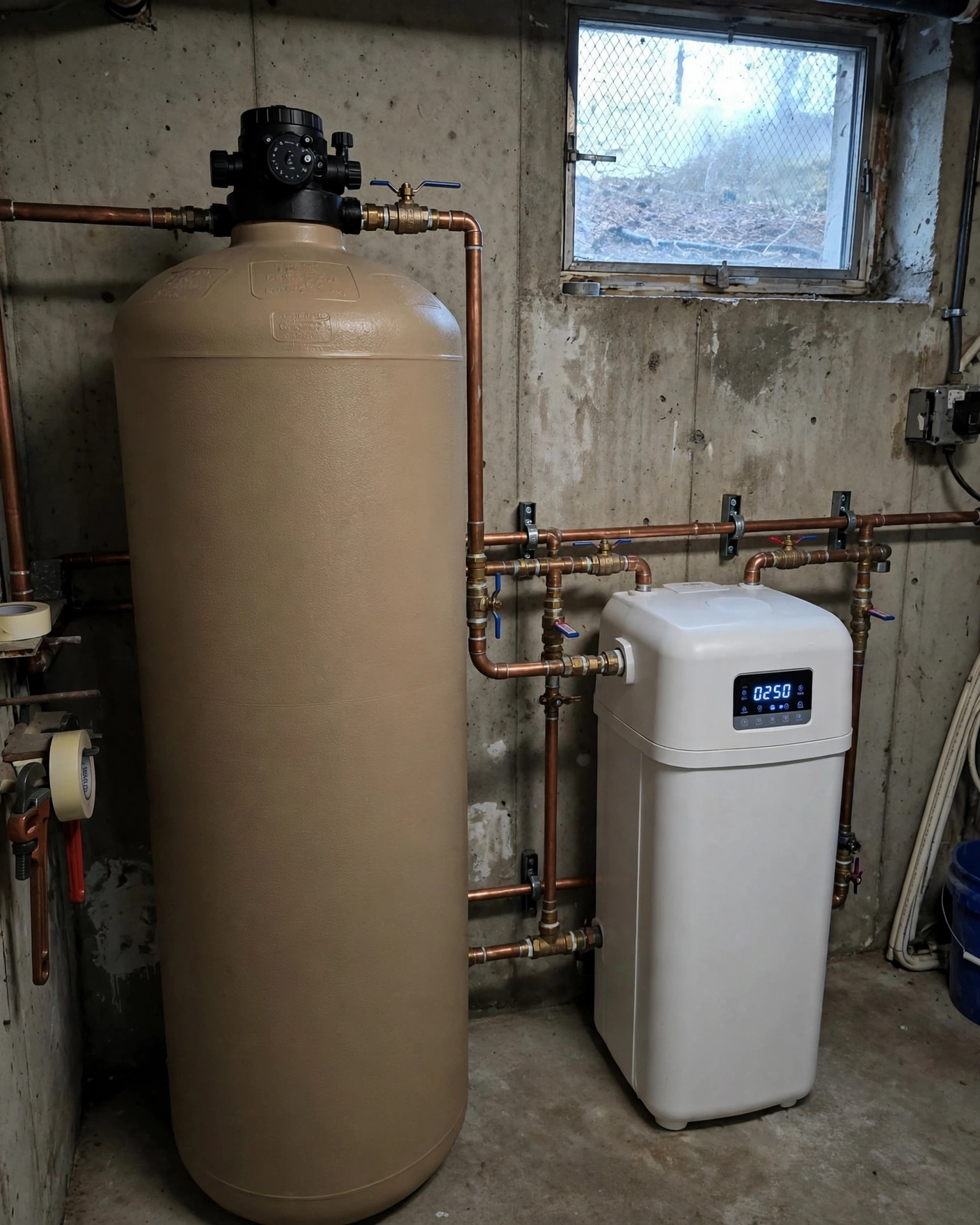
The pattern is clear: the CF1 wins on maintenance and media life, the Rhino answers with an actual WQA certification (42 and 61 — chlorine taste/odor and materials, not PFAS), and the iSpring wins on price at the cost of yearly cartridge swaps. The Rhino’s chloramine model adds catalytic carbon if your city disinfects with chloramine — our Aquasana Rhino review covers it. If you want certified PFAS reduction at every tap, the comparison is not really the Rhino — it is the Aquasana HealthShield, WQA certified to NSF/ANSI 53 and 401.
Who should buy it
Buy it if
- You are on city water and want chlorine, chloramine, and taste/odor issues gone at every tap.
- You hate maintenance — a million-gallon media life with one cheap yearly pre-filter is the whole pitch.
- You want strong flow for a busy household — 9 GPM on the CF1, with larger sizes up to 20 GPM for bigger homes.
Skip it if
- You want certified contaminant reduction — the CF1’s PFAS and VOC claims are brand-stated, not third-party certified.
- Your main problem is hard water, scale, or TDS — this is a carbon filter, not a softener and not RO.
- You are on well water with iron, sulfur, or manganese — the CF1 is a city-water product; well water needs different equipment.
The specs
- Brand
- SpringWell
- System
- CF1 whole-house
- Configuration
- Upflow carbon + KDF media tank, 5-micron sediment post-filter
- Media
- Catalytic coconut-shell carbon + KDF
- Rated capacity
- 1,000,000 gallons / ~10 years (brand-stated)
- Flow rate
- 9 GPM (CF1); line up to 20 GPM
- Home size
- 1–3 bathrooms (CF1)
- Certifications
- None at system level (brand-stated targets only)
- Contaminants (brand-stated)
- Chlorine, chloramine, VOCs, PFAS, pesticides, herbicides, sediment
- Warranty
- Lifetime on tanks and head; 6-month money-back guarantee
- Extras
- Bluetooth filter-life monitoring; bypass valve included
- Base price
- ~$1,040–$1,240 (estimated)
FAQs
Is the SpringWell CF1 worth it?
For city-water homes that want a decade of low-maintenance filtration, yes — the million-gallon media life, 9 GPM flow, and lifetime tank warranty are real strengths. It is not worth it if your goal is certified contaminant reduction, softer water, or lower TDS, because it offers none of those. Match the system to your water problem first.
Is the SpringWell CF1 NSF certified?
Not at the system level. Independent reviewers report that no certifier lists the CF1 for contaminant reduction, and its NSF coverage is described as component-level rather than full-system certification. Before you buy, look the model up yourself at info.nsf.org.
How long does the SpringWell CF1 filter last?
The tank media is rated by SpringWell at 1,000,000 gallons, roughly ten years for a typical household. The sediment pre-filter is the consumable — it needs swapping every 6–9 months at roughly $27–$40 a year. Heavier sediment loads mean more pre-filter swaps, but the main tank is not a recurring purchase within that decade.
Does the SpringWell CF1 reduce PFAS?
SpringWell states that the CF1 targets PFAS (PFOA/PFOS), but this is a manufacturer claim, not a certified reduction — no third-party PFAS certification was found for this system. If PFAS is your main reason for buying, choose a system certified to NSF/ANSI 53 or 401 for PFAS instead.
Will the CF1 lower my water pressure?
Barely, if sized correctly. One review site measured 68 PSI at install and 65 PSI after three years of daily use. Small dips owners notice cluster near the end of the pre-filter’s cycle and clear immediately after a swap. Confirm the CF1’s 9 GPM suits your home, or step up to a larger size.
CF1 vs CF4 vs CF+ — which size do I need?
The CF1 delivers 9 GPM and suits 1–3 bathroom homes; larger sizes in the line run up to 20 GPM. Undersizing is the most common mistake — if several showers, a dishwasher, and laundry run at once, the larger size is safer. Match the flow rating to your peak demand, not your average.
Does the CF1 soften hard water?
No. It is a carbon filter, not a softener — it does not remove dissolved hardness minerals or lower TDS. Scale spots, dry shower glass, and hard-water buildup will remain. If hardness is your problem, you need a softener or conditioner.
Can I install the SpringWell CF1 myself?
Confident DIYers do, with the included bypass valve, fittings, and installation video — but the system ships unassembled and the media needs a full 48-hour soak before you connect the tank. State and local codes may require a licensed plumber, and many buyers budget one. Plan the location before delivery.
Conclusion
The SpringWell CF1 is the whole-house system you buy when your problem is simple and you want it solved for a decade: chlorine and chloramine at every tap, almost no maintenance, at a per-gallon cost that spreads the premium sticker thin. That is a genuinely good deal for city-water homes — with one condition. The contaminant claims are brand-stated, not certified, and it will not soften water, lower TDS, or handle well-water contaminants. Know which buyer you are: a quiet, long-lived chlorine filter, the CF1 earns its price. Certified PFAS reduction or softer water — this is the wrong answer.
Price checked at time of writing; it changes often — see the live price before you buy.
Update log
- Zulqarnain: Review published.