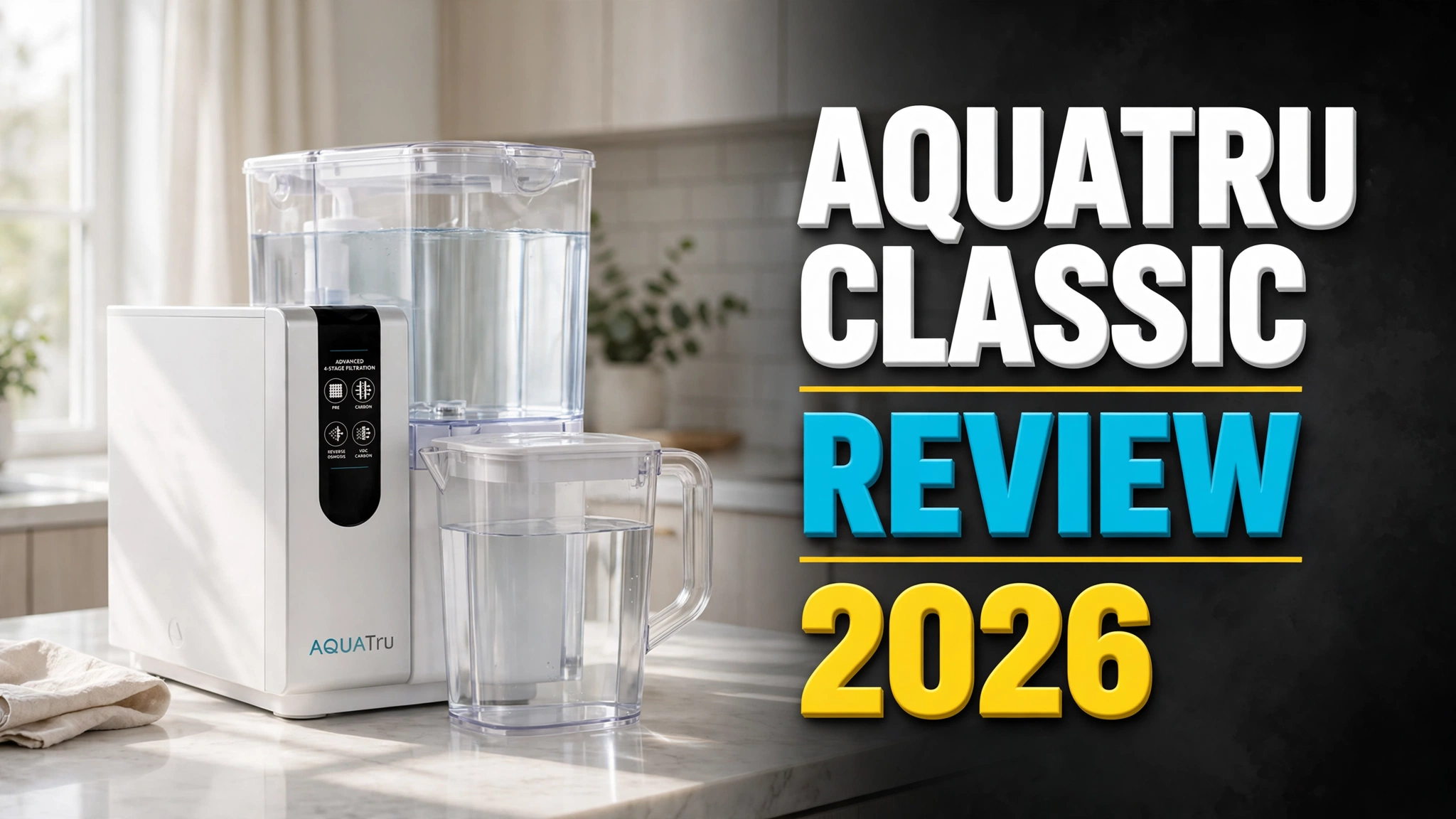

AquaTru Classic Review (2026): Is It Worth It?
★ TOP PICK COUNTERTOP ROYou want reverse-osmosis water — lead, fluoride, PFAS, dissolved salts gone — but you cannot install an under-sink system. Maybe you rent. Maybe you will not drill into granite. Either way, the usual RO answer does not fit, and a pitcher only fixes taste.
Here is the short answer: the AquaTru Classic is the countertop RO we would shortlist first. AquaTru states IAPMO certification to NSF/ANSI 42, 53, 58, and 401 — the longest list we found on a no-install unit — covering lead, PFOA/PFOS, fluoride, TDS, and microplastics. It costs roughly $449–475 upfront (estimate), about $100–130 a year in filters (estimate), and needs only a power outlet. The trade-offs: small 0.75-gallon batches, slow cycles, and a tap-water tank you must empty every refill. This review covers the certifications, the cost math, and the complaints owners keep repeating.
Our scores
Table of Contents
Quick verdict
The bottom line: the Classic is the right buy if you want the broadest certified contaminant reduction without plumbing — lead, PFAS, fluoride, dissolved salts, per AquaTru’s published IAPMO listing. It is not the right buy if you need a lot of water fast, hate small-batch routines, or want the cheapest to run.
Verdict: the best-certified countertop RO for no-install homes — with a slow, small-batch routine you have to accept.
Price checked at time of writing; it changes often — see the live price before you buy.

Why you should trust this review
We did not receive a test unit and we did not run a lab bench test. Instead, this is research and comparison: manufacturer specs and published certification listings, independent lab-tested reviews, hundreds of owner reviews, and cost math from rated filter life and retail prices.
How we researched
- Compared 5 countertop RO models — Classic vs SimPure Y7P, Waterdrop K19-SFK, Bluevua ROPOT-Lite, AquaTru Carafe.
- Checked certifications against AquaTru’s published IAPMO listing detail (42, 53, 58, 401, 372) as reported by independent reviewers — we could not re-pull the live directory entry, so this section is brand-stated-plus-reported.
- Read hundreds of owner reviews — looking for recurring complaints, not one-off bad experiences.
- Ran the yearly filter-cost math — from rated filter life and retail filter prices.
Pros and cons
Pros
- Longest certified list on a no-install RO — IAPMO 42/53/58/401: lead, PFOA/PFOS, fluoride, TDS, microplastics.
- Zero plumbing — plug it in, fill the rear tank, ready in about five minutes.
- Long filter life — 600 gal (pre/VOC), 1,200 gal (membrane).
- Reasonable running cost — roughly $100–130 a year in filters (estimate), about $17 per 100 gallons.
- Independent PFAS lab panel — a published Tap Score panel found all 14 tested PFAS analytes below reporting limits in AquaTru-treated water.
- Removable fridge pitcher — the 0.75-gallon clean-water pitcher lifts out and fits in the refrigerator.
Cons
- Small batches — the clean tank holds only 0.75 gallon; cooking for a group means another cycle.
- Slow — roughly 10–15 minutes per gallon; filling a large jug takes patience.
- Reject water must be emptied every cycle — concentrated water collects in the tap-water tank before each refill.
- Waste ratio disputed — advertised 4:1; independent testers report roughly 3:1 (75% recovery).
- Counter footprint + outlet — about 12 × 14 × 14 inches, and it must be plugged in.
- No remineralization — water comes out very clean but flat; the alkaline version costs extra.
- Premium price, 1-year warranty — roughly $449–475 upfront (estimate); some owners report frustrating customer service.
Certifications
AquaTru states the Classic is certified by IAPMO R&T to NSF/ANSI 42, 53, 58, and 401, plus 372 for lead-free wetted materials. The detail below is the published listing as reported by independent reviewers — we could not re-pull the live IAPMO directory entry ourselves, so we deliberately do not call this section “database-checked.”

| What the listing covers | Standard | Basis |
|---|---|---|
| TDS (dissolved salts), lead, fluoride, arsenic (V), nitrate/nitrite | NSF/ANSI 58 | AquaTru’s published IAPMO listing |
| PFOA, PFOS, VOCs | NSF/ANSI 53 | AquaTru’s published IAPMO listing |
| Chlorine taste and odor | NSF/ANSI 42 | AquaTru’s published IAPMO listing |
| Microplastics | NSF/ANSI 401 | AquaTru’s published IAPMO listing |
| Lead-free wetted materials (material safety — NOT lead removal) | NSF/ANSI/CAN 372 | AquaTru’s published IAPMO listing |
Two things to read carefully. First, 372 covers the lead content of the unit’s wetted parts — a materials-safety standard, not a lead-removal claim. Lead reduction sits under the 58 listing. Second, independent lab results back up the broad picture: Quality Water Lab’s published Tap Score panel found all 14 tested PFAS analytes below reporting limits in AquaTru-treated water, with microplastics non-detect in five of six particle-size ranges and one trace at the reporting limit. Independent testing, not the certification itself — worth knowing, but not the same thing.
Certification covers only the contaminants in the listing, and only under standardized test conditions. Because we could not verify the live IAPMO directory entry, confirm the current listing at IAPMO’s public directory before buying.
For all AquaTru models at brand level, see our AquaTru review.
Design and usability
The Classic is a batch machine: fill the rear tap-water tank, press start, and come back in about 10–15 minutes to a removable pitcher of RO water. The pitcher lifts out and fits in the refrigerator — though it needs shelf space, and only one is included. Filter changes are simple twist-in swaps, and the unit tracks usage. The pump hum is soft, the reservoirs are BPA/BPS-free Tritan, and one long-term review reports the unit holding up well through three-plus years of use.
The catch is the reject water: each cycle leaves concentrated water in the rear tank, and it must be emptied before the next fill — the number-one source of “waste confusion” among owners. Hard-water households should also know the feed tube can clog with limescale — the manufacturer’s troubleshooting guide recommends periodic descaling.
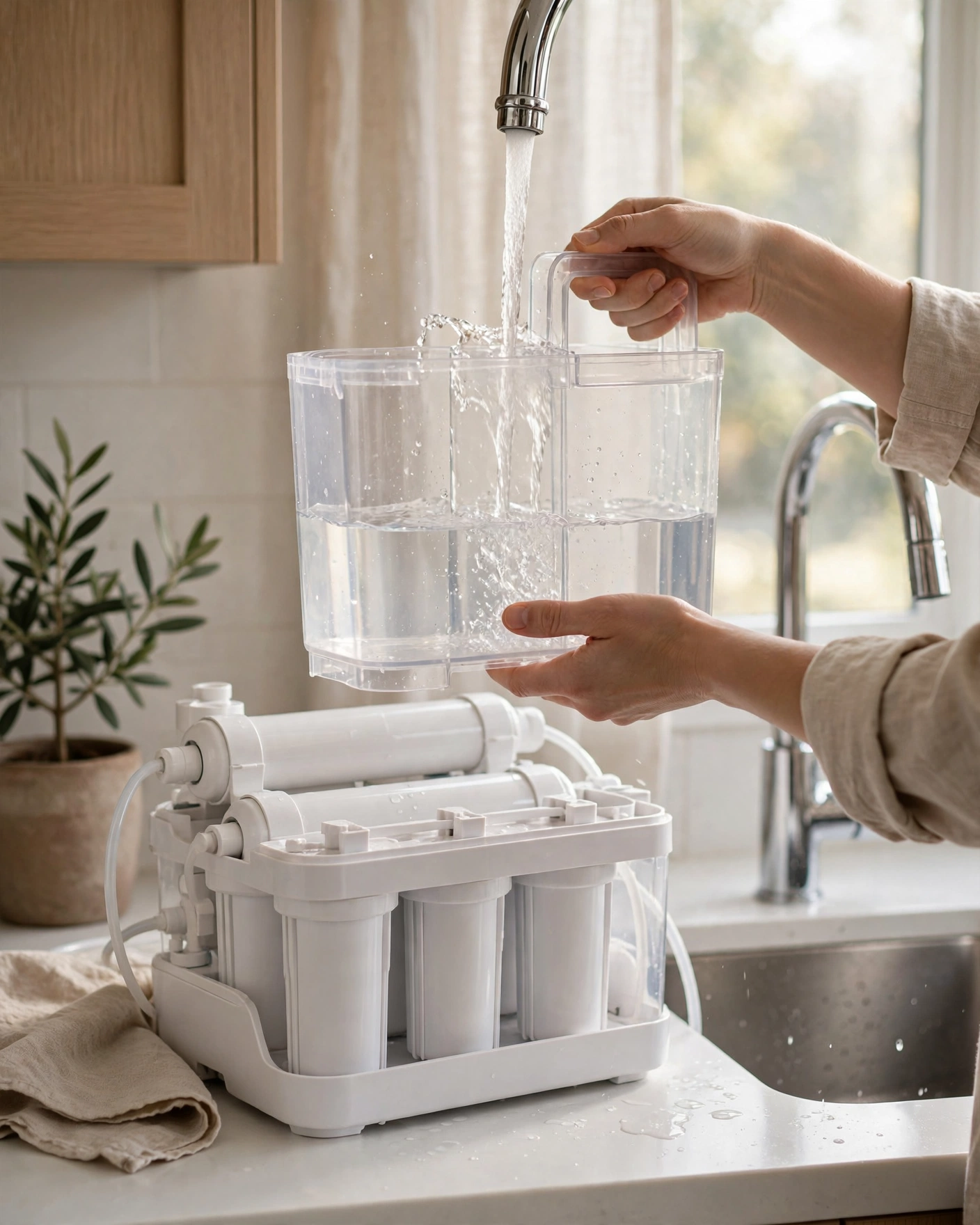
Prefer a glass carafe that lives in the fridge? Our AquaTru Carafe review covers exactly what changes.
Filter cost math
Forget the sticker price: RO systems are a subscription you pay in filters.

| Item | AquaTru Classic |
|---|---|
| Unit (upfront) | ~$449–475 |
| Pre-filter + carbon (VOC) filter life | ~600 gallons each |
| RO membrane life | ~1,200 gallons |
| Cost per 100 gallons | ~$17 |
| Estimated yearly filter cost | ~$100–130 |
| Estimated 5-year ownership | ~$950–1,125 |
Two things jump out. First, at about $17 per 100 gallons this is genuinely cheap water — roughly $0.17–0.25 a gallon against $1+ for bottled, so it pays for itself against a bottled-water habit in well under a year. Second, the long filter life means no monthly treadmill: two to three changes a year, the membrane double that. Hard water shortens everything — treat these as estimates. The cheapest to run we researched is the Waterdrop K19-SFK at roughly $79 a year in filters — see our Waterdrop K19 review if running cost decides it.
What owners complain about
Small batches. The 0.75-gallon clean tank is the most repeated complaint: fine for one or two people, but a family dinner means another 10–15-minute cycle. Owners who love the unit run it on a routine — a batch before it is needed — rather than on demand.
Slow dispensing. Even with a full pitcher, filling a large jug from the spout takes patience — the weakest scored category in multiple independent tests.
The reject-water ritual. New owners are routinely surprised that the tap-water tank must be emptied of concentrated water before every refill. Not a malfunction — just how a drainless countertop RO works.
Counter space. At roughly 12 × 14 × 14 inches, this is a permanent countertop resident, and the mild pump hum is audible in a quiet kitchen.
Limescale slowdowns. In hard-water areas, the feed tube can clog with scale and the unit slows or stops mid-cycle. The manufacturer’s fix is a descaling kit — an extra purchase under-sink owners never think about.
Customer service. Some owners report frustrating support experiences — long back-and-forths, partial resolutions.

None of these are hidden gotchas once you know them, and none are unique to AquaTru — small batches and slow cycles are the price of every drainless countertop RO. But they are the real-world friction points, and you are better off knowing them now.
AquaTru Classic vs rivals
The Classic against the countertop ROs buyers cross-shop most often — published specs and independent reviewer figures.

| AquaTru Classic | SimPure Y7P | Waterdrop K19-SFK | AquaTru Carafe | |
|---|---|---|---|---|
| Typical unit price | ~$449–475 | ~$370 | ~$349 | ~$375–395 |
| Certifications (as reported) | IAPMO 42/53/58/401 (brand-stated) | Not certified (SGS lab-tested per reviewers) | IAPMO 58 (TDS only) | IAPMO 42/53/58 (brand-stated) |
| Pure-to-drain ratio | 4:1 advertised; ~3:1 reported | 4:1 stated | 3:1 | ~4:1 (independent test) |
| Yearly filter cost | ~$100–130 | — | ~$79 | — |
| Best for | Widest certified list, no plumbing | Least waste, high output | Lowest running cost | Glass carafe, fridge-friendly |
— = not published in our sources. All prices and costs are estimates; re-check before buying.
The pattern is clear: the Classic’s real competition is buyers deciding how much certification is worth. The SimPure Y7P wins on waste ratio and output for the money (our SimPure Y7P review covers it), the Waterdrop K19-SFK wins on running cost with a narrower TDS-only certification, and the Carafe is the same family with a smaller footprint. If the certified list is what you are paying for, the Classic stands alone.
Who should buy it
Buy it if
- You cannot install under-sink — renters, dorm dwellers, granite-countertop owners.
- You want the widest certified reduction a countertop unit offers — lead, PFAS, fluoride, TDS.
- Your water report shows fluoride, nitrate, or high dissolved solids.
- You are fine with a batch routine — fill, wait, pour, empty the reject tank, repeat.
Skip it if
- You need a lot of water fast — a family of four will feel the 0.75-gallon limit.
- You hate maintenance rituals — the empty-and-refill cycle plus occasional descaling is non-negotiable.
- You want mineralized water out of the box — the base model strips minerals (remineralization is a taste choice, not a health upgrade).
- Your budget is under $300 — uncertified rivals cost less, with narrower proven coverage.
If hot and cold dispensing matters more than certifications, our Waterdrop A1 review covers that option.
The specs
- Brand
- AquaTru
- Model
- Classic (4-stage)
- System type
- Countertop reverse osmosis
- Clean-water tank
- 0.75 gallon (removable pitcher)
- Tap-water tank
- ~3 quarts
- Stages
- Mechanical pre-filter, activated carbon, RO membrane, final carbon
- Filter rated life
- ~600 gal (pre/VOC); ~1,200 gal (membrane)
- Certifications
- IAPMO: NSF/ANSI 42, 53, 58, 401 + 372 (brand-stated)
- Pure-to-drain
- 4:1 advertised; ~3:1 reported
- Typical unit price
- ~$449–475 (estimate)
- Warranty
- 1-year limited
- Materials
- BPA/BPS-free Tritan (per independent review)
FAQs
How long do AquaTru Classic filters last?
The pre-filter and VOC (carbon) filter are rated for about 600 gallons each, the RO membrane for about 1,200. The unit’s indicator tracks usage and tells you when to change. In hard-water areas, descale on schedule — limescale can slow the system before the filters are spent.
Does the AquaTru Classic remove lead?
Per AquaTru’s published IAPMO listing detail (reported by independent reviewers), lead is covered under the NSF/ANSI 58 certification, alongside TDS, fluoride, arsenic (V), and nitrate/nitrite. Certification means it reduced lead under standardized test conditions. If lead is your main concern, test your water first.
Does the AquaTru Classic remove PFAS?
The listing detail reported by independent reviewers places PFOA and PFOS under the NSF/ANSI 53 certification. Separately, an independent Tap Score panel found all 14 tested PFAS analytes below reporting limits in AquaTru-treated water. We could not re-pull the live IAPMO directory entry, so confirm the current listing before you buy.
Does the AquaTru Classic remove fluoride?
Per AquaTru’s published listing detail — as reported by independent reviewers — fluoride is covered under the IAPMO NSF/ANSI 58 certification. That is a brand-stated claim; we could not verify the live IAPMO directory entry.
How much water does the AquaTru Classic waste?
AquaTru advertises 4:1, but independent testers report roughly 3:1 — about 75% of the water you add becomes purified. The reject water collects in the tap-water tank; empty it each refill. Not knowing this is the number-one source of “waste confusion” among owners.
Why is my AquaTru filtering slowly?
Usually limescale: the tube carrying water from the tap-water tank to the first filter clogs with scale, and the manufacturer’s troubleshooting guide recommends descaling (they sell a kit for it). It can also mean a filter is near the end of its life, or that a tank is not seated properly.
Does AquaTru water taste flat? Is there a remineralized version?
Yes — RO strips minerals, so the water tastes very clean but flat; one independent reviewer measured pH 5.5–6.0. AquaTru sells an alkaline/mineral-boost version that adds minerals back for taste; it costs extra. Remineralization is a taste choice only — not a health upgrade.
AquaTru Classic vs Carafe — which should I buy?
Buy the Classic for the widest certified list (IAPMO 42/53/58/401 as brand-stated) and a 0.75-gallon pitcher. Buy the Carafe for a glass carafe that lives in the fridge and a smaller footprint. The Carafe measured about 4:1 in independent testing, slightly better than the Classic’s roughly 3:1.
Conclusion
The AquaTru Classic is for one buyer: the person who wants the broadest certified contaminant reduction without plumbing — lead, PFAS, fluoride, dissolved salts — and will live with a small-batch, slow-cycle routine. For that buyer, the premium buys something real: an IAPMO list no other countertop RO we researched can match. For everyone else — big families, impatient pourers, tight budgets — the routine will grate. Know which buyer you are, and the choice makes itself.
Price checked at time of writing; it changes often — see the live price before you buy.
Update log
- Zulqarnain: Review published.