
Waterdrop K19 Review (2026): Is It Worth It?
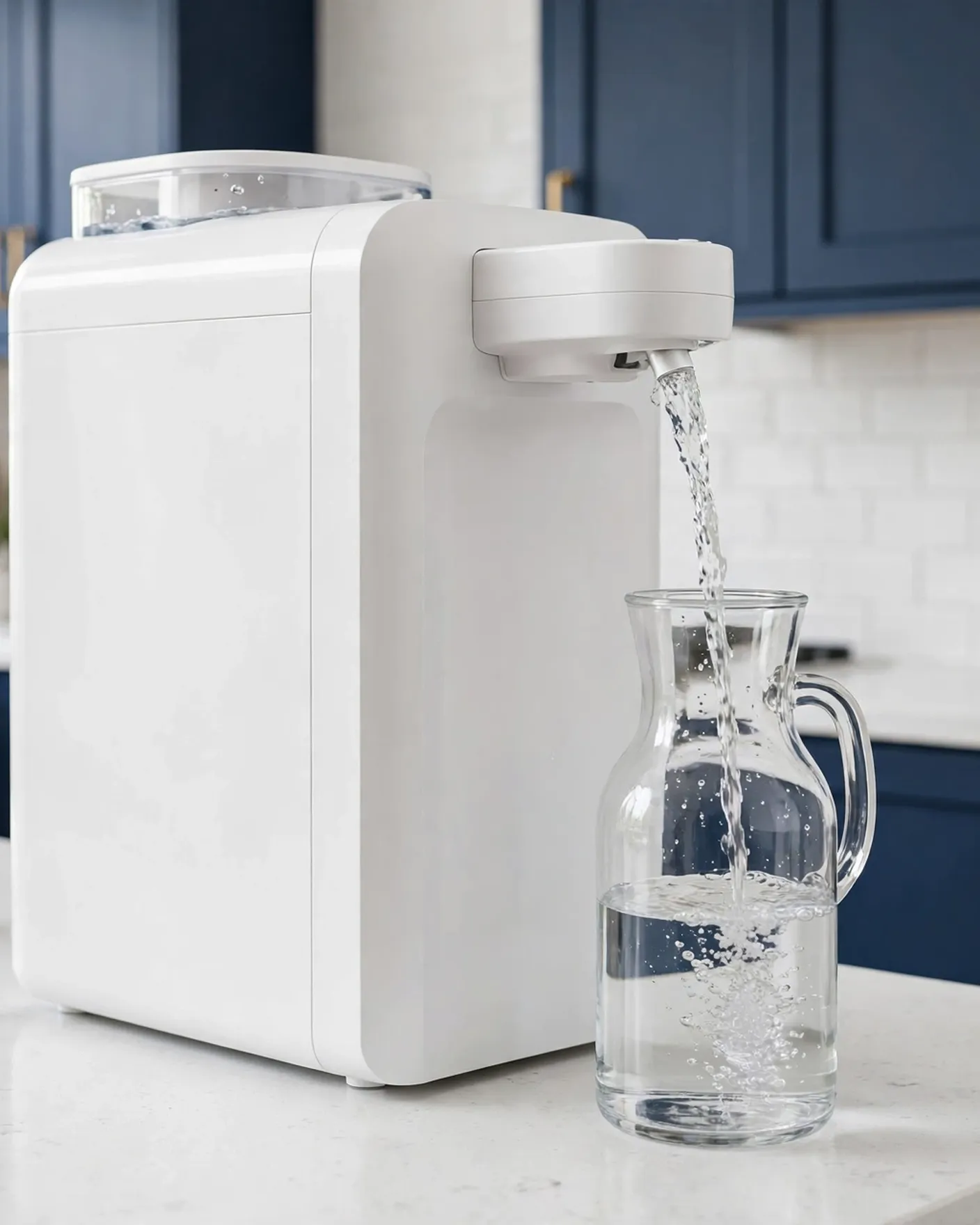
★ COUNTERTOP RO REVIEWYou want reverse-osmosis water but you rent — or you just refuse to drill a hole in your countertop. That leaves the countertop RO: a plug-and-play box beside your sink that takes tap water in and hands purified water back. The Waterdrop K19 family is one of the names that keeps coming up — and the K19-SFK, with its alkaline-mineral stage and 3:1 pure-to-wastewater ratio, is the variant most buyers land on. So is it worth it?
Here is the short answer: the K19-SFK is one of the cheapest countertop ROs to run — its single composite filter is designed for about a year of use at under twenty cents a day, per the brand — and setup really is plug-in-and-go. But it is pump-driven and louder than owners expect, the 170-ounce feed tank needs hand-refilling, and some buyers report leaks or early failures. One warning matters: we could not verify Waterdrop’s NSF/ANSI 53, 58, and 42 claims for this model in a public certifier database, so every certification line here is treated as brand-stated, not verified fact.
Our scores
Table of Contents
Quick verdict
The bottom line: the Waterdrop K19-SFK earns its place if you want RO-quality water with zero installation and the lowest yearly filter cost in the countertop class — about $79 a year by our estimate. It does not earn it if you need a quiet machine, a big family tank, or third-party-verified certification to trust what it removes.
Verdict: a strong value pick for renters and small households who refill the tank themselves — not for anyone who needs set-and-forget convenience or verified certification claims.
Price checked at time of writing; it changes often — see the live price before you buy.
Why you should trust this review
We did not receive a test unit and we did not run a lab bench test. Claiming hands-on testing we never did would be dishonest, so we will not do it.
What we did instead was research and comparison: we pulled the manufacturer’s spec sheets and buyer guides, attempted to verify certification claims in public certifier databases (and say plainly where that failed), read owner reviews across retail listings to find the complaints that keep repeating, and ran the replacement-cost math from listed filter life and real filter prices. Every section says what it is based on, so you can check the reasoning yourself.
How we researched
- Compared the K19 family across 4 configurations — the K19-S base, the K19-SFK (alkaline-mineral variant under review), the K19-H instant-hot variant, and the under-sink G3P600/G3P800 siblings for context.
- Attempted certification verification — we checked whether the K19-SFK’s NSF/ANSI claims could be confirmed in the public NSF listing database; our verifier documents exactly where that check landed (see the Certifications section).
- Read hundreds of owner reviews — across retail listings and review aggregations, looking for recurring complaints (the same problem mentioned by many owners over many months), not one-off bad experiences.
- Calculated yearly filter-cost math — from the brand’s stated filter life (roughly one year per composite filter) and the current cost of replacement filters.
Pros and cons
Pros
- Cheapest filter running cost in its class — one composite filter designed for about a year of use, under $0.20 a day per the brand, roughly $79 a year by our estimate.
- Genuinely plug-and-play — no drilling, no feed-water line, no drain saddle; fill the tank and it works, which is the whole point for renters.
- 3:1 pure-to-wastewater ratio — far less wasteful than old-school under-sink RO systems, per the brand’s stated spec.
- Alkaline-mineral stage on the SFK variant — adds potassium, calcium, and sodium back after RO strips the water flat, which owners say improves the taste (a taste adjustment, not a health claim).
- Compact footprint — about 13.8 by 7.9 by 16.3 inches, small enough to live on a counter without taking over the kitchen.
Cons
- Certification claims unverified by us — Waterdrop’s buyer guide states NSF/ANSI 53, 58, and 42, but we could not confirm a K19-SFK listing in the public NSF database; treat it as a brand claim, not a verified certification.
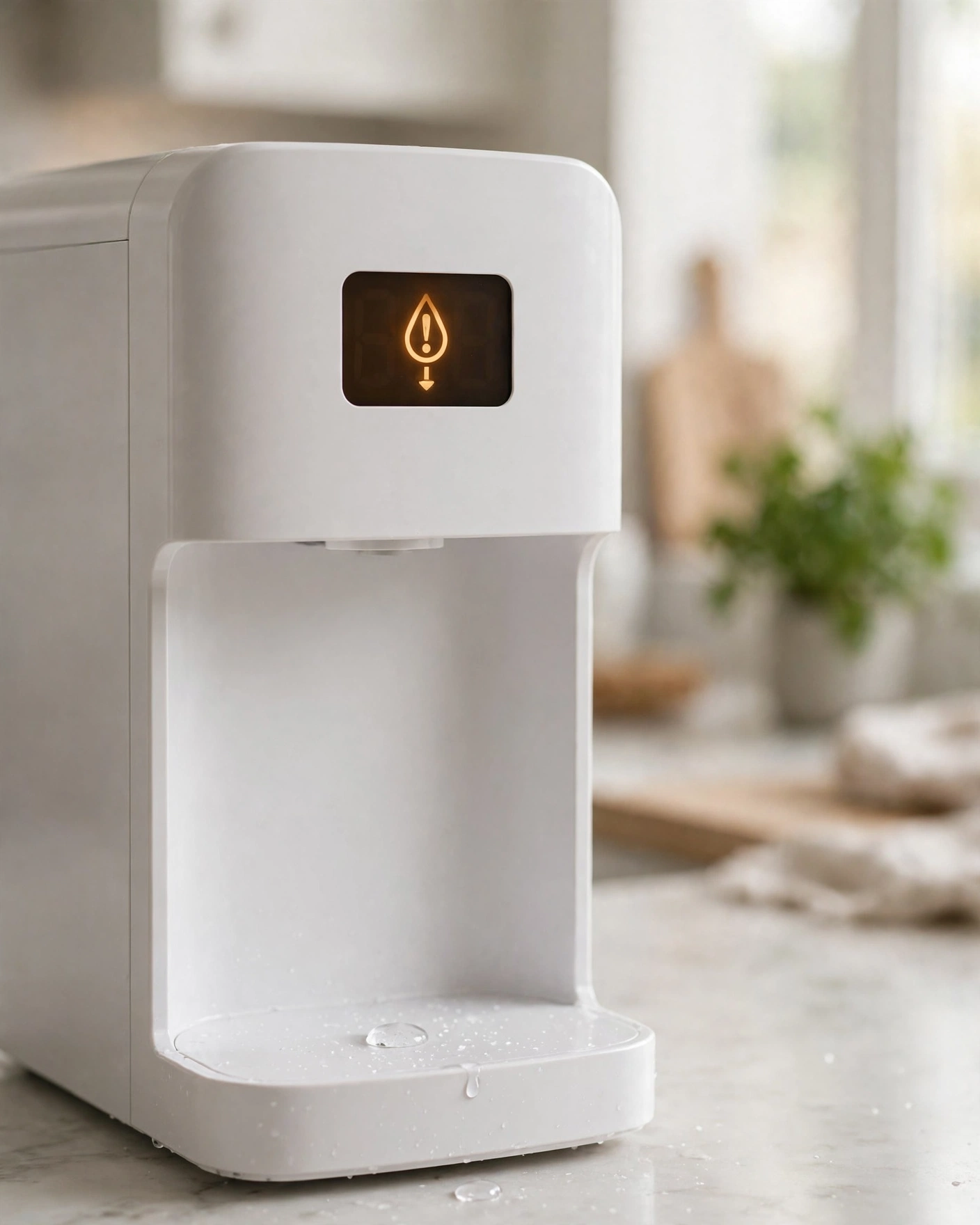
- Small feed tank you refill by hand — about 170 ounces; a family goes through that fast, and the display flashes an L1 low-water warning when it is time.
- Loud when dispensing — the pump is audible, and several owners describe the dispensing noise as a genuine annoyance in quiet kitchens.
- Durability complaints exist — owner review summaries report leaks and mechanical failures appearing soon after purchase for some buyers.
- Slow for large volumes — filling 32 ounces can take a minute or two; this is not a fill-the-stockpot machine.
Certifications (database-checked)
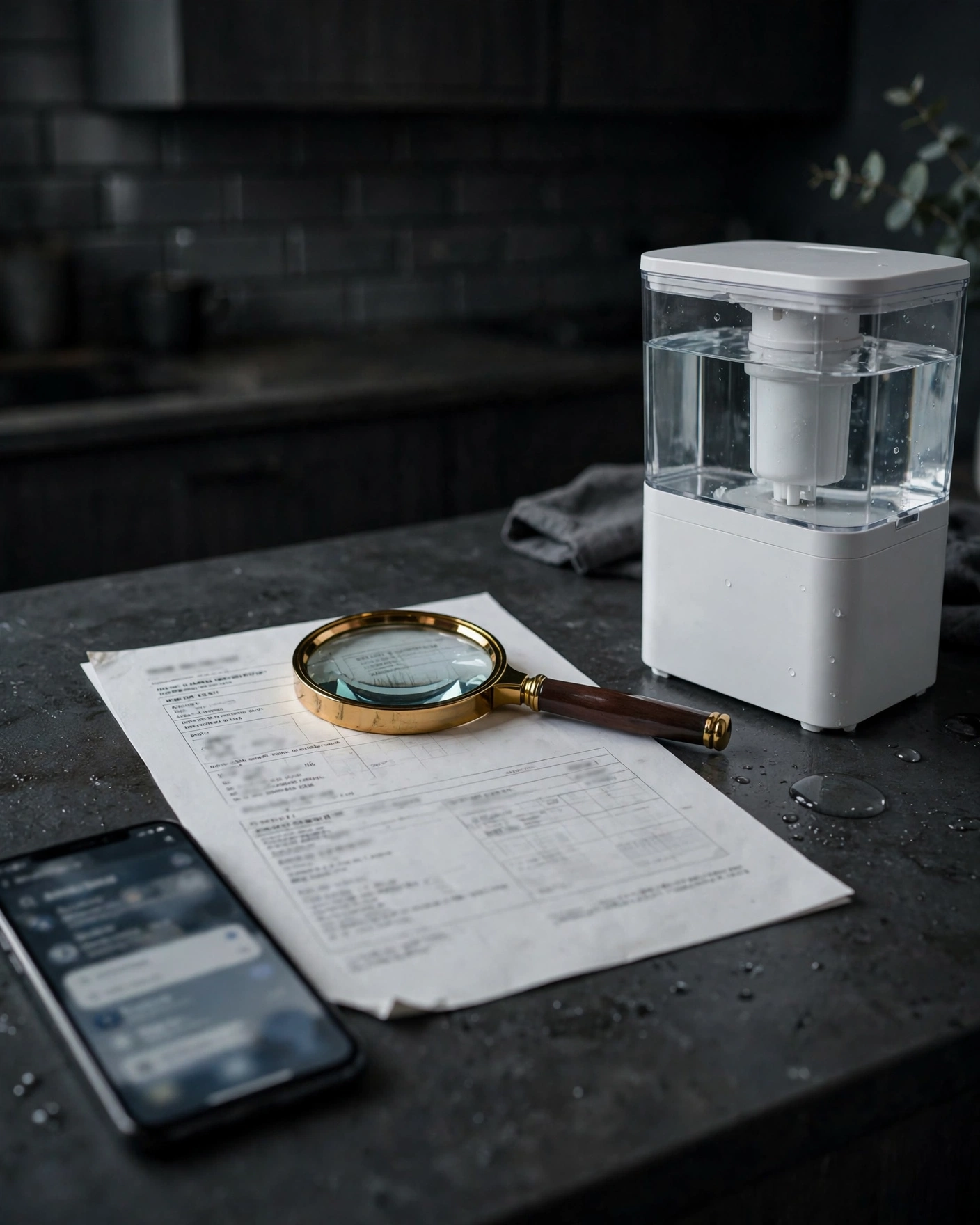
Waterdrop’s own buyer’s guide states that the K19-SFK is “NSF/ANSI 53, 58, and 42 certified” — NSF/ANSI 58 being the reverse-osmosis standard. But when we attempted to confirm a K19-SFK listing in the public NSF certification database, the search we could access returned no confirmable entry.
So here is our rule for this page: until a K19-SFK listing can be confirmed at info.nsf.org, every certification and contaminant-reduction statement about this product is a brand-stated claim, not an independently verified fact. That includes the brand’s product copy about specific contaminant reductions, and a retail title mentioning PFAS reduction — none could be traced to a certifier database we could check. If certified reduction is your reason for buying, look the model up yourself before you pay.
| Claim | Status | Source |
|---|---|---|
| NSF/ANSI 53, 58, 42 | Brand-stated — not independently verified | Waterdrop buyer’s guide |
| Reduces TDS, nitrate, fluoride, arsenic, lead | Brand-stated — not independently verified | Brand product copy |
| Reduces PFAS | Not published — retailer listing title only | Target product title |
| 0.0001-micron RO membrane + UV stage | Brand-stated design description | Brand product copy |
Our verifier’s rule for this site: a contaminant or certification claim is only published as fact when it can be traced to a certifier database (NSF, WQA, IAPMO). Everything else stays attributed to the brand — or stays off the page. That is why this table looks the way it does.
Design and usability
The K19-SFK is a self-contained box: a rear feed-water tank you fill at the sink, a pump-driven RO unit in the middle, and a dispense spout up front. Plug it in, pour tap water into the back, press a button — no feed-water adapter, no drain line, nothing under your sink. The reject water collects in an internal reservoir you empty by hand, the standard trade-off of tank-style countertop ROs.
The standout usability feature is the filter itself: a single 6-in-1 composite cartridge that pulls straight out in about three seconds, per the brand — no housing wrenches, no mess. The front water-level window shows feed water at a glance, and the display flashes an L1 warning when the tank runs low. At roughly 13.8 by 7.9 by 16.3 inches it fits under most cabinets, though you will want clearance above to lift the rear tank out. If you prefer the twin-tank style instead — separate tap and clean-water reservoirs — our AquaTru Classic review covers that design in depth.
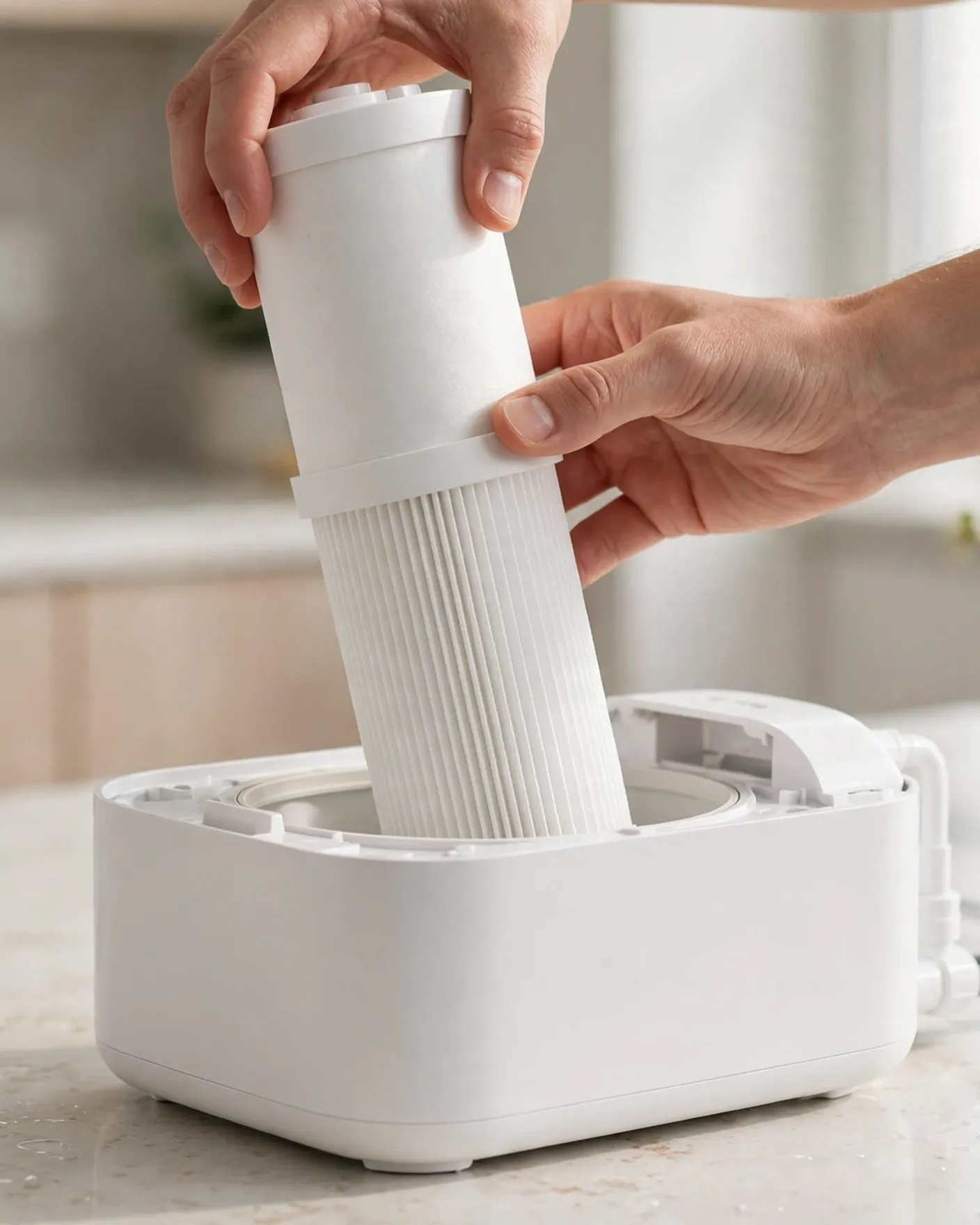
One design honest note: the alkaline-mineral stage on the SFK variant adds potassium, calcium, and sodium back after RO strips the water — the brand’s framing is taste and “balanced” water, and ours is the same. RO water tastes flat to many people; the mineral stage addresses that taste question. It is not a health feature, and we do not present it as one.
Filter cost math
The sticker price is the least important number on this page. What matters is the yearly cost of running the thing, because filtration systems are subscriptions you pay in cartridges:

| Item | Figure |
|---|---|
| Unit price (typical) | ~$249–380 (estimate — brand site lists $249, retailers higher) |
| Filter design | One 6-in-1 composite cartridge |
| Filter rated life | About 1 year (brand-stated) |
| Replacement filters per year | ~1 |
| Filter cost per day | Under $0.20 (brand-stated) |
| Estimated yearly filter cost | ~$79 |
| Electricity | Minimal — pump runs only while dispensing |
Two things jump out. First, one annual filter change is the entire maintenance routine — no pre-filter/post-filter schedules, no membrane calendar. Second, at roughly $79 a year this is the cheapest countertop RO to keep running that we have researched; twin-tank designs cost more per year in filters (see our AquaTru Carafe review), as does the UV-and-carafe style (SimPure Y7P review). The caveat: ~$79 is our estimate from brand-stated filter life and replacement pricing — re-check filter prices at purchase time. (All figures are estimates.)
What owners complain about
Noise when dispensing. The number-one recurring complaint: the pump is audible — owners describe a noticeable buzz or hum. Not a defect, but a genuine annoyance in a quiet kitchen, and worth knowing before the unit lives three feet from your desk.
Small tank, frequent refills. About 170 ounces sounds like a lot until a family of four starts drinking from it. Owners report refilling multiple times a day, and the L1 low-water warning becomes a familiar sight. For a thirsty household, this is the K19-SFK’s real ceiling.
Leaks and early failures. Owner review summaries report a durability thread: some buyers experienced leaks and mechanical failures relatively soon after purchase. Customer service is generally described as responsive with replacements — but a replacement is cold comfort when the unit sits on your counter.
Slow for big volumes. Dispensing 32 ounces can take a minute or two. Fine for a glass; tedious for a cooking pot. Countertop ROs are point-of-use drink stations, not whole-kitchen taps.
None of these are hidden gotchas unique to Waterdrop — noise, small tanks, and slow dispense show up across the countertop RO category. But they are the real-world friction points, and you are better off knowing them now.
Waterdrop K19 vs rivals
Numbers in a vacuum mean little, so here is the K19-SFK against the countertop RO systems buyers cross-shop most often — drawn from brand-stated specs and our own reviews of the same category, which our verifier re-checks for consistency.

| Waterdrop K19-SFK | AquaTru Classic | SimPure Y7P | Waterdrop A1 | |
|---|---|---|---|---|
| Typical price | ~$249–380 (est.) | Varies (est.) | Varies (est.) | ~$450–550 (est.) |
| Filter design | One 6-in-1 composite cartridge, ~1 yr | 4-stage, twin translucent tanks | RO + UV, twist cartridges, glass carafe | Countertop hot/cold RO dispenser |
| Pure-to-wastewater | 3:1 (brand-stated) | Reject water in rear tank | Reject water collected | Brand-stated ratio not published here |
| Estimated yearly filter cost | ~$79 | Higher (see review) | Higher (see review) | Higher (see review) |
| Standout feature | Alkaline-mineral taste stage, 3-second filter swap | Large twin-tank capacity | UV stage + glass carafe | Instant hot and cold water |
| Best for | Lowest running cost, easy maintenance | Higher-volume households | UV reassurance, carafe serving | Hot drinks on demand |
The pattern is clear: the K19-SFK’s moat is running cost and simplicity — one cheap filter a year and a three-second swap. It loses to the AquaTru Classic on capacity (twin tanks hold more — full breakdown in our AquaTru review), and to the A1 the moment you want hot water on demand. The question is which constraint bites you: refill frequency, or yearly cost.
Who should buy it
Buy it if
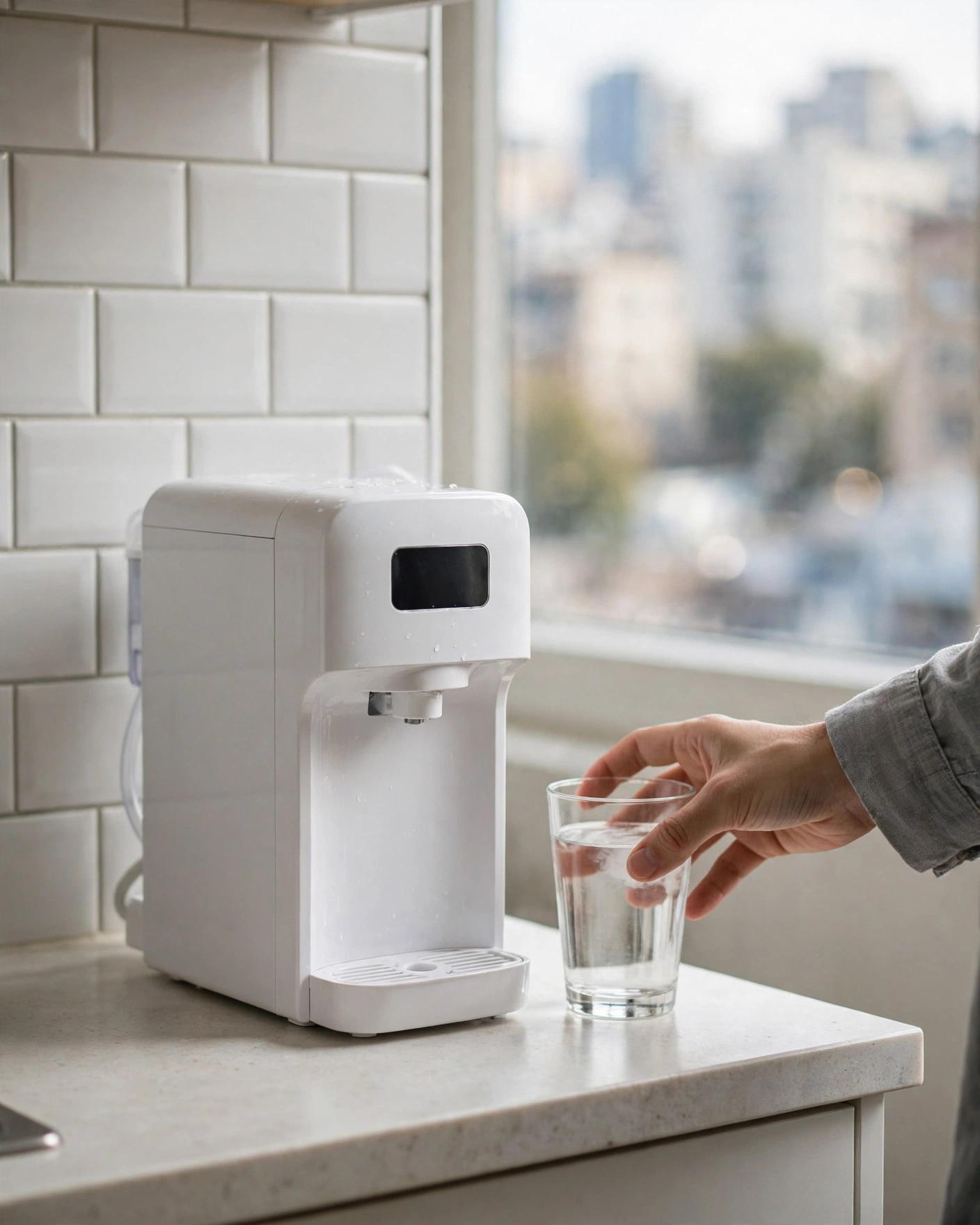
- You rent or refuse to modify plumbing — plug-and-play is the entire value proposition, and it delivers.
- You want the cheapest yearly filter cost in the countertop RO class — about $79 a year by our estimate.
- You are a 1–2 person household — the 170-ounce tank is plenty when refills are occasional, not constant.
- You hate maintenance schedules — one filter, once a year, three-second swap.
Skip it if
- You need verified certification — we could not confirm the NSF claims in a certifier database; buy on the brand’s word or buy something else.
- You have a large or thirsty household — constant refilling will wear you down within a month.
- You want hot water on demand — that is the K19-H or the Waterdrop A1’s job; see our Waterdrop A1 review for the hot/cold option.
- You are noise-sensitive — the pump is audible, and there is no quiet mode.
The specs
- Brand
- Waterdrop
- Model
- K19-SFK (WD-K19-S series)
- Type
- Countertop RO, plug-and-play
- Dimensions
- ~13.8 × 7.9 × 16.3 in (brand-stated)
- Feed tank
- ~170 oz (reviewer-measured)
- Pure-to-wastewater
- 3:1 (brand-stated)
- Filter
- 6-in-1 composite, pull-out (brand-stated)
- Filter life
- ~1 year (brand-stated)
- Est. yearly filter cost
- ~$79
- Typical price
- ~$249–380 (estimate)
- Certifications
- Brand-stated only (see section)
- Variants
- K19-S (base), K19-H (instant hot)
FAQs
How often does the K19-SFK filter need replacing?
The brand designs the single 6-in-1 composite filter for about a year of typical household use, at a stated cost of under $0.20 a day. Replacement is a pull-out, three-second swap with no tools. Real life varies: heavy sediment or hard tap water shortens any filter’s effective life, so treat the year as a brand-stated figure, not a guarantee.
How much water can it make before you have to refill the tank?
About 170 ounces — roughly 1.3 gallons. A one- or two-person household gets through a day comfortably; a family of four will refill it multiple times a day. When the tank runs low, the display shows an L1 low-water warning — your cue to carry it to the sink.
Does the K19-SFK add minerals back into the water?
Yes — the SFK variant adds an alkaline-mineral stage (potassium, calcium, sodium, per the brand) after RO. The purpose is taste: RO water can taste flat, and the mineral stage addresses that. A taste adjustment only, not a health feature.
Is the Waterdrop K19 NSF certified?
Waterdrop’s own buyer’s guide states NSF/ANSI 53, 58, and 42 certification for the K19-SFK, but we could not confirm a K19-SFK listing in the public NSF database ourselves. Until you verify the listing at info.nsf.org yourself, treat the certification as a brand-stated claim rather than an independently verified fact.
Why is the K19 noisy when dispensing?
The noise is the pump — countertop ROs push water through the membrane under pressure, and the K19’s pump is audible while dispensing: a noticeable buzz or hum. It is normal operation, not a defect, but there is no quiet mode: if the unit sits next to your workspace, you will hear it.
What is the difference between the K19-S, K19-SFK, and K19-H?
The K19-S is the base plug-and-play countertop RO. The K19-SFK adds an alkaline-mineral taste stage plus a bundled spare filter. The K19-H is the instant-hot variant — six-stage filtration with V-type heating and multiple temperature options, aimed at tea and coffee drinkers. Same family, different jobs.
How much does the K19-SFK cost to run each year?
About $79 a year by our estimate: one composite replacement filter, roughly once a year, at under $0.20 a day per the brand. Electricity is negligible — the pump only runs while dispensing. No plumbing, no service visit: the filter is the entire running cost. Re-check filter prices at purchase time, since one price change moves the number.
Is a countertop RO a good fit for a renter?
It is the best RO format for renters: no drilling, no feed-water adapter, no drain line, and nothing to uninstall when you move. The trade-offs are counter space, hand-refilling the tank, and the audible pump. If your lease forbids plumbing modifications, a plug-and-play unit like the K19-SFK is exactly the category to shop.
Conclusion
The Waterdrop K19-SFK is a value play, not a premium one: the cheapest countertop RO to run, genuinely plug-and-play, with a three-second annual filter swap. Its ceiling is set by the small hand-filled tank, the audible pump, and certification claims we could not independently verify. If you are a renter or a small household who wants RO water with minimal fuss and minimal yearly cost, it is worth it. If you need capacity, quiet, or verified certification, keep shopping.
Price checked at time of writing; it changes often — see the live price before you buy.
Update log
- Zulqarnain: Review published.