

Best RO System For Renters (2026): Compared & Ranked
★ TOP PICK FOR RENTERSYou love the idea of reverse-osmosis water — that clean, flat taste with no chlorine smell — but you rent. Drilling a hole in the countertop for a dedicated faucet is not happening, and tapping into the cold-water line under the sink would mean a fight with your landlord and possibly your security deposit. So what do renters actually do when they want RO-quality water without touching the plumbing?
Here is the short answer: you have two realistic paths. Countertop RO units that plug into a regular outlet and fill manually — no drilling, no drain saddle, nothing permanent. Or gravity filter systems that need no power at all and move with you in a box. We researched and compared the current options, ran the yearly cost math from real filter prices and rated filter life, and read owner reviews for the complaints that keep repeating. This roundup lays out the three picks that make the most sense for renters, what each one costs to run for a full year, and the buying-guide rules that keep you out of trouble with your lease.
Our scores
Table of Contents
- Quick picks: the 3 best options for renters
- How we researched
- Best overall: SimPure UV RO system
- Best no-power pick: ProOne Big+ gravity system
- Best for frequent movers: Boroux Legacy gravity system
- Side-by-side comparison
- Buying guide: what makes a system renter-friendly
- Replacement cost math
- FAQs
- Conclusion
Quick picks: the 3 best options for renters
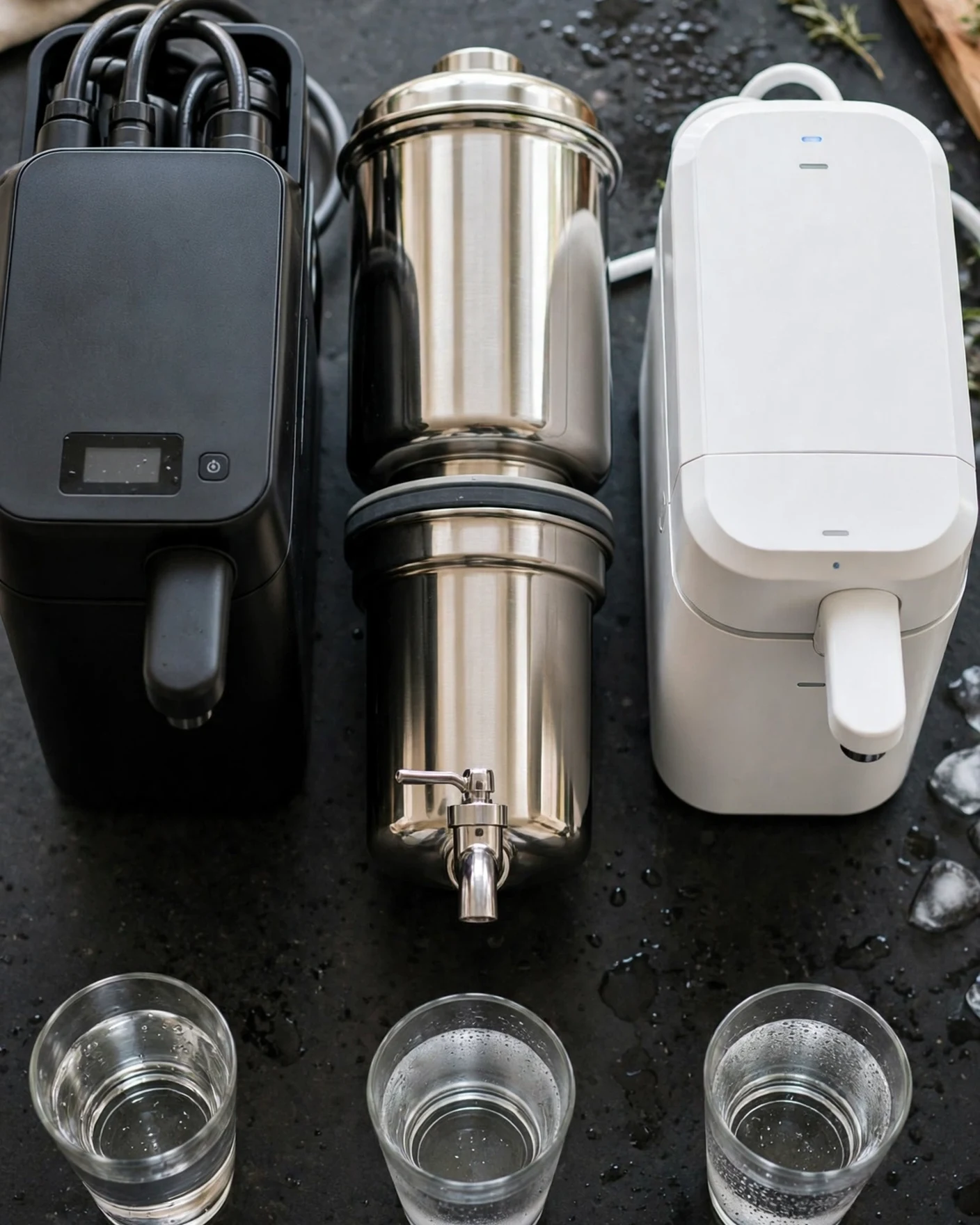
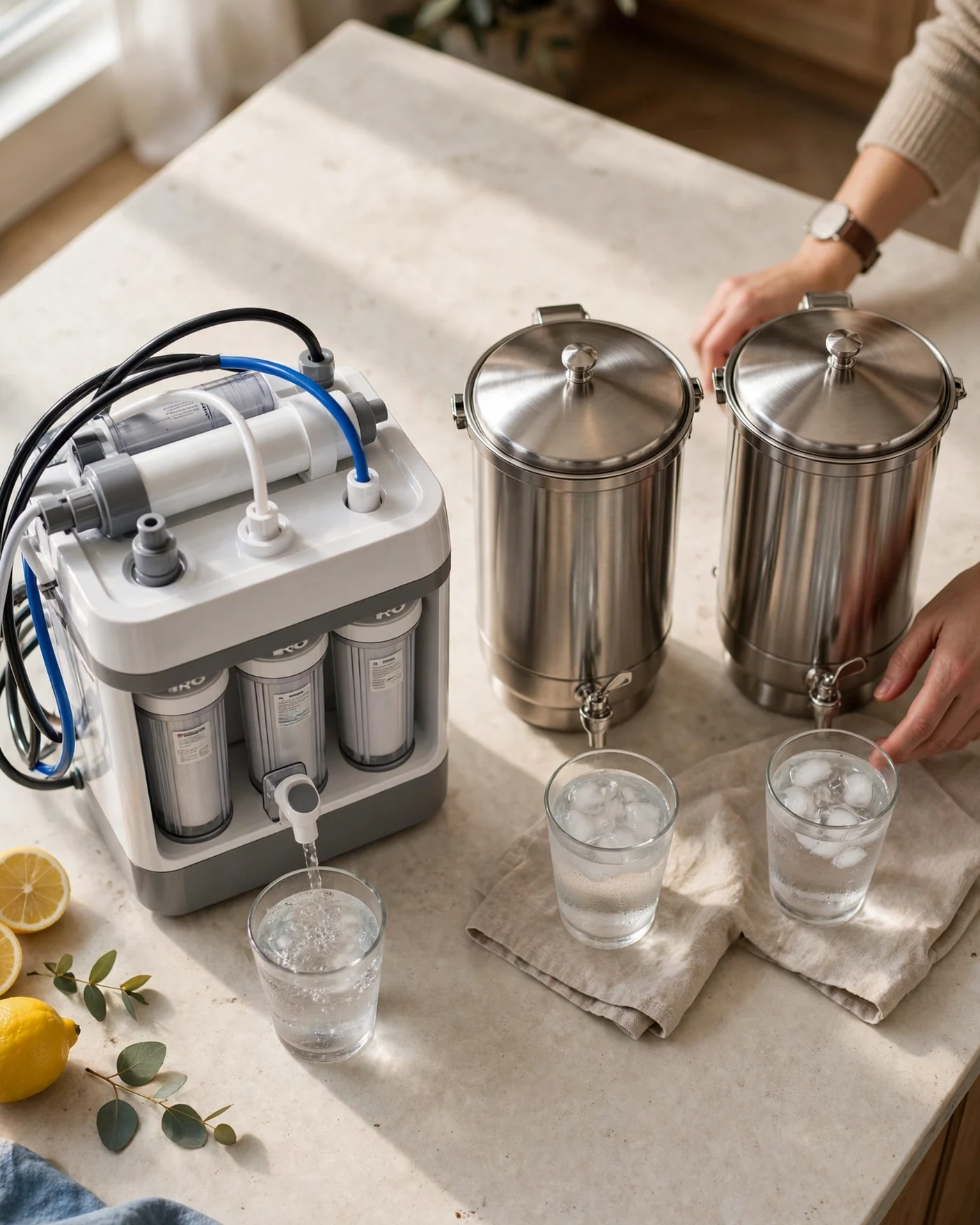
If you want the one-paragraph version before the deep dive, here it is. The SimPure UV RO system is the closest thing to a true under-sink RO experience without touching your plumbing — plug it in, fill the tank, and the RO membrane plus UV stage does the heavy lifting. The ProOne Big+ is the best choice when you have no spare outlet or counter space to waste: a gravity system that filters with no power at all. And the Boroux Legacy is the one to buy if you move every year or two — stainless steel, simple to clean, and easy to pack.
| Pick | Product | Type | Estimated price |
|---|---|---|---|
| Best overall | SimPure UV RO system | Countertop RO + UV | ~$300–450 (estimate) |
| Best no-power | ProOne Big+ (3 gal) | Gravity | ~$180–220 (estimate) |
| Best for movers | Boroux Legacy (3 gal) | Gravity | ~$300–350 (estimate) |
One honest framing note before we go further: strictly speaking, only the SimPure is a reverse-osmosis system. The ProOne and Boroux are gravity filters — they use carbon and ceramic elements, not an RO membrane. They are here because they are the most practical renter alternatives when a countertop RO does not fit your space, power, or moving schedule. Nothing on this page requires drilling, plumbing changes, or landlord approval.
How we researched
We did not receive test units and we did not run a lab bench test. Claiming hands-on testing we never did would be dishonest, so we will not do it.
What we did instead was research and comparison:

- Compared specs across the renter-relevant RO category — countertop RO units, gravity systems, and the under-sink systems renters usually cannot install, to understand exactly what renters give up and what they keep.
- Checked every certification claim we repeat — anything the manufacturer says about NSF, ANSI, WQA, or IAPMO is labeled as brand-stated, and where we could not confirm a listing in a public certifier database, we say so instead of copying the marketing claim.
- Read owner reviews for recurring complaints — across major retail listings, looking for the same problem mentioned by many owners over many months, not one-off bad experiences.
- Calculated yearly running costs — from listed filter life (gallons and months) and current retail filter prices, all marked as estimates.
- Applied renter-specific filters — no permanent installation, fits a normal apartment kitchen, and can be removed or moved without damage.
Best overall: SimPure UV RO system
The SimPure UV RO system is the pick for the renter who wants actual reverse osmosis — the membrane, the low-TDS water, the whole deal — without modifying a single pipe. It sits on the counter, plugs into a normal outlet, and runs tap water through a multi-stage RO process with a UV stage added at the end. You fill the feed tank yourself and pour out filtered water, so there is no connection to the faucet and no drain line to install. For a lease that forbids plumbing changes, that is the entire ballgame.

Pros
- True RO membrane filtration — rejects dissolved solids the way under-sink RO does, which gravity filters cannot match.
- UV stage included — adds a disinfection step on top of the membrane, useful if your building’s pipes are a question mark.
- Zero installation — no faucet adapter, no drain saddle, no landlord conversation required.
- Portable — unplug it, drain the tanks, and it moves to the next apartment in a box.
Cons
- Needs an outlet and counter space — a real footprint in a small kitchen; measure before buying.
- Manual refilling — you are the water line. Heavy drinkers will feel the refill cycle.
- Room-temperature output — no chilling or heating; what comes out is what the room gives it.
- Reject water to handle — like all RO, it produces some wastewater you pour down the sink yourself.
Certification note: SimPure states that this unit was tested to NSF/ANSI 58 by SGS. That is a brand-stated claim — we could not confirm the listing in a public certifier database at the time of writing, so treat it as the manufacturer’s statement rather than an independently verified certification. This is exactly the kind of claim you should look up in the NSF or WQA public listing before a big purchase.
Estimated street price ~$300–450 (estimate); it changes often — see the live price before you buy.
Best no-power pick: ProOne Big+ gravity system
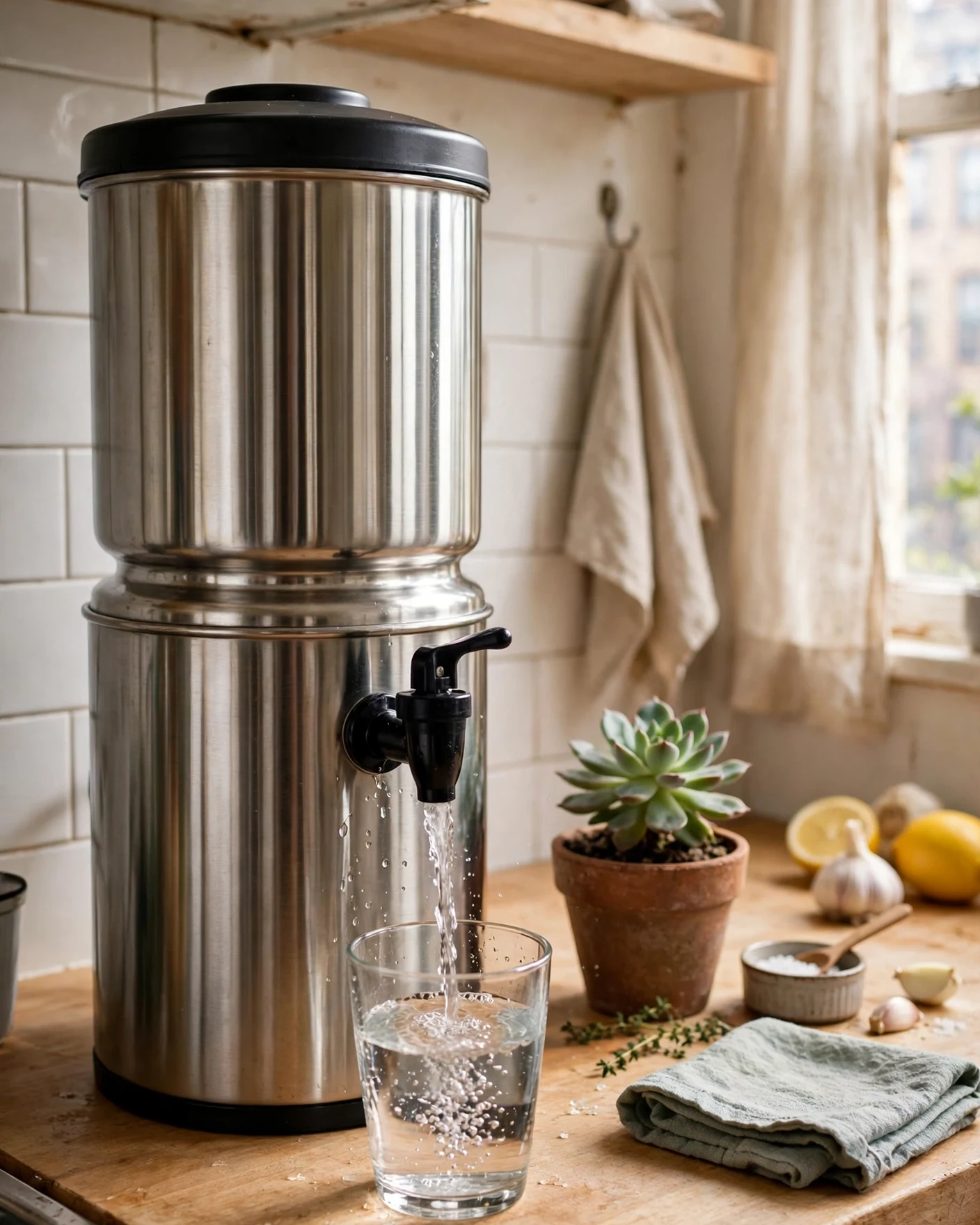
Not every rental kitchen has a free outlet near the counter, and not every renter wants another appliance humming away. The ProOne Big+ is a 3-gallon gravity system: you pour tap water in the top chamber, gravity pulls it through the filter elements, and clean water collects in the bottom chamber with a spigot. No electricity, no tanks to plug in, no noise. If your priority is simplicity — fill it in the morning, drink from it all day — this is the easiest ownership experience of the three.
Pros
- No power required — works during outages and in kitchens with zero free outlets.
- Silent — no pump, no UV ballast hum; it just sits there filtering.
- 3-gallon capacity — the Big+ size means fewer refills than smaller gravity units.
- Simple maintenance — elements are removable and scrubbable; no cartridges to click in on a schedule.
Cons
- Not reverse osmosis — gravity elements reduce many contaminants, but they do not produce the near-zero TDS water an RO membrane does. Fluoride, for example, is not what gravity carbon elements are built for.
- Slow — gravity is patient. Refilling the top chamber and waiting is the rhythm of ownership.
- Counter footprint — a 3-gallon urn is tall; check clearance under your wall cabinets.
Certification note: ProOne states IAPMO certification for its filter elements covering NSF/ANSI 42, 53, 372, and 401. As with every certification claim on this page, that is brand-stated — we could not independently verify the listing in a public certifier database at the time of writing.
Estimated street price ~$180–220 (estimate); it changes often — see the live price before you buy.
Best for frequent movers: Boroux Legacy gravity system
If you move every year or two, durability and packability beat raw filtration specs. The Boroux Legacy is a 3-gallon stainless steel gravity system — the spiritual successor to the classic stainless urns renters have been hauling between apartments for years. Stainless does not crack in a moving box the way plastic housings can, the parts are simple to disassemble and clean, and setup at the new place is: set it on the counter, fill the top, done. For serial movers, that simplicity is worth more than any spec sheet.

Pros
- Stainless steel build — survives moves that would crack plastic housings.
- Dead-simple setup — no tools, no instructions worth reading; fill and drink.
- No power, no plumbing — the same lease-proof profile as the ProOne.
- Easy to clean — disassembles for scrubbing; no proprietary cartridges.
Cons
- Highest upfront price of the three — you pay for the steel.
- Not reverse osmosis — same gravity caveat as the ProOne: no membrane, no near-zero TDS output.
- Heavy when full — 3 gallons of water plus steel is not something you lift casually; fill it where it sits.
Certification note: Boroux publishes WQA listings referencing NSF/ANSI 42, 401, and 372. One important clarification: 372 covers lead-free materials — it is not a lead-removal certification. Do not read it as proof the system removes lead from water. As with the other picks, we could not independently verify these listings in a public certifier database at the time of writing.
Estimated street price ~$300–350 (estimate); it changes often — see the live price before you buy.
Side-by-side comparison
The three picks solve the same renter problem in different ways. The table below puts the trade-offs in one place — type of filtration, what you need to run it, and what it costs over time.
| SimPure UV RO | ProOne Big+ | Boroux Legacy | |
|---|---|---|---|
| Filtration type | RO membrane + UV | Gravity elements | Gravity elements |
| Capacity | Tank-fed, refill as used | 3 gallons | 3 gallons |
| Power needed | Yes (outlet) | No | No |
| Installation | None — plug in | None | None |
| Noise | Pump/UV hum | Silent | Silent |
| Estimated upfront | ~$300–450 | ~$180–220 | ~$300–350 |
| Estimated yearly consumables | ~$70–130 | ~$130–180 | ~$140–190 |
| Best for | RO-level water, no plumbing | No outlet, max simplicity | Frequent movers |
If your decision comes down to countertop RO models specifically, our best countertop RO systems guide compares the wider category in detail — and the countertop RO for apartments roundup covers more small-space picks.
Buying guide: what makes a system renter-friendly
A filter can be excellent and still be wrong for a rental. These are the constraints that actually matter when the kitchen is not yours.

No permanent changes, period
The rule is simple: if it requires drilling, cutting a pipe, or clamping anything to the plumbing, it is not a renter product without written landlord approval. Countertop RO units and gravity systems pass this test by design — they sit on the counter like a coffee maker. Anything that taps the cold-water line or needs a drain saddle belongs in the owner category, not this one.
Measure your counter before you buy
Apartment kitchens punish assumptions. Countertop RO units need height clearance for refilling plus depth for the tanks; 3-gallon gravity urns are tall and need room under wall cabinets. Measure height, width, and depth of your intended spot, then compare against the product dimensions. Returns are more expensive than a tape measure.
Count your outlets
UV-equipped countertop RO units need a standard outlet within cord reach. If your counter outlets are already claimed by the microwave, toaster, and coffee maker, a no-power gravity system removes the problem entirely. This single question eliminates half the category for many renters.
Understand the wastewater trade-off
Every RO system — countertop included — rejects some water to flush the membrane. On a countertop unit you pour that reject water down the sink yourself, so the “waste ratio” shows up as extra refills, not a plumbing bill. If the idea of pouring water down the drain bothers you, gravity systems waste essentially nothing.
A TDS meter is not a safety test
Countertop RO units love to show off with built-in TDS displays, and low numbers feel reassuring. But a TDS reading measures dissolved solids, not safety — it cannot tell you whether your water has lead, PFAS, or bacteria. Use the meter as a rough performance check (is the membrane still working?), not as proof your water is safe. If you are worried about specific contaminants, a proper water test is the answer.
Test your water before you overspend
You cannot pick the right filter without knowing what is in your water. Cheap hardness test strips — the JNW Direct 150-pack runs about $12–20 (estimate) — tell you about hardness and a few basics in a minute. That is enough to decide whether you need RO-level treatment or whether a simpler system covers your actual problem. Spending $400 on filtration for water that only needed a $20 answer is the most common renter mistake in this category.
Estimated street price ~$12–20 (estimate); it changes often — see the live price before you buy.
For the full no-installation landscape beyond RO — pitchers, faucet mounts, and more — see our no-installation water filters for renters guide, and the broader best countertop water filters for renters roundup.
Replacement cost math
The sticker price is the least important number on this page. What matters is the yearly cost of running the thing, because every filter is a subscription you pay in cartridges or elements:

| Product | Upfront (est.) | Yearly consumables (est.) | 3-year total (est.) |
|---|---|---|---|
| SimPure UV RO | ~$300–450 | ~$70–130 | ~$510–840 |
| ProOne Big+ | ~$180–220 | ~$130–180 | ~$570–760 |
| Boroux Legacy | ~$300–350 | ~$140–190 | ~$720–920 |
Three things jump out. First, the cheapest upfront pick (ProOne) is not the cheapest to run — gravity elements cost real money each year, and the gap narrows fast. Second, the SimPure’s RO prefilters and membrane are the cheapest consumables of the three, which partly offsets its higher sticker price over three years. Third, these are all estimates from listed filter life and current retail prices — your water quality moves the numbers, because heavy sediment loads exhaust any filter faster than the rating assumes. Re-check filter prices before you buy, and budget for the consumables, not just the box.
FAQs
Can I use a reverse osmosis system in a rental apartment?
Yes — if you choose the right type. Countertop RO units need no plumbing changes: they plug into a regular outlet, you fill the feed tank manually, and nothing gets drilled or tapped. Traditional under-sink RO systems do need plumbing modifications, so those require your landlord’s written permission first.
Do I need landlord permission for a countertop RO system?
Generally no. Countertop and gravity systems are freestanding appliances — legally closer to a coffee maker than to a plumbing fixture — so they do not modify the property. Under-sink systems that tap the water line or need a drain saddle are a different story and should have written approval. When in doubt, ask; it costs nothing.
Do gravity filters count as RO systems?
No. Gravity systems use carbon and ceramic filter elements, not a reverse-osmosis membrane, so they do not produce the near-zero TDS water RO does. They reduce many common contaminants and need no power, which makes them excellent renter options — but they are a different filtration category with a different reduction profile.
How much does a renter RO setup cost per year?
Based on estimated street prices: a countertop RO like the SimPure runs roughly $70–130 a year in replacement filters on top of a $300–450 upfront cost (estimates). Gravity systems cost less upfront in some cases but their replacement elements run roughly $130–190 a year (estimates). All figures are estimates — re-check current filter prices before you buy.
Do countertop RO systems waste a lot of water?
All RO membranes reject some water to stay clean — that is how the technology works. On a countertop unit there is no drain line, so you pour the reject water down the sink yourself when you empty the wastewater tank. It is visible and slightly annoying, which honestly makes most owners more water-conscious, not less.
Can a TDS meter tell me my water is safe?
No. A TDS meter measures total dissolved solids — a rough proxy for “how much stuff is in the water” — but it cannot detect lead, PFAS, bacteria, or most specific contaminants. Treat the built-in TDS display on a countertop RO as a performance check for the membrane, not as proof your water is safe.
How often do countertop RO filters need replacing?
Follow the manufacturer’s rated life in gallons and months, and replace whichever comes first. Prefilters usually go first (around 6 months), the RO membrane lasts longer (often 12–24 months depending on feed water). Hard water and heavy sediment shorten every interval — if output slows or the taste changes, change early.
What should I do before buying any system for my rental?
Three steps. First, test your water — cheap test strips cost around $12–20 (estimate) and tell you whether you actually need RO-level treatment. Second, measure your counter space and count free outlets. Third, re-read your lease for any clause about appliances or water connections. Ten minutes of homework beats a $400 mistake.
Conclusion
Renting does not mean settling for whatever comes out of the tap. If you want true reverse-osmosis water with zero plumbing changes, the SimPure UV RO system is the pick — plug it in, fill the tank, and the membrane plus UV stage handles the rest. If you have no spare outlet or want the simplest possible ownership, the ProOne Big+ gravity system filters silently with no power at all. And if your life involves a moving truck every year or two, the Boroux Legacy’s stainless build will outlast the lease and the one after that. Test your water first, measure your counter second, and buy the system that fits the kitchen you actually have.
Estimated street price ~$300–450 (estimate); it changes often — see the live price before you buy.
Update log
- Zulqarnain: Review published.