Best Countertop Reverse Osmosis System (2026): Compared & Ranked
★ 2026 COUNTERTOP RO ROUNDUPYou want reverse-osmosis water — the kind that actually reduces lead, fluoride, and PFAS — but you rent your apartment, or you refuse to drill a hole through your countertop. An under-sink system means plumbing, a dedicated faucet, and a landlord’s permission. So you are looking at the countertop version: same RO membrane technology, no installation, just fill the tank and plug it in.
Here is the short answer after we researched and compared six of the most talked-about countertop RO systems: the AquaTru Classic is the best overall pick because it carries the strongest independent certification behind it — IAPMO listing to NSF/ANSI 42, 53, 58, and 401 per the brand’s published documentation. The Waterdrop K19-SFK is the cheapest to run year after year. And if you want hot water on demand or a glass carafe instead of plastic tanks, there are purpose-built picks for that too. This guide ranks all six, shows the running-cost math, and tells you exactly what each certification claim is worth.
Our scores — AquaTru Classic
Table of Contents
- Quick picks: our top 3
- How we researched
- Best overall: AquaTru Classic
- Best budget: Waterdrop K19-SFK
- Best efficiency: SimPure Y7P (UV)
- Best hot and cold: Melissani M1
- Best chilled water: NOVETE countertop RO
- Best glass carafe: Bluevua RO100ROPOT-Lite
- Countertop RO systems compared
- Buying guide: what to check before you buy
- Replacement filter cost math
- FAQs
- Conclusion
Quick picks: our top 3
Best overall — AquaTru Classic (~$449–475): the only pick with IAPMO certification to four NSF/ANSI standards (42, 53, 58, 401) per the brand’s published documentation, covering lead, fluoride, PFOA/PFOS, and microplastics under stated test conditions. If certified contaminant reduction is the point of buying RO, this is the safest bet.
Best budget — Waterdrop K19-SFK (~$320–380): the cheapest to run of any system we compared — about $79 a year in filters per independent reviewers — with a 3:1 pure-to-drain ratio. Ideal for city tap water where you mainly want TDS and taste handled.
Best efficiency — SimPure Y7P (~$330–400): a stated 4:1 pure-to-waste ratio (four gallons of purified water per gallon discarded) plus a UV stage, per the manufacturer. The pick if water waste bothers you.
Price checked at time of writing; it changes often — see the live price before you buy.

How we researched
We did not receive test units and we did not run a lab bench test. Claiming hands-on testing we never did would be dishonest, so we will not do it.
What we did was research and comparison. Here is exactly what that meant for this roundup:
- Compared six countertop RO systems across the specs that matter: certifications, pure-to-drain efficiency, filter life and cost, daily output, footprint, and extras like hot/cold dispensing.
- Checked every certification claim against brand-published documentation — performance data sheets, IAPMO/WQA listing references, and independent lab reviews — and we flag where a claim is manufacturer-stated but not yet confirmed in a public certifier database. If a claim could not be traced to a real source, it does not appear on this page.
- Read owner reviews across major retail listings looking for recurring complaints (the same problem reported by many owners over months), not one-off bad experiences.
- Ran the replacement-cost math from published filter life and current filter prices, so the “cheap” pick and the “expensive” pick can be compared honestly over three years.

Best overall: AquaTru Classic
The AquaTru Classic is the countertop RO with the most independent verification behind it. Per the brand’s published documentation, it is independently certified by IAPMO to NSF/ANSI 42, 53, 58, and 401 — the longest certification list we found on any countertop unit. The Classic’s performance data sheet documents reductions including lead, fluoride, chromium-6, chlorine, chloramine, and PFOA/PFOS under specified test conditions. No other countertop pick here covers that combination with third-party certification to back it.
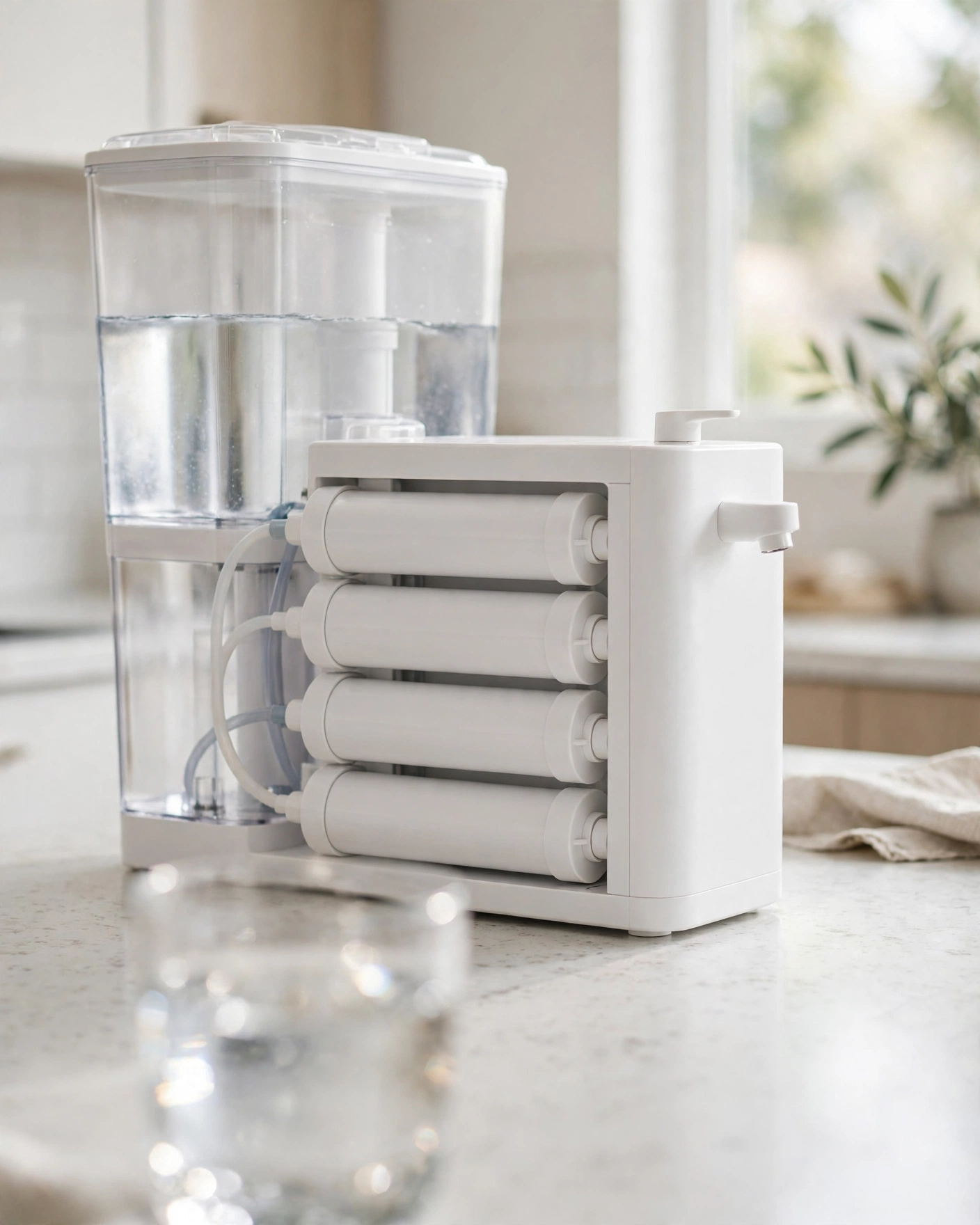
In practice it is a simple machine: a 4-stage Ultra RO system (pre/carbon, RO membrane, VOC carbon), a refillable tap-water tank, and a 0.75-gallon clean-water tank with push-button dispensing. You plug it in and fill the tank — no plumbing, no drilling, ready in minutes. The brand advertises a 4:1 pure-to-waste ratio, which independent reviewers have echoed as among the best efficiency figures in the category. Filters are rated at roughly 6 months for the pre/carbon stages and about 2 years for the RO/VOC stages, which is why the yearly cost stays reasonable despite the premium price.
The honest trade-offs: the reservoirs are BPA-free Tritan plastic, so your water does sit in plastic — buyers who care about that should know. The clean tank holds only 0.75 gallon, and it is slow at roughly 12–15 minutes per gallon, so a large family may want it as a complement rather than the only filter. And the water comes out flat and slightly acidic (RO strips minerals) — remineralization drops are the usual fix, and they are a taste preference, not a health requirement. Our full AquaTru review goes deeper on the Classic and its Carafe sibling.
~$449–475 estimated; price changes often — see the live price before you buy.
Best budget: Waterdrop K19-SFK
If your tap water is ordinary city water and your main goals are better taste, lower TDS, and the lowest possible running cost, the Waterdrop K19-SFK is the value pick. It typically sells for around $320–380, and independent reviewers report it costs about $79 a year in replacement filters — the cheapest to run of any system we compared.

It runs a 3:1 pure-to-drain ratio and is compact enough for small kitchens and apartments. One independent reviewer lists it as IAPMO-certified to NSF/ANSI 58 for TDS reduction — we could not confirm that listing in a public certifier database at the time of writing, so treat the certification as reported-but-unverified and check the IAPMO directory before you buy. That is precisely the trade-off of this pick: you are buying low cost and convenience, not the certified lead-and-PFAS coverage of the AquaTru.
~$320–380 estimated; price changes often — see the live price before you buy.
Best efficiency: SimPure Y7P (UV)
The SimPure Y7P is the pick for anyone bothered by water waste. The manufacturer states a 4:1 pure-to-waste ratio — four gallons of purified water for every gallon sent to drain — which is the highest stated efficiency among the systems we compared, matched only by the AquaTru’s advertised 4:1. It also adds a UV purification stage, which the other picks here do not have.

On certifications, be careful with the wording: SimPure’s product page claims NSF/ANSI 58 compliance for the Y7P, but we could not independently confirm an active listing in a public certifier database — the same honest caveat our dedicated SimPure Y7P review carries. Treat the NSF 58 claim as manufacturer-stated and verify it at info.nsf.org before you buy. What is concrete: the unit is widely sold, has been on the market for years with a large owner base, and owner reviews consistently praise the fast dispensing and the twist-in filter changes. The limitation is temperature — it dispenses room-temperature water only, with no hot or chilled option.
~$330–400 estimated; price changes often — see the live price before you buy.
Best hot and cold: Melissani M1
Some buyers want more than filtered water — they want instant hot water for tea and coffee without a kettle. The Melissani M1 is a countertop RO with near-instant hot and cold dispensing (the brand advertises hot water in about 3 seconds), which makes it the pick if your countertop appliance should replace two devices at once.

It typically sells for around $300–400, putting it in the mid-range of this roundup. We found no independent certification listing for the M1 in a public database — so buy it for the hot/cold convenience and the RO filtration, not for certified contaminant claims. Owner feedback centers on the convenience factor: one button for hot, one for cold, no kettle to refill. The trade-off is complexity — more features means more that can eventually need service — and a larger countertop footprint than the simple tank-style units.
~$300–400 estimated; price changes often — see the live price before you buy.
Best chilled water: NOVETE countertop RO
If your household drinks cold water all day, the NOVETE countertop RO with cooling is the purpose-built pick — it chills filtered water down toward 32°F on demand, so you never open the fridge for a cold glass. It typically sells for around $400–500, the upper-middle of this roundup.

Like the Melissani, this is a convenience-first pick: we found no public-database certification listing, so the value proposition is RO-filtered water served cold, not certified lead or PFAS reduction. Cooling also means the unit draws more power and needs ventilation space around it — check the clearance requirements in the manual before squeezing it under a cabinet. For renters who want cold filtered water without a fridge dispenser or a plumbed line, it fills a genuine gap.
~$400–500 estimated; price changes often — see the live price before you buy.
Best glass carafe: Bluevua RO100ROPOT-Lite (UV)
The Bluevua RO100ROPOT-Lite is the pick if you dislike the idea of your purified water sitting in a plastic tank. It filters into a removable glass carafe that fits in the fridge door — the most “pitcher-like” experience in this roundup, aimed at one- or two-person households.

It typically sells for around $369, runs a 3:1 pure-to-drain ratio, and includes a UV stage. On certification: a published brand comparison cites third-party certification documentation listing the ROPOT-Lite to NSF/ANSI 58 for TDS, lead, and chromium — we could not independently confirm that listing in a public database, so verify at the WQA or NSF directory before relying on it. The carafe format is the real selling point here, plus the smallest countertop footprint of the six. The trade-off is capacity — a carafe suits light use, not a family refilling bottles all day — and the full-size RO100ROPOT (around $410) is the step up if you want more volume.
~$369 estimated; price changes often — see the live price before you buy.
Countertop RO systems compared

| System | Typical price | Certification status | Pure-to-drain | Best for |
|---|---|---|---|---|
| AquaTru Classic | ~$449–475 | IAPMO: NSF/ANSI 42, 53, 58, 401 (brand-documented) | 4:1 (advertised) | Certified lead + PFAS reduction |
| Waterdrop K19-SFK | ~$320–380 | NSF/ANSI 58 reported, unverified at database | 3:1 | Lowest running cost |
| SimPure Y7P | ~$330–400 | NSF/ANSI 58 manufacturer-stated, unverified at database | 4:1 (stated) | Least water waste + UV |
| Melissani M1 | ~$300–400 | No public-database listing found | Not published | Hot and cold on demand |
| NOVETE (cooling) | ~$400–500 | No public-database listing found | Not published | Chilled water on demand |
| Bluevua RO100ROPOT-Lite | ~$369 | NSF/ANSI 58 reported (TDS, lead, chromium), unverified at database | 3:1 | Glass carafe, small households |
| AquaTru Carafe (alternative) | ~$349–375 | IAPMO: NSF/ANSI 42, 53, 58, 401 (brand-documented) | 4:1 (measured by one lab) | Certified filtration, compact + carafe |
Certification status reflects what we could trace to brand documentation or third-party reviews at the time of writing. “Unverified at database” means we could not confirm an active listing in the public NSF, IAPMO, or WQA directory — check before you buy, because listings change.
Buying guide: what to check before you buy
Truly no installation?
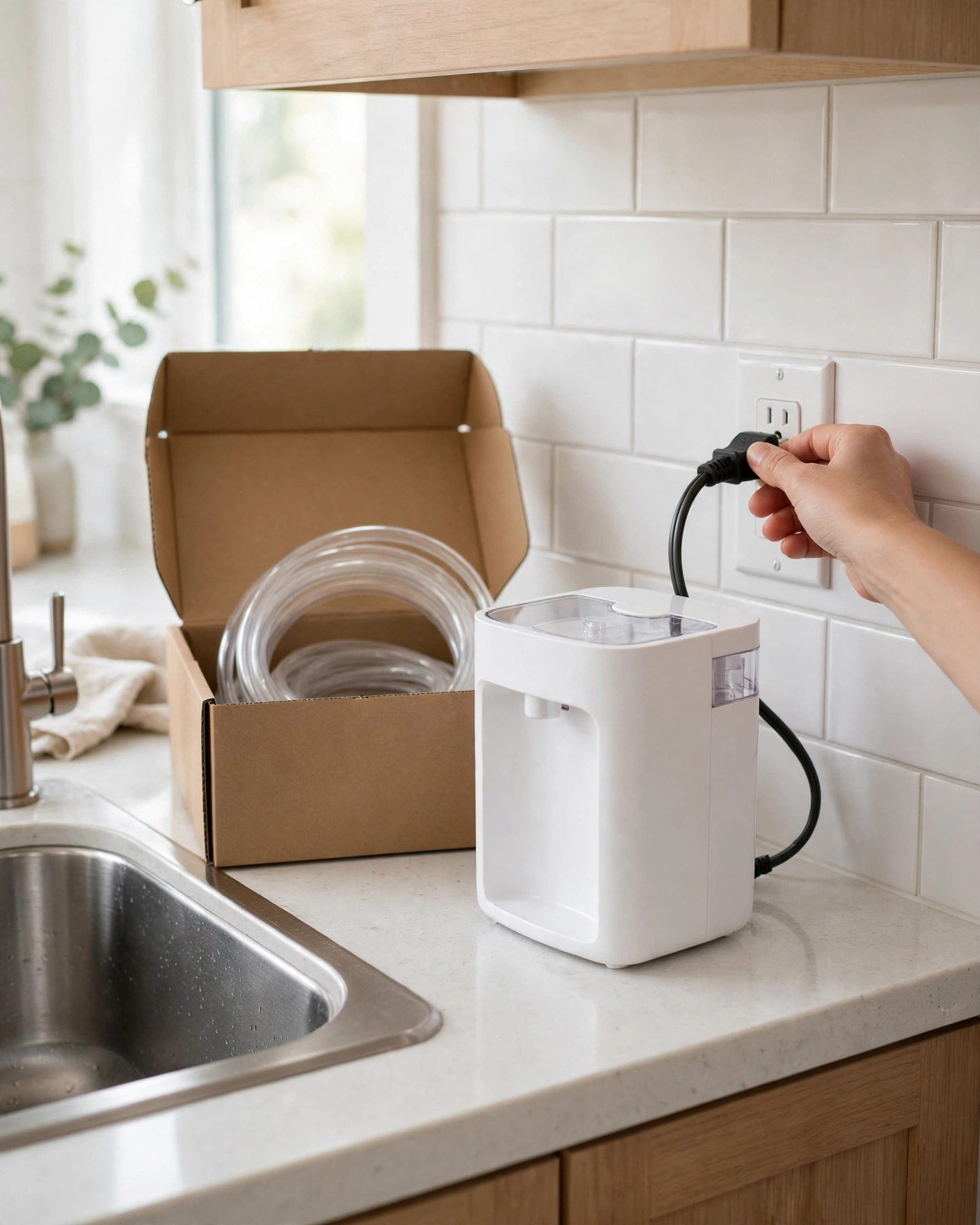
Yes — that is the whole category’s promise, and it holds up. Every system here plugs into a standard outlet and works from a refillable tap-water tank. There is no feed-water adapter, no drain saddle, no dedicated faucet. If you want the full no-plumbing shortlist beyond RO, see our no-installation countertop filter guide — and if you need something you can carry between homes, our portable RO roundup covers the travel-friendly end of the spectrum.
How much water gets wasted
RO membranes reject a concentrated stream — “waste” water is inherent to the technology. What has changed is the ratio: modern countertop units advertise 3:1 or 4:1 pure-to-drain, versus 1:3 or worse on old under-sink systems. Treat advertised ratios as best-case lab numbers. Real-world efficiency drops with high-TDS tap water and cold feed water, and owners routinely report more drain water than the brochure suggests. As a rule of thumb from owner consensus, a membrane’s rated daily output is optimistic — one widely repeated estimate puts a 100 GPD-rated membrane at roughly ~45 GPD in real homes — so buy more capacity than you think you need.
Certifications: read the fine print
This is where most buyers get misled. “Tested to NSF standards” is not the same as “certified by NSF/IAPMO/WQA” — the first can mean a lab ran the protocol once, the second means an ongoing certification listing you can look up. Before you trust a contaminant claim (lead, PFAS, fluoride), search the model in the public database at info.nsf.org or the IAPMO directory. Announcements are not listings: one large pitcher brand (PUR) announced an IAPMO re-certification in September 2026 covering lead, microplastics, and total PFAS, but the claim currently rests on a single blog source — treat it as an announcement until it appears in the certifier’s database. The same discipline applies to every brand on this page.
Speed and capacity
Countertop RO is slow — expect roughly 12–15 minutes per gallon on tank-style units. A 0.75-gallon clean tank (AquaTru Classic) suits drinking and cooking for one or two people; a family constantly refilling bottles will find themselves waiting. Hot/cold units (Melissani, NOVETE) dispense on demand but still filter slowly into their internal tanks. Match the tank size to your household, not your aspirations.
Renters and apartments
Countertop RO is the renter’s RO: nothing is attached to the plumbing, nothing is drilled, and the whole unit moves with you. If renting shapes your whole shortlist, our renter-specific countertop picks and our apartment RO guide go deeper on space, noise, and move-day practicalities.
Replacement filter cost math
The sticker price lies. A $350 system with expensive filters costs more over three years than a $475 system with cheap ones. Here is the honest math from published filter life and current filter prices — all figures are estimates to re-check at publish time:

| System | Filter life (published) | Est. filter cost / year | Est. 3-year total |
|---|---|---|---|
| AquaTru Classic | Pre/carbon ~6 mo; RO/VOC ~2 yr | ~$100–130 | ~$790–865 |
| Waterdrop K19-SFK | ~6–12 mo per set | ~$79 | ~$587–617 |
| SimPure Y7P | ~6–12 mo | ~$100–140 | ~$660–820 |
| Melissani M1 | ~6–12 mo | ~$100 (est.) | ~$600–700 |
| NOVETE (cooling) | ~6–12 mo | ~$110 (est.) | ~$730–830 |
| Bluevua RO100ROPOT-Lite | ~6–12 mo | ~$90 (est.) | ~$639 |
Two patterns stand out. First, the Waterdrop K19-SFK wins the 3-year math by a wide margin — the “budget” pick stays the budget pick. Second, the AquaTru Classic’s premium is real but not outrageous: you pay roughly $200–250 more over three years for the certified contaminant coverage. Whether that premium is worth it depends entirely on whether you need certified lead and PFAS reduction or just better-tasting water.
FAQs
Do countertop RO systems need any installation?
No plumbing, no drilling, and no dedicated faucet. A countertop RO plugs into a standard outlet, you fill its tap-water tank, and it dispenses purified water into a clean-water tank or carafe. Setup genuinely takes minutes. The only requirements are counter space and a power outlet — which is why they are popular with renters.
How much water does a countertop RO waste?
Every RO system rejects some water — that is how the membrane works. Modern countertop units advertise pure-to-drain ratios from 3:1 to 4:1, meaning 3–4 gallons of purified water per gallon discarded. Treat advertised ratios as best-case: real-world efficiency depends on your tap water’s TDS and temperature, and owners often report more waste than the brochure number.
Is the AquaTru Classic worth the money?
If certified contaminant reduction is what you are paying for, yes. It is the only countertop pick here with IAPMO certification to four NSF/ANSI standards (42, 53, 58, 401) per the brand’s published documentation, covering lead, fluoride, PFOA/PFOS, and microplastics under stated test conditions. If you only want better-tasting city water, the cheaper Waterdrop K19-SFK does that for less.
Do countertop RO systems remove PFAS?
A system certified to NSF/ANSI 53 or 401 for PFOA/PFOS — like the AquaTru Classic per its IAPMO documentation — is certified to reduce those specific PFAS compounds under test conditions. A system with no PFAS certification should not be assumed to handle PFAS, even though it uses an RO membrane. Check the certification list, not just the technology name.
Does reverse osmosis remove fluoride?
Yes — RO membranes reduce fluoride, and the AquaTru Classic’s performance data sheet documents fluoride reduction under NSF/ANSI 58 test conditions. But fluoride reduction is a certified claim on some systems and an uncertified assumption on others. If fluoride is your reason for buying, pick a system whose documentation actually lists it.
How often do countertop RO filters need replacing?
It depends on the stage. Pre-filters and carbon stages typically last about 6 months; RO membranes and final carbon stages often last 1–2 years. Most units have filter-change indicator lights — follow them rather than the calendar, because heavy sediment or high TDS wears filters out faster.
Does RO water need to be remineralized?
Not for safety — it is a taste preference. RO strips dissolved minerals, so the water tastes flat and measures slightly acidic. Some people add mineral drops or choose a unit with an alkaline stage because they prefer the taste. No credible source we found treats remineralization as a health requirement for otherwise safe tap water.
Can I use a countertop RO in a rental apartment?
Yes — that is one of their main selling points. No plumbing changes, no drilled holes, and no landlord permission needed: fill the tank, plug it in, and take it with you when you move.
Conclusion
Countertop RO finally gives renters and drilling-averse homeowners the real thing: membrane-level filtration with no plumber involved. Buy the AquaTru Classic if certified contaminant reduction — lead, fluoride, PFAS — is the reason you are shopping; no other countertop unit backs its claims with this much third-party certification. Buy the Waterdrop K19-SFK if you want the lowest running cost for everyday city water. Pick the SimPure Y7P for the least water waste, the Melissani M1 for instant hot water, the NOVETE for chilled water, or the Bluevua RO100ROPOT-Lite for a glass carafe. Know which buyer you are, run the 3-year filter math, and verify the certification listing before you click buy.
Price checked at time of writing; it changes often — see the live price before you buy.
Update log
- Zulqarnain: Review published.