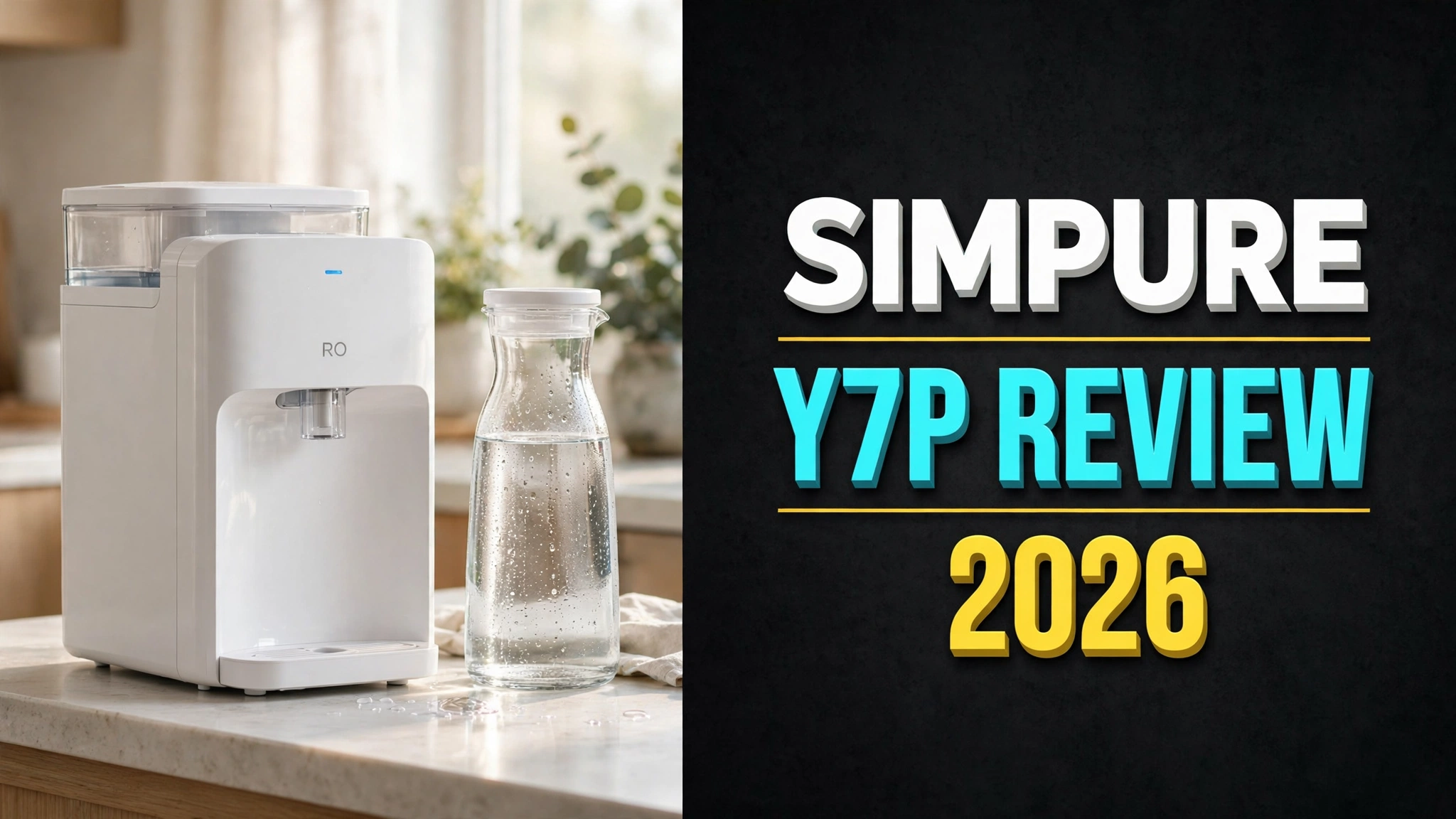

SimPure Y7P Review (2026): Is It Worth It?
★ TOP COUNTERTOP ROYou want real reverse-osmosis water — the kind that takes out lead, fluoride, and PFAS — but you are not about to drill a hole in your sink cabinet, hire a plumber, or lose your rental deposit. A pitcher filter only fixes taste. An under-sink system fixes everything but demands installation. There has to be something in between, and that gap is exactly what the SimPure Y7P (sold as the Y7P-BW and Y7P-W — same machine) is built for: a plug-in countertop RO system with a UV stage and no installation at all.
Here is the short answer: the Y7P does what it promises — pour tap water in the back tank, get RO-filtered water from the spout, with a genuinely efficient 4:1 pure-to-drain ratio and brand-stated filter costs of about $100 a year. SimPure states it is tested against NSF/ANSI 58, though we could not independently confirm an active NSF listing, so check that yourself at info.nsf.org before relying on it. The honest caveats: room-temperature water only, a feed tank that needs refilling in a busy household, and a real chunk of counter space.
Our scores
Table of Contents
Quick verdict
The bottom line: the SimPure Y7P is the right buy if you want RO-level filtration without any installation — renters, apartment dwellers, and anyone who refuses to modify their plumbing. The 4:1 pure-to-drain ratio is genuinely best-in-class for countertop RO, and filter costs are reasonable at about $100 a year (brand-stated). It is not the right buy if you need hot or cold water on demand, have a big family that would drain the small feed tank constantly, or need a verified NSF listing you can point to — because SimPure’s certification claim deserves your own verification before you buy.
Verdict: the best no-install route to RO water, with honest asterisks.
Price checked at time of writing; it changes often — see the live price before you buy.

Why you should trust this review
We did not receive a test unit and we did not run a lab bench test. Claiming hands-on testing we never did would be dishonest, so we will not do it.
What we did instead was research and comparison: we pulled SimPure’s official spec page for the Y7P, read the certification wording on the product listings carefully (including what “tested by SGS against NSF/ANSI 58” actually means), gathered recurring owner complaints from retail reviews spanning months, and ran the filter-cost math from the manufacturer’s stated filter life and replacement prices. Where we could not verify a claim — most importantly the NSF certification listing — we say so plainly instead of repeating it as fact.
How we researched
- Pulled the official spec sheet — dimensions, flow rate, filter life, warranty, and the stated “NSF/ANSI 58” certification from SimPure’s own product page for the Y7P.
- Read the certification fine print — what the listings mean by “tested and certified by SGS against NSF/ANSI 58 and EPA 537,” and what an NSF database listing would actually prove. A contaminant claim that does not appear in a certification database does not appear on this page as a fact.
- Read hundreds of owner reviews — across major retail listings, looking for recurring complaints (the same problem mentioned by many owners over many months), not one-off bad experiences.
- Calculated the yearly filter-cost math — from the manufacturer’s stated 6-month filter life and its stated average annual filter cost of $99.99.
Pros and cons
Pros
- Zero installation — plug it in, pour water in the back tank, done. Renters and offices can use it anywhere with a power outlet.
- 4:1 pure-to-drain ratio — the best water efficiency we found in the countertop RO category; most under-sink RO systems waste far more water per glass.
- UV purification stage — a chemical-free extra layer for microorganisms, on top of the 5-stage RO filtration.
- Reasonable running costs — the brand states an average annual filter cost of about $100, with both filters on a 6-month replacement cycle.
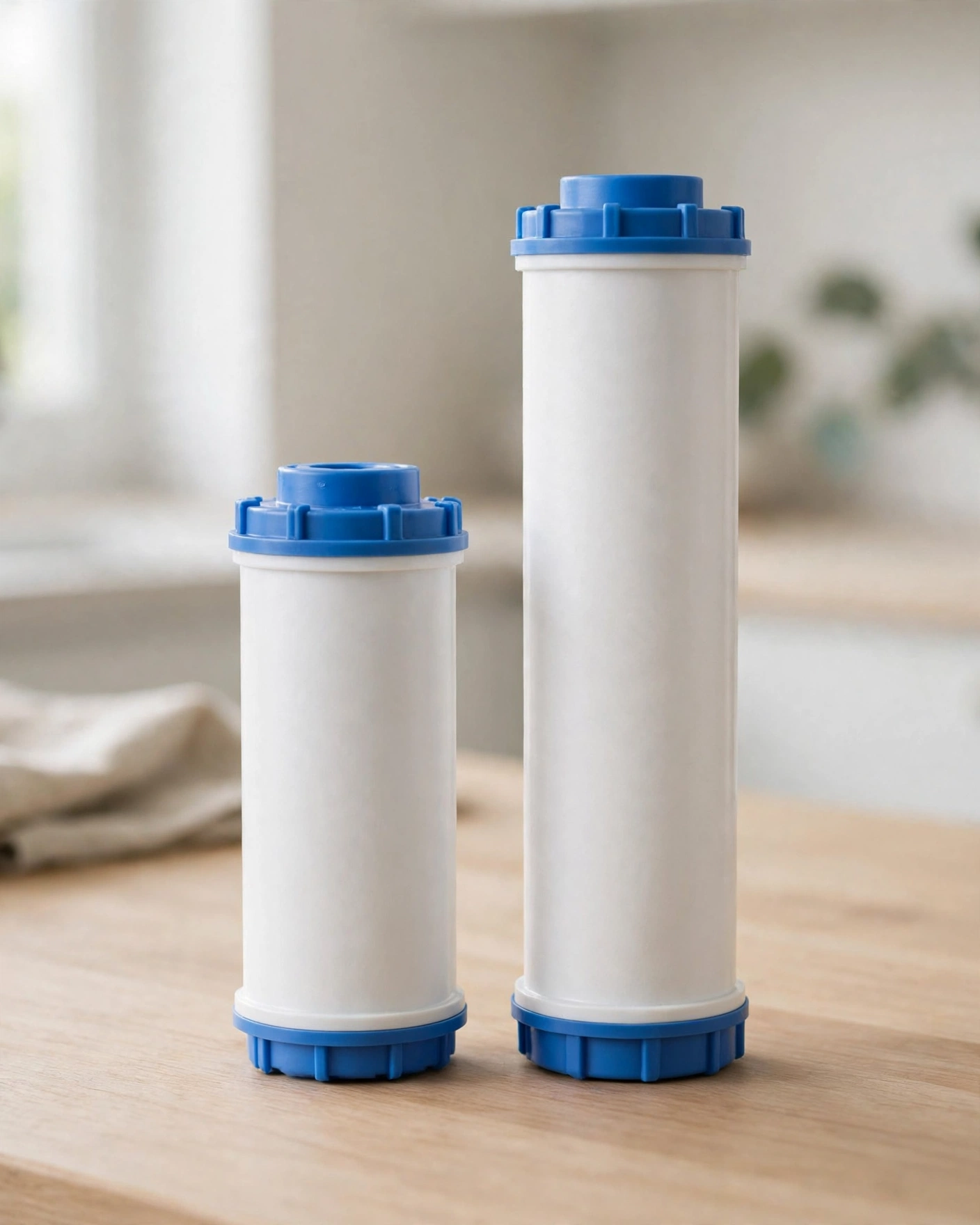
- Twist-and-lock filter changes — no tools, no plumber: open the back cover, twist the old cartridge out, twist the new one in.
Cons
- Room-temperature water only — no hot or cold dispensing. If you want instant cold or boiling water, this is the wrong unit.
- Small feed tank for families — the 1.3-gallon back tank means frequent refills in a household of four or five.
- Certification needs your own verification — SimPure states SGS testing against NSF/ANSI 58, but we could not independently confirm an active NSF listing. Check info.nsf.org before you rely on it.
- Eats counter space — about 18 inches wide and 16 inches tall, and the lid needs roughly 22 inches of vertical clearance to open fully. Measure before you buy.
- Needs a power outlet nearby — it is electric (110V), so “anywhere” really means anywhere within cord reach of an outlet.
Certifications (database-checked)
This is the section where we owe you more honesty than the product listings do. SimPure’s marketing states the Y7P is “tested and certified by SGS against NSF/ANSI 58 and EPA 537.” Let us unpack what that wording actually means, because the words matter:
| Claim as stated | What it really means | Our status |
|---|---|---|
| “Tested and certified by SGS against NSF/ANSI 58” | SGS is a private testing lab, not NSF International. “Against NSF/ANSI 58” means tested to that standard’s requirements — it is not the same as an NSF certification listing, which is the independently verifiable gold standard. | Brand-stated; could not confirm an active listing at info.nsf.org — verify yourself |
| “EPA 537” | EPA 537 is a laboratory test method for measuring PFAS in water — it is a test method, not a certification. A product cannot be “certified to EPA 537.” | Brand wording; do not read it as a PFAS certification |
| “Removes 99.99% of 1,000+ contaminants including PFAS, lead, arsenic” | This is marketing copy from the product listing, not a certified reduction list. NSF/ANSI 58 certification would list specific contaminants under specific test conditions. | Brand claim — not published as fact on this page |
For context: NSF/ANSI 58 is the standard for reverse-osmosis drinking-water systems, and it supports certified reduction claims for things like lead, fluoride, TDS, and nitrate/nitrite — the usual reasons people buy RO. But a standard existing is not the same as this product holding a certification under it. Before you spend $300-plus on the strength of a certification claim, look the Y7P up at info.nsf.org yourself. If it is listed, buy with confidence. If it is not, buy it for what it provably is — a well-reviewed no-install RO unit — not for the claim.
Certification covers only the contaminants in the database entry, and only under NSF’s test conditions. Never take “tested against a standard” at face value when the product page does not link to a live listing.
Design and usability
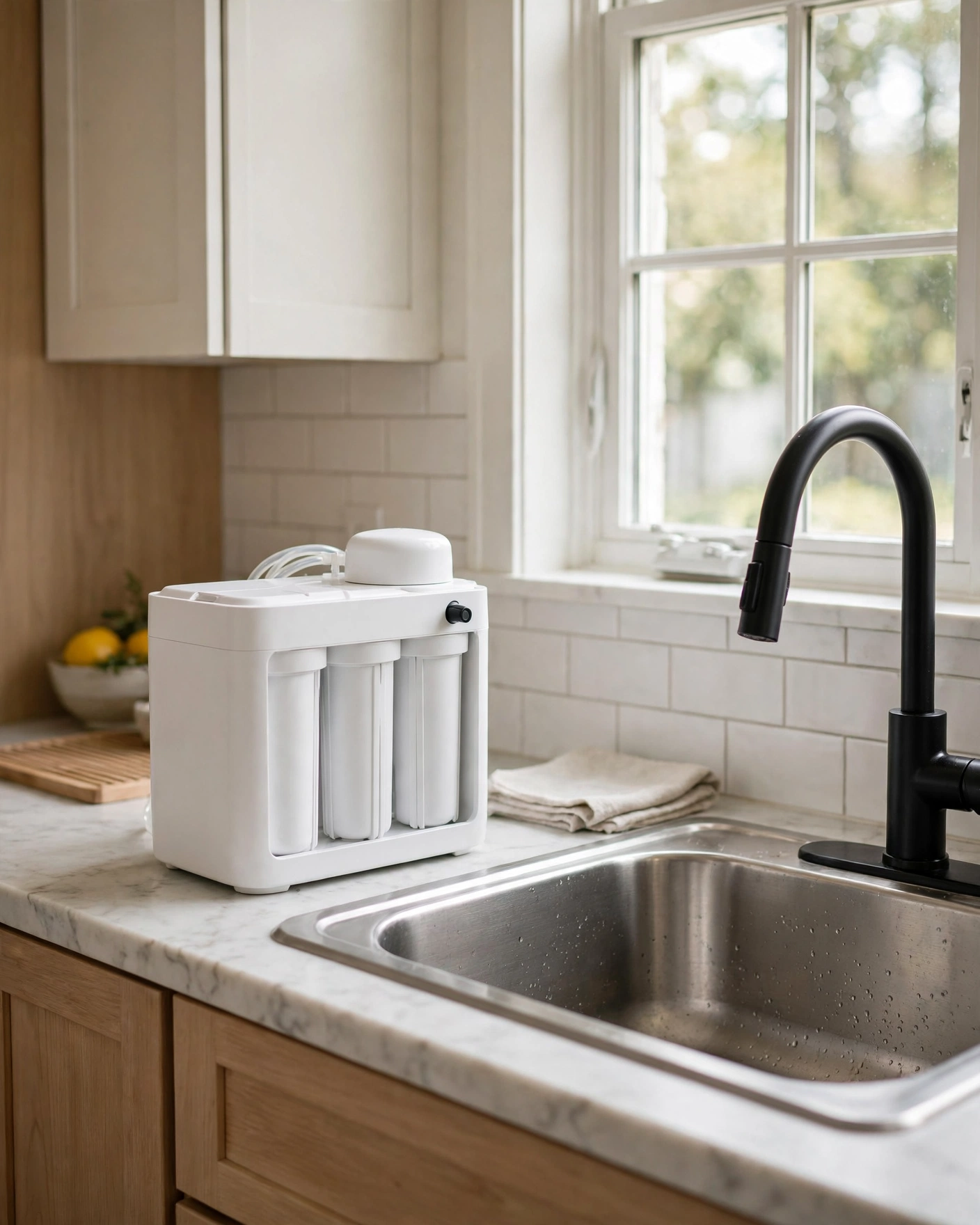
The Y7P is a self-contained countertop appliance, roughly the footprint of a large coffee maker: about 18 inches wide, 8 inches deep, and 16 inches tall with the lid closed — but the lid needs around 22 inches of vertical clearance to open for refilling, so measure under-cabinet space before you buy. The 1.3-gallon feed tank sits at the back; you pour tap water in, the unit filters it automatically into a 0.45-gallon internal pure-water tank, and you dispense at the spout with a button press.

Daily use is genuinely simple, which is the whole point of the category: fill, press, pour. Owners consistently praise the setup — out of the box and running in minutes — and the twist-and-lock filters that need no tools. The trade-offs are the small feed tank (a busy family will refill it often) and the room-temperature-only output. At 14.8 pounds it is portable enough to move between kitchen and office. If countertop RO in general is new to you, our AquaTru review covers the category’s premium end for comparison.
Filter cost math
The sticker price is the least important number on this page. What matters is the yearly cost of running the thing, because RO filters are a subscription you pay in cartridges. SimPure publishes the numbers here, so the math is straightforward:
| Item | Figure | Source |
|---|---|---|
| Unit (upfront) | ~$330–400 (estimate) | Street pricing |
| CF filter life | 6 months | SimPure official spec page |
| RO filter life | 6 months | SimPure official spec page |
| Average annual filter cost | $99.99 (brand-stated) | SimPure official spec page |
| Capacity per filter set | 528 gallons (brand-stated) | Product listings |
| Warranty | 1 year + 1 extra (brand-stated) | SimPure official spec page |
Two things stand out. First, about $100 a year in filters is genuinely reasonable for an RO system — under-sink systems often cost more per year in cartridges. Second, at roughly 528 gallons per filter set, heavy users who would otherwise buy 5-gallon refill jugs at around $2.50 each break even on the unit in well under two years. The honest caveat: treat the $99.99 as SimPure’s number, not a locked-in promise, and re-check replacement cartridge prices before you buy.
What owners complain about
Frequent refilling. The number-one recurring complaint: the 1.3-gallon feed tank is small for a family. Owners in households of four or five say they refill it multiple times a day. Solo users and couples barely notice.
Noise after refilling. Several owners report the unit humming or gurgling audibly while it processes a fresh tank of water. Not a deal-breaker for most, but noticeable in a quiet kitchen.
Feed tank is awkward to clean. The back tank’s corners collect sediment and scale, and reaching into them is a recurring gripe. Regular rinsing keeps it manageable, but it is the least-loved maintenance chore.
Dispenser hiccups. A smaller thread of owners reports the pure-water indicator flashing or the unit refusing to dispense until the tank is reseated. It usually resolves, but it is the kind of electronic quirk that shows up in reviews of every dispenser-style unit.
Counter footprint. It is bigger in person than in product photos, and the 22-inch lid-clearance requirement surprises buyers with low cabinets. Measure first — this complaint is entirely preventable.
Post-replacement flushing is tedious. After swapping filters, the flush cycle to rinse new cartridges is described as annoying — expected and documented, but nobody enjoys it.
None of these are hidden gotchas, and the long-term reviews describe reliable units that never leaked. But they are the real-world friction points, and you are better off knowing them now.
SimPure Y7P vs rivals
The countertop RO shelf is crowded, and most Y7P shoppers also look at these three. Here is how the Y7P positions against them — with links to our full reviews so you can dig deeper:
| SimPure Y7P | AquaTru Carafe | Waterdrop K19 | Waterdrop A1 | |
|---|---|---|---|---|
| Format | Plug-in countertop dispenser | Carafe-style countertop RO | Countertop RO dispenser | Countertop RO dispenser |
| Typical unit price | ~$330–400 (estimate) | See our full review | See our full review | See our full review |
| UV stage | Yes | No | Model-dependent | Model-dependent |
| Pure-to-drain ratio | 4:1 (brand-stated) | See our full review | See our full review | See our full review |
| Hot/cold dispensing | No (room temp only) | No | See our full review | Yes — hot and cold options |
| Standout trait | Best water efficiency; no install | Carafe portability | Countertop RO alternative | Instant hot/cold water |
The pattern: if your priority is no-install RO with the least wasted water, the Y7P’s 4:1 ratio is its strongest card — none of the rivals lead with efficiency the way SimPure does. If you want hot and cold water on demand, the Waterdrop A1 review is the one to read. If portability matters more, the carafe format in our AquaTru Carafe review is worth a look, and the Waterdrop K19 review covers the closest like-for-like countertop RO alternative.
Who should buy it
Buy it if
- You rent or cannot modify plumbing — this is the core case for the Y7P: real RO filtration with zero installation.
- You hate wasting water — the 4:1 pure-to-drain ratio is the best efficiency figure we found in countertop RO.
- You want low running costs — about $100 a year in filters (brand-stated) is cheap for an RO system.
- You are fine with room-temperature water and refilling a tank a few times a day.
Skip it if
- You want hot or cold water on demand — look at hot/cold countertop dispensers instead.
- You have a large family — constant refilling of a 1.3-gallon tank will annoy you within a week.
- You need a verified NSF listing you can point to — verify SimPure’s claim at info.nsf.org first, or choose a unit with a published listing, like the models in our AquaTru Classic review.
- You have tiny counters or low cabinets — measure the 22-inch lid clearance before anything else.
The specs
- Brand
- SimPure
- Model
- Y7P / Y7P-BW / Y7P-W (same machine)
- Type
- Countertop RO, no installation
- Filtration stages
- 5-stage RO + UV
- Pure-to-drain ratio
- 4:1 (brand-stated)
- Dimensions
- 18 × 8 × 16.1 in (lid open: ~21.3 in)
- Weight
- 14.8 lbs
- Feed tank
- 1.3 gallons
- Internal pure-water tank
- 0.45 gallons
- Filter life
- CF: 6 months / RO: 6 months
- Feed water TDS limit
- <500 ppm
- Water temperature
- Room temperature only
- Power
- 110V corded electric
- Certifications
- NSF/ANSI 58 — brand-stated, verify at info.nsf.org
- Warranty
- 1 + 1 years (brand-stated)
- Typical price
- ~$330–400 (estimate)
FAQs
Is the SimPure Y7P NSF certified?
SimPure states the Y7P is tested and certified by SGS against NSF/ANSI 58 — but SGS is a private testing lab, not NSF International, and “tested against” is not the same as holding an NSF certification listing. We could not independently confirm an active listing for the Y7P at info.nsf.org. Before you rely on the certification claim, look the model up in the NSF public database yourself — it takes two minutes.
Does the SimPure Y7P remove PFAS and lead?
SimPure’s marketing claims the Y7P removes PFAS (including PFOA/PFOS) and heavy metals like lead and arsenic — but these are brand-stated marketing claims, not certified reduction claims we could verify in a certification database. Reverse-osmosis membranes as a technology are well suited to reducing these contaminants, but do not take the brand’s percentage claims as certified fact.
Does the SimPure Y7P require installation?
No. The Y7P is a countertop unit that needs no plumbing and no installation — you plug it into a 110V outlet, pour tap water into the 1.3-gallon feed tank at the back, and dispense filtered water from the front spout. That is the entire setup, and it is why renters and offices are the core audience.
How long do the Y7P filters last, and what do replacements cost?
Both the CF composite filter and the RO membrane are rated for 6 months each, and the cartridges twist out with no tools. SimPure states an average annual filter cost of $99.99 — reasonable for an RO system. Filter prices move over time, so re-check the current cartridge prices before you buy.
What is the difference between the Y7P, Y7P-BW, and Y7P-W?
They are the same machine. Y7P is the series name; Y7P-BW and Y7P-W are variant labels used on different retail listings. The specs, filters, and 4:1 pure-to-drain ratio are identical across the labels, so buy whichever listing has the better price.
Does the SimPure Y7P dispense hot or cold water?
No — the Y7P dispenses room-temperature water only. If you want instant hot or cold water from a countertop unit, you need a different model; our Waterdrop A1 review covers a countertop RO dispenser with hot and cold options.
Conclusion
The SimPure Y7P earns its place as the top countertop RO for one specific buyer: the person who wants genuine reverse-osmosis filtration with zero installation, the least wasted water in the category, and reasonable running costs. Its 4:1 pure-to-drain ratio and about-$100-a-year filters (brand-stated) are real, defensible advantages. The asterisks are equally real: room-temperature water only, a small feed tank that keeps families busy refilling, and a certification claim you should verify yourself at info.nsf.org before you buy on its strength. Know which buyer you are, and the choice makes itself.
Price checked at time of writing; it changes often — see the live price before you buy.
Update log
- Zulqarnain: Review published.