
Aquasana Healthshield Review (2026): Is It Worth It?
★ WHOLE-HOUSE PICKPFAS — the “forever chemicals” — are turning up in tap water, and you want a whole-house filter that protects every tap, not just the kitchen sink. The problem: most whole-house systems are really chlorine-and-sediment machines. Their certifications stop at taste and odor, and the moment you ask about PFAS or VOCs, the claims turn vague.
Aquasana launched the HealthShield in August 2026 as its answer to exactly that gap. According to the company’s launch materials, it is the first whole-house system certified to reduce PFAS and volatile organic compounds from every tap: WQA tested and certified to NSF/ANSI Standards 53 and 401. The short answer: the certifications are real — 61 contaminants including PFAS, VOCs, BPA, and ibuprofen. But the system is expensive, it needs a power outlet, the flow rate is modest, and the tank itself is a consumable you replace roughly every two years. This review covers what the HealthShield is certified to do, what it costs to own, and what buyers should know first.
Our scores
Table of Contents
Quick verdict
The bottom line: the Aquasana HealthShield is the right buy if PFAS and VOCs are your main concern — it is the only whole-house system we found WQA-certified (NSF/ANSI 53 and 401) to reduce them at every tap. It is not the right buy if your problem is hard water, high flow demand, or budget: it does not soften water, it runs 5.7 GPM versus 14 GPM on Aquasana’s own Rhino Max Flow, and the tank itself is replaced roughly every two years.
Verdict: the strongest-certified whole-house system for PFAS-conscious households — with a premium price and a 2-year tank cycle that deserves honest math.
Price checked at time of writing; it changes often — see the live price before you buy.
Why you should trust this review
We did not receive a test unit and we did not run a lab bench test. Claiming hands-on testing we never did would be dishonest, so we will not do it.
What we did instead was research and comparison: we pulled Aquasana’s spec sheets, product FAQ, and launch materials; we checked every certification statement against the company’s WQA certification claims; and we ran the ownership-cost math from real system and filter prices. One caveat up front: the HealthShield launched in August 2026, so there is no long-term owner track record yet — where data doesn’t exist, we say so instead of filling the gap with optimism.
How we researched
- Compared specs across 4 whole-house systems — the HealthShield against the Aquasana Rhino WH-1000, the Rhino Max Flow, and the budget PRO+AQUA Elite PRO-100-E GEN2.
- Checked certification claims line by line — separating WQA-certified reductions (NSF/ANSI 53 and 401: PFAS, VOCs, BPA, ibuprofen) from manufacturer-tested claims (chlorine, chloramines), and from the Rhino line’s different certifications (NSF/ANSI 42 and 61), which do not include PFAS.
- Read owner reviews of Aquasana’s whole-house line — looking for recurring complaints, not one-off bad experiences. With the HealthShield only a few months old, we drew on Rhino-line owner feedback for installation and maintenance patterns.
- Calculated ownership cost — from Aquasana’s stated launch pricing and listed replacement filter prices, with assumptions labeled throughout.
Pros and cons
Pros
- WQA certified for PFAS and VOCs — NSF/ANSI 53: 99.9% PFAS reduction to below 4 parts per trillion, 99.8% of VOCs; NSF/ANSI 401: 94.7% BPA and ibuprofen reduction, per Aquasana’s certification statements.
- Broadest certified coverage we compared — 61 contaminants including PFAS, VOCs, pharmaceuticals, chlorine, and chloramines in one tank, per the manufacturer.
- Works for city and well water — unlike the Rhino city-water line, the HealthShield is designed for both, with an optional UV add-on for well-water disinfection concerns.
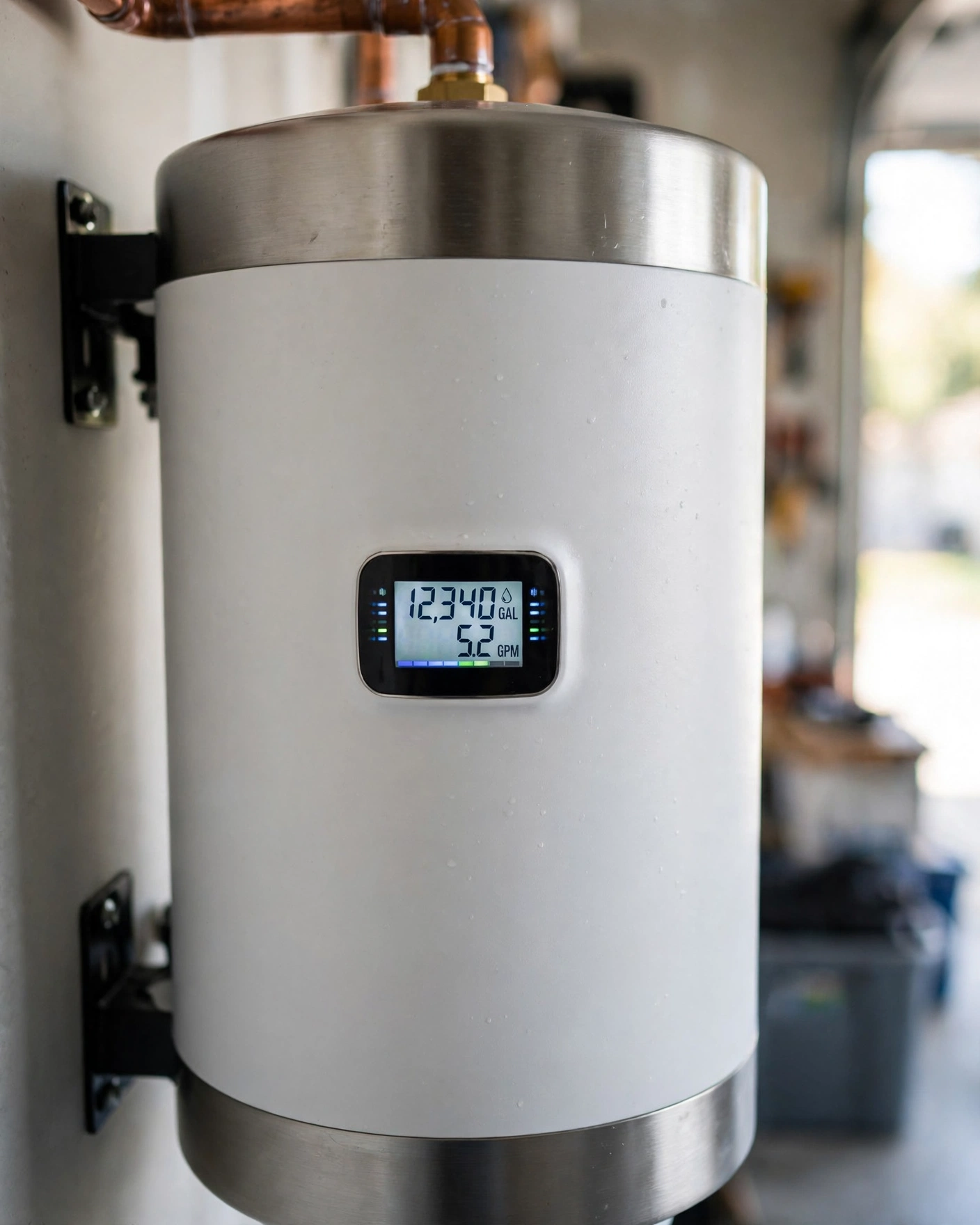
- Smart performance indicator — a color-coded display (green, yellow, red) shows remaining gallons and live flow rate, so you know exactly when the tank is due.
Cons
- Tank is a ~2-year consumable — the main tank itself is replaced every 165,000 gallons or ~2 years, unlike the Rhino’s 10-year media. The biggest long-term cost factor.
- Needs a power outlet — the performance indicator requires 120V within 10 feet of the unit, which can add electrical work to the install.
- Modest flow rate — 5.7 GPM, versus 14 GPM on the Rhino Max Flow, which matters in busy households running multiple showers.
- Premium price — launch pricing started at $2,099, rising to $5,796 with the Max Flow UV add-on, before installation labor.
Certifications (database-checked)
This section is why the HealthShield exists — so precision matters. Aquasana states the system is WQA tested and certified to NSF/ANSI Standards 53 and 401; the figures below are the company’s own published certification claims, not our lab results:
| Contaminant | Claimed certification | Source |
|---|---|---|
| PFAS (PFOA, PFOS, PFNA, PFHxS, PFHpA) | NSF/ANSI 53 — 99.9% reduction to below 4 ppt (WQA tested & certified) | Aquasana HealthShield product FAQ |
| VOCs | NSF/ANSI 53 — 99.8% reduction (WQA tested & certified) | Aquasana HealthShield product FAQ |
| BPA and ibuprofen | NSF/ANSI 401 — 94.7% reduction (certified) | Aquasana launch announcement (Aug 2026) |
| Chlorine | 97.4% over 165,000 gallons — manufacturer-tested, NOT certified | Aquasana HealthShield product FAQ |
| Chloramines | 97.49% — manufacturer-tested, NOT certified | Aquasana HealthShield product FAQ |
Two honest distinctions. First: WQA certified PFAS, VOCs (53) and BPA plus ibuprofen (401); chlorine and chloramines were only tested internally, not certified — a third-party seal is worth more than a manufacturer test. Second: don’t confuse the HealthShield with Aquasana’s Rhino line — the Rhino WH-1000 and Max Flow are WQA certified only to 42 and 61 (chlorine taste/odor, materials), which is why the Rhino is cheaper and longer-lived but not a PFAS system. Our Aquasana Rhino review covers it in full.
Transparency note: we verified these figures against Aquasana’s published WQA certification statements (product page, product FAQ, and the August 2026 launch announcement). The public WQA product directory is interactive and could not be pulled by text fetch, so we report the claims exactly as the manufacturer publishes them rather than claiming an independent database pull we did not do.
Design and usability
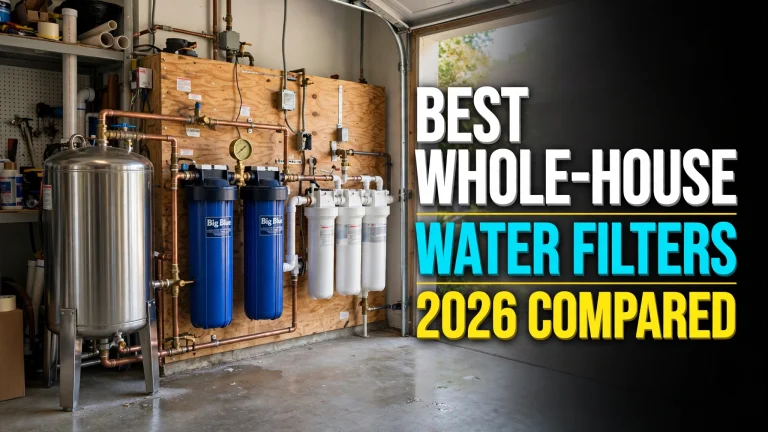
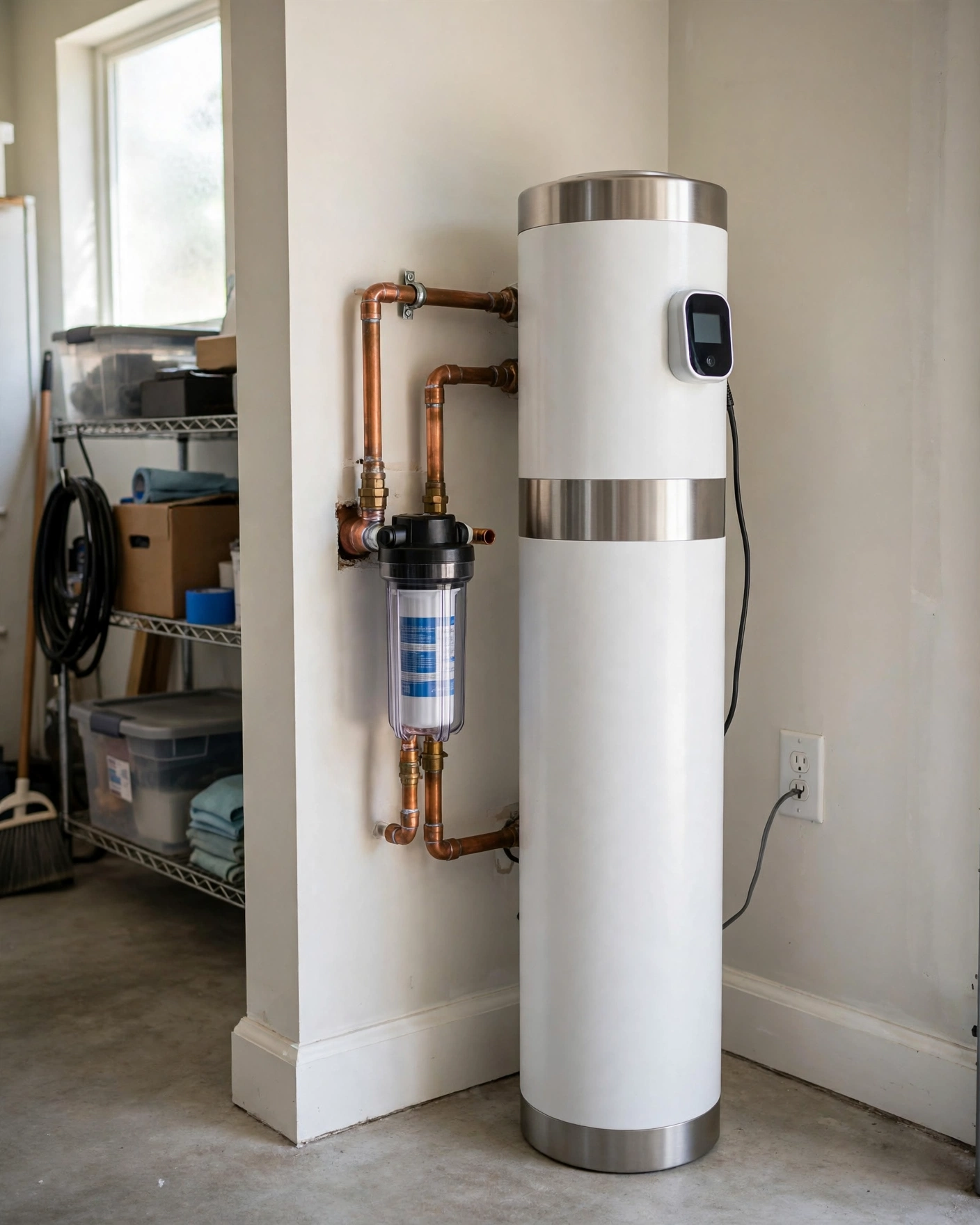
The HealthShield is a compact single-tank system — one main tank holding a three-layer media blend, flanked by a sediment pre-filter and a carbon post-filter. Per Aquasana, the first layer targets chlorine and chloramines, the second enhances PFAS reduction (including harder-to-reduce short-chain PFAS compounds), and the third handles VOCs, ibuprofen, BPA, and additional PFAS.
Usability centers on the performance indicator: a color-coded display shows green at 10–100% capacity, yellow at 0–10%, red when the tank is due — plus remaining gallons and live flow rate. No drain line is needed (non-backwashing, so it wastes no water). The trade-offs: it needs a 120V outlet within 10 feet (factor that into the install budget), and Aquasana strongly recommends a licensed plumber — some states and local codes require one. See also our SpringWell whole-house review for how these installs typically go.
Filter cost math
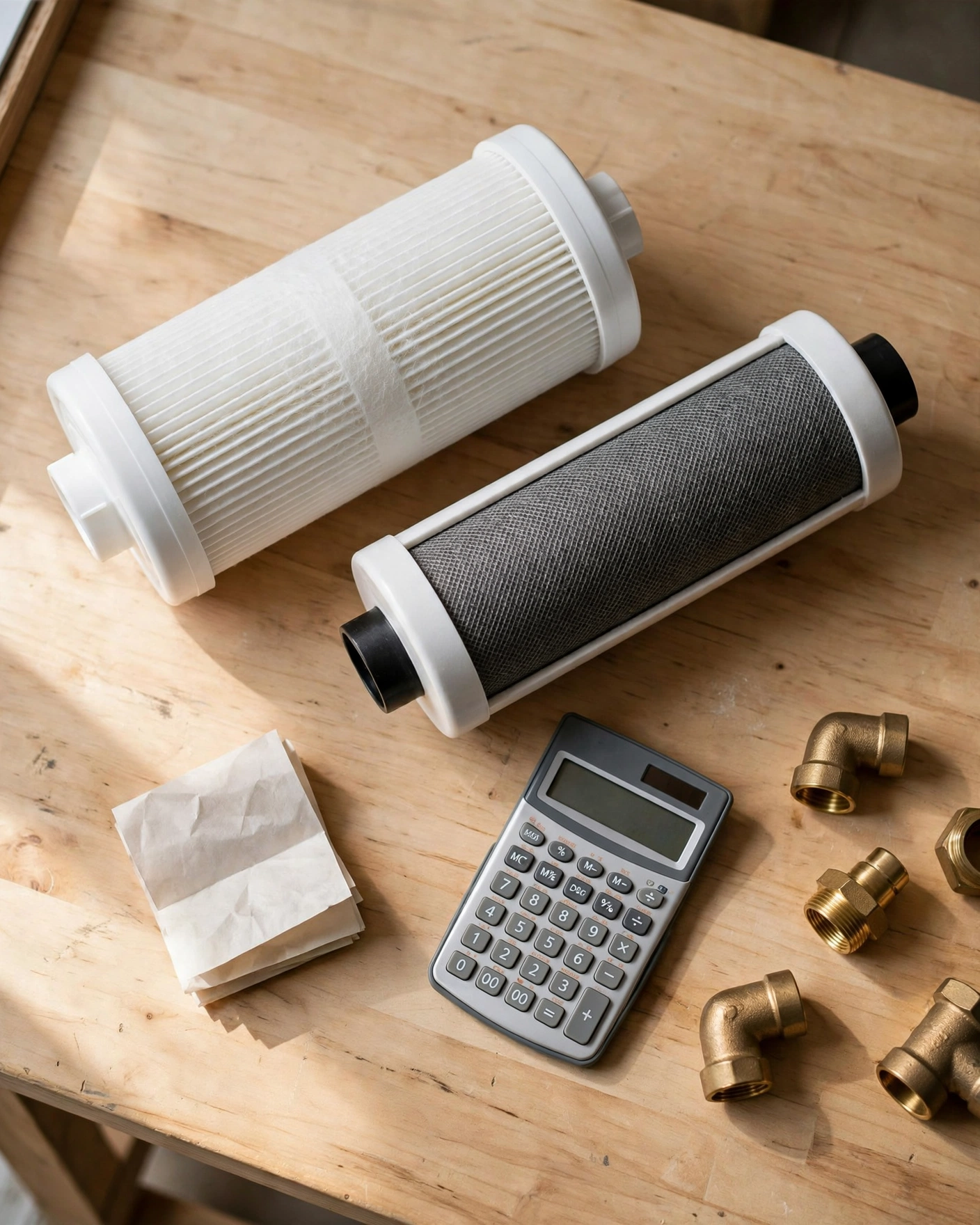
The sticker price is the least important number on this page. What matters is the two-year ownership cycle, because unlike the Rhino’s 10-year media, the HealthShield tank itself is a consumable. Here is the math with every assumption labeled:
| Item | Figure | Source / status |
|---|---|---|
| System (base) | Starting at ~$2,099 | Aquasana launch pricing, Aug 2026 — check current price |
| System with Max Flow UV add-on | ~$5,796 | Aquasana product listing (JSON-LD) — check current price |
| Installation labor | Plumber recommended; several hundred dollars typical | Owner reviews of Aquasana whole-house installs; get a local quote |
| Post-filter replacements | ~$37 each (Aquasana lists its whole-house post-filter replacement at $36.99) | Aquasana replacements page — verify HealthShield schedule |
| Tank replacement (~every 2 years) | Price not published by Aquasana at review time | UNVERIFIED — confirm with Aquasana before buying |
At ~$2,099 base, the system alone works out to roughly $87 per month across its two-year cycle — before installation, before UV, and before the replacement tank whose price Aquasana hadn’t published when we checked. Compare with the Rhino WH-1000 (~$900–1,100 estimate, 10-year media): a fraction of the yearly cost, but not certified for PFAS. You’re paying for the certification, not for cheap filtration. We deliberately quote no single “total cost of ownership” number: the replacement tank price — the largest variable — isn’t published. Any reviewer who gives you one hard number for this system is guessing.
A note on a number you may see elsewhere: some roundup tables cite a “$7,211 HealthShield 5-year upkeep” figure. We could not verify that figure at any primary source — not Aquasana’s site, not the WQA database, not a published price sheet — so we do not repeat it. The table above contains only figures we could trace.
What owners complain about
The HealthShield is new, so long-term complaints don’t exist yet. It launched in August 2026. What follows is drawn from Aquasana whole-house-line owner reviews (mostly Rhino systems) plus the HealthShield’s documented requirements — the friction points to expect.
Installation is a project, not a weekend task. Aquasana strongly recommends a licensed plumber, and local regulations may require one. Rhino-line owners report that whole-house installs rarely happen in one step: you may need a new electrical outlet (120V within 10 feet — an extra expense some buyers miss), and at least one reviewer reported missing parts in the box, shipped later by Aquasana support. Budget labor and a contingency.
Cloudy water right after install. Aquasana’s own FAQ addresses this: trapped air in the pipes and filtration media can make water look milky for a week to a month after installation. Common and not harmful — but it alarms new owners, so knowing about it in advance matters.
It is a big unit that needs the right spot. Whole-house systems must sit as close to the main water line as possible, which limits placement options. No basement or utility room? Plan for that.
It does not soften water or reduce hardness/TDS. This is a contaminant-reduction system, not a water softener. For scale and hard-water spots you need softening or conditioning — the optional salt-free conditioner only prevents minerals binding (scale control), not removing hardness. Don’t buy a $2,000+ system for the wrong problem.

HealthShield vs rivals
Here is the HealthShield against the systems buyers cross-shop most often, drawn from published specs and brand-stated certifications.
| Aquasana HealthShield | Aquasana Rhino WH-1000 | Aquasana Rhino Max Flow | |
|---|---|---|---|
| System price | Starting at ~$2,099 | ~$900–1,100 (estimate) | ~$2,798 |
| Rated life | 165,000 gal / ~2 years | 1,000,000 gal / up to 10 years | 1,000,000 gal / up to 10 years |
| Flow rate | 5.7 GPM | Not published separately | 14 GPM |
| Certifications (brand-stated) | WQA: NSF/ANSI 53 (PFAS, VOCs) + 401 (BPA, ibuprofen) | WQA: NSF/ANSI 42 + 61 (chlorine, materials) | WQA: NSF/ANSI 42 + 61 (chlorine, materials) |
| Water source | City or well | City | City |
| Best for | Certified PFAS/VOC reduction | Long-life chlorine reduction | High-flow chlorine reduction |
The pattern is clear: within Aquasana’s own lineup, the choice is certification coverage versus longevity. The Rhino systems give you a decade of chlorine reduction at a fraction of the per-year cost — our Rhino review is the deep dive. The HealthShield is the only one certified for PFAS and VOCs, and it charges for that privilege both upfront and every two years. Also worth a look in this price class: the SpringWell CF1 review, SpringWell’s own whole-house answer. At the budget end, the PRO+AQUA Elite PRO-100-E GEN2 (~$300–450 estimate) is a basic 3-stage well-water system — but we found no verified third-party certifications for it, so treat it as a budget pick, not a certified contaminant-reduction pick.
Who should buy it
Buy it if
- You want third-party-certified PFAS and VOC reduction at every tap — no other whole-house system we compared carries WQA certification for both.
- You are on well or city water and want one system covering both, with optional UV disinfection (also see our iSpring WGB32B review and Express Water review).
- You value smart capacity tracking — the flow-meter display removes guesswork about when the tank is spent.
Skip it if
- Your main problem is hard water or scale — the HealthShield is not a softener and does not reduce hardness or TDS.
- You need high flow for a busy household — 5.7 GPM is modest next to the Rhino Max Flow’s 14 GPM.
- You want a fit-and-forget decade — a 10-year Rhino media cycle is cheaper and less certified than a 2-year tank cycle.
The specs
- Brand
- Aquasana
- System
- HealthShield whole-house
- Configuration
- Single tank + sediment pre-filter + post-filter
- Rated capacity
- 165,000 gallons / ~2 years
- Flow rate
- 5.7 GPM
- Certifications
- WQA: NSF/ANSI 53 (PFAS, VOCs) + 401 (BPA, ibuprofen)
- Contaminants (brand-stated)
- 61, incl. PFAS, VOCs, pharmaceuticals, chlorine, chloramines
- Power
- 120V outlet required (within 10 ft)
- Drain line
- No (non-backwashing)
- Base price
- Starting at ~$2,099
FAQs
How long does the Aquasana HealthShield tank last?
The HealthShield tank is rated for 165,000 gallons or about two years, whichever comes first — unlike the Rhino’s 10-year media. The display shows remaining capacity in gallons: yellow at 0–10%, red when the tank is due. Aquasana says a used tank is generally household waste under federal rules, but local disposal rules vary — check with your local waste authority.
Is the HealthShield really certified to remove PFAS?
Aquasana states the system is WQA tested and certified to NSF/ANSI 53 for 99.9% PFAS reduction to below 4 parts per trillion — covering PFOA, PFOS, PFNA, PFHxS, and PFHpA — plus 99.8% VOC reduction under the same standard, and 94.7% BPA/ibuprofen reduction under NSF/ANSI 401. The Rhino line’s different certifications (42 and 61) do not include PFAS, so don’t mix the two systems up on spec sheets.
Does the HealthShield need electricity?
Yes — the performance indicator needs a 120V/60Hz outlet within 10 feet of the unit. If there’s no outlet near your main water line, budget an electrician to add one.
Does the HealthShield soften hard water?
No — it’s a contaminant-reduction system, not a softener, and does not reduce hardness minerals or TDS. Aquasana’s optional salt-free conditioner only prevents scale buildup; it doesn’t remove hardness. Hard water is your main problem? Wrong category of product.
Can I install the HealthShield myself?
Aquasana strongly recommends a licensed plumber, and state or local regulations may require one. Whole-house installs rarely happen in one step, and professional coverage insures against installation damage. Get a plumbing quote before you buy.
HealthShield vs Rhino — which Aquasana whole-house system is better?
Different problems. The Rhino WH-1000 (and Max Flow) are long-life chlorine-reduction systems — WQA certified to 42 and 61, rated for 1,000,000 gallons or up to 10 years, at a lower per-year cost. The HealthShield is a PFAS/VOC specialist — WQA certified to 53 and 401 — but its tank is a ~2-year consumable and it costs more. A decade of chlorine reduction? Rhino. Certified PFAS/VOC reduction at every tap? HealthShield.
Is the UV filter included with the HealthShield?
No — it’s an optional add-on, listed at $5,796 with the Max Flow UV filter on Aquasana’s site. Aquasana recommends UV for well water and any non-municipal supply, stating it sterilizes up to 99.8% of bacteria and nonpathogenic viruses and is NSF tested and certified to Standard 55, Class B.
Conclusion
The Aquasana HealthShield is the most honestly certified whole-house system we have reviewed for the contaminants people actually fear now: PFAS, VOCs, BPA, and ibuprofen — with WQA certification to NSF/ANSI 53 and 401 backing the headline numbers. But “most certified” is not the same as “best for everyone.” It costs roughly $2,100 before installation, needs a power outlet, runs a modest 5.7 GPM, won’t soften water, and the tank is a two-year consumable whose replacement price Aquasana hadn’t published when we checked. If PFAS/VOC protection at every tap is your priority and you understand the 2-year ownership cycle, the HealthShield earns its premium. If your problem is chlorine taste, hard water, or budget, Aquasana’s own Rhino line is the smarter buy.
Price checked at time of writing; it changes often — see the live price before you buy.
Update log
- Zulqarnain: Review published.