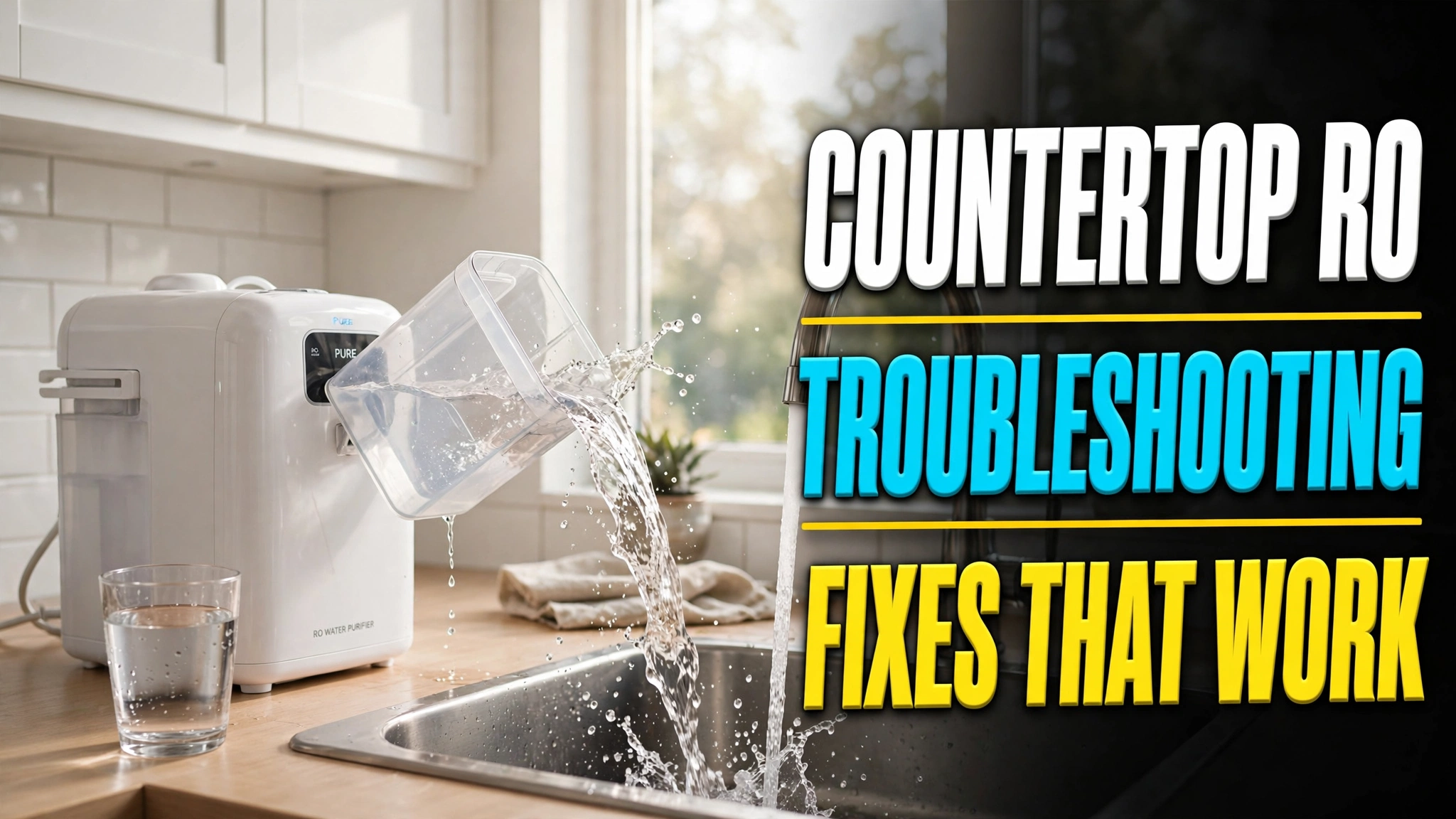

Countertop RO Troubleshooting (2026): Fixes That Work
Guide
You open the clean-water tank and the water looks cloudy. Or the unit quit right after you refilled it — nothing broken. Maybe the tank fights you every time, or the thing beeps for no clear reason.
Short answer: nearly every countertop RO problem traces to one design quirk — the unit parks concentrated wastewater in the tank you refill. Master the dump-and-refill routine and most “breakdowns” clear in five minutes.
Check Current PriceTable of Contents
Quick verdict
Symptoms and quick diagnosis
Countertop RO units have no drain line: they recirculate tap water and return concentrated wastewater to the tap-water tank — always discard that residual water before refilling, or you risk clogs and a voided warranty.

| Symptom | Likely cause | Start with |
|---|---|---|
| Cloudy water, or unit won’t start after refill | Wastewater left in tap tank | Fix 1: dump-and-refill |
| Unit will not power on at all | Filter cover off, magnet missing, tanks unseated | Fix 2: reseat everything |
| Tank hard to put back / will not seat | Misaligned or scaled valve | Fix 2, then descale |
| Water leaking from tanks | Unseated tank or scaled valve | Valve descale |
| Tanks smell musty / slime inside | Dirty tank, sunlight, stagnant water | Deep clean |
| Warning light after washing tanks | Wet/soapy water-level sensor | Fix 3: dry the sensor |
| Flashing, will not dispense (SimPure Y7P) | Owner-reported sensor glitch | Fix 4: power cycle |
| Slow fill | Normal RO pace, clogged filter, or scale | Slow fill fixes |
5-minute fixes
Try these in order — they resolve the large majority of countertop RO complaints.

Fix 1 — The dump-and-refill (wastewater in the fresh tank)
- Lift the tap-water tank completely off the base.
- Pour all remaining water down the sink. Do not top it up — the leftover is concentrated wastewater.
- Refill with fresh tap water and press the tank down firmly until it seats.
The AquaTru manual states the tap tank must always be removed and its water discarded before refilling — skipping this can void the warranty. After a power outage the unit restarts on its own, so check for wastewater first.
Fix 2 — Reseat both tanks (power, leaks, “tank hard to put back”)
- Remove both tanks and press each straight down until fully seated.
- Close the filter cover fully — on the AquaTru, a magnet inside the cover must be present or the unit will not power on.
- Valve leaking? Press the small white spring pin at the tank’s bottom over a sink — if it sticks, descale (see below).
Fix 3 — Dry the water-level sensor (warning light after washing)
The sensor sits near the top of the clean-water tank, by the handle. If the unit will not start after washing, rinse out soap, shake water off the sensor, and let the tank dry.
Fix 4 — Power cycle (flashing lights, frozen touchscreen)
Unplug for five minutes, then plug back in — the Waterdrop A1 manual lists this for an unresponsive touchscreen. SimPure Y7P flashing with no dispensing? Same first step; if it returns, call support.
Fix 5 — Refill to stop the beep
A short beep every 20 seconds is the low-water alert — the tap tank is empty. Refill it (dump residual first, per Fix 1). Still beeping with a full tank? Reseat the tank.
Step-by-step repairs
When the 5-minute fixes do not clear it, the cause is usually mineral scale, biofilm, or an expired filter.

Repair 1 — Descale a sticky or leaking tank valve
- Fill the tank with a 50/50 mix of white vinegar and hot water.
- Let it stand for 30 minutes.
- Drain by pressing the valve under the tank, then wash thoroughly with soap and water before reinstalling.
The manual’s own method for scale-seized valves. Use plain vinegar or the brand’s descaling powder — not harsh chemical descalers, which can damage seals.
Repair 2 — Deep-clean smelly or slimy tanks
- Wash both tanks with soap and water — weekly washing is the manufacturer’s standing guidance.
- Keep the unit out of direct sunlight and heat, and do not let water sit stagnant for days.
Caveat: an owner complaint record notes support said descaling does not cover mold — if you see actual mold spots, wash and dry thoroughly and consider replacing the tank instead.
Repair 3 — Replace expired filters and reset the timer
A clogged pre-filter shows up as slow output or off taste. Per AquaTru: pre/carbon ~6 months, RO ~1 year, VOC carbon ~2 years. After installing new filters, press the filter reset button on the back.
Slow fill and low output
Countertop RO is slow by nature — 10–15 minutes per gallon is a universal owner complaint, not a defect. (The AquaTru Carafe manual rates max flow at 0.5 GPM, supporting incoming water up to 1000 PPM TDS.)

Gotten slower than it used to be? Check these:
- Filter indicator lights. A clogged pre-filter chokes flow before the membrane does.
- Scale. Mineral buildup restricts flow — run the vinegar routine above.
- Source water. Very hard or high-TDS tap water shortens filter life and slows output.
- SimPure Y7P owners: a 6–8 minute refill cycle is a recurring owner complaint — treat lengthening refills as a filter/scale issue.
Taste and odor problems
Two different problems hide under “bad taste,” with opposite fixes.

Flat or “empty” taste. RO strips nearly all dissolved minerals — the main source of water’s taste. Flat taste is a taste effect, not a malfunction; mineral drops or a splash of tap water fixes it.
Stale, musty, or chemical taste/odor. A maintenance signal: expired filters, an unwashed tank, or a new filter never flushed. Work through the repairs above, and see whether countertop RO removes chlorine for what RO does and does not take out.
DIY troubleshooting: pros and cons
Pros
- Fast and free — the top fixes take minutes and solve most complaints.
- No tools needed — every fix here uses household items like vinegar and dish soap.
- Protects the unit — dumping wastewater each cycle also protects the warranty.
Cons
- Warranty risk — skipping the wastewater routine can void coverage.
- Real limits — cracked tanks, failed valves, and recurring electronic faults need support.
- Recurring faults return — the same problem coming back after proper fixes means a defect.
When to replace instead of repair
Sometimes the honest fix is a new unit.

| Situation | Call |
|---|---|
| Scale, smells, slow flow, expired filters | Repair — all covered above |
| Cracked tank or valve that still leaks after descaling | Replace the part or the unit |
| Flashing / electronic faults surviving a power cycle | Replace (or warranty claim) |
| Mold returning after thorough cleaning | Replace the tank at minimum |
| 4+ years old with multiple recurring faults | Replace — parts cost approaches a new unit |
Shopping for a replacement? See our best countertop RO systems roundup, the renter picks, no-installation options, and portable RO picks.
| Model | Type | Price | |
|---|---|---|---|
| AquaTru Classic | 4-stage countertop RO | ~$449–475 | Check price |
| SimPure Y7P UV | Countertop RO with UV | ~$330–400 | Check price |
| Waterdrop K19-SFK | Countertop RO | ~$320–380 | Check price |
| Bluevua RO100ROPOT-Lite | Countertop RO, glass carafe | ~$230–410 | Check price |
Reference: AquaTru Classic specs
- Brand
- AquaTru
- Model
- Classic
- Type
- Countertop 4-stage RO
- Filter life
- Pre/carbon ~6 mo; RO ~1 yr; VOC carbon ~2 yr
- Efficiency
- ~75% (brand-stated)
- Certifications
- AquaTru states IAPMO 42/53/58/401*
- Typical price
- ~$449–475 (estimate)
- Power
- Corded electric
*AquaTru’s IAPMO 42/53/58/401 certification is brand-stated; we could not independently verify it in the public certification databases. Treat it as the manufacturer’s claim.
Conclusion
Countertop RO troubleshooting is mostly habit, not hardware: dump the wastewater every cycle, reseat tanks firmly, wash weekly, keep the unit out of sunlight, replace filters on schedule. When a fault survives all of that — cracked parts, recurring glitches — stop repairing and replace.
FAQs
Why is there wastewater in my AquaTru’s fresh tank?
It is not a malfunction — it is how the unit works. Not a malfunction — the unit parks concentrated wastewater in the tap-water tank. Always remove the tank, discard all remaining water, then refill — every cycle.
Why is my AquaTru tank so hard to put back on?
Usually misalignment or mineral scale. Line the tank up straight and press down firmly. Still stuck? Soak in 50/50 vinegar and hot water for 30 minutes, then wash and retry.
My countertop RO has no on/off button — is it wearing out the filters?
No — units like the AquaTru start and stop automatically. Filters wear by gallons processed and time in service, so follow the published schedule.
Why does my SimPure Y7P flash and not dispense?
An owner-reported issue. Power-cycle and reseat the tanks. If flashing returns, contact SimPure support — board-level DIY risks the warranty.
I found mold or slime in my tank — is descaling enough?
Not necessarily. Wash both tanks, dry completely, and keep the unit out of sunlight. If spots return, replace the tank — descaling does not cover mold.
Why does my RO water taste flat?
RO removes nearly all dissolved minerals, which shape water’s taste — flat taste is a taste effect, not a failed filter. Stale or musty taste signals expired filters or a dirty tank.
Why does my RO system keep beeping or humming loudly?
A short beep every 20 seconds is the low-water alert — refill the tap tank. Louder humming means the pump is fighting scale or trapped air: descale and reseat.