Should I Get a Countertop or Under-Sink Water Filter? (2026): Which Wins for Your Kitchen
Guide
You want cleaner water from your kitchen tap, and now you are stuck on the installation question: a countertop unit you can set up today with no tools, or an under-sink system you plumb in once and then forget about?
Here is the problem: both styles promise the same thing — better water — but the wrong pick costs you something real. Pick countertop when you needed plumbed-in, and you are refilling a reservoir three times a day. Pick under-sink when you rent, and you are explaining a drilled hole to your landlord. The answer is simpler than the marketing makes it look: the right choice comes down to three things — whether you rent or own, how much filtered water your household actually uses, and what you are trying to take out of the water.
Check Current PriceTable of Contents
Quick verdict: pick in 60 seconds
Choose a countertop filter if: you rent, your kitchen is small, you mainly want filtered drinking water, or you want zero plumbing work. It is the lowest-commitment way to get cleaner water.
Choose an under-sink system if: you own your home, you cook with filtered water (pots, rice, coffee), several people drink from the same tap, or you want your counter space back. One installation, then water on demand for years.
The real problem (it’s not about “better”)
Ask “which is better, countertop or under-sink?” and you will get loud answers from people selling one of them. The honest answer: neither is better in the abstract. A countertop reverse-osmosis unit and an under-sink reverse-osmosis unit can hold nearly identical filter stages — the water that comes out can be comparably clean. What differs is the logistics around the water.
Think of it as a lifestyle question wearing a product question’s clothes. A countertop unit trades your counter space for zero installation. An under-sink system trades a one-time installation (and some cabinet space) for invisible, on-demand water. The frustration we see in owner reviews almost never comes from water quality — it comes from a mismatch: the renter who drilled into a cabinet, or the family of five refilling a two-liter reservoir every morning.
How each type actually works
A countertop filter sits on your counter and works in one of two ways. Most countertop RO units have a feed-water reservoir you fill from the tap (or a diverter hose that hooks to the faucet). Water passes through the stages — typically sediment, carbon, the RO membrane, and a final polish — and dispenses into your glass. No plumber, no permanent changes, about 15–30 minutes from box to first glass.
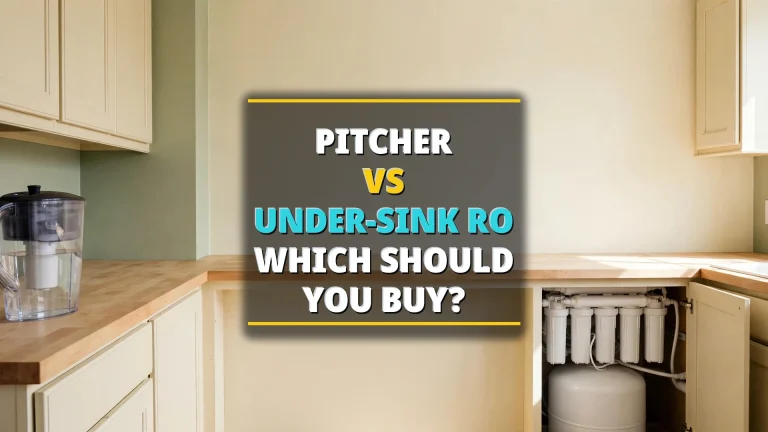
An under-sink system taps into the cold-water line beneath your sink. Water flows through a chain of filter housings or a quick-change manifold mounted inside the cabinet, and treated water comes out of a dedicated faucet on your sink (or, on some systems, your existing faucet). RO versions add a small storage tank — or skip the tank entirely on tankless models — plus a drain connection for the membrane’s wastewater. Installation takes one to three hours with basic tools.

Countertop vs under-sink: head-to-head
Here is the comparison that actually decides it, row by row:

| Factor | Countertop | Under-sink |
|---|---|---|
| Installation | None — plug in or hook to faucet (15–30 min) | Plumbs into cold-water line (1–3 hrs; pro install $100–$500) |
| Counter space | Takes a chunk of it permanently | Zero — everything hides in the cabinet |
| Cabinet space | None used | Gives up a cabinet section |
| Upfront cost | $100–$700 typical (market estimates) | $200–$800 equipment + install (market estimates) |
| Yearly filter cost | ~$150–$250 (market estimates) | ~$150–$250 (market estimates) |
| Output | Reservoir-limited; refill as you go | On demand from a dedicated faucet |
| Filter changes | Easy — everything at counter height | Crouch into the cabinet; quick-change designs help |
| Renters | Yes — no permanent changes | Only with landlord permission |
| Moving | Unplug and take it with you | Stays with the house (or a long uninstall) |
Cost figures are 2026 market estimates from third-party pricing guides (Angi, Modernize, Crystal Quest), not quotes — your total depends on the model and your plumber.
When a countertop filter wins
Countertop is the right call more often than the internet admits. It wins cleanly in four situations:
You rent. This is the big one. A countertop unit makes zero permanent changes, so there is nothing to restore and nothing to explain. When you move, it moves with you — we have seen owners take the same unit through three apartments.

Your kitchen is small. If your under-sink cabinet is already packed with cleaning supplies and a garbage disposal, there may be nowhere sensible to mount a system. Counter space is easier to reorganize than plumbing.
You mainly drink, not cook. If filtered water is for glasses and the coffee maker — not for filling stock pots — a reservoir you refill once or twice a day is no burden at all.
You want the lowest-commitment start. Not sure filtered water is worth it to you yet? A countertop unit is the cheapest experiment. If you love it and later buy a home, you already know your water preferences.

If this is your lane, start with our countertop RO roundup to see which models owners rate highest.
When an under-sink system wins
Under-sink is the “buy it once, enjoy it daily” option. It wins when:
You own your home. Drilling a small faucet hole and tapping the cold-water line are one-afternoon jobs in a home you will keep for years — and the system quietly adds to the kitchen rather than cluttering it.
You cook with filtered water. Filling pots, the kettle, the rice cooker — this is where a dedicated faucet earns its keep. Nobody wants to refill a countertop reservoir four times while making dinner.
Multiple people use the same tap. Families burn through filtered water fast. On-demand flow from a dedicated faucet beats a reservoir in a busy kitchen, every time.
You want your counter back. The cleanest-looking kitchens have no appliances on the counter. An under-sink system is invisible — the only evidence is the little faucet.

For the RO-specific version of this debate, see countertop vs under-sink reverse osmosis, countertop RO vs under-sink RO, and under-sink vs countertop water filtration.
The true cost: 5-year math
Sticker prices mislead because installation and filters dominate the real cost. Here is what third-party 2026 pricing guides report as market ranges — treat them as estimates, not quotes:
- Countertop RO equipment: roughly $200–$700 (Angi), $250–$500 (Modernize), $100–$500 (Crystal Quest). Installation: $0 — it is DIY.
- Under-sink RO equipment: roughly $200–$800 (Angi), $300–$800 (knowhowexpert). Professional installation typically adds $100–$500 (Modernize) or $200–$600 (knowhowexpert).
- Yearly filters: roughly $150–$250 for either style (knowhowexpert) — membranes last 2–3 years on top of that.
| Style | Low estimate | High estimate |
|---|---|---|
| Countertop RO | ~$200 + 5 × $150 = ~$950 | ~$700 + 5 × $250 = ~$1,950 |
| Under-sink RO (DIY install) | ~$200 + 5 × $150 = ~$950 | ~$800 + 5 × $250 = ~$2,050 |
| Under-sink RO (pro install) | ~$200 + $100 + 5 × $150 = ~$1,050 | ~$800 + $600 + 5 × $250 = ~$2,650 |
Two takeaways. First, DIY-installed under-sink and countertop cost about the same over five years — the gap only opens if you pay a plumber. Second, budget under-sink systems like the Geekpure 5-stage RO (roughly $130–$220, our under-sink example pick) can undercut many countertop units on equipment price alone; the installation is where under-sink gets expensive.

Installation, step by step
Countertop (no tools, 15–30 minutes)
- Unbox and rinse. Wash the reservoir and any removable parts; most manuals ask for an initial flush of the filters.
- Set it in place. Near an outlet if it is electric (most countertop RO units are), with room to lift the reservoir for refills.
- Prime and flush. Fill the reservoir, run one or two full tanks to waste per the manual, and you are drinking filtered water.
Under-sink (basic tools, 1–3 hours)
- Shut off the cold water and clear the cabinet. Measure twice — the system, tank, and your existing pipes all have to fit.
- Tap the cold-water line with the included feed adapter and mount the filter bracket or manifold.
- Fit the dedicated faucet. Most sinks have a spare sprayer or soap-dispenser hole you can reuse; otherwise it is one drilled hole.
- Connect the drain line (RO systems). The membrane’s wastewater needs a drain saddle on the sink tailpiece.
- Flush and leak-check. Fill the tank, flush per the manual, then check every fitting with a dry hand — and put a towel down for the first night.
Not comfortable under a sink? A plumber typically charges $100–$500 for this job (Modernize’s 2026 range) — still cheaper than buying the wrong system twice.
5 mistakes to avoid
1. Buying RO when carbon would do. If your only complaint is chlorine taste, a simple carbon filter — countertop or under-sink — solves it for far less money and zero wastewater. Reserve reverse osmosis for dissolved contaminants. And remember: a low TDS meter reading does not mean water is safe — TDS measures dissolved solids, not safety (standard water-chemistry guidance).
2. Ignoring the wastewater. Standard point-of-use RO sends roughly 5 gallons down the drain for every gallon of treated water, per EPA figures cited in Angi’s 2026 cost data. Newer high-efficiency models reach about 1:1 but cost roughly $300 more. If you are on a metered supply or a septic system, factor this in.
3. Trying to boil away lead. Boiling water concentrates lead — it does not remove it (CDC/EPA guidance). If lead is your concern, you need certified filtration, not heat.
4. Assuming every RO handles fluoride the same. Do not assume every NSF/ANSI 58 system reduces fluoride to the same degree — check the specific model’s performance data sheet before buying for fluoride (a caution raised in thekitchenprofessor’s 2026 fluoride guide).

5. Skipping the fit check. Measure your cabinet before ordering an under-sink system, and check your lease before drilling anything. For renters weighing RO specifically, countertop filters vs full reverse osmosis breaks down when the simpler option wins.
Conclusion
There is no universal winner — there is only the winner for your kitchen. Rent, small space, or drink-only habits point to a countertop unit you can set up today and take with you when you move. Own your home, cook with filtered water, or share the tap with a family, and an under-sink system pays back its one-time installation every single day. Match the system to your living situation first and your contaminant second, and you will not go wrong.
FAQs
Can I install an under-sink water filter in a rental apartment?
Usually not without written permission — under-sink systems need a tap into the cold-water line and often a drilled faucet hole, which counts as a modification. For rentals, a countertop unit is the safe pick: zero permanent changes, and it moves with you.
Does a countertop filter remove as much as an under-sink system?
It depends on the technology, not the location. A countertop RO and an under-sink RO with similar stages produce comparably clean water. But a carbon-only countertop filter will not match an under-sink RO on dissolved contaminants like nitrates or fluoride — compare the filter technology, not the box it sits in.
How much does an under-sink RO system cost installed?
Market estimates for 2026 put under-sink RO equipment at roughly $200–$800, with professional installation adding $100–$500. DIY installation brings the total close to a countertop unit; a plumber is what opens the gap.
Do countertop RO units waste water?
Yes — wastewater is a property of reverse osmosis, not of where the unit sits. Standard point-of-use RO sends about 5 gallons to the drain per gallon treated (EPA figures via Angi’s 2026 data); high-efficiency models reach about 1:1 but cost more upfront.
How often do the filters need changing?
Follow the manufacturer’s schedule for your model — it varies by stage, water quality, and household volume. Pre-filters are typically yearly, RO membranes every 2–3 years. A low TDS reading alone does not prove your filters are still working; TDS measures dissolved solids, not safety.
Can I take a countertop filter with me when I move?
Yes — that is one of its biggest advantages. Unplug it (or unhook the faucet adapter), pack it, and set it up in the new kitchen in minutes. An under-sink system stays with the house unless you uninstall it.