Countertop Water Filter vs Reverse Osmosis (2026): Which Should You Buy?
Here is the choice in plain English: a countertop RO dispenser you plug in and fill by hand, or an under-sink RO system with a storage tank and its own little faucet. Both run your tap water through a reverse-osmosis membrane. Pick the wrong one and you either drill a hole in a granite countertop for a system you resent — or you spend two years hauling water to a dispenser when a tank under the sink would have done the pouring for you.
The short answer: the filtration itself is basically the same — both use the same RO technology, and published comparisons put both around 90–99% removal of common dissolved contaminants. The real differences are installation, daily capacity, wastewater, and five-year cost. Countertop RO wins if you rent, hate plumbing, or want hot and cold water on demand. Under-sink RO wins if you own your home, have a family drinking a lot of water, or want filtered water plumbed to your fridge. This comparison lays out the side-by-side numbers, what certifications actually mean, and what owners say after living with each — so you buy the right format the first time.
The under-sink pick
Under-sink RO (Geekpure 5-Stage)
~$130–220
A 3–4 gallon tank and a dedicated faucet mean filtered water on demand, all day.
The countertop pick
Countertop RO (Melissani M1)
~$300–400
No drilling, no drain line, and it moves with you — hot and cold water in seconds.
The bottom line: buy the countertop RO if installation is the dealbreaker — no drilling, no drain line, and it moves with you. Buy the under-sink RO if volume is the dealbreaker — a 3–4 gallon tank and a dedicated faucet mean filtered water on demand, all day.
Verdict: renters and small households go countertop; homeowners with families go under-sink.
Prices checked at time of writing; they change often — see the live price before you buy.

Table of Contents
Side-by-side comparison
| Countertop RO ★ Winner | Under-sink RO | |
|---|---|---|
| Installation | Plug in, fill the tank by hand | Drain saddle plus a dedicated faucet — usually a drilled hole |
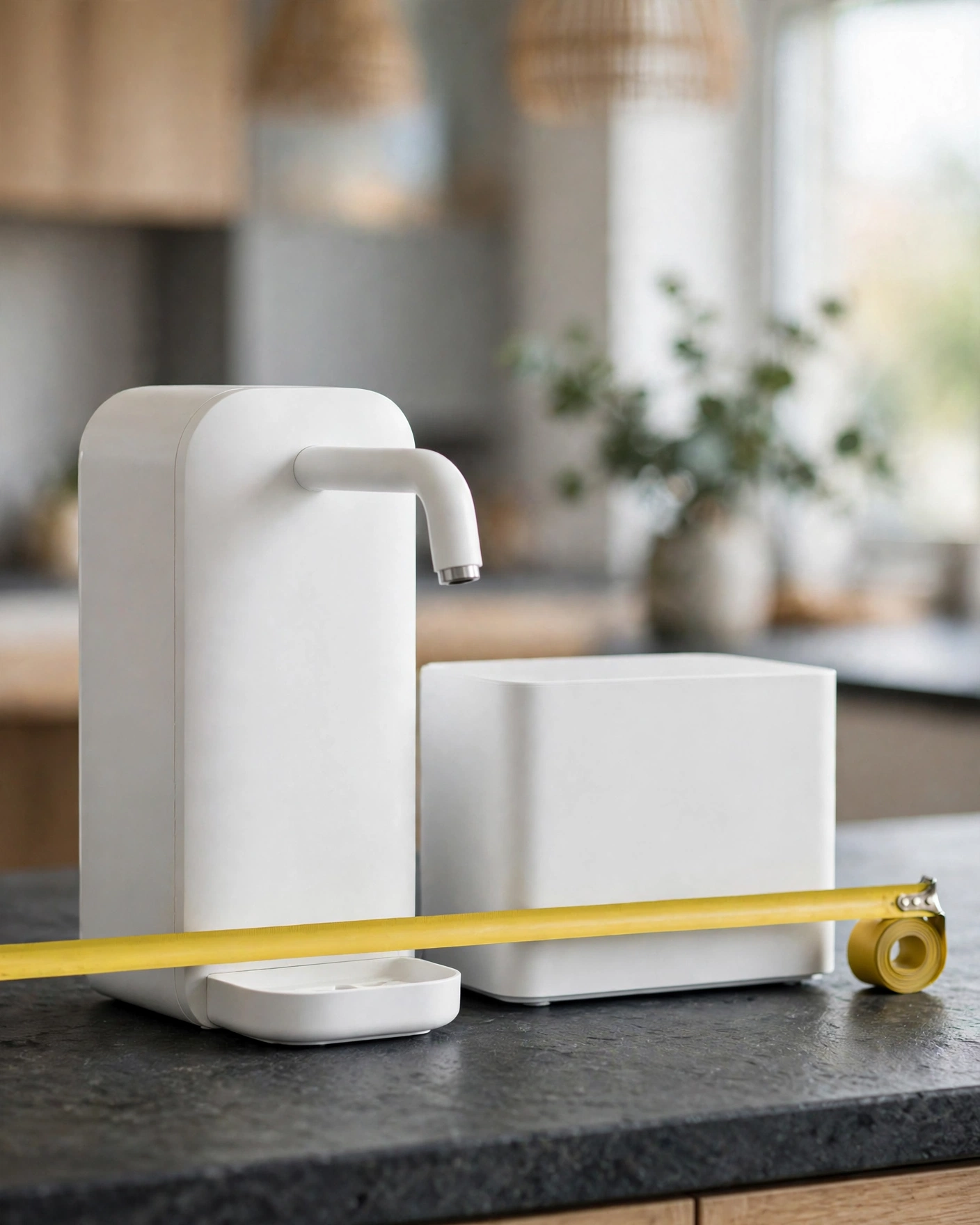
| Counter space | Uses it — roughly a coffee-maker footprint | Uses none — lives under the sink |
| Water on demand | Most units have no big tank — you wait for each batch | 3–4 gallon tank — pour instantly, all day |
| Wastewater (typical) | About 3:1 pure-to-waste on efficient units | About 1:4 on older tanked units; about 3:1 pure-to-drain on newer ones |
| Contaminant removal | Same RO technology — published comparisons put both around 90–99% of common dissolved contaminants | |
| Filter changes | Cartridges every 6–12 months; published set prices ~$79–150 | Pre-filters every 6–12 months; membrane every 1–2 years |
| Upfront cost (estimate) | ~$300–500 (Melissani M1 / NOVETE class) | ~$130–220 (Geekpure 5-stage class) |
| Best for | Renters, small households, hot and cold water on demand | Homeowners, families, fridge and ice-maker hookups |
If your shortlist is specifically countertop RO models against under-sink RO models, our countertop vs under-sink reverse osmosis model comparison goes deeper on individual units.
Countertop RO — the zero-install format
Pros
- Zero installation — plug it in, fill the feed tank, drink. No drilling, no drain line, no plumber.
- Fully portable — moves with you, the natural pick for renters.
- Hot and cold on demand — models like the Melissani M1 heat or chill water in seconds.
- Less wastewater on efficient units — about 3–4 gallons pure per gallon of waste on the better designs.
Cons
- Takes counter space — roughly a coffee maker lives on your counter permanently.
- Manual refilling — the number-one owner complaint; you are the plumbing.
- Limited daily volume — fine for one or two people, not for a family of five.
- Filters replaced more often — published measurements note more frequent swaps than under-sink units.
Under-sink RO — water on demand
Pros
- Water on demand — a 3–4 gallon tank pours instantly, all day, for the whole household.
- Invisible — the system hides under the sink; only a small faucet shows.
- Fridge and ice-maker hookups — a simple add-on line no countertop unit can match.
- Lower running cost — cheaper to buy and cheaper per gallon over the years.
Cons
- Installation is real work — drain saddle, feed adapter, and usually a drilled faucet hole.
- Not portable — it stays with the home when you move.
- Wastewater goes to the drain — older tanked units send about 4 gallons down per gallon purified.
- Eats under-sink space — tank and housings take most of the cabinet.
Why you should trust this comparison
We did not receive units from any brand and we did not run a lab bench. Claiming hands-on testing we never did would be dishonest, so we will not do it. What we did instead was research and comparison: manufacturer spec sheets for representative models on each side, the NSF/ANSI 58 standard explained, waste-ratio and running-cost figures from published independent measurements, owner reviews mined for recurring complaints, and replacement-cost math from listed filter prices and rated filter life.
Certifications (what to actually check)

Reverse osmosis has its own standard: NSF/ANSI 58. That is the number to look for on any RO system, awarded by a named body such as IAPMO, NSF, WQA, or SGS. A percentage claim without a standard number and a certifying body attached is marketing language rather than a specification.
Two traps worth knowing. First, NSF/ANSI 372 is about lead content in the materials that touch water — it does not certify lead removal. Second, a brand announcing a certification is not the same as a database listing; the listing in the public NSF, WQA, or IAPMO database is the proof.
An honest note on the models featured here: at the time of writing we could not verify current public-database listings for the NOVETE, Melissani M1, or Geekpure certifications, so this page makes no certified-reduction claims for them. Check the database entry for the exact model before you buy.
For countertop RO options with documented certifications, see our best countertop reverse osmosis systems roundup.
Cost per year
| Item | Countertop RO | Under-sink RO |
|---|---|---|
| Upfront (estimate) | ~$300–500 | ~$130–220 |
| Filter set price | ~$79–150 (published range) | Varies by brand; membranes cost more, pre-filters less |
| Change interval | Every 6–12 months | Pre-filters every 6–12 months; membrane every 1–2 years |
| Estimated yearly filter cost | ~$150–250 | ~$60–120 |
| Electricity | Small — pump and heater on hot/cold models | None on basic units |
| Wastewater cost | Visible — you empty the waste tank yourself | Hidden in the water bill |
| Install cost | $0 | $0 DIY — or a plumber’s visit if you hire it out |
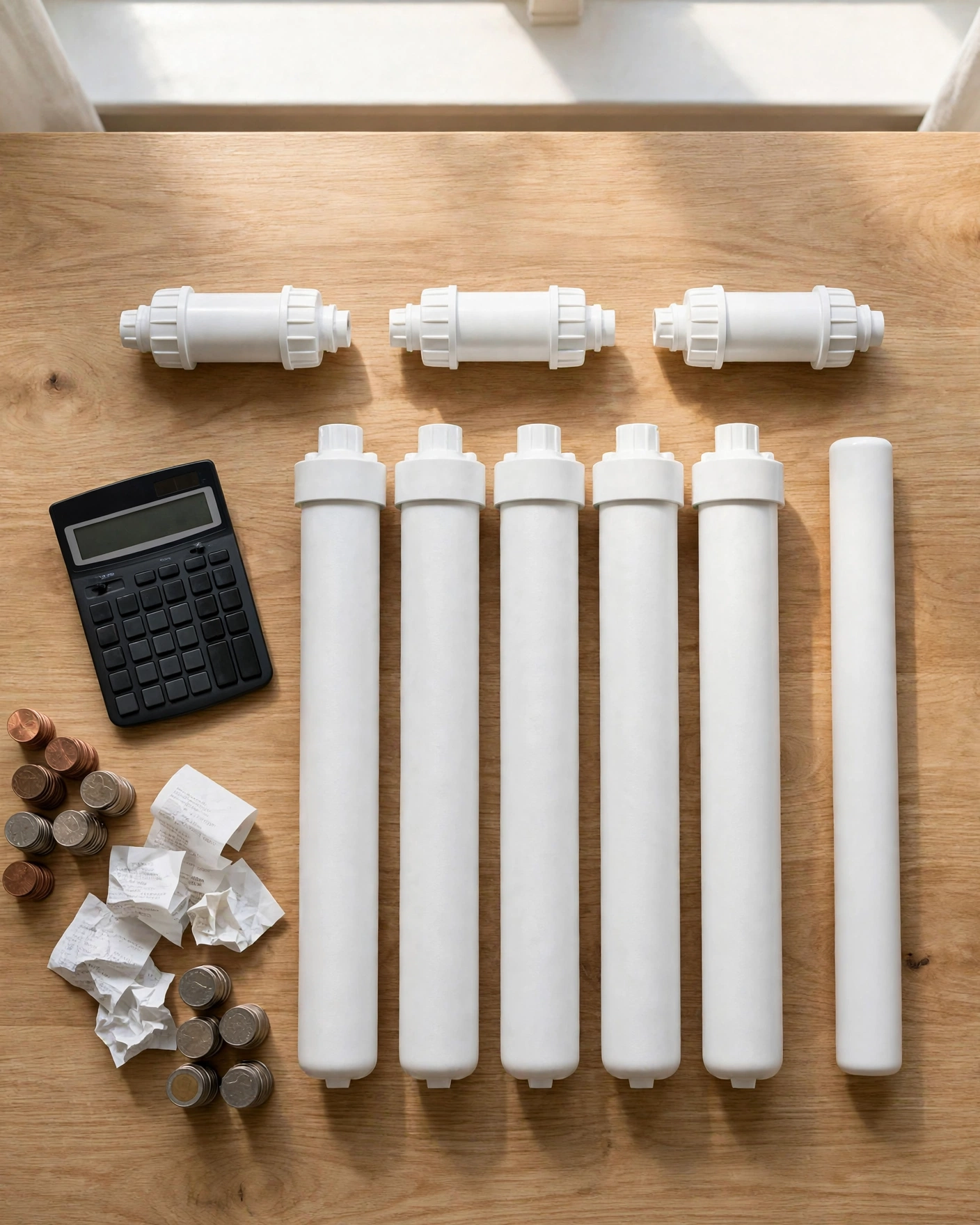
Two things jump out. First, the under-sink system usually costs less to buy and less per year to feed — the countertop premium buys convenience, not cheaper water. Second, published in-home cost measurements put countertop RO running costs between roughly 7 and 11 cents a gallon, so even the pricier format beats bottled water by a mile. All figures here are estimates — re-check live prices before you buy. One honest footnote: a 100-GPD-rated membrane rarely produces anything close to 100 gallons a day in a real home — our owner-research estimate is roughly half that under normal household pressure — so treat rated output as a lab number.
Still deciding between formats at the fixture level? Our countertop or under-sink guide walks through the decision step by step.
What owners say

Countertop RO owners love the plug-and-play setup and — on hot/cold models — near-boiling water in seconds. The recurring complaints are the chores: refilling the feed tank gets old fast, the waste tank needs emptying, and the unit permanently occupies prime counter space.
Under-sink RO owners love the on-demand flow and the invisible install — the most common praise is simply “I forget it is there.” The recurring complaints cluster around day one: drilling the faucet hole, clamping the drain saddle, and the slow first tank fill. After that, the complaints mostly stop, which is itself a signal.
The pattern is useful: countertop complaints are about daily chores; under-sink complaints are about the one-time install.
Who should buy which
Buy countertop RO if
- You rent — no plumbing changes, no landlord negotiations, and it moves with you.
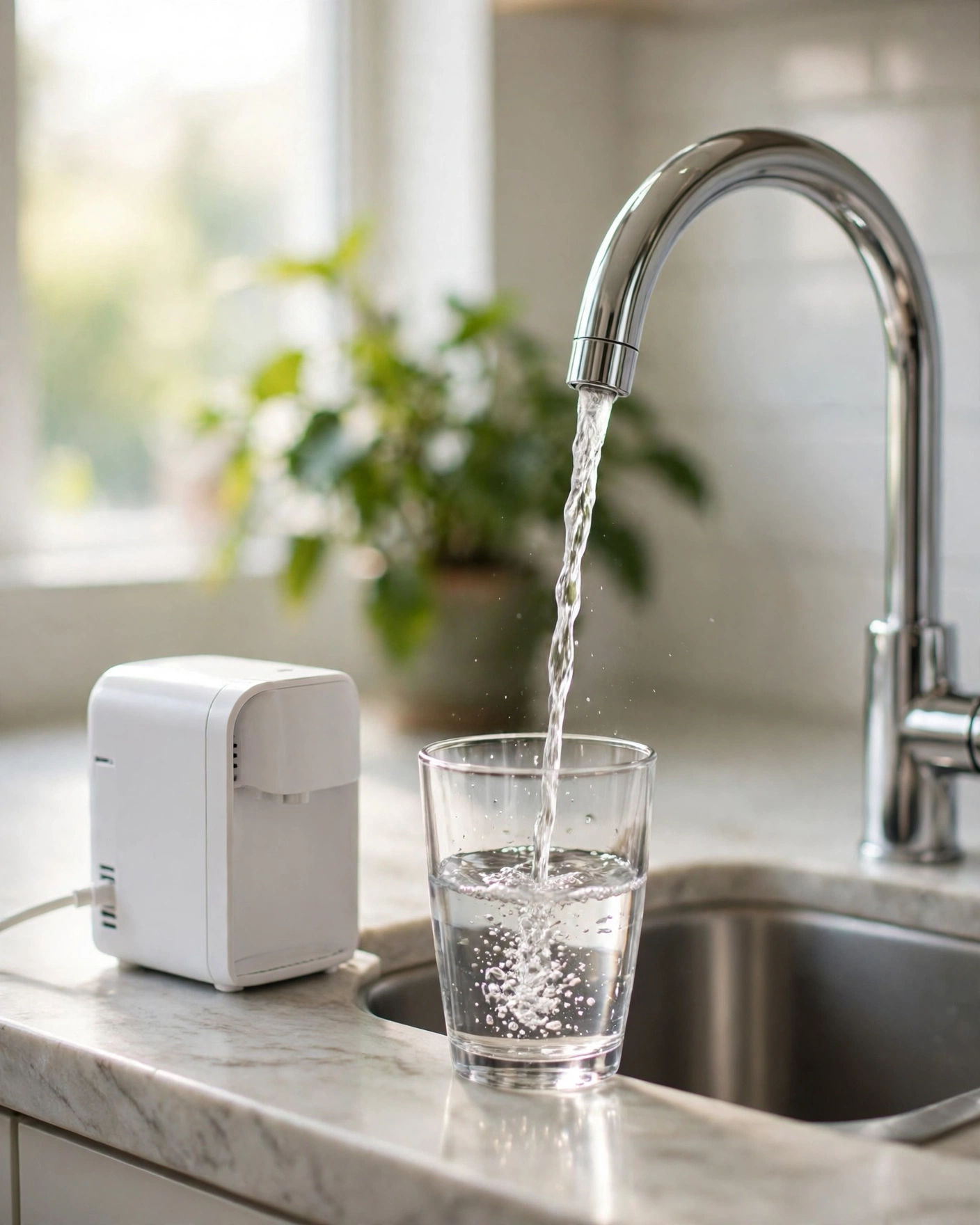
- You want hot and cold water on demand — a 3-second hot pour replaces the kettle for tea, coffee, and instant meals.
- Your household drinks a few glasses a day — one or two people, mostly drinking and cooking water.
- You want zero installation risk — no drilled holes, no drain connections, no flood risk from a loose fitting.
Buy under-sink RO if
- You own your home — the install is a one-time project that pays back for years.
- A family drinks gallons a day — the 3–4 gallon tank keeps up where a countertop feed tank cannot.
- You want a fridge and ice-maker hookup — filtered ice is the under-sink format’s exclusive trick.
- Your water is hard or high in dissolved solids — RO is where carbon-only filters quit, and a plumbed system handles the volume.
For the broader under-sink versus countertop filtration question beyond RO, see under-sink vs countertop water filtration.
How we researched
- Compared published specs across representative models — countertop RO dispensers (NOVETE with a cooling function, Melissani M1 with 3-second hot and cold water) against a classic 5-stage under-sink RO (Geekpure).
- Checked what the certification standard means — NSF/ANSI 58 is the standard specific to reverse osmosis; a percentage claim without a standard number and a named certifying body is marketing language, not a specification.
- Pulled waste and running-cost numbers from published measurements — conventional under-sink RO discards roughly 4 gallons per gallon purified; efficient countertop units reverse that to about 4 gallons pure per gallon of waste; in-home cost measurements land between roughly 7 and 11 cents a gallon.
- Read owner reviews for recurring complaints — the same problem mentioned by many owners over many months, not one-off bad experiences.
- Ran the cost math from listed prices and rated filter life — sediment and carbon filters every 6–12 months, the RO membrane every 1–2 years.
The specs
- Melissani M1 — format
- Countertop RO dispenser
- Melissani M1 — upfront
- ~$300–400 (estimate)
- Melissani M1 — standout
- 3-second hot and cold water
- Melissani M1 — certifications
- Not verified in public databases at time of writing
- NOVETE — format
- Countertop RO dispenser
- NOVETE — upfront
- ~$400–500 (estimate)
- NOVETE — standout
- Cooling function (brand-stated)
- NOVETE — certifications
- Not verified in public databases at time of writing
- Geekpure — format
- Under-sink 5-stage RO, tanked
- Geekpure — upfront
- ~$130–220 (estimate)
- Geekpure — standout
- Value pick with wide parts availability
- Geekpure — certifications
- Not verified in public databases at time of writing
FAQs
Do I really need reverse osmosis, or is a countertop filter enough?
It depends on your water. For chlorine taste and odor alone, a basic carbon filter costs far less and does the job. Reverse osmosis earns its keep against dissolved problems carbon barely touches — lead, fluoride, nitrates, high dissolved solids, and PFAS. Check your utility’s annual water quality report first; if none of those show up, RO is overkill.
Which wastes more water — countertop RO or under-sink RO?
Older tanked under-sink systems waste the most — roughly 4 gallons down the drain per gallon purified. Newer under-sink designs run about 3:1 pure-to-drain, and efficient countertop units reverse the ratio to about 3–4 gallons of pure water per gallon of waste. The exact ratio depends on pressure, temperature, and the model, so read the spec sheet rather than assuming.
Is countertop RO cheaper to run than under-sink RO?
Usually not. Under-sink systems cost less upfront (roughly $130–220 for a 5-stage value unit versus $300–500 for a countertop dispenser) and their yearly filter cost runs lower (roughly $60–120 versus $150–250). The countertop premium buys zero installation and portability, not cheaper water. Published in-home cost measurements put countertop RO at roughly 7–11 cents a gallon — still far cheaper than bottled water.
Can I install an under-sink RO system in a rental?
Only with your landlord’s approval, and the risk is higher than most renters expect. The install needs a drain-saddle clamp and usually a drilled hole for the dedicated faucet, and a loose fitting can damage the cabinet and flooring. For a rental, choose countertop unless you have written permission and a clear plan for restoring the sink when you leave.
Do countertop and under-sink RO remove the same contaminants?
Broadly, yes — both use the same reverse-osmosis membrane technology, and published comparisons put both around 90–99% removal of common dissolved contaminants. You are not sacrificing purification quality by choosing one format over the other. The real differences are capacity, installation, wastewater handling, and cost — not what comes out of the glass.
What certification should an RO system have?
Look for NSF/ANSI 58 — the standard specific to reverse osmosis — awarded by a named body such as IAPMO, NSF, WQA, or SGS. A percentage claim without a standard number and a certifying body attached is marketing language rather than a specification. Note that NSF/ANSI 372 covers lead content in materials, not lead removal — do not confuse the two.
Conclusion
Countertop RO and under-sink RO are the same technology wearing different clothes. If installation freedom matters more than volume, buy the countertop dispenser — the Melissani M1 class gives you hot and cold water with zero plumbing. If daily volume matters more than freedom, buy the under-sink system — the Geekpure 5-stage class gives you gallons on demand for less money. Match the format to your home and check the NSF/ANSI 58 listing before you pay.
Prices checked at time of writing; they change often — see the live price before you buy.
Update log
- Zulqarnain: Review published.