
Reverse Osmosis Waste Ratio Explained (2026)
Guide
You are shopping for a reverse osmosis system and a spec line stops you cold: “waste ratio 4:1.” Four gallons down the drain for every gallon you drink? It sounds terrible — and it is the number-one reason people hesitate before buying RO.
Here is the short answer: yes, reverse osmosis sends water down the drain by design — the membrane has to flush rejected contaminants somewhere. But the real number depends on the generation of system you buy: an older tank-based unit really does run about 4:1, while a modern pump-assisted or tankless system can run close to 1:1. This guide explains what the ratio means, the real numbers by system type, what pushes your ratio up, and the steps that cut waste.
Check Current PriceTable of Contents
- Quick verdict
- Why you should trust this guide
- What “waste ratio” actually means
- Real waste ratios by system type
- What pushes your ratio up or down
- How much water an RO really uses per day
- How to cut your RO’s waste: step by step
- What to do with the waste water
- Is reverse osmosis wasteful?
- Mistakes to avoid
- Low-waste countertop picks
- The specs
- Conclusion
- FAQs
Quick verdict

Why you should trust this guide
We did not bench-test RO systems in a lab, and we will not pretend we did. Claiming hands-on testing we never did would be dishonest, so we will not do it.
Instead we researched and compared: published spec sheets and performance data, ratio figures checked against EPA WaterSense criteria and third-party measurement reports, owner discussions on real-world ratios, and household math from those published numbers.
What “waste ratio” actually means
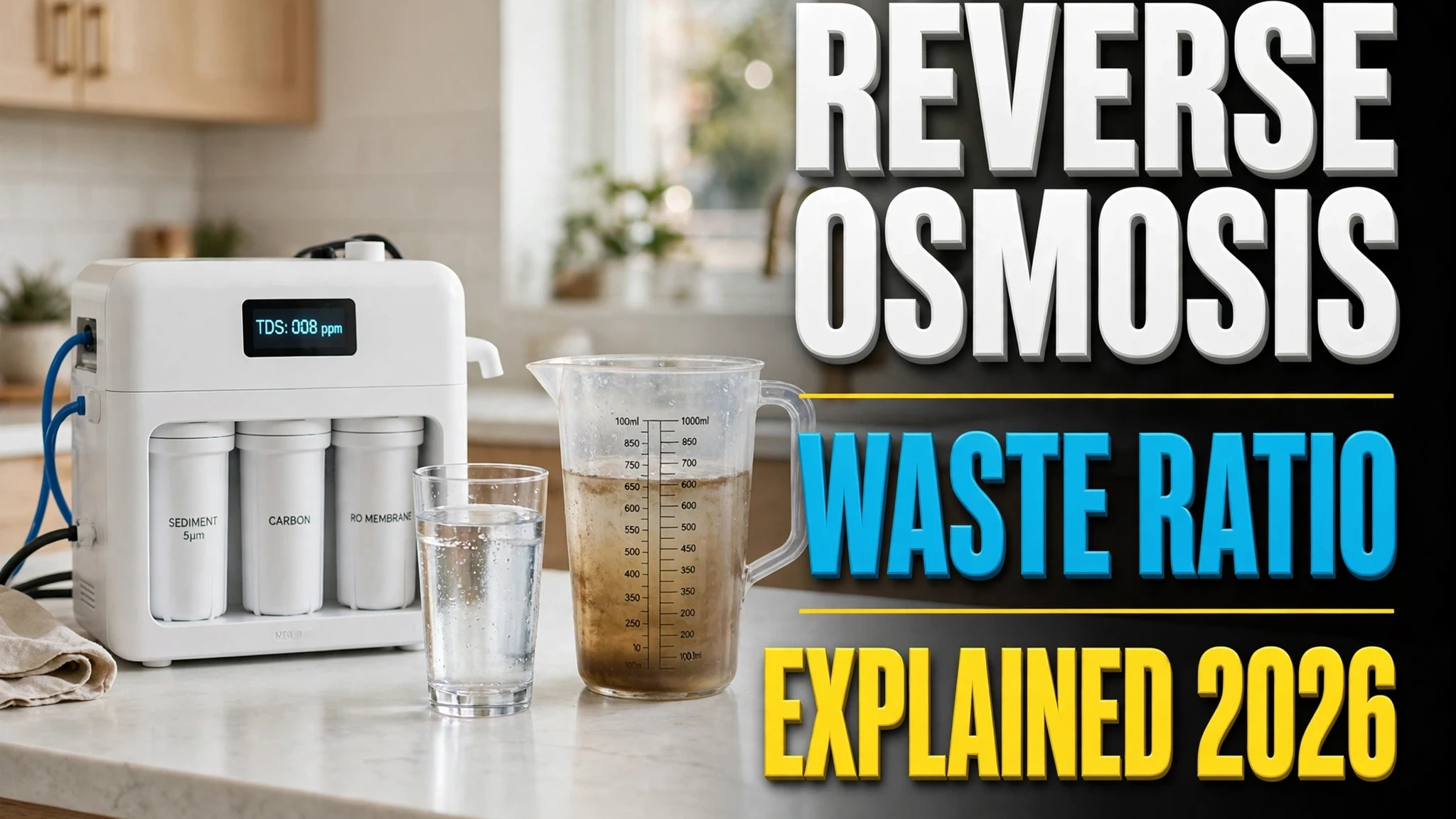
Reverse osmosis forces water through a membrane with pores so tiny that dissolved contaminants cannot pass. The water that gets through is your drinking water; everything rejected gets flushed to the drain in a concentrated stream. That flush stream is the “waste” (or reject/brine) water — and the waste ratio is how much of it goes down the drain per unit of purified water.
Here is where most people get tripped up: the order of the ratio matters, and brands do not always write it the same way. “4:1 waste-to-treated” means four gallons down the drain per gallon of drinking water. “2:1 treated-to-drain” means two gallons of drinking water per gallon drained — the same as 0.5:1 waste-to-treated. The EPA’s WaterSense program writes waste relative to treated water; some brands flip it. Convert both numbers to the same order before you compare.

Recovery rate is the same idea as a percentage: 4:1 waste-to-treated is 20% recovery (one gallon kept of five); 1:1 is 50%.
Real waste ratios by system type
Not all RO systems waste the same amount of water — not even close. The ratio on the box tells you which of the three design generations you are looking at:

| System design | Typical ratio | What it means day to day |
|---|---|---|
| Traditional tank-based RO | 3:1 to 5:1 | Up to five gallons down the drain per gallon of drinking water (EPA: typical point-of-use systems reject five or more per gallon treated) |
| Standard modern RO with shut-off valve and pump | 1:1 to 2:1 | Waste cut by half or more; drain flow stops once the tank is full |
| Tankless direct-flow RO | Around 1:1 | Purified on demand while you draw it; little lost to standby flushing |
| WaterSense-labeled RO | 2.3:1 or better | Must meet the EPA’s efficiency limit of 2.3 gallons of reject water or less per gallon treated |
Two caveats: these figures assume correct installation and timely filter changes — a neglected system runs worse — and a system’s rated daily output (GPD) is a different number from its waste ratio. Keep the two separate.
If you want the model-by-model numbers, our RO waste ratio comparison lines up popular systems side by side.
What pushes your ratio up or down
The spec-sheet number was measured in a lab. Your kitchen is not one — five things move your real ratio:
- Feed water pressure. The biggest lever. Low household pressure forces the membrane to reject more water; a booster pump that restores pressure is the most effective efficiency upgrade there is.
- Water temperature. Cold water moves through the membrane more slowly, so winter ratios run worse than summer ones in cold climates.
- Feed-water TDS and hardness. Dirtier, harder, saltier feed water means more rejected water — and faster membrane clogging.
- Membrane and pre-filter condition. A fouled membrane or clogged pre-filters quietly drag the ratio down over months. The system still makes water; it just wastes more doing it.
- Usage pattern. Short, frequent draw cycles and standby flushing add waste no lab test captures.

How much water an RO really uses per day
Ratios are abstract; buckets are not. A family of four typically drinks and cooks with about 2 to 3 gallons of purified water a day — the rest of the household’s water never touches the RO.
| System ratio | Drain water per day | Drain water per year |
|---|---|---|
| 4:1 (older tank system) | ~10 gallons | ~3,650 gallons |
| 2:1 (modern system) | ~5 gallons | ~1,825 gallons |
| 1:1 (tankless / high-efficiency) | ~2.5 gallons | ~900 gallons |
One more number: rated output is not real output. Owner reports and small lab measurements suggest a 100-GPD membrane typically delivers closer to 45 GPD in real homes — treat GPD as a best-case estimate.
All figures here are estimates for illustration — your numbers depend on the factors above. The point is the shape of the difference: upgrading from an old 4:1 system to a modern one can cut your RO’s drain water by half to three-quarters.
How to cut your RO’s waste: step by step
Whether you own an RO or are about to buy one, here is the practical sequence in the order that matters:
- Buy efficiency first. The cheapest waste reduction is the system choice: pump-assisted or tankless designs, ideally with the EPA WaterSense label (2.3 gallons of reject per gallon treated or less). Our best countertop RO guide compares efficient models.
- Fix low feed pressure. A booster pump is the highest-impact upgrade for a low-pressure home — it brings the membrane back into its efficient range.
- Change pre-filters on schedule. Clogged pre-filters starve the membrane of pressure, which silently worsens your ratio for months.
- Make sure the shut-off valve works. A healthy automatic shut-off valve stops all flow to the drain once the tank is full. Constant drain flow means a failed valve — the first thing to check.
- Consider a permeate pump. It uses the drain stream’s own energy to push purified water into the tank, cutting waste noticeably — a legitimate, widely used upgrade.
- Reuse the reject water instead of sending it to the drain — next section.

What to do with the waste water
Here is the open secret of RO “waste” water: it is not sewage. It is your own tap water, slightly more concentrated — the RO process adds nothing to it. That makes it fine for plenty of non-drinking jobs:
- Watering plants and the lawn — the most popular reuse. Caution: this is RO reject water specifically. A water softener’s salty discharge is a different stream and will harm plants — do not confuse the two.
- Mopping floors and general cleaning
- Washing the car or outdoor surfaces
- Flushing toilets — a bucket of reject water per flush adds up fast

Three caveats: reject water is not automatically suitable for every reuse; do not improvise collection — ask the manufacturer or installer about backflow protection and local rules; and if your RO treats a known contaminant (lead, arsenic, nitrates), get advice on that reject stream first. Treat reject water as non-potable.
Renters who cannot touch the plumbing: a countertop unit with a manual reject tank lets you simply pour the reject water out yourself. See our best countertop water filters for renters.
Is reverse osmosis wasteful?
Fair question — let us put the number in perspective. Your RO only purifies the water you drink and cook with: a few gallons a day. Everything else in your home uses far more water and never goes near the RO. At 4:1, a family might send roughly a bathtub’s worth down the drain per day from the RO; at 1:1, a few buckets. Next to the household’s total water use, the RO’s share is small — and with reuse, close to zero.

The honest framing: an RO uses more water than a pitcher filter, which wastes none. If your tap water only needs better taste, a pitcher is the less wasteful tool. But if you need RO-level reduction of dissolved contaminants, a modern efficient system wastes surprisingly little.
Mistakes to avoid
- Choking the drain line to “save” water. Restricting the reject flow with an improvised valve or kinked tube is not a safe efficiency hack — it can damage the membrane and wreck water quality. Use the right flow restrictor for your membrane instead.
- Ignoring a constantly running drain. Nonstop drain flow usually means a failed shut-off valve or fouled membrane — cheap to diagnose, expensive to ignore.
- Reading the ratio backwards. “2:1 treated-to-drain” is excellent; “2:1 waste-to-treated” is mediocre. Check the order before you buy.
- Running a fouled membrane for years. Output drops and the ratio silently worsens — replace membranes on schedule.
- Reusing reject water blindly. Fine for plants and cleaning in most homes — but if your RO treats a known contaminant, check before you reuse.
- Judging a system by its GPD rating. Rated daily output is a lab best-case; real homes see far less. Size for your actual use, not the brochure.
Low-waste countertop picks
If the waste ratio is your deciding factor, countertop systems have a built-in advantage: many collect the reject water in a tank you empty yourself, so you see exactly how much there is — and can pour it straight onto your plants. The efficient options we researched:

| System | Type | Reported waste ratio | Est. price | |
|---|---|---|---|---|
| AquaTru Classic — our low-waste pick | Countertop RO | ~3:1 (published spec summaries) | ~$449–475 | Check price |
| AquaTru Carafe — compact glass-carafe model | Countertop RO | ~4:1 (third-party lab measurement) | ~$375–395 | Check price |
| PRO+AQUA Elite PRO-100-E GEN2 | Whole-house | Not published — varies by configuration | ~$300–450 | Check price |
The AquaTru ratios above are reported figures from published summaries and a third-party lab measurement, not our own tests. The brand also lists IAPMO certifications for the Classic, which we could not independently confirm — check info.nsf.org before you buy.
For head-to-head waste numbers on the two most compared countertop models, see our AquaTru vs Bluevua waste ratio breakdown — and our portable RO roundup covers travel-friendly options.
The specs
- Featured pick
- AquaTru Classic (4-stage)
- System type
- Countertop RO
- Reported waste ratio
- ~3:1 (published summaries)
- Reject handling
- Manual tank — you pour it out
- Certifications
- Brand-stated IAPMO 42/53/58/401
- Estimated price
- ~$449–475
- Best for
- Waste-conscious buyers, renters
- Skip if
- You need plumbed whole-house RO
Conclusion
The waste ratio is real, but not the deal-breaker the old 4:1 reputation suggests. Buy a modern pump-assisted or tankless system, keep pressure up and pre-filters fresh, make sure the shut-off valve works — and reuse the reject water on your plants. Then your RO’s drain water shrinks to a few buckets a day, most of which never reaches the drain.
FAQs
What is a good waste ratio for a reverse osmosis system?
At or below 2:1 waste-to-purified is good; around 1:1 is excellent. The EPA WaterSense label caps reject at 2.3 gallons per gallon treated — a safe benchmark.
Why does my RO send water to the drain all the time?
A healthy tank system only drains while refilling. Constant flow usually means a failed shut-off valve, a fouled membrane, or very low feed pressure — check the valve first.
Can I drink reverse osmosis waste water?
No — it holds everything the membrane filtered out, concentrated. Use it for plants, cleaning, or flushing toilets instead.
How can I measure my system’s actual waste ratio?
Put the drain tube in a jug and a glass under the faucet, run both for one minute, and compare. Repeat in six months — if the waste side has grown, your membrane or pre-filters need attention.
Is it worth replacing an old 4:1 system just for efficiency?
Often — if the unit is old, your water is pricey or scarce, or a membrane swap is due anyway. Moving 4:1 to 1:1 cuts drain water by roughly three-quarters. But try fresh pre-filters and a working shut-off valve first.
Do countertop RO systems waste less water than under-sink ones?
Often — and always more visibly, since the reject water collects in a tank you empty yourself. Published summaries list the AquaTru Classic at about 3:1; third-party lab measurements put the Carafe at about 4:1.