
Brita Pitcher vs Faucet Filter (2026): Which Should You Buy?
You want Brita-level filtration and you are stuck on the oldest fork in the road: buy the familiar blue pitcher, or screw a small filter system onto your kitchen faucet instead? Same brand, same Budget Filters aisle, similar price — two totally different ways to solve the problem.
Here is the short answer: pick the pitcher for cold, ready-to-pour filtered water in the fridge and a filter that fits every kitchen, whatever faucet you have. Pick the faucet filter for filtered water straight from the tap on demand, with faster flow and Brita’s brand-stated 99% lead reduction at the sink. We compared certifications, yearly cost, and owner reports so you can choose with confidence.
The fridge-cold pick
Brita Pitcher
~$35–41
Cold filtered water ready in the fridge, and it works with every faucet — but you refill it yourself, and gravity filtration is slow.
The on-demand pick
Brita Faucet Filter
~$20–35
Filtered water straight from the tap at a rated 0.58 gpm, with brand-stated 99% lead reduction and no fridge space lost.
The bottom line: a lifestyle choice more than a quality contest. The faucet system gives you filtered water on demand at the tap — no refilling, no waiting for gravity, no fridge space lost — and Brita states it reduces 99% of lead, with NSF/ANSI 42 and 53 certification on the faucet-system Performance Data Sheet. The pitcher gives you cold filtered water ready in the fridge and works with any faucet — but you refill it yourself.
Verdict: heavy tap-water users and most renters should buy the faucet filter; fridge-cold-water drinkers and anyone with a pull-down or sprayer faucet should buy the pitcher.
Not sold on Brita? Our best water filter pitcher roundup covers the full pitcher field — Brita, PUR, and ZeroWater.
Table of Contents
Side-by-side comparison
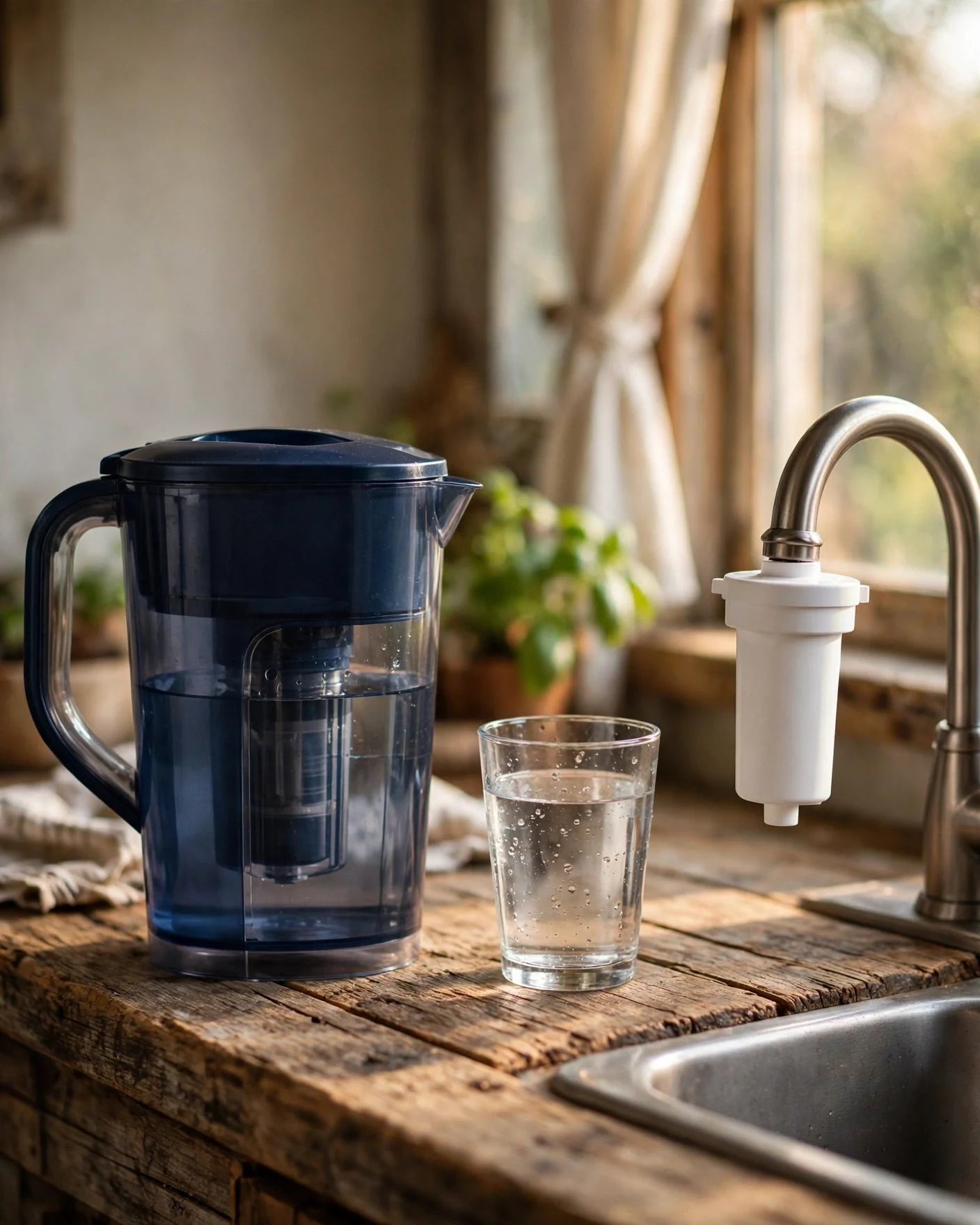
The pitcher column lists both Brita cartridges — Standard (OB03) and Elite (OB06) — because the pitcher is just a vessel; the cartridge decides what it filters. The faucet column reflects Brita’s faucet-mount systems (Basic and Complete, FF-100 / SAFF-100) with the FR-200 replacement filter.
| Feature | Brita pitcher | Brita faucet filter ★ Winner |
|---|---|---|
| Form factor | Pour-through pitcher or dispenser; lives in fridge or on counter | Faucet-mount system; attaches to kitchen faucet spout |
| Flow speed | Slow — gravity filtration, refills take minutes | Fast — 0.58 gpm rated flow at the tap |
| Filter life | Standard OB03: ~40 gal / ~2 months; Elite OB06: ~120 gal / ~6 months | FR-200: ~100 gal / ~4 months |
| Change signal | Lid indicator counts down by pitcher model | Indicator light: green / amber (2 weeks left) / red (change now) |
| Certifications (brand-stated) | Elite OB06: WQA-listed NSF/ANSI 42 and 53 incl. lead; Standard OB03: 42 and 53 listed, not for lead | NSF/ANSI 42 and 53 certified per the FF-100 Performance Data Sheet; brand states 99% lead reduction |
| Yearly filter cost (estimate) | ~$35–40 (Elite) or ~$48–60 (Standard) | ~$45–55 |
| Fridge fit | Takes a full shelf; water comes out cold | No fridge use — water is room temperature |
| Renter-friendliness | Perfect — no faucet contact at all | Good — no tools, no plumber; screws onto a compatible faucet |
| Faucet compatibility | Works with every faucet, even pull-down and sprayer models | Does NOT fit pull-down, pull-out, sprayer, or sensor faucets |
Prices are October 2026 street estimates and they move; filter life is the manufacturer’s rating — your local water changes it.
If neither feels like enough — slow pitchers, faucet clutter — the step up is under the sink. Our pitcher vs under-sink comparison shows when it is worth the jump.
Certifications
Certification is the only place where “what the box says” actually means something. Brita publishes Performance Data Sheets for both lines, and the claims diverge in an important way.
The faucet system
Per Brita’s FF-100 faucet-system Performance Data Sheet, the system is certified by NSF International and by WQA to NSF/ANSI Standards 42 and 53 for the listed reductions. On its current product pages, Brita states the faucet system removes 99% of lead and reduces chlorine (taste and odor), benzene, asbestos, and trichloroethylene at the tap — and lead reduction is indeed listed in the current faucet-system data sheet for the FF-100 / SAFF-100 systems with the FR-200 filter, used with cold water.
The pitcher cartridges
Pitchers are cartridge-dependent. The Elite filter (OB06) is WQA-listed to NSF/ANSI 42 and 53 including lead, rated at 120 gallons or about 6 months. The Standard filter (OB03) is mainly a taste-and-odor product — 40 gallons or about 2 months — not the lead-concern choice. The catch: certification lives on the cartridge, not the plastic pitcher, so an Everyday pitcher kept on Standard cartridges is a taste-only product. Both the faucet system and the Elite pitcher end with certified lead reduction on paper — so make daily routine, not lead, the tiebreaker.

Still weighing the brand itself? Our Is Brita worth it guide puts the whole lineup under the same microscope.
Cost per year
The sticker price matters less than the filter bill — both products are subscriptions you pay in cartridges. Brita assumes an average household uses about 11 cups a day, 240 gallons a year, so we use that baseline:

| Pitcher + Standard OB03 | Pitcher + Elite OB06 | Faucet system + FR-200 | |
|---|---|---|---|
| Device (upfront) | ~$28–30 (Everyday pitcher) | ~$35–41 (Elite pitcher) | ~$20–35 (Basic / Complete faucet system) |
| Filter rated life | 40 gal / ~2 months | 120 gal / ~6 months | 100 gal / ~4 months |
| Filters per year | ~6 | ~2 | ~3 |
| Replacement price (each) | ~$8–10 | ~$17–20 | ~$15–18 (2-packs drop it to ~$15) |
| Estimated yearly filter cost | ~$48–60 | ~$35–40 | ~$45–55 |
Three things jump out. First, the Elite pitcher is cheapest to run — two changes a year — but only if you want its certification story; the Standard-filter pitcher is the most expensive to run despite being cheapest to buy. Second, the faucet filter sits in the middle, though one independent analysis estimates ~$78 a year at 40 gallons a month — more gallons, more filters. Third, the real cost story is convenience: the pitcher needs daily hand-refilling; the faucet filter’s bill buys you instant water. (All figures are approximate street prices.)
Our Is PUR worth it guide runs the same cost math on Brita’s biggest rival.
Owner voices
Owner reviews of both products repeat the same patterns — not one-off complaints.
Faucet filter owners
Leaking at the adapter. The number-one faucet-mount complaint: water weeping where the system meets the faucet. The fix is mundane — check the washer and screen are seated in the mounting nut, hand-tighten the adapter, and tighten the back cover all the way.
It does not fit modern faucets. The complaint that costs people a return: pull-down sprayers, pull-out heads, sensor taps, and some designer faucets are simply incompatible. Check your faucet type before ordering.
The indicator light is a timer, not a sensor. Experienced owners watch flow rate and taste instead — it counts down, it does not measure anything.
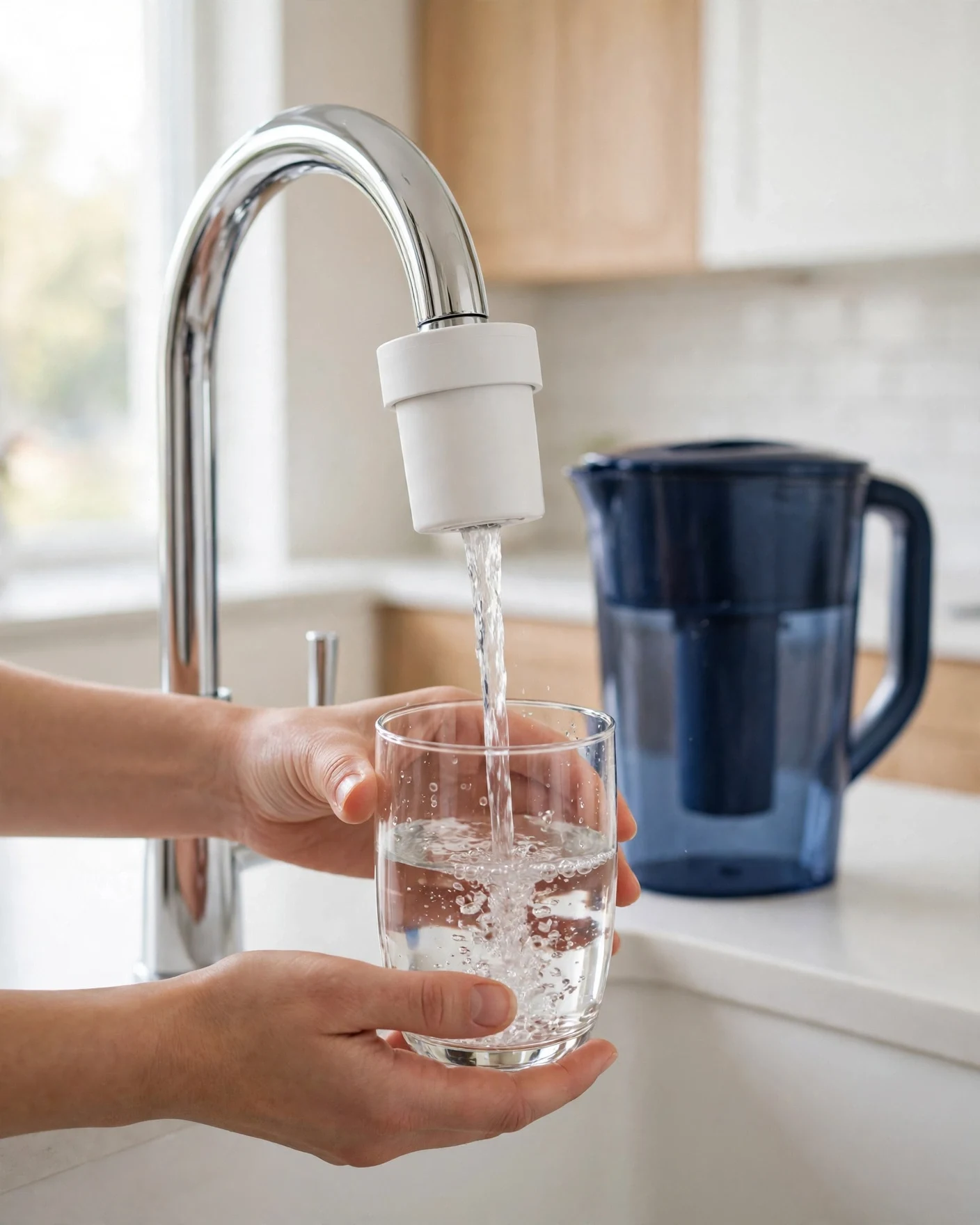
Speed and convenience win praise. The flip side: filtered water on demand without refilling anything, a five-minute no-tools install, and a profile that eats no counter or fridge space. Renters especially praise the no-plumbing aspect.
Pitcher owners
Black carbon specks. The classic Brita complaint: tiny black flecks in the first pitchers from a fresh filter. The manufacturer attributes them to harmless carbon fines; owners say they clear after rinsing and discarding the first pitchers.
The lid falls off. A long-running irritation — the lid has no latch and slides off when you pour a full pitcher.
Refilling gets old. Owners love cold fridge water, then slowly resent the ritual: fill, wait for it to drain, fill again. For households over two people, a 10-cup pitcher is a part-time job.
None are deal-breakers — the pattern that matters is that faucet complaints cluster around installation and fit, while pitcher complaints cluster around daily use. If you are also eyeing the purity-obsessed alternative, our Is ZeroWater worth it guide covers the third way people filter at this price.
Which should you buy?
The bottom line: same brand, different job. The faucet filter is the better buy for anyone who wants filtered water the instant the tap opens — cooking, coffee, filling pots — with brand-stated lead reduction and NSF/ANSI 42 and 53 certification on the faucet-system Performance Data Sheet.
The pitcher wins if cold fridge water is non-negotiable, or if your faucet is pull-down, pull-out, sprayer, or sensor — none fit the mount.
Choose the pitcher if
- You want cold filtered water ready in the fridge — the faucet filter can never give you this.
- You have a pull-down, pull-out, sprayer, or sensor faucet — the mount does not fit these.
- You rent and want zero faucet contact — nothing touches the fixtures.
- You drink modest amounts and do not mind refilling.
Choose the faucet filter if
- You want filtered water on demand — no refilling, no waiting for gravity.
- You cook and brew a lot — filling pots at 0.58 gpm beats pitcher refills.
- You want brand-stated lead reduction at the tap with NSF/ANSI 42 and 53 certification on the faucet-system data sheet.
- You are short on fridge and counter space — the system lives on the faucet.
FAQs
Does the Brita faucet filter remove lead?
Brita states the faucet system reduces 99% of lead, and lead reduction is listed in the current faucet-system Performance Data Sheet for the FF-100 / SAFF-100 systems with the FR-200 filter — used with cold water. Check the current data sheet for your exact model.
Will the Brita faucet filter fit my faucet?
Not every faucet: Brita mounts fit standard threaded kitchen faucets only. Pull-down or pull-out sprayer faucets, sensor faucets, and some designer faucets are out. Check your faucet first — the number-one avoidable return.
Is the faucet filter cheaper to run than the pitcher?
About the same, with the Elite pitcher slightly cheaper. On Brita’s ~240-gallon-a-year household baseline: pitcher + Standard runs ~$48–60 a year (6 filters), pitcher + Elite ~$35–40 (2 filters), and the faucet filter ~$45–55 (3 filters). Heavy users pay more on the faucet mount — one independent analysis estimates ~$78 a year at 40 gallons a month.
Which is better for lead — the Elite pitcher or the faucet filter?
Both carry lead-reduction claims per Brita: the Elite cartridge (OB06) is WQA-listed to NSF/ANSI 53 including lead, and the faucet system is NSF/ANSI 42 and 53 certified with a brand-stated 99% lead reduction. Neither fixes very high lead levels from old service lines. Choose by routine: faucet for instant tap water, Elite pitcher for cold fridge water.
Does either option remove fluoride?
No. Fluoride is not among the certified reductions on either product’s Performance Data Sheet. If fluoride reduction is your goal, you need a different category of product, such as reverse osmosis.
Update log
- Zulqarnain: Review published.