Boroux Legacy vs ProOne (2026): Which Should You Buy?
You are shopping for a stainless steel gravity filter and two names keep landing on your list: the Boroux Legacy and the ProOne Big+. They look almost identical, both hold about 3 gallons. Yet one costs about $399 and the other about $184 to $230, one brags about 80-plus contaminants and the other about certifications, and their replacement filters could not be more different. Picking on looks alone is how you end up with the wrong yearly bill.
Here is the short answer. Buy the Boroux Legacy for the Berkey-style experience with the least upkeep — its elements are rated 12 months a pair, so it is the cheapest to run. Buy the ProOne Big+ if paperwork is the point: its G3.0 elements hold IAPMO listings for lead, total PFAS and microplastics that Boroux cannot match — but elements swap every 6 months, and Culligan, ProOne’s new owner, is phasing the brand out. We researched and compared the specs, listings, costs and owner reports.
The certification pick
ProOne Big+
~$184–230
G3.0 elements hold IAPMO listings for lead, total PFAS and microplastics — but elements swap every 6 months, and Culligan is phasing the brand out.
The least-upkeep pick
Boroux Legacy
~$399
The Berkey-style experience with the least upkeep — Foundation elements rated 12 months a pair, so it is the cheapest to run.
The bottom line: two 3-gallon urns placing opposite bets. The Boroux Legacy bets on element life — a Foundation pair rated 12 months, the cheapest yearly ownership here. The ProOne Big+ bets on paperwork — G3.0 elements listed for lead, total PFAS and microplastics — but swaps run every 6 months and Culligan is winding it down.
Verdict: the Boroux Legacy for most buyers. The ProOne Big+ only if certified lead and PFAS reduction matters more than running cost and brand longevity.
Our Boroux Legacy review covers its build, primer and lab results.
Table of Contents
Side-by-side comparison

Spec for spec, from published specs and certifier listings. Prices are estimates — the ProOne is discounted as stock winds down.
| Feature | Boroux Legacy ★ Winner | ProOne Big+ |
|---|---|---|
| System price (estimate) | ~$399 | ~$184–230 (list $229.95); smaller models ~$130–200 |
| Capacity | 3 gallons (Compact 1.8 gal) | 3 gallons (Big II 2.5 gal; Traveler+ 2.25 gal) |
| Elements included | 2 Foundation (fits up to 4) | 1 G3.0 7-inch (fits up to 3) |
| Element type | Black carbon | Ceramic shell + carbon core |
| Element life (brand rating) | 12 months per pair | 6 months or ~1,000 gal per element |
| Replacement price (estimate) | ~$159 per pair | ~$63–79 each; G2.0 9-inch ~$70–90 |
| Priming | Automatic primer included (~90 sec) | No priming needed |
| Fluoride | Separate Proactive add-on (~$129 est.) | Built into element (brand lab data; not certified) |
| Flow (independent measurement) | ~0.75 gal/hour, 2 elements | ~0.77 gal/hour, 2 elements |
| Warranty / trial | Lifetime chambers; 60-day trial | 5 years steel; 1 year element |
| Best for | Lowest yearly cost, least upkeep | Certified lead + PFAS paperwork |
Prices are October 2026 street estimates; element life is the brands’ own rating.
Our ProOne Big+ review walks through the whole range and the Culligan change.
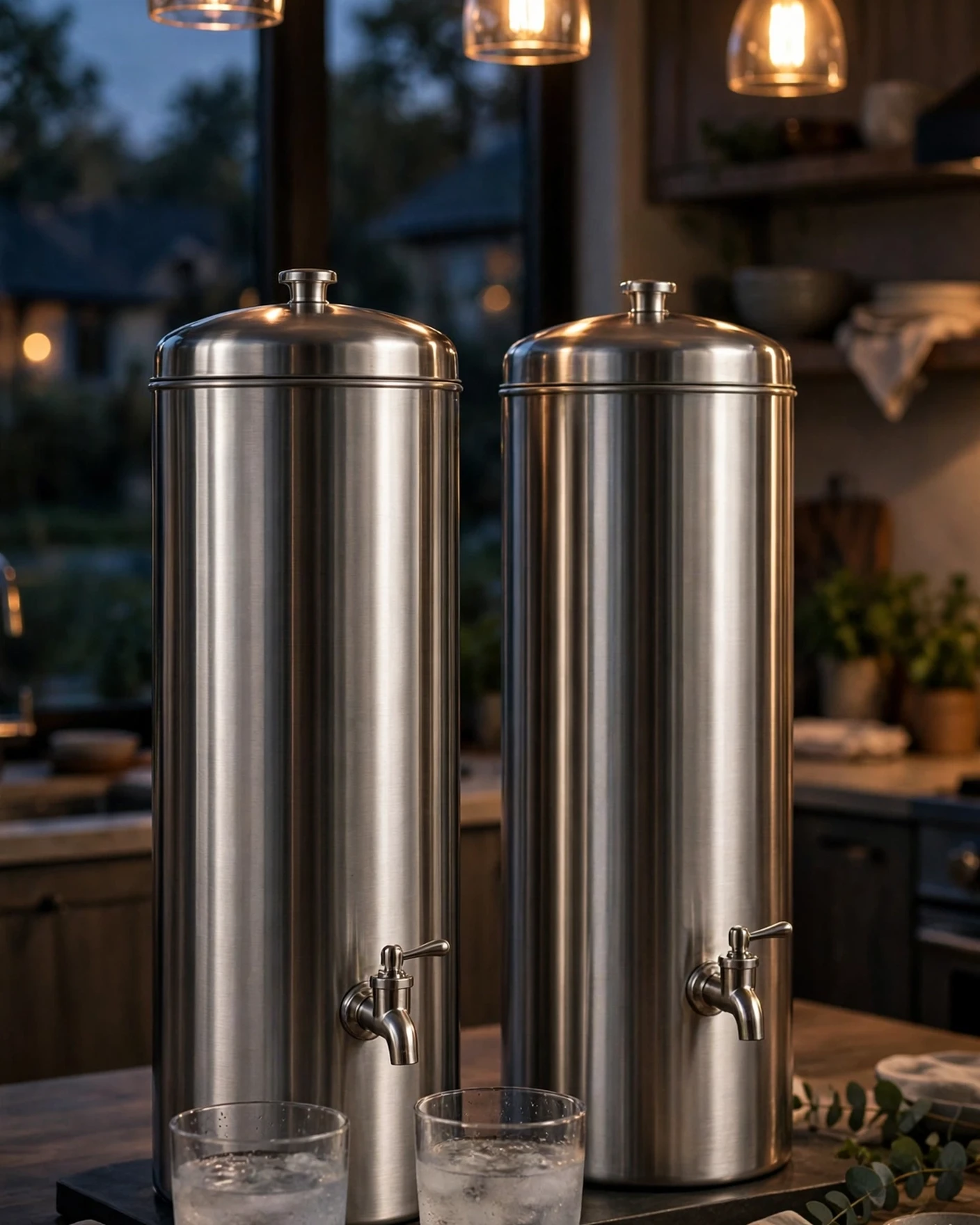
Boroux Legacy — the least-upkeep pick
Pros
- Longest element life here — 12 months a pair, one swap a year.
- Lowest yearly cost — about $159 a year in elements (estimate).
- Auto primer, lifetime chamber warranty, 60-day trial.
Cons
- Highest buy-in — about $399, roughly double the ProOne.
- Listing narrower than the marketing — lead and PFAS rest on brand lab results.
- Fluoride costs extra — a separate add-on, about $129 (estimate).
ProOne Big+ — the certification pick
Pros
- Strongest listings in gravity — lead, total PFAS, microplastics (IAPMO).
- No priming, ever — elements work from the box, can sit dry.
- Cheapest buy-in now — about $184 while stock lasts.
Cons
- Short element life — 6-month swaps, the pricier system to run.
- Small certified capacity — 50 gallons per element (IAPMO listing).
- Brand being phased out — support moves to Culligan MaxClear.
Certifications
This is where the brands part ways. A brand claim, a lab report and a certifier listing are three different things.
Boroux: WQA-certified, but a narrow listing
Boroux states on its FAQ page that its filters are WQA-certified to NSF/ANSI 42, NSF/ANSI/CAN 401 and NSF/ANSI/CAN 372. Our search of NSF’s public database returns zero Boroux listings — the certifications are WQA’s, not NSF’s. The WQA listing is narrow: particulates under 42, microplastics under 401 — and 372 is a lead-free materials standard: made without lead, not certified to remove it. With no Standard 53 listing, Boroux’s lead and PFAS numbers are brand-published lab results only. Boroux is the successor brand from the former Berkey dealer network, launched after the EPA’s 2023 stop-sale order on silver-treated Berkey elements, upheld by the First Circuit on September 18, 2026 (No. 24-1917).
ProOne: the broader listing, with fine print
IAPMO’s database — checked October 2026 — lists the Big+ and Traveler+ to NSF/ANSI 42 (chlorine, chloramine), 53 (lead, total PFAS) and 401 (microplastics), held since October 2024. That combination is rare in gravity. The fine print: certified capacity is just 50 gallons per element — a test capacity, not a swap schedule — and fluoride and cysts are not listed, so fluoride reduction is brand-published lab data. ProOne’s own site still calls the G3.0 only “NSF/ANSI-42 component certified” — trust the database over brand wording. For a certified cyst claim, the British Berkefeld is the outlier — our British Berkefeld review breaks down its NSF listings.
The untreated-water line
One limit covers both: neither is a microbiological purifier. NSF’s P231 listing holds two manufacturers and four products, all faucet-connected or plumbed-in — no gravity-fed system — and Boroux states its filters are “not intended to filter microorganisms.” Use treated tap water, or boil first.
Listings change — look up the exact element in IAPMO’s database or the WQA Gold Seal listings before buying.

Cost per year
The sticker prices say ProOne wins; the calendar says otherwise. At 2 gallons a day, two elements fitted to each, here are the numbers. All prices are estimates.
| Item | Boroux Legacy | ProOne Big+ |
|---|---|---|
| System upfront (estimate) | ~$399 | ~$184–230 |
| Elements bought per year | 1 pair | 4 |
| Yearly element cost (estimate) | ~$159 | ~$252–316 |
| 5-year all-in (estimate) | ~$1,035 | ~$1,515–1,835 |
| Cost per gallon over 5 years | ~$0.28 | ~$0.42–0.50 |
Boroux also quotes up to 6,000 gallons per element — but the 12-month rating is the budget number, since elements age on the calendar. And the ProOne can run on one element, halving its element bill to about $126–158 a year at half the flow. Element economics decide most gravity matchups — the same pattern appears in our British Berkefeld vs Berkey comparison.

Owner voices
The themes below repeat across reviews and teardowns we researched in October 2026.
Boroux Legacy owners
Owners rate the Legacy about 4.8 out of 5 across 449 ratings on Boroux’s site. Praise is consistent: premium-feeling steel, an automatic primer that removes the worst chore of gravity ownership, clean taste, and a lifetime chamber warranty with a 60-day trial behind the $399 price. Complaints repeat too: flow fades as the upper chamber empties — the biggest gripe — and published third-party lab results show cobalt at 6.9 µg/L against a 2 µg/L lab guideline after Foundation use, plus trace benzene and toluene with fluoride filters and the priming pump. Single-run findings, not a verdict.
ProOne Big+ owners
ProOne owners bought paperwork and got it — the IAPMO listings are the reason most cite, and the no-priming elements earn real love from campers. The friction is the calendar: elements every 6 months at about $63–79 each feel like a subscription, the single-element base box is slow, and one reviewer found THM reduction underwhelming at 47%. The newest theme is phase-out anxiety, eased by Culligan’s statement that MaxClear filters fit ProOne housings. Berkey still on your list? Our ProOne vs Berkey comparison covers that matchup.

Which should you buy?
The bottom line: the Boroux Legacy is the better buy for most households — same speed, roughly half the yearly element bill, a brand building up rather than winding down. The ProOne Big+ is the specialist pick: the strongest listing in gravity, bought knowing its 6-month elements and fading nameplate.
Choose the Boroux Legacy if
- You want the lowest yearly cost — about $159 a year, one swap annually.
- You want the Berkey-style experience, improved — auto priming, steel spigot, lifetime chamber warranty.
- Your concerns are taste and chlorine, not one certified claim.
Choose the ProOne Big+ if
- Certified lead and total PFAS reduction decides it — the IAPMO listing is real.
- You accept 6-month swaps and roughly double the yearly cost.
- You accept Culligan MaxClear as the platform’s future, at a low buy-in now.
Prices change often — see the live price before you buy.
FAQs
Is Boroux the same company as Berkey?
No. Boroux came from the team behind BerkeyFilters.com, once the largest Berkey dealer — not affiliated with Berkey. Its Foundation elements come from Clearbrook, the same maker and formulation as the black Berkey-style elements, per Boroux. The split followed the EPA's May 2023 stop-sale order on silver-treated Berkey elements, upheld by the First Circuit on September 18, 2026 (No. 24-1917).
Which filter is actually certified for lead and PFAS?
The ProOne G3.0. IAPMO's listings (checked October 2026) show the Big+ and Traveler+ listed to NSF/ANSI 42 (chlorine, chloramine), 53 (lead, total PFAS) and 401 (microplastics). Boroux's WQA listing covers particulates (42) and microplastics (401) — its lead and PFAS numbers are brand-published lab results, not certification.
Does the ProOne Big+ remove fluoride?
Not as a certified claim — no certifier lists fluoride for it. ProOne's published lab data says the G-series element reduces fluoride in the same cartridge, no add-on needed. Boroux's Foundation elements do not target fluoride; a separate Proactive add-on (about $129, estimate) does. Treat both as lab-data claims.
Which is cheaper to own over five years?
The Boroux, by about $500 to $800 at two gallons a day. Boroux elements run about $159 a year (one pair, rated 12 months); ProOne's run about $252 to $316 a year on the 6-month schedule, two elements fitted. Five-year totals: about $1,035 versus about $1,515 to $1,835.
What happens to ProOne now that Culligan owns it?
Culligan is retiring the ProOne name. Remaining systems sell while supplies last — the Big+ was about $184 in October 2026 checks — and the line continues as Culligan MaxClear. Culligan states MaxClear filters fit ProOne and Propur housings, so owners are not stranded.
Can I use either filter on well water or pond water?
No. Neither is a microbiological purifier: NSF's P231 listing holds two manufacturers and four products, all faucet-connected or plumbed-in — no gravity-fed system — and Boroux states its filters are not intended to filter microorganisms. Use treated tap water, or boil first.
Update log
- Zulqarnain: Review published.