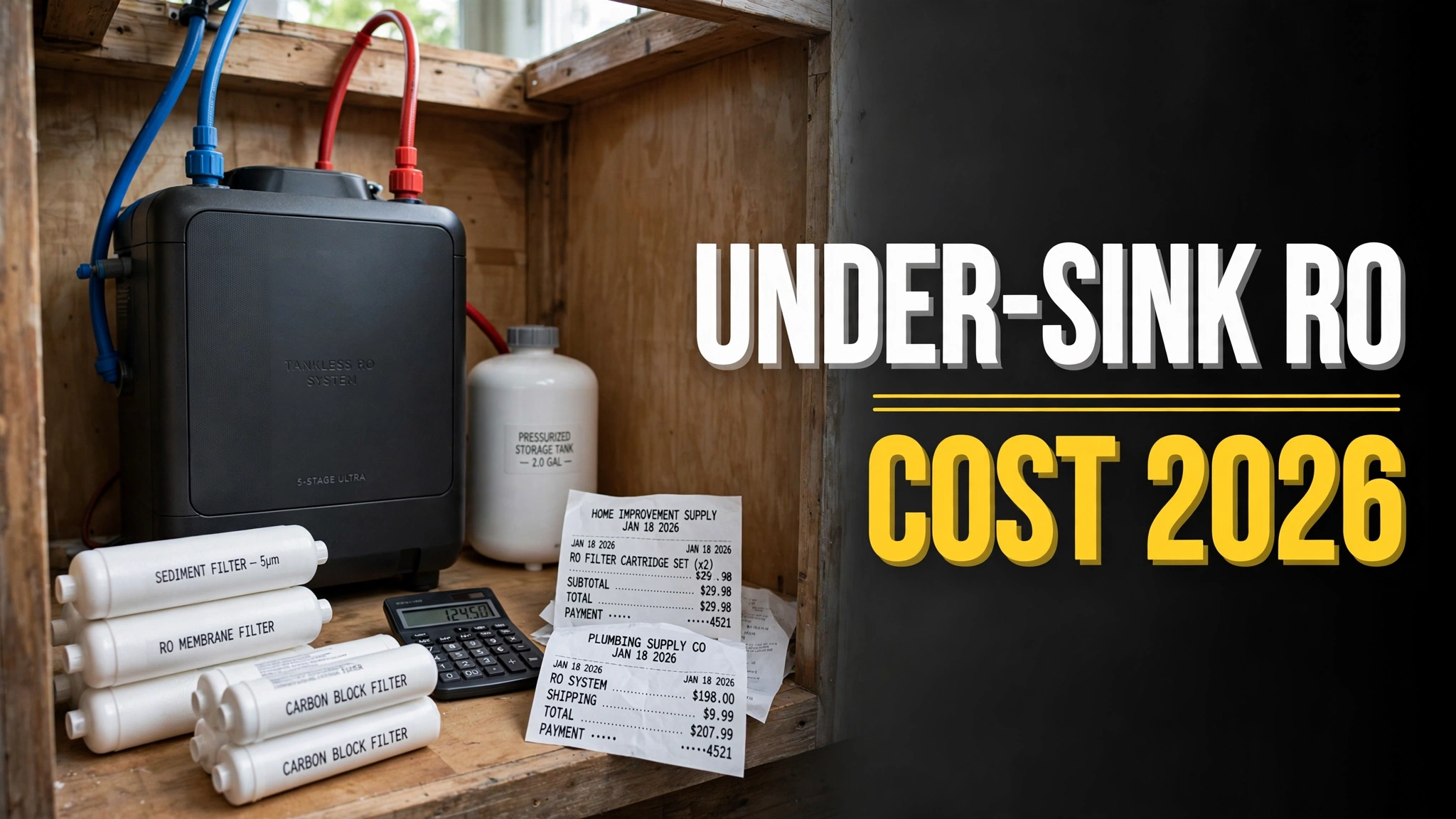

Under-Sink RO System Cost (2026): Real Yearly Math
Guide
An Amazon listing says $198. A plumber quotes $650 installed. A friend says her under-sink RO costs “about a hundred a year” in filters, and a thread swears it is closer to $250. Nobody is lying — they measure different parts of the bill.
Here is the honest answer, worked out line by line: most under-sink RO systems cost roughly $150–$500 for the unit, installation is often DIY ($0) or about $100–$300 for a plumber, and yearly upkeep runs about $60–$175 depending on the tier. Over five years that is $450–$1,475 — and the cheapest box to buy is rarely the cheapest to own. Every number below is an estimate with its method shown, built from manufacturer-listed replacement intervals and current street prices for filter sets.
Check Current PriceTable of Contents
Quick verdict
What an under-sink RO costs upfront
The day-one bill has two parts: the box and the labor. Units span roughly $150–$700 (October 2026 street-price estimates): a basic 5-stage tanked system at the low end, a mid-range 6-stage in the middle, and tankless UV systems and “smart” models at the top. If you compare the tiers first, our best reverse osmosis systems roundup ranks them by value, not just price.
Here is the good news: most under-sink RO systems are built for DIY install — push-fit tubing, a feed-water adapter, and a drain saddle, about an hour under the sink. Labor is $0 for most households. If you hire a plumber, expect roughly $100–$300 (an estimate from homeowner-reported quotes — get a local quote), more if you are adding a fridge line or the cabinet plumbing is cramped.

| System tier | Unit (est.) | Install (est.) | Day-one total (est.) |
|---|---|---|---|
| Budget 5-stage tanked | ~$150–250 | $0 DIY / ~$100–200 plumber | ~$150–450 |
| Mid-range 6-stage | ~$250–400 | $0 DIY / ~$100–300 plumber | ~$250–700 |
| Tankless UV (e.g. SimPure-style) | ~$300–450 | $0 DIY / ~$100–200 plumber | ~$300–650 |
| Premium “smart” RO | ~$400–700 | ~$100–300 plumber | ~$500–1,000 |
One thing listings blur: $150 budget systems usually have a storage tank that eats most of the cabinet, while $300+ tankless systems buy back that space. You are paying for convenience and footprint, not cleaner water. (If contaminant reduction is your goal, look for systems certified to NSF/ANSI 58, the industry standard for reverse osmosis.)
Yearly filter cost math
This is the number that decides the real winner, and almost nobody calculates it. The method: take the manufacturer’s stated replacement interval, multiply by the street price of the replacement part, and you get yearly upkeep. Every figure below is an estimate — the method is visible so you can re-check it. This section answers how much an RO system costs per year and the RO system maintenance cost question for every tier.

| System tier | What you replace | Typical interval | Yearly upkeep (est.) |
|---|---|---|---|
| Budget 5-stage tanked | Sediment + carbon pre-filters (2 swaps), post-filter (1×), membrane prorated over 2–3 yrs | Pre-filters 6–12 mo; membrane 2–3 yrs | ~$60–115/yr |
| Mid-range 6-stage | Larger pre-filter set (2 swaps), post-filter (1×), membrane prorated over 2–3 yrs | Pre-filters 6–12 mo; membrane 2–3 yrs | ~$75–135/yr |
| Tankless UV | Quick-change filter set (1–2×), UV bulb (1 per 1–2 yrs) | Filters 6–12 mo; bulb 1–2 yrs | ~$85–175/yr |
The worked math on a budget 5-stage: a sediment pre-filter at ~$8–15 plus a carbon pre-filter at ~$10–20, swapped twice a year, is ~$36–70. Add a ~$10–20 post-filter yearly and a ~$30–60 membrane amortized over about 2.5 years (~$12–24/yr) and you land at ~$60–115 a year. Tankless systems cost more per year because their quick-twist filter sets run ~$75–150 and a UV bulb needs swapping every 1–2 years — convenience has a price.
Two add-ons to price in: a remineralization/alkaline post-filter is another ~$20–40 a year in replacements — our best RO systems with remineralization guide covers which ones are worth it. And on well water with heavy sediment, pre-filters can clog in 3–4 months instead of 6–12, roughly doubling the pre-filter line of the budget.
5-year total cost of ownership
Add it all up — unit + install + five years of upkeep — and the true price of each tier appears. This is the table to bookmark, because it is the only number that lets you compare systems honestly.

| System | Unit | Install | Upkeep/yr | 5-year total |
|---|---|---|---|---|
| Budget 5-stage tanked | ~$150–250 | $0 DIY | ~$60–115 | ~$450–825 |
| Mid-range 6-stage | ~$250–400 | ~$0–150 | ~$75–135 | ~$625–1,225 |
| Tankless UV (SimPure-style) | ~$300–450 | ~$0–150 | ~$85–175 | ~$725–1,475 |
| Premium “smart” RO | ~$400–700 | ~$100–300 | ~$100–175 | ~$1,000–1,875 |
Method: 5-year total = unit + install + (5 × yearly upkeep). Unit prices are October 2026 street-price estimates; install and upkeep are estimates from homeowner-reported quotes and manufacturer replacement schedules. Your water quality, local labor rates, and how strictly you follow the replacement schedule move the real number — treat these as planning figures, not quotes. Arithmetic note: each row’s total is (unit + install) + 5 × upkeep, checked row by row.
The takeaway: the budget 5-stage is the cheapest water you can buy from an RO system — about $8–$14 a month over five years. Tankless UV costs the most to own because its cartridges are proprietary, but it reclaims your cabinet and delivers water on demand — you are paying for the design, not better water. If your main goal is saving money, the budget tier wins.
Hidden costs people forget
The 5-year table above covers the predictable stuff. The surprises live below it — and they are the difference between a project that lands on budget and one that does not.
Wastewater. A conventional tanked RO system sends roughly 3–4 gallons to the drain for every gallon it purifies — the physics of how the membrane flushes. At 1–2 gallons of drinking water a day, the waste adds roughly $5–$15 a year at typical city water rates (an estimate — your rate varies). Tankless systems usually do better, often around 2:1. On well water there is no water bill to raise at all, just a little extra pump electricity.

Well water eats pre-filters. Sediment, iron, and manganese clog pre-filters in 3–4 months instead of the listed 6–12 — one well-water RO expense city buyers never see. A cheap sediment pre-filter upstream (~$30–60 a year in cartridges) pays for itself by stretching the RO filters. Our best RO systems for well water guide covers which setups handle dirty water without bankrupting you.
Rated output is not real output. A “100 GPD” membrane is rated in lab conditions — warm water, full pressure, clean feed. In real homes, industry sources put actual production at roughly 50–75% of the rating, lower still with cold water or low pressure. That does not change the yearly cost much, but it means buying a bigger GPD rating than you think you need — and a bigger membrane costs more to replace.
Skipped maintenance and skipped testing. The expensive mistake is skipping pre-filter changes: chlorine and sediment foul the RO membrane, and a ruined membrane costs far more than the filters you skipped. And a $20–$50 water test before buying is part of the project cost — it tells you whether you even need RO.
Under-sink RO vs alternatives
Under-sink RO makes excellent drinking water for one tap. But if your needs are different — you rent, you want whole-house treatment, you only drink a little — another option may be cheaper. Same 5-year math, every category, all estimates:

| Option | Upfront (est.) | Upkeep/yr (est.) | 5-year total (est.) | What it covers |
|---|---|---|---|---|
| Pitcher filter | ~$35–45 | ~$50–70 | ~$300–400 | Drinking water only |
| Fridge filter (2 swaps/yr) | $0 (owned) | ~$90–110 | ~$450–550 | Drinking + ice |
| Gravity-fed (ProOne Big+ / Boroux Legacy) | ~$180–350 | ~$60–120 | ~$480–950 | Drinking water, countertop, no install |
| Countertop RO | ~$300–500 | ~$80–150 | ~$700–1,250 | Drinking water, no install |
| Under-sink RO | ~$150–450 | ~$60–175 | ~$450–1,475 | Dedicated drinking tap |
| Bottled water (1 gal/day) | $0 | ~$365–550 | ~$1,825–2,750 | Drinking water only |
The honest read: bottled water is the most expensive way to drink filtered water — even a premium tankless RO costs less over five years than two years of gallon jugs. Gravity-fed systems (no plumbing, no electricity) land between a pitcher and under-sink RO on cost while filtering far more thoroughly, which is why renters love them. Our RO vs bottled water cost comparison goes deeper on that head-to-head.
How to keep the total bill down
DIY the install. Most under-sink RO systems are an hour under the sink with push-fit fittings — deleting a ~$100–$300 labor line is the single biggest day-one saving on this page. Pick standard 10-inch housings where you can: generic replacement cartridges are far cheaper than proprietary quick-twist sets. Change pre-filters on schedule — every skipped change is borrowed time on the expensive membrane. Do not over-buy GPD or stages — a 100 GPD 5-stage is plenty for a drinking tap; extra stages are replacements you buy forever. For the cheapest systems worth buying, see our best budget RO systems.
Conclusion
An under-sink RO system costs roughly $150–$500 upfront (often with $0 DIY install), then ~$60–$175 a year in upkeep — putting 5-year ownership between about $450 and $1,475 by tier. The cheapest box is rarely the cheapest to own, tankless buys convenience at a higher yearly price, and bottled water loses the money comparison almost every time. Budget from the 5-year table, change pre-filters on schedule, and buy only the capacity your household drinks.
FAQs
How much does an under-sink RO system cost per year?
Roughly $60–$175 a year by tier: a budget 5-stage tanked system runs about $60–$115 a year (pre-filters twice a year, post-filter yearly, membrane prorated over 2–3 years), a mid-range system about $75–$135, and a tankless UV system about $85–$175 because its quick-change cartridges and UV bulb cost more. All estimates — the method is in the yearly math table above, and your water quality and change schedule move the number.
Is reverse osmosis worth it?
If you buy bottled water, almost always — a household spending $50–$100 a month on bottled water typically recoups an under-sink RO investment within 12–18 months, and the 5-year cost of ~$450–$1,475 is usually less than two years of bottled water. If your tap water is already low in dissolved solids and tastes fine, it is harder to justify. Test your water first; RO earns its keep when there is a real problem to solve — high TDS, chlorine taste, or known contaminants.
How much water does an RO system waste, and does it raise the water bill?
A conventional tanked RO system sends roughly 3–4 gallons to the drain for every gallon it purifies. That sounds alarming until you run the math: at 1–2 gallons of drinking water a day, the waste adds roughly $5–$15 a year at typical city water rates — noticeable to your conscience more than your bill. Tankless systems usually do better, often around 2:1. On well water there is no water bill to raise at all.
How often do you need to replace RO filters?
The standard schedule: sediment and carbon pre-filters every 6–12 months, the RO membrane every 2–3 years, and the carbon post-filter every 12 months. On well water with heavy sediment, pre-filters can need swapping every 3–4 months instead. Skipping pre-filter changes is the expensive mistake — chlorine and sediment foul the membrane, and a ruined membrane costs far more than the filters you skipped.
Can I install an under-sink RO system myself?
Yes — most under-sink RO systems are built for DIY install with push-fit tubing and take about an hour under the sink, which is why so many households pay $0 for labor. You need basic cabinet access, a cold-water feed with a saddle or adapter valve, and a drain connection for the reject water. If your plumbing is cramped or you are adding a fridge line, a plumber typically charges ~$100–$300 — an estimate, so get a local quote.