
EDR4RXD1 Replacement (2026): Fit, Reset & Cost Guide
Guide
The red filter light on your Whirlpool, Maytag, KitchenAid, or Amana fridge just came on, and your manual says to buy an EDR4RXD1. So you look it up — and the listings are full of UKF8001s, 4396395s, and suspiciously cheap “compatibles” that may or may not be the same filter. Which part number is really the right one? Is the genuine EveryDrop worth twice the price? And how do you make that red light go away?
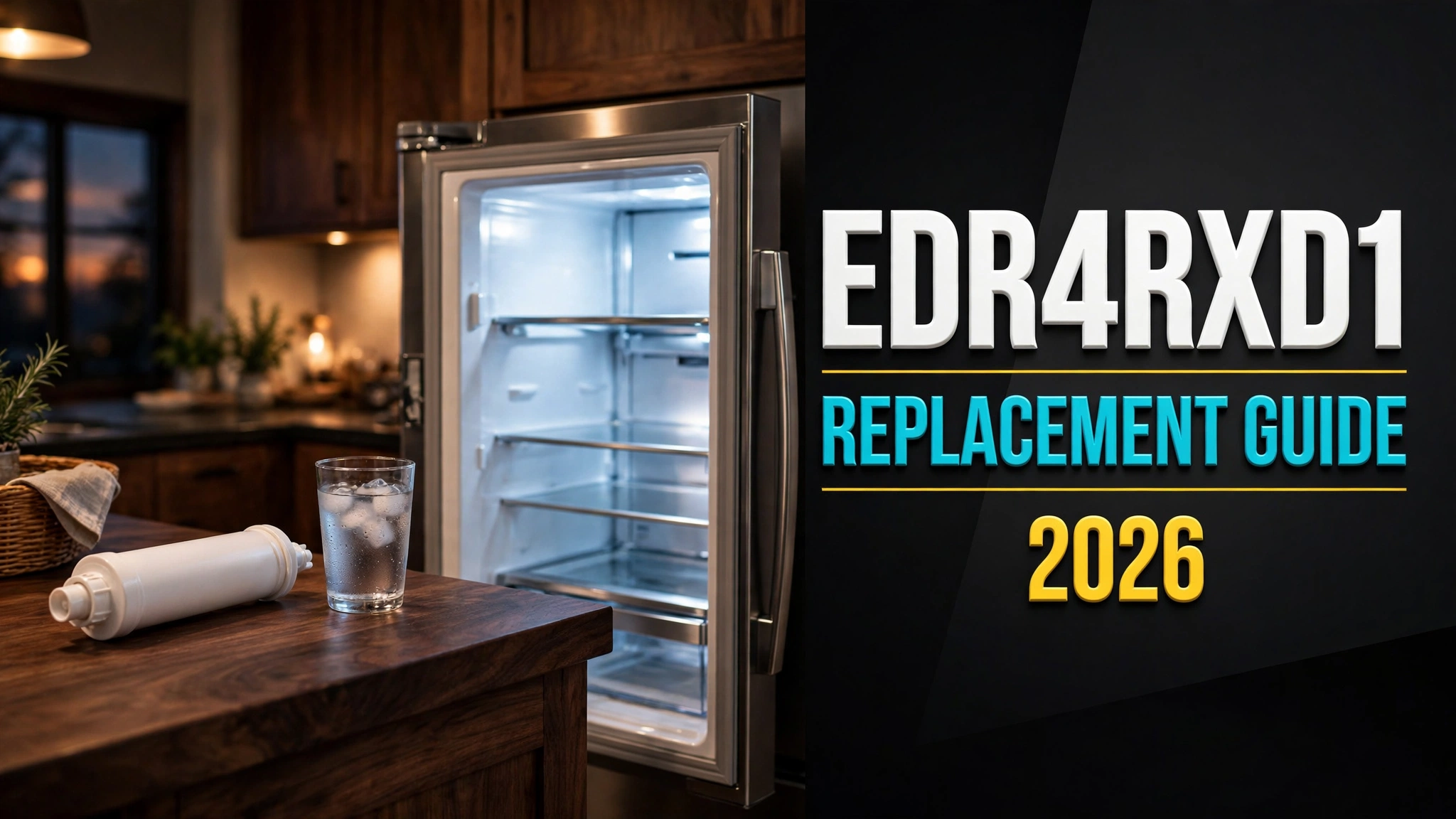
Here is the short answer: the EDR4RXD1 is Whirlpool’s EveryDrop Filter 4, and it is the same filter sold under the UKF8001 and 4396395 numbers — those aliases are interchangeable. It is rated for 6 months (or 200 gallons), Whirlpool’s brand pages state NSF/ANSI 42, 53, and 401 certification including certified lead reduction, and the swap takes about two minutes. The red light is a timer, not a sensor — it resets with a button sequence that depends on your fridge brand. Genuine cartridges run roughly $90–120 a year; decent compatibles run under $40. This guide covers which models it fits, genuine vs compatible, the reset steps for each brand, and the real yearly math.
Check Current PriceTable of Contents
Which models it fits

The EDR4RXD1 is a twist-in cartridge for the Whirlpool family of brands: Whirlpool, Maytag, KitchenAid, and Amana refrigerators that use EveryDrop Filter 4. You will find the housing inside the fresh-food compartment — usually in the upper-right corner or behind the base grille, depending on the model — feeding both the water dispenser and the ice maker. If your fridge has a filter on the back wall or a different cartridge shape, you need a different part number.
The confusing part is the naming: the same filter is sold under several part numbers. Any of these on your old cartridge means the EDR4RXD1 is the right replacement:
| Part number | What it is |
|---|---|
| EDR4RXD1 | Current EveryDrop Filter 4 part number |
| UKF8001 / UKF8001AXX / UKF8001-750 | Earlier EveryDrop Filter 4 packaging codes |
| 4396395 | Whirlpool service part number, same filter |
| W11256135 / W11311161 | Whirlpool system codes replaced by EDR4RXD1 (per KitchenAid) |
| 6700-series numbers | Legacy codes (e.g. 67002671, 67003523, 67003591, 67003727, 67006474, 67006637) |
| OWF50 / OWF51 / WF50 variants | Amana and Maytag cross-reference numbers |
The fastest check is still the rating plate inside your fridge or the label on the old cartridge itself — if the shape matches and one of the numbers above appears, it fits.
- Brand
- EveryDrop by Whirlpool
- Filter model
- EDR4RXD1 (Filter 4)
- Fits brands
- Whirlpool, Maytag, KitchenAid, Amana
- Rated life
- 6 months / 200 gallons
- Certifications (brand-stated)
- NSF/ANSI 42, 53, 401 — 31 contaminants incl. lead
- Replaces
- UKF8001, 4396395, W11256135, W11311161
- Typical genuine price
- ~$45–60 (estimate)
Shopping by model number instead of by brand is always the safer path. LG owners can run the same lookup in our LG LT1000P replacement guide, and the tall Samsung cartridge has its own page in our Samsung HAF-QIN replacement guide.
Genuine vs compatible

Third-party EDR4RXD1 compatibles are everywhere, often at a third of the genuine price. The housings match, the water flows, and most owners report no leaks. We researched and compared rather than guessing, and the honest answer is: what the genuine cartridge buys you is certification.
Whirlpool’s brand pages state that the genuine EveryDrop Filter 4 is NSF certified to reduce 31 contaminants, including lead, pesticides, and pharmaceuticals — the NSF/ANSI 42, 53, and 401 categories — and KitchenAid’s product page states the filter is certified to reduce 99% of lead. Most compatibles carry only the brand’s own claims, which is not the same as a listed certification. If you go third-party, pick a brand that appears in the NSF database at info.nsf.org and be wary of “genuine” listings at impossibly low prices — counterfeit fridge filters are a real and common problem.
Genuine EveryDrop — pros
- Widest certified claim set — brand-stated NSF/ANSI 42, 53, and 401 including certified lead reduction (per KitchenAid’s product page).
- Exact-fit housing — built to Whirlpool’s dimensions, so sealing and valve engagement are never a question.
- Certified in a checkable way — you can look up the claims in the NSF database at info.nsf.org.
Genuine EveryDrop — cons
- 2–3x the price of compatibles — the certification costs real money every six months.
- Counterfeits are common — “genuine” multi-packs at rock-bottom prices are usually fakes; buy from reputable sellers.
- Brand-stated, not lab-verified by us — we researched and compared the published claims; we did not run lab tests.
| Genuine EveryDrop | Third-party 3-pack | Third-party single | |
|---|---|---|---|
| Price per filter | ~$45–60 | ~$15–17 | ~$15–20 |
| Rated life | 6 months / 200 gal | 6 months / 200 gal (claimed) | 6 months / 200 gal (claimed) |
| Certification | NSF/ANSI 42, 53, 401 (brand-stated) | Varies: some listed, most brand-stated only | Usually brand-stated only |
| Lead reduction | Certified (brand-stated) | Rarely certified | Rarely certified |
| Fit | Exact | Matches dimensions | Matches dimensions |
| Best for | Certified lead reduction and exact fit | Budget rebuy in bulk | Trying one before committing |
One reassurance: using a compatible filter does not void your fridge warranty. Under the Magnuson-Moss Warranty Act, a manufacturer generally cannot void coverage just because you used a third-party part — though a leak caused by a badly made cartridge is still on you, which is another reason to pick a listed brand.
We ran the same genuine-vs-compatible math for Frigidaire’s filters in our WF3CB vs ULTRAWF comparison, and for Samsung’s slim cartridge in our Samsung DA29-00020B replacement guide — the pattern is identical: the genuine cartridge buys you the checkable certification, the compatible buys you the savings.
Reset instructions

The filter light does not reset itself, so do this every time you change the cartridge. First, the swap itself — no tools needed, about two minutes:
- Remove the old cartridge. Turn it counterclockwise about a quarter-turn and pull it straight out. A little water may spill — keep a towel handy.
- Insert the new cartridge. Unwrap it, insert the end into the filter head, and turn clockwise until it stops. A filter that is not fully seated is the number-one cause of slow flow after a swap.
- Flush the dispenser. Run 2–4 gallons through the water dispenser before drinking. The water may look grey or cloudy at first — that is carbon fines and trapped air from the new cartridge, and it clears as you flush.
- Reset the indicator light. The sequence depends on your fridge brand:
- Whirlpool and KitchenAid: press and release the LIGHT button 5 times quickly.
- Maytag: press and hold the LIGHT and LOCK buttons together until the water filter light flashes.
- Amana: press and hold the AUTO and DISPENSER LOCK buttons together for about 4 seconds until the indicator flashes.
If your fridge has no filter indicator at all, Whirlpool’s literature recommends replacing the cartridge every 6 to 9 months anyway — and the official recommendation is every 6 months or 200 gallons, whichever comes first. Do not wait for a taste change.
GE fridges use completely different reset buttons for the same job — our GE XWFE replacement guide walks through the GE sequence step by step.
Cost per year

The filter is rated at 6 months or 200 gallons, so a normal household buys two cartridges a year. The yearly cost is just two times the per-cartridge price:
| Option | Price per cartridge | Cartridges per year | Estimated yearly cost |
|---|---|---|---|
| Genuine EveryDrop (single) | ~$45–60 | 2 | ~$90–120 |
| Genuine EveryDrop (2-pack) | ~$40–55 each | 2 | ~$80–110 |
| Third-party 3-pack | ~$15–17 | 2 | ~$30–34 |
| Third-party single | ~$15–20 | 2 | ~$30–40 |
The gap is real: genuine costs about 2–3 times the compatible per year — roughly $60–80 more annually — for the brand-stated NSF/ANSI 42, 53, and 401 claims, including certified lead reduction. A 3-pack of compatibles covers a full year with one cartridge to spare, which is why so many owners buy them in bulk. And remember: prices move constantly, so treat these as estimates and check the live listing before you buy.
For a second data point on fridge-filter math, Samsung’s slim cartridge runs a similar yearly pattern — our Samsung DA29-00020B replacement guide breaks it down the same way.
Conclusion
The EDR4RXD1 is one of the simplest filters to live with: one part number (with a few aliases) covers the whole Whirlpool family, the swap takes two minutes, and the light resets with a short button sequence once you know your brand’s combination. Genuine cartridges run roughly $90–120 a year for the brand-stated NSF/ANSI 42, 53, and 401 claims, including certified lead reduction; a decent compatible cuts that under $40. Buy the genuine if you want the certified cartridge, buy a listed compatible if you want the savings — and either way, change it on schedule, because a filter you leave in too long is just plumbing.
Update log
FAQs
Which fridge models use the EDR4RXD1?
Whirlpool, Maytag, KitchenAid, and Amana refrigerators that take EveryDrop Filter 4 — that is, any fridge whose manual or old cartridge lists EDR4RXD1, UKF8001, UKF8001AXX, 4396395, W11256135, W11311161, or the 6700-series legacy numbers. The fastest check is the rating plate inside the fridge or the label on the old cartridge itself.
What part numbers does the EDR4RXD1 replace?
The EDR4RXD1 replaces the UKF8001 and 4396395 directly — they are the same filter under different numbers. KitchenAid also lists it as the replacement for W11256135 and W11311161. Legacy 6700-series codes (such as 67002671, 67003523, and 67003727) and the Amana/Maytag OWF50, OWF51, and WF50 cross-references point to the same cartridge as well.
Are compatible EDR4RXD1 filters as good as the genuine EveryDrop?
For fit, usually yes — the housings match and most owners report no leaks. For certification, that is where they differ: the genuine EveryDrop is stated by Whirlpool’s brands to be NSF/ANSI 42, 53, and 401 certified, including certified lead reduction, while most compatibles carry only the brand’s own claims. If you buy third-party, pick a brand that appears in the NSF database and be wary of “genuine” listings at impossibly low prices.
How do I reset the water filter light after replacing the EDR4RXD1?
It depends on your fridge brand: on Whirlpool and KitchenAid, press and release the LIGHT button 5 times quickly; on Maytag, press and hold the LIGHT and LOCK buttons together until the indicator flashes; on Amana, press and hold the AUTO and DISPENSER LOCK buttons together for about 4 seconds until the indicator flashes. The light is a timer and does not reset itself. Button layouts vary by model and year, so check your manual if these do not work.
How often should I replace the EDR4RXD1?
Every 6 months or 200 gallons, whichever comes first — that is the official recommendation. If your fridge has no filter indicator, Whirlpool’s literature suggests 6 to 9 months. Households with hard water or heavy sediment may need to swap sooner: slow dispenser flow or a taste change are the practical signals.
Does the EDR4RXD1 remove lead?
KitchenAid’s product page states that the EveryDrop EDR4RXD1 is certified to reduce 99% of lead, and the filter is brand-stated as NSF/ANSI 42, 53, and 401 certified across 31 contaminants. That is the brand’s certification claim — you can verify the listing yourself in the NSF public database at info.nsf.org. If lead is your main concern, a water test is still the smart first step.
Does using a compatible filter void my refrigerator warranty?
Generally, no. Under the Magnuson-Moss Warranty Act, a manufacturer generally cannot void coverage just because you used a third-party part. A leak caused by a badly made cartridge is still on you, though — which is another reason to buy compatibles from listed, reputable brands rather than mystery sellers.