
AquaTru vs Bluevua (2026): Which Should You Buy?
You want reverse-osmosis water without calling a plumber. No drilling a hole in the countertop, no tubing snaked under the sink, no landlord conversation. So you narrow it down to the two names that dominate every countertop-RO search: AquaTru, the certification-first veteran, and Bluevua, the newer brand with the glass carafe and the friendlier price. And now you are stuck, because every result seems to pick one of them for a different reason.
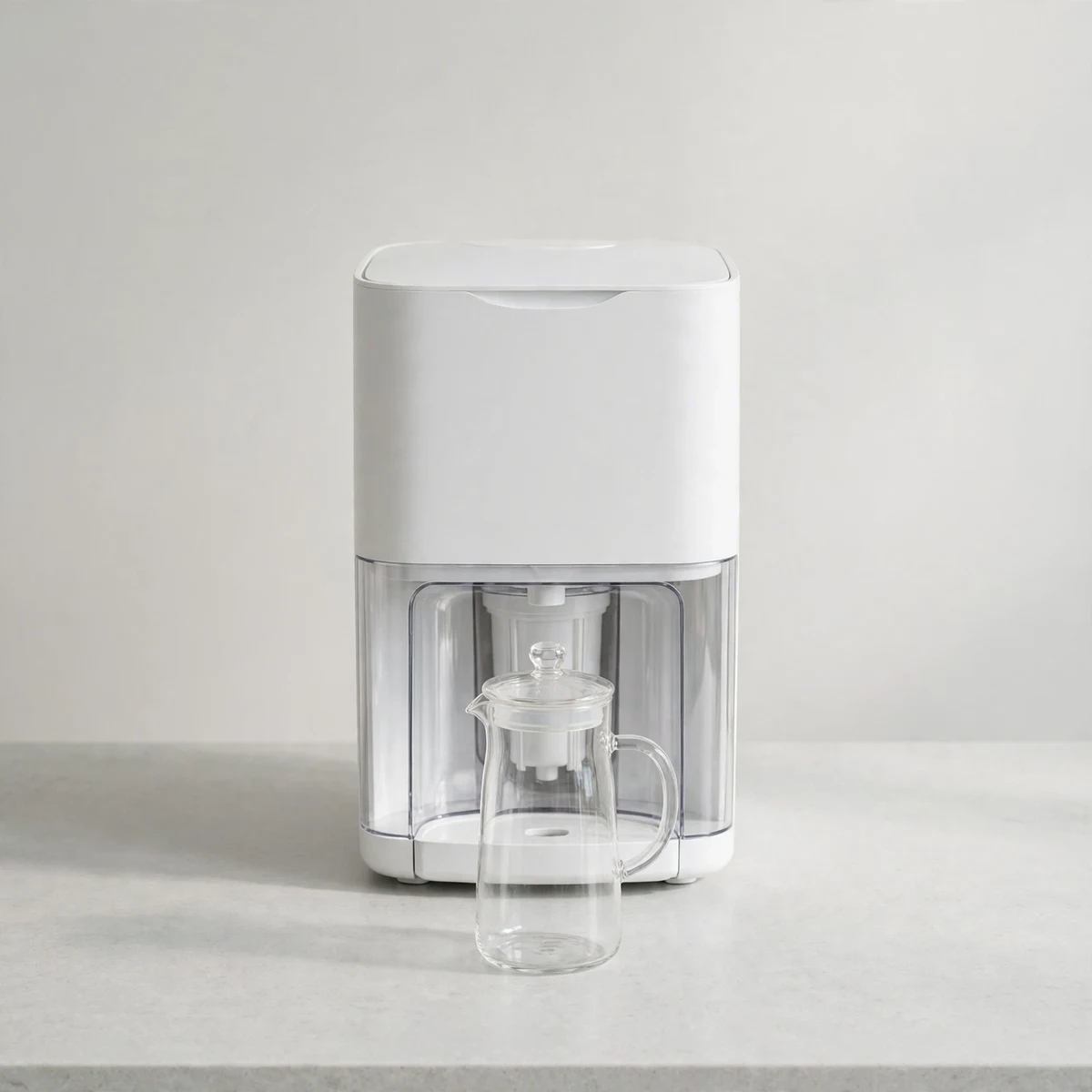
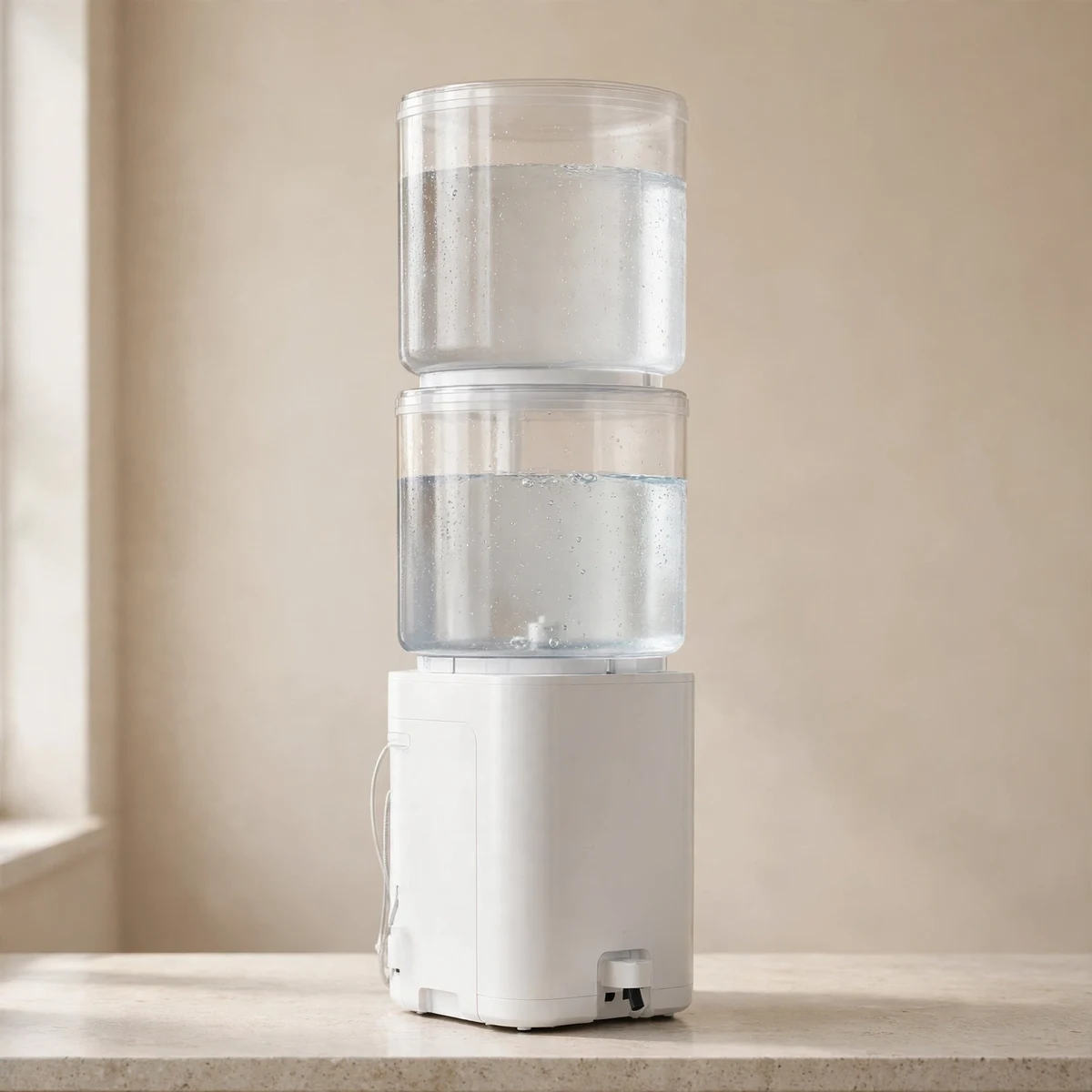
Here is the honest short answer after researching spec sheets, certification records, published lab-test write-ups, and hundreds of owner reviews: AquaTru Classic is the safer pick if certified contaminant reduction is your priority — its IAPMO certification to NSF/ANSI 42, 53, 58, and 401 (as stated by the brand and reported by independent reviewers) is the deepest in the category. Bluevua ROPOT is the better value if budget, a small footprint, and a glass carafe matter more to you — independent lab testing of the ROPOT is strong, but its formal contaminant-reduction certification is limited. The price gap is real too: roughly $280–330 for the ROPOT (estimate) versus $449–475 for the Classic (estimate). This comparison breaks down certifications, yearly cost, water waste, and what owners actually complain about, so you can match the machine to your kitchen instead of guessing.
The value pick with the glass carafe
Bluevua ROPOT
~$280–330
Roughly $150–170 cheaper with a 60 oz glass carafe and strong independent lab results — but no broad contaminant-reduction certification.
The certification-first veteran
AquaTru Classic
~$449–475
Brand-stated IAPMO certification to NSF/ANSI 42, 53, 58, and 401 — the deepest in the category — with a 0.75-gallon clean tank.
The bottom line: buy the AquaTru Classic if your top concern is independently verified filtration — it is the only one of the two with broad, brand-stated IAPMO certification to NSF/ANSI 42, 53, 58, and 401, and it holds more water per cycle. Buy the Bluevua ROPOT if you want the best value and the nicest daily experience: it costs roughly $150–170 less (estimates), comes with a glass carafe instead of plastic tanks, and independent lab testers rate its filtration performance highly — you just give up the deep certification paperwork.
Verdict: AquaTru for proof, Bluevua for value and convenience. Renters and small kitchens lean Bluevua; lead- and PFAS-conscious buyers lean AquaTru.
Price checked at time of writing; it changes often — see the live price before you buy.
Table of Contents
Side-by-side comparison

The two machines look like twins on a spec sheet — countertop RO, no plumbing, TDS monitor — until you read the fine print. Here is the head-to-head that matters:
| AquaTru Classic ★ Winner | Bluevua RO100ROPOT | |
|---|---|---|
| Price (est.) | ~$449–475 | ~$280–330 (standard) |
| Filtration stages | 4-stage: mechanical pre-filter, activated carbon, RO membrane, final carbon | Multi-stage RO: pre-filter, RO membrane, post-carbon; remineralization on standard/UV models |
| Capacity | 0.75-gal clean tank; ~3-quart tap-water tank | 100 oz batch; 60 oz glass carafe (standard) / 40 oz (Lite) |
| Pure-to-drain ratio | 4:1 advertised; independent testers report ~3:1 | 3:1 (brand claim); 2:1 on some UV listings |
| Certifications | IAPMO to NSF/ANSI 42, 53, 58, 401 + 372 (brand-stated, independently reported) | WQA to NSF/ANSI/CAN 372 (lead-free materials) — no broad contaminant-reduction certification |
| Glass carafe | No — BPA/BPS-free Tritan plastic tanks | Yes — borosilicate glass carafe |
| Remineralization | Optional VOC/mineral-boost filter (costs extra) | Included on standard and UV models (taste, not health) |
| TDS monitor | Yes | Yes |
| Footprint | ~12″ × 14″ × 14″ | ~10.9″ × 15.4″ × 14.3″ |
| Filter life | Pre/VOC filters ~600 gal; RO membrane ~1,200 gal | 12–24 months (brand) |
| Yearly filter cost (est.) | ~$100–130 | ~$75–120 (after year one) |
| 5-year total (est.) | ~$950–1,125 | ~$580–810 |
| Warranty | 1-year limited | 1-year limited |
| Best for | Certification-first buyers, small families | Renters, small kitchens, value buyers |
One matchup note: the fairest glass-carafe-versus-glass-carafe fight is not Classic vs ROPOT — it is AquaTru Carafe vs Bluevua ROPOT-Lite. The AquaTru Carafe (~$375–395 est.) is the brand-stated IAPMO 42/53/58-certified compact unit with a glass carafe, at near price parity with the ROPOT-Lite(UV) (~$369 est.). If a glass carafe is non-negotiable for you, our AquaTru Carafe review covers that side of the matchup in full.
AquaTru Classic — the certification-first veteran
Pros
- Deepest certification in the category — brand-stated IAPMO certification to NSF/ANSI 42, 53, 58, and 401, independently reported by reviewers; includes lead and PFOA/PFOS coverage under those standards.
- Bigger clean-water tank — 0.75 gallons per cycle suits small families better than the ROPOT’s smaller batches.
- Strong independent lab backing — third-party testing has measured single-digit TDS and PFAS analytes below reporting limits (published test results, not certifications).
- Efficient on paper — the brand advertises a 4:1 pure-to-drain ratio, the best claim of any countertop RO we have seen.
Cons
- The price premium is steep — roughly $150–170 more than the ROPOT (estimates), before filters.
- Plastic tanks — BPA/BPS-free Tritan, but still plastic; the ROPOT’s glass carafe feels nicer to live with.
- Slow and hands-on — about 10–15 minutes per gallon, and you empty reject water from the tap tank before every refill.
- Footprint — ~12″ × 14″ × 14″ is a permanent countertop commitment.
Price checked at time of writing; it changes often — see the live price before you buy.
Bluevua ROPOT — the value pick with the glass carafe
Pros
- Better value — roughly $150–170 cheaper upfront (estimates) and cheaper per year to run.
- Glass carafe — 60 oz of borosilicate glass; filtered water that pours and stores like it came from a nice pitcher.
- Strong independent lab results — BOS Water’s lab testing scored it 4.49/5 and WaterFilterGuru scored it 8.68/10 (third-party reviews, not our testing).
- Smaller and more renter-friendly — compact footprint, plug in and fill by hand, take it with you when you move.
Cons
- No broad contaminant-reduction certification — the WQA certificate covers NSF/ANSI/CAN 372 (lead-free materials) only; contaminant claims are manufacturer claims without certification backing.
- Slower in real kitchens — rated flow 0.26 L/min; owners report about five minutes for a full container.
- Wastewater handling — 3:1 pure-to-drain (brand claim), and you empty a waste tray by hand; auto-flushing adds to total water use.
- Hard water slows it down — mineral buildup reduces fill speed over time; vinegar descaling is the documented fix.
Why you should trust this comparison
We did not receive test units and we did not run lab bench tests. Claiming hands-on testing we never did would be dishonest, so we will not do it.
What we did instead was research and comparison: we pulled the manufacturers’ spec sheets and listing claims, checked certification claims against what certifier databases and third-party analysts actually show, collected published lab-test results from independent reviewers, read hundreds of owner reviews to find the complaints that keep repeating, and ran the replacement-cost math from rated filter life and listed prices. Every section says what it is based on, so you can check the reasoning yourself.
Certifications
This is the section that decides the comparison for a lot of buyers, and it is where the two brands are furthest apart.

AquaTru Classic: the brand states IAPMO certification to NSF/ANSI 42, 53, 58, and 401 (plus 372 for lead-free materials), and independent reviewers — World Water Reserve and BuyBetterWithBrian — report the same listing. We could not re-pull the live IAPMO directory entry ourselves (it loads as a JavaScript app), so treat this as brand-stated and independently reported rather than directory-verified by us, and confirm the listing before you buy. As reported, the coverage breaks down roughly as: 58 for TDS plus lead, fluoride, arsenic-V and nitrate/nitrite; 53 for PFOA/PFOS and VOCs; 401 for microplastics; 42 for chlorine taste and odor. Two cautions from our verification: 372 covers lead-free materials, not lead removal — do not confuse the two. And disregard AquaTru’s brand-stated “84 contaminants” count; it is marketing arithmetic, not a certified number. Our full AquaTru Classic review walks through the per-standard detail, and our AquaTru overview covers the brand lineup.
Bluevua ROPOT: the WQA certificate the brand shows off is against NSF/ANSI/CAN 372 — that standard certifies the wetted parts are lead-free materials. It is not a contaminant-reduction certification. As WaterFilterGuru’s analysis puts it, Bluevua has no certifications for contaminant reduction on the ROPOT lineup. The brand’s own contaminant claims (TDS, PFOA/PFOS, chlorine, fluoride, arsenic, lead) are manufacturer claims without independent performance certification backing them — you may find them persuasive given the strong lab-test results, but they are not certified. One date-stamped caveat: the certification picture appears to be moving. A World Water Reserve roundup updated in October 2026 reports a WQA listing to NSF/ANSI 58 for the ROPOT-Lite(UV) covering TDS, cadmium, and chromium-3, while specialist reviewers describe broader contaminant-reduction certifications as still pending. Check the WQA find-products directory for the exact model before you buy.
The honest framing: certification tells you what was independently verified under test conditions. Strong lab-test results (the ROPOT’s 4.49/5 from BOS Water) tell you a reviewer’s unit performed well in their testing. Neither tells you what is in your tap water — only a water test does that.
Cost per year
The sticker price is the least important number on this page. Countertop RO units are a subscription you pay in cartridges — so here is the running-cost math:
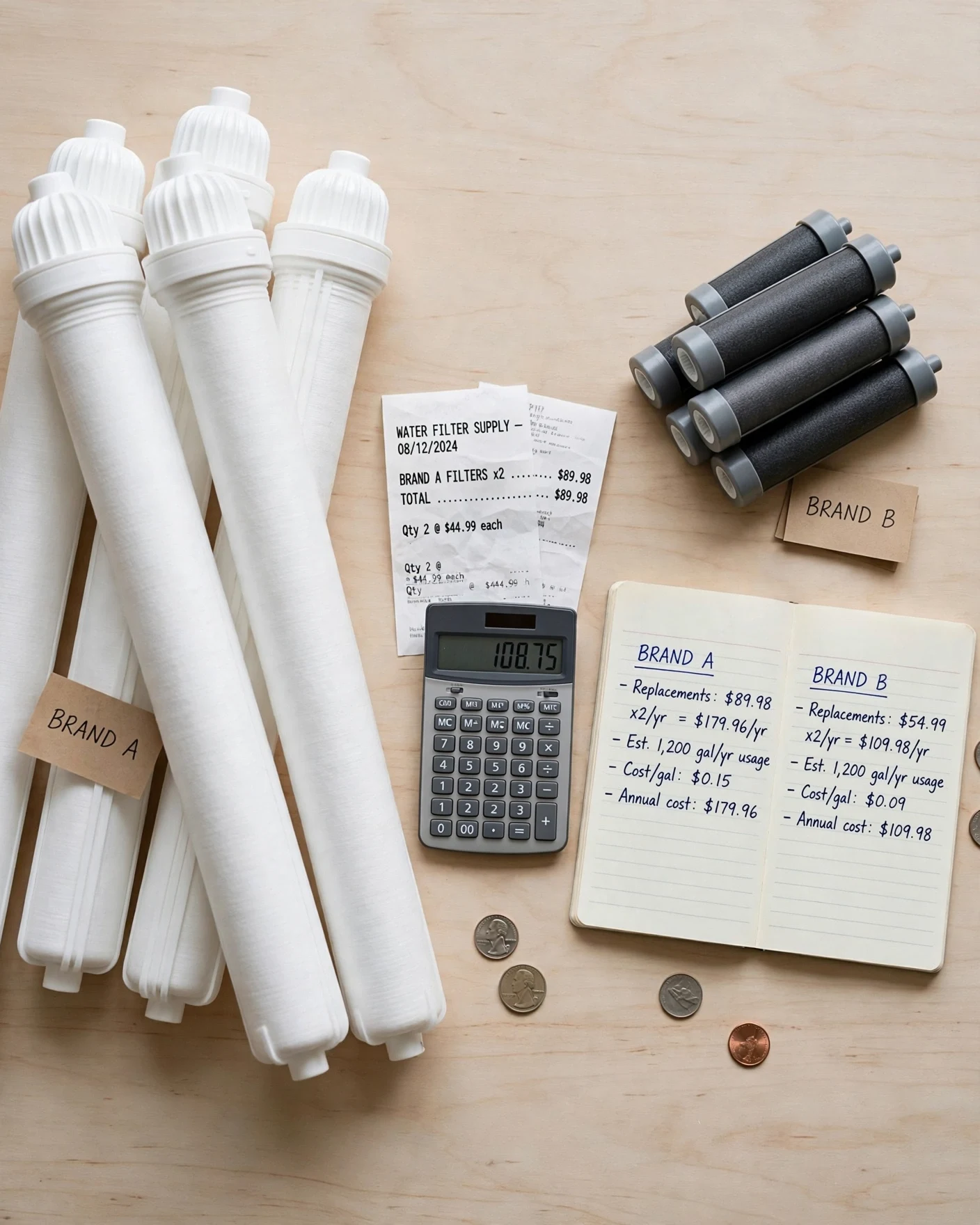
| Item | AquaTru Classic | Bluevua ROPOT (standard) |
|---|---|---|
| Unit | ~$449–475 | ~$280–330 |
| Filter life | Pre/VOC ~600 gal; membrane ~1,200 gal | 12–24 months (brand) |
| Yearly filter cost | ~$100–130/yr | ~$75–120/yr (after year one) |
| 5-year total | ~$950–1,125 | ~$580–810 |
| Cost per 100 gallons | ~$17 (per World Water Reserve) | — (not published by independent reviewers) |
Two things jump out. First, the Bluevua costs roughly $370–315 less over five years (estimates) — about a third cheaper all-in. The AquaTru premium buys certification and capacity, not savings. Second, both beat bottled water by a mile: a household buying two cases a week spends well over $500 a year on bottled water, so either unit pays for itself inside the first year. The yearly figures are estimates from published reviews and brand-stated filter life — your water quality moves both, since hard water and heavy sediment eat cartridges faster.
Owner voices
No invented quotes, no cherry-picked five-stars — just the themes that keep repeating across owner reviews on major retail listings for each machine:
AquaTru Classic owners consistently praise the taste and the trust factor — owners who tested with a TDS meter report single-digit readings, and one independent lab panel found 14 PFAS analytes below reporting limits (a published test result, not a certification). The recurring complaints: each gallon takes about 10–15 minutes, reject water collects in the tap tank and must be emptied before every refill, limescale can clog the feed tube in hard-water areas (the manufacturer sells a descaling kit), and a minority of owners describe frustrating customer-service experiences.
Bluevua ROPOT owners love the glass carafe and the no-plumbing convenience — it is the “it just works on my counter” machine. The recurring complaints: hard-water mineral buildup slows filling over time (the documented fix is vinegar-and-water descaling), wastewater collects in a tray you empty by hand, a full container takes about five minutes, and the ~11″ × 15″ × 14″ footprint is a real commitment in a tiny kitchen.
The pattern: AquaTru complaints are about process (slow cycles, manual tank handling), Bluevua complaints are about maintenance (descaling, wastewater). Neither set is a deal-breaker — they are the friction you are signing up for. If you want a third option in the same category, our SimPure Y7P review covers the other big name in countertop RO.
Who should buy it

Buy the AquaTru Classic if
- Certified performance is your priority — you want lead, PFOA/PFOS, and VOC reduction claims backed by a brand-stated IAPMO certification, not just lab-test write-ups.
- You drink a lot of water — the 0.75-gallon clean tank and ~600–1,200-gallon filter ratings suit households that go through water quickly.
- The premium does not bother you — you are paying roughly $150–170 more (estimates) for the certification and capacity.
Buy the Bluevua ROPOT if
- Value and convenience win — lower upfront price, lower yearly cost, and the glass carafe make daily life nicer.
- You rent or move often — compact, plug-in, no plumbing changes; it travels with you.
- Strong lab results are enough for you — independent testers rate its filtration highly, even without the deep certification paperwork.
Skip both if
- You can drill a hole and plumb a faucet — an under-sink RO system costs less per gallon over time and hides out of sight.
- You only want better-tasting water — a basic carbon filter handles chlorine taste and odor for far less money; RO is overkill.
Which should you buy?
Most buyers are really asking one of two questions. “Which one is the safer, more proven filter?” That is the AquaTru Classic — the brand-stated IAPMO certification to four NSF/ANSI standards is the strongest paperwork in countertop RO, the bigger tank suits families, and independent lab results back the filtration. You pay for it: roughly $150–170 more upfront and about $25–55 more per year in filters (estimates).
“Which one is the smarter buy for a normal kitchen?” That is the Bluevua ROPOT. It filters well according to independent lab testers, costs a third less over five years, takes up less space, and the glass carafe is genuinely nicer to live with. You trade away the deep certification — its contaminant claims are manufacturer claims, not certified ones.
Our call: certification-first buyers take the AquaTru Classic; everyone else takes the Bluevua ROPOT and pockets the difference. Still comparing? Our other head-to-head, AquaTru vs Rorra, covers the other popular AquaTru matchup.
Certification-first pick — price checked at time of writing; it changes often.
Value pick — price checked at time of writing; it changes often.
The specs
- Brand
- AquaTru
- Model
- Classic (4-stage)
- System type
- Countertop reverse osmosis
- Installation
- None — plug in, fill tank by hand
- Clean tank
- 0.75 gallons
- Tap-water tank
- ~3 quarts
- Filter life
- Pre/VOC ~600 gal; membrane ~1,200 gal
- Pure-to-drain
- 4:1 advertised; ~3:1 reported by testers
- Cycle time
- ~10–15 min per gallon
- Footprint
- ~12″ × 14″ × 14″
- Certifications
- IAPMO: NSF/ANSI 42, 53, 58, 401 + 372 (brand-stated)
- Warranty
- 1-year limited
- Brand
- Bluevua
- Model
- RO100ROPOT
- System type
- Countertop reverse osmosis
- Installation
- None — plug in, fill tank by hand
- Capacity
- 100 oz batch; 60 oz glass carafe
- Remineralization
- Yes (standard/UV models; taste only)
- Filter life
- 12–24 months (brand)
- Pure-to-drain
- 3:1 (brand claim)
- Rated flow
- 0.26 L/min
- Footprint
- ~10.9″ × 15.4″ × 14.3″
- Certifications
- WQA: NSF/ANSI/CAN 372 (lead-free materials)
- Warranty
- 1-year limited
FAQs
Which is better, AquaTru or Bluevua?
It depends on what you value. The AquaTru Classic is better if certification confidence is your priority — it carries the brand-stated IAPMO certification to NSF/ANSI 42, 53, 58, and 401, plus a bigger clean-water tank. The Bluevua ROPOT is better if value and convenience matter more — it costs roughly $150–170 less (estimates), has a glass carafe, and independent lab testers rate its filtration performance highly. There is no universal winner, only the right pick for your kitchen.
Is the Bluevua ROPOT certified to NSF standards?
Partially. Bluevua’s WQA certificate is against NSF/ANSI/CAN 372, which certifies that the wetted parts are lead-free materials — it is not a contaminant-reduction certification. Specialist reviewers note the ROPOT has no broad contaminant-reduction certification. Its filtration claims are manufacturer claims; independent lab testing (BOS Water 4.49/5) is strong but is not the same as certification. The certification picture appears to be evolving, so check the WQA find-products directory for your exact model before buying.
Which one costs less to run?
The Bluevua ROPOT. Its yearly filter cost runs about $75–120 after year one (estimate), versus about $100–130 a year for the AquaTru Classic (estimate). Over five years, the ROPOT totals roughly $580–810 and the Classic roughly $950–1,125 (estimates). Both figures move with your water quality — hard water eats cartridges faster.
Do either of them need plumbing or installation?
No. Both are true countertop systems: plug into a power outlet, fill the top tank by hand, and dispense. No drilling, no water-line connection, no plumber. That is the whole point of the category — and why renters buy them.
Which one wastes less water?
On paper, the AquaTru — the brand advertises a 4:1 pure-to-drain ratio. In practice, independent testers report roughly 3:1 for the AquaTru, and Bluevua claims 3:1 for the ROPOT — so in real kitchens they waste a similar amount. Both collect wastewater you empty by hand. If water waste is a major concern, a tankless under-sink RO wastes far less.
Is the remineralized water healthier?
Treat remineralization as a taste feature, not a health feature. The Bluevua’s remineralization stage (and AquaTru’s optional mineral-boost filter) adds minerals back after the RO membrane so the water does not taste flat. That is a genuine taste improvement — but it is not a health claim, and we do not present it as one.
Conclusion
AquaTru vs Bluevua is not a good-versus-bad decision — it is a priorities decision. The AquaTru Classic is the certification-first machine: the deepest brand-stated IAPMO certification in countertop RO, the bigger tank, and independent lab results to back it up, at a premium price. The Bluevua ROPOT is the value-and-convenience machine: roughly a third cheaper over five years, a glass carafe instead of plastic tanks, and strong independent lab scores — without the deep certification paperwork. Match the machine to what keeps you up at night (unverified contaminants vs. wasted money), and the choice makes itself.
Price checked at time of writing; it changes often — see the live price before you buy.
Price checked at time of writing; it changes often — see the live price before you buy.
Update log
- Zulqarnain: Review published.