

Brita Everyday Pitcher Review (2026): Is It Worth It?
★ BUDGET PICKYou are tired of the faint swimming-pool taste in your tap water, and bottled water feels like paying rent on something that should come out of the tap for free. A plumbed-in system sounds like overkill. So the Brita Everyday pitcher catches your eye — the cheapest Brita on the shelf — and the real question is whether the cheapest option is good enough, or just cheap.
Here is the short answer: the Brita Everyday is a genuinely good buy if all you want is better-tasting water from a municipal supply you already consider safe. It pairs Brita’s entry-level pitcher with the Standard filter, the brand-listed claims cover chlorine taste and odor plus a short list of metals, and the yearly running cost is among the lowest in the pitcher category. But it is not a safety device. The Standard filter carries no certified lead or PFAS reduction, and anyone shopping for health protection needs a different product. This review lays out what the Everyday is actually certified to do, what owners complain about after living with it, and what a full year of filters really costs — so you can decide with open eyes.
Our scores
Table of Contents
Bottom line
The bottom line: the Brita Everyday pitcher is the right buy if you want the cheapest path to better-tasting tap water and your city water is already safe to drink. It is not the right buy if lead, PFAS, or any health-related contaminant is your concern — the Standard filter is not certified for those, full stop.
Verdict: the best-value taste upgrade in the pitcher aisle; not a safety filter.
Estimated price about $28–30; it changes often — see the live price before you buy.

We did not receive a test unit and we did not run a lab bench test. What we did instead was research and comparison: we pulled Brita’s own product and filter listings, checked the certification claims against the public certification databases, read owner feedback across major retail listings for the complaints that keep repeating, and ran the yearly cost math from listed filter prices. Where a claim comes only from the brand’s own listing, we say so — and where a popular claim could not be verified, we left it out entirely.
One thing to know up front: if your main worry is lead or a wider contaminant list, the upgrade path sits inside Brita’s own lineup. Our Brita Elite pitcher review covers the pitcher that pairs with the longer-life, wider-certification Elite filter — the Everyday is the budget end of that same ladder.
Pros and cons
Pros
- Lowest entry price in the Brita lineup — the pitcher itself runs about $28–30 (estimate), well under the Elite and dispenser models.
- Real chlorine taste and odor improvement — the most consistent praise in owner feedback, and the job the Standard filter is actually listed for.
- Cheap, easy-to-find filters — Standard cartridges are stocked everywhere and among the least expensive name-brand replacements.
- Upgrade path built in — the same pitcher accepts Elite cartridges later, so you are not locked into the basic filter.
Cons
- Short filter life — about 40 gallons or 2 months per cartridge means roughly 6 swaps a year.
- No certified lead or PFAS reduction — with the Standard filter, this is a taste product, not a safety product.
- Black carbon specks — the number-one recurring owner complaint; harmless carbon fines, but alarming the first time you see them.
- Lid fit and drips — owners report the lid does not always stay put, and pouring a full pitcher can drip at the spout.
Certifications (database-checked)
This section is where budget pitchers get oversold, so we will be precise. Everything in the table below is brand-stated / listing-stated: it comes from Brita’s own product pages and filter listings, which describe the Standard filter (model OB03) as certified to NSF/ANSI 42 and NSF/ANSI 53 for the specific substances listed. “Compliant” is not the same as “certified,” and certification only ever covers the exact substances in the listing — nothing more. Before you buy, look the listing up yourself in the public database at info.nsf.org; it takes two minutes and it is the only way to be sure the claim still stands.

| Substance | Brand-stated standard | Status on this page |
|---|---|---|
| Chlorine (taste and odor) | NSF/ANSI 42 | Listing-stated — self-check at info.nsf.org |
| Zinc | NSF/ANSI 42 | Listing-stated — self-check at info.nsf.org |
| Copper | NSF/ANSI 53 | Listing-stated — self-check at info.nsf.org |
| Cadmium | NSF/ANSI 53 | Listing-stated — self-check at info.nsf.org |
| Mercury | NSF/ANSI 53 | Listing-stated — self-check at info.nsf.org |
| Lead | — | NOT certified for the Standard filter — do not buy for lead |
| PFAS (PFOA/PFOS) | — | NOT certified for the Standard filter |
Read that table the honest way: the Standard filter is a taste-and-odor filter with a handful of metal reductions on top. That is a perfectly useful thing — chlorine taste is the number-one reason people stop drinking their tap water — as long as nobody sells it to you as health protection. If reducing certified contaminants is your priority, the PUR PLUS pitcher review covers a rival whose filter carries a wider brand-stated certified list, and Brita’s own Elite filter sits a step above the Standard in the same pitcher body.
Certification covers only the substances in the database entry, and only under standardized test conditions. If your water concern is hard-water minerals, bacteria, or anything not in the table above, a basic pitcher filter is the wrong category of product regardless of brand.
Design and usability
The Everyday is a pour-through design: you fill the top reservoir, water trickles through the Standard filter into the main body, and you pour from the spout. The flagship Everyday pitcher holds about 10 cups — enough for a day of drinking water for a small household without constant refilling. Brita also sells smaller 6-cup pitchers in the same family for singles and tight fridge shelves, so check which size you are actually ordering before you check out.
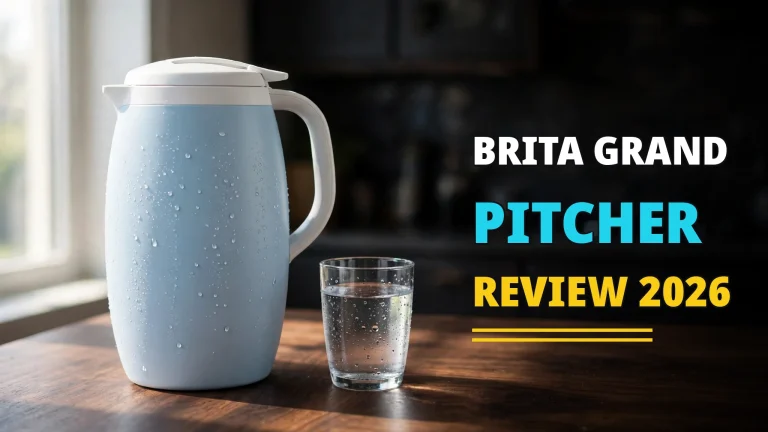
Day to day, the design is deliberately simple. The flip-top lid makes one-handed refills easy, the pitcher is made without BPA, and the slim profile fits most refrigerator doors and shelves. A filter-change indicator on the lid (electronic on some versions, a simple sticker tracker on the most basic ones) reminds you when the cartridge is due — useful, because the most common way people waste money on pitcher filters is running an exhausted cartridge for months. Two honest caveats from owner feedback: the lid does not always seat perfectly, and the pitcher is tall enough that you should measure your fridge shelf before buying. If you refill a 10-cup pitcher constantly and want more volume at the tap instead, our Brita Grand pitcher review covers the larger sibling in the lineup.

- Brand
- Brita
- Filter model
- Standard (OB03)
- Pitcher capacity
- About 10 cups (Everyday)
- Filter rated life
- 40 gallons / ~2 months
- Certifications (brand-listed)
- NSF/ANSI 42 & 53
- Lead / PFAS reduction
- Not certified (Standard filter)
- Typical pitcher price
- ~$28–30 (estimate)
- Dishwasher safe
- No — hand-wash
Care is as basic as the design: cold tap water only, hand-wash the pitcher and lid with mild soap, and always remove the filter before washing. Brita’s own guidance caps the water temperature for pitcher filters, so never fill it with hot water to “speed things up” — you will damage the cartridge, not help it.
Filter cost math
The sticker price is the least important number on this page. What matters is the yearly cost of running the thing, because pitcher filters are a subscription you pay in cartridges:
| Item | Everyday + Standard filter | Everyday/Elite + Elite filter |
|---|---|---|
| Pitcher (upfront) | ~$28–30 | ~$35–41 |
| Filter rated life | 40 gallons / ~2 months | 120 gallons / ~6 months |
| Filters per year | ~6 | ~2 |
| Replacement filter price (each) | ~$5–7 (estimate) | Higher per cartridge |
| Estimated yearly filter cost | ~$30–42 | ~2 × Elite filter price |
Two things jump out. First, even with six swaps a year, the Standard filter’s low per-cartridge price keeps the Everyday’s yearly running cost among the lowest of any name-brand pitcher — roughly $30–42 a year in filters (estimate), on top of a sub-$30 pitcher. Second, the Elite’s appeal is convenience, not savings: two changes a year instead of six, at a higher price per cartridge. If you are the kind of person who forgets filter changes for months, that convenience is worth real money; if you keep a calendar, the Standard filter wins the math. Either way, the honest comparison lives in our Brita Elite pitcher review, where the same math is run from the other side.
What owners complain about
Black carbon specks. The number-one recurring complaint across years of owner feedback: tiny black particles in the first few pitchers from a fresh filter. They are carbon fines — loose particles of the filter media itself. Brita’s setup instructions say to discard the first two or three pitchers of filtered water, and owners who follow that step generally report the specks clearing quickly. Owners who skip it report specks for much longer.

The lid does not always stay on. A long-running complaint thread: the lid seats loosely on some units and can shift or fall when you pour a full pitcher. It is annoying rather than dangerous, but if it happens to you, pouring with one hand on the lid is the workaround owners settle on.
Leaks that are really overfills. Brita’s own support guidance points at the most common “leak”: filling past the max fill line lets water spill into or over the handle when you pour. Fill to the line, let the reservoir drain fully before pouring, and most reported leaks disappear.
Slow filtering and short real-world life. The 40-gallon rating is a lab number. In homes with heavy sediment or very hard water, owners report the flow slowing and the taste turning sooner than two months — the cartridge clogs faster than the rating assumes. The fix is simply changing the filter earlier; the frustration is that the calendar on the box does not warn you.
None of these are hidden gotchas, and none are unique to the Everyday — carbon specks and lid complaints show up across the whole Brita pitcher family. But they are the real friction points of the cheapest model, and you are better off knowing them now.
Who should buy it
Buy it if
- Your municipal water is safe but tastes like chlorine — that is exactly the job this filter is listed for.
- You want the lowest total cost of ownership in a name-brand pitcher: cheap pitcher, cheap filters, no installation.
- You are a single person or small household and a 10-cup pitcher (or the 6-cup sibling) covers your day.
- You like having an upgrade path — the same pitcher takes Elite cartridges later if your priorities change.
Skip it if
- Lead or PFAS is your concern — the Standard filter is not certified for either. Start with a water test, then look at certified products.
- You hate changing filters — six swaps a year will wear on you; the Elite’s two-a-year rhythm exists for a reason.
- You want near-zero TDS water — that is a different technology (ZeroWater-style ion exchange), not this pitcher.
- You need filtered water on the go — a pour-as-you-drink design like the one in our Brita Stream pitcher review fits that use better.

Cross-shopping is where most buyers actually decide, so here is the Everyday against the pitchers it is most often compared with — drawn from published specs and brand-stated certifications, with prices labeled as estimates. The PUR Ultimate pitcher review covers the other PUR model in this class if you want the full head-to-head.
| Brita Everyday (Standard) | Brita Elite | PUR PLUS | ZeroWater | |
|---|---|---|---|---|
| Typical pitcher price | ~$28–30 | ~$35–41 | ~$38–44 | ~$35–44 |
| Filter rated life | 40 gal / ~2 months | 120 gal / ~6 months | 40 gal / ~2 months | Varies (TDS-meter dependent) |
| Certifications (brand-stated) | NSF/ANSI 42 & 53 (narrow list) | NSF/ANSI 42 & 53 incl. lead | NSF/ANSI 42/53/401 | NSF/ANSI 42 & 53 |
| Best for | Cheapest taste upgrade | Certified lead reduction + long life | Wide certified list, shorter life | Near-zero TDS taste |
FAQs
How often do I need to change the Standard filter?
Every 40 gallons or about every 2 months, whichever comes first — that is Brita’s own guidance for the Standard filter. In practice that means roughly 6 cartridges a year for a typical household. The pitcher’s filter-change indicator (or a sticker/card tracker on basic models) is the practical reminder; a spent filter you keep using is just an expensive funnel.
Does the Brita Everyday pitcher remove lead?
No — the Standard filter is not certified for lead reduction, so do not buy this pitcher for lead. Brita’s listing-stated certifications for the Standard filter cover chlorine (taste and odor), zinc, copper, cadmium, and mercury only. If lead is your concern, look at the Elite filter or a different category of product, and start with a water test.
Does the Brita Everyday pitcher remove PFAS?
No. The Standard filter is not certified for PFAS (PFOA/PFOS) reduction. No pitcher on this page’s comparison table carries that claim for the Standard filter — the only Brita filter with a brand-stated PFAS claim is the Elite under NSF/ANSI 53. Treat any ad or review claiming PFAS removal from a Standard filter as marketing, not certification.
Why are there black specks in my filtered water?
Those specks are carbon fines — tiny particles of filter media from a new cartridge — and the most common owner complaint about standard Brita filters. The setup instructions say to discard the first two or three pitchers of filtered water, which flushes most loose fines out. Owners who follow that step generally report the specks clearing within the first few pitchers.
Can I use the Elite filter in the Everyday pitcher?
Yes. Brita states that Standard and Elite filters fit all Brita pitchers and dispensers except the Stream line, so you can upgrade an Everyday pitcher to the Elite cartridge later without buying a new pitcher. The Elite brings a wider certified contaminant list and about 6 months of filter life, so the pitcher itself is not a dead end if your needs change.
Can the Everyday pitcher go in the dishwasher?
No — Brita’s care guidance says pitchers are not dishwasher safe. Hand-wash the pitcher, lid, and reservoir with mild soap and warm water, and always remove the filter first. The dishwasher’s heat can warp the plastic and damage the lid’s filter-change indicator.
Conclusion
The Brita Everyday pitcher is the right buy for exactly one buyer: someone on decent municipal water who wants better taste for the least money. For that buyer, nothing else in the pitcher aisle beats it on price per glass — a sub-$30 pitcher, filters at a few dollars each, and chlorine taste gone. For everyone worried about lead, PFAS, or “what else is in there,” it is simply the wrong product, and no amount of budget appeal changes that. Know which buyer you are, and the choice makes itself.
Estimated price about $28–30; it changes often — see the live price before you buy.
Update log
- Zulqarnain: Review published.