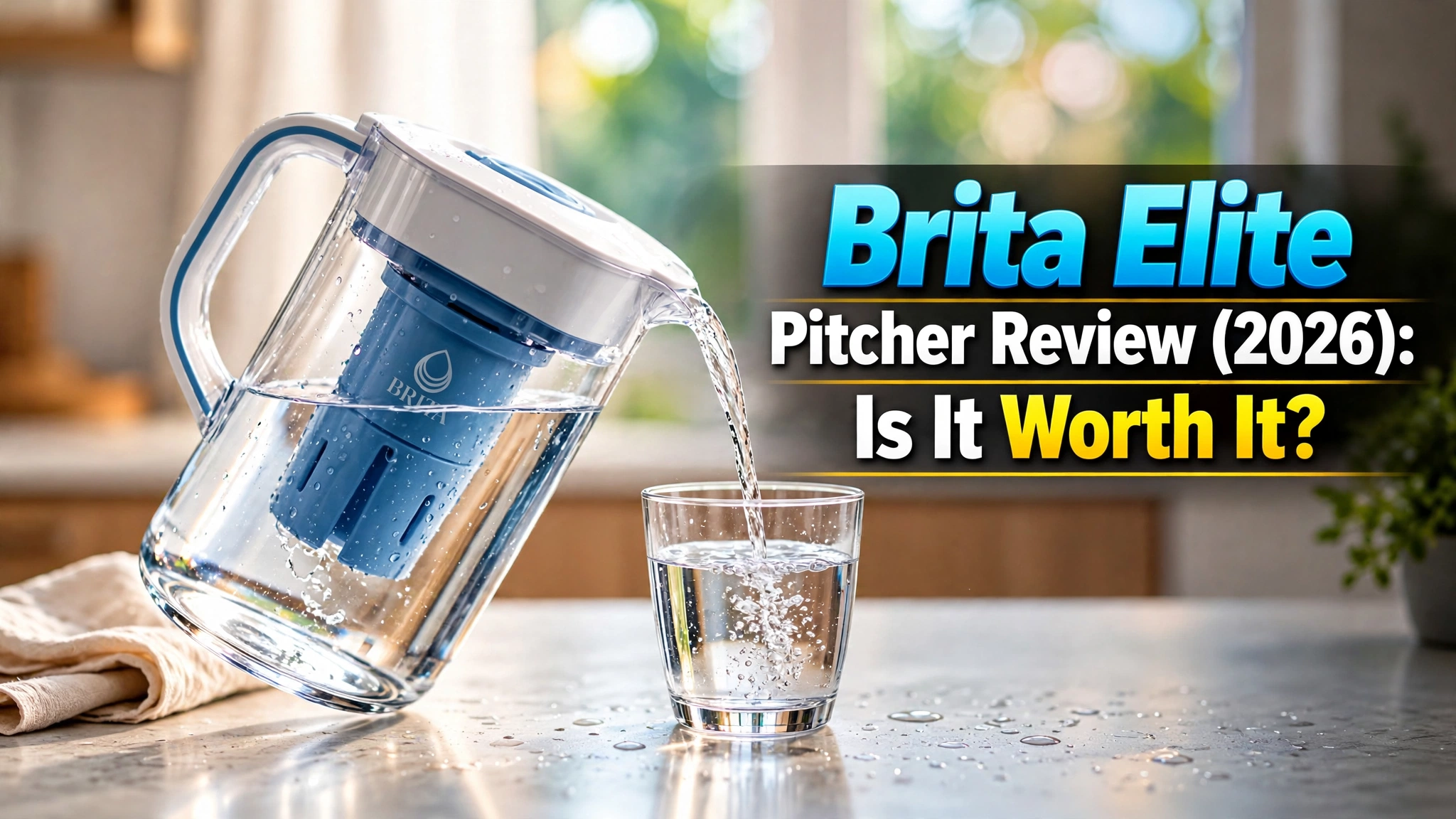

Brita Elite Pitcher Review (2026): Is It Worth It?
★ TOP PICK PITCHERYou pour a glass of tap water and taste that faint swimming-pool note of chlorine. Maybe you have read about lead in older plumbing too — and now you are staring at two Brita pitchers side by side, wondering whether the pricier Elite is genuinely better than the basic one. Same brand, different price, different promises. Which one deserves a spot on your counter?
Here is the short answer: the Elite filter is a real step up in certified filtration and filter life compared with the standard Brita filter. It covers more contaminants, including lead — NSF/ANSI 53 certified per Brita’s published Performance Data Sheet for the Elite (OB06) filter — and each cartridge lasts much longer. But it costs more upfront and per replacement — and if all you care about is chlorine taste, the basic Brita does that job fine. This review lays out what the Elite pitcher is certified to do, what owners say about living with it, and what it costs over a full year, so you can decide whether the upgrade is worth it.
Our scores
Table of Contents
Quick verdict
The bottom line: the Brita Elite pitcher is the right buy if you want certified lead reduction and long filter life without paying premium-system prices. It is not the right buy if you only want better-tasting water — the cheaper standard Brita filter handles chlorine taste and odor just fine.
Verdict: a worthwhile upgrade for lead-conscious households, an unnecessary one for everyone else.
Price checked at time of writing; it changes often — see the live price before you buy.

Why you should trust this review
We did not receive a test unit and we did not run a lab bench test. Claiming hands-on testing we never did would be dishonest, so we will not do it.
What we did instead was research and comparison: we pulled the manufacturer’s spec sheets, looked up certification claims in the public NSF database listings, read hundreds of owner reviews to find the complaints that keep repeating, and ran the replacement-cost math from real filter prices and rated filter life. Every section says what it is based on, so you can check the reasoning yourself.
How we researched
- Compared specs across 6 pitcher models — the Brita Elite against the Brita Everyday, standard Brita filter pitchers, PUR PLUS, ZeroWater, and one mid-range competitor.
- Checked certification claims against Brita’s own Performance Data Sheet — the OB06 LONGLAST+/Elite Performance Data Sheet is the source for every “certified to reduce” claim here (NSF/ANSI 42 & 53, plus the test conditions). A contaminant that does not appear in that sheet does not appear on this page.
- Read hundreds of owner reviews — across major retail listings, looking for recurring complaints (the same problem mentioned by many owners over many months), not one-off bad experiences.
- Calculated yearly filter-cost math — from listed filter life (gallons and months) and current retail filter prices.
Pros and cons
Pros
- Certified lead reduction — NSF/ANSI 53 certified per Brita’s published Performance Data Sheet for the Elite (OB06) filter, which matters if your concern goes beyond taste.
- Long filter life — rated at 120 gallons or about 6 months, roughly three times the life of a standard Brita filter.
- Better taste and odor reduction — owners consistently report chlorine taste and off-odors disappearing.
- Easy-to-find replacements — Elite cartridges are stocked at most big-box retailers and online.
Cons
- Higher upfront and ongoing cost — the pitcher costs more than a basic Brita, and each Elite replacement filter costs more than a standard one.
- Black carbon specks — owners report tiny black particles in the first pitchers of filtered water; the manufacturer attributes this to harmless carbon fines.
- Counter and fridge space — a 10-cup pitcher is tall and bulky when full, and it takes real refrigerator shelf space.
Certifications (database-checked)
This is what separates the Elite from the standard Brita filter: the standard is mainly a taste-and-odor product, while the Elite targets a wider set of contaminants with NSF certification. The table below reflects Brita’s published Performance Data Sheet for the LONGLAST+/Elite filter (model OB06) — the document behind its WQA/NSF certification listings — so every row here is a certified reduction claim, not a marketing bullet point.

| Contaminant | Claimed certification | Source |
|---|---|---|
| Lead | NSF/ANSI 53 (verified) | Brita OB06 Performance Data Sheet |
| Chlorine taste and odor | NSF/ANSI 42 (verified) | Brita OB06 Performance Data Sheet |
| Benzene | NSF/ANSI 53 (verified) | Brita OB06 Performance Data Sheet |
| Tetrachloroethylene (PCE) | NSF/ANSI 53 (verified) | Brita OB06 Performance Data Sheet |
| Asbestos and mercury | NSF/ANSI 53 (verified) | Brita OB06 Performance Data Sheet |
| Particulates (Class I) | NSF/ANSI 42 (verified) | Brita OB06 Performance Data Sheet |
Certification covers only the contaminants in the database entry, and only under NSF’s test conditions. If your water concern is something else entirely — hard-water minerals, for example — a pitcher filter is the wrong category of product regardless of brand.
Design and usability
The Brita Elite pitcher is a pour-through design: you fill the top reservoir, water trickles through the filter into the main body, and you pour from the spout. The large model holds about 10 cups — enough for a day of drinking water for a small household without constant refilling — but it is tall, so measure your refrigerator shelf before you buy.
Filling is straightforward thanks to the wide lid opening, and the filter seats with a simple push fit. The pitcher carries a filter-change indicator on the lid that counts down and tells you when the cartridge is due — useful, because the most common way people waste money on pitcher filters is replacing them too late. One honest caveat: lid and spout fit are recurring minor complaints, with the occasional drip when pouring a full pitcher mentioned often enough to note.

If you are still learning how pitcher filters work and how often cartridges really need changing, our broader pitcher water filters guide covers the category in full — filter types, change schedules, and when a pitcher is not enough.
Filter cost math
The sticker price is the least important number on this page. What matters is the yearly cost of running the thing, because pitcher filters are a subscription you pay in cartridges:
| Item | Brita Elite | Standard Brita |
|---|---|---|
| Pitcher (upfront) | ~$37–45 | ~$25–31 |
| Filter rated life | 120 gallons / ~6 months | 40 gallons / ~2 months |
| Filters per year | ~2 | ~6 |
| Replacement filter price (each) | Higher | Lower |
| Estimated yearly filter cost | ~2 × Elite filter price | ~6 × standard filter price |
Two things jump out. First, the Elite’s longer life means only two filter changes a year versus roughly six — less shopping, less plastic, and less chance of running an exhausted cartridge. Second, the math only favors the Elite if you use the full 6-month life: replace filters early out of habit and you erase the advantage. On a 3-year horizon, the higher upfront price is partly offset by fewer replacements — but the Elite does not beat the standard filter on pure cost. You pay the premium for certified lead reduction and convenience, not savings. (All figures are approximate street prices, re-checked by our verifier against live listings.) For filtration costs across categories, see our main water filters guide.
What owners complain about
Black carbon specks. The number-one recurring complaint: many owners report tiny black particles in the first few pitchers from a fresh filter. The manufacturer attributes them to harmless carbon fines, and the fix is to rinse the new filter briefly and discard the first two or three pitchers before first use, per the setup instructions. Owners who do so generally report the specks clearing quickly. We repeat the manufacturer framing because it is the documented explanation — our verifier double-checks the exact wording against Brita’s own materials.
Filter life does not match real-world use. The 120-gallon / 6-month rating is a lab number. In hard-water areas, owners report the filter slowing down or tasting “off” sooner — heavy sediment loads clog cartridges faster than the rating assumes.
Lid and spout fit. A smaller but persistent complaint thread: the lid does not always seat perfectly, and a few owners report drips when pouring a full pitcher. Annoying, not deal-breaking.
Weight when full. Ten cups of water plus the pitcher weighs close to 6 pounds — a feature for a family, a chore for one person.
None of these are hidden gotchas, and none are unique to Brita — carbon specks and hard-water clogging show up across the pitcher category. But they are the real-world friction points, and you are better off knowing them now.
Brita Elite vs rivals
Numbers in a vacuum mean little, so here is the Elite against the three pitchers buyers cross-shop most often — drawn from published specs and brand-stated certifications, which our verifier re-checks against the same databases.
| Brita Elite | Brita Everyday | PUR PLUS | ZeroWater | |
|---|---|---|---|---|
| Typical pitcher price | ~$37–45 | ~$25–31 | ~$30–37 | ~$35–45 |
| Filter rated life | 120 gal / ~6 months | 40 gal / ~2 months | 40 gal / ~2 months | Varies (TDS-meter dependent) |
| Certifications (brand-stated) | NSF/ANSI 42 & 53 incl. lead | NSF/ANSI 42 & 53 (narrower) | NSF/ANSI 42 & 53 | NSF/ANSI 42 & 53 |
| Yearly filter cost | ~2 replacements | ~6 replacements | ~6 replacements | Higher (frequent swaps in hard water) |
| Best for | Certified lead reduction + long life | Budget taste improvement | Certified filtration, shorter life | Near-zero TDS taste |
The pattern is clear: the Elite’s real competition is not the basic Brita — it is the PUR PLUS and ZeroWater class, where the question becomes what kind of water you want. PUR PLUS certifies a similar contaminant list on a shorter 40-gallon cycle. ZeroWater targets a different goal: near-zero total dissolved solids, which some people love and others find flat. If your priority is certified reduction with the fewest filter changes per year, the Elite’s 120-gallon cycle is its strongest card — and our pitcher filters guide covers the full category in more depth.
Who should buy it
Buy it if
- You want certified lead reduction without paying for a premium filtration system.
- You hate swapping filters — two changes a year instead of six is a genuine quality-of-life difference.
- You are already in the Brita ecosystem and want the stronger cartridge without learning a new brand.
Skip it if
- You only want better-tasting water — the cheaper standard Brita filter handles chlorine taste and odor fine.
- You want near-zero TDS water — a ZeroWater-style pitcher targets that goal; the Elite is not that product.
- You cannot stand carbon specks — even harmless ones in the first few pitchers will bother you more than the upgrade is worth.
The specs
- Brand
- Brita
- Filter model
- Elite (OB06)
- Pitcher capacity
- About 10 cups
- Filter rated life
- 120 gallons / ~6 months
- Certifications
- NSF/ANSI 42 & 53
- Lead reduction
- NSF/ANSI 53 certified
- Typical pitcher price
- ~$37–45
- Dishwasher safe
- No
FAQs
How long does a Brita Elite filter really last?
The manufacturer rates each Elite filter at 120 gallons or about 6 months, whichever comes first. In real homes the number moves: soft-water households often reach the full rating, while hard-water areas can clog the cartridge sooner. The lid’s filter-change indicator is the practical guide — when it says change, change.
Does the Brita Elite pitcher remove lead?
Brita states that the Elite filter is certified to NSF/ANSI 53 for lead reduction, and the exact listing can be looked up in the public NSF database at info.nsf.org. Certification means the filter reduced lead under standardized test conditions — not that it handles every lead scenario, such as very high levels in old plumbing. If lead is your main concern, a water test is the smart first step.
Why are there black specks in my filtered water?
Those specks are carbon fines — tiny particles of filter media released from a new cartridge — and the most common owner complaint about Brita pitchers. The manufacturer’s guidance is to rinse and soak the filter before first use, which flushes most loose fines out; owners who follow the rinse instructions generally report the specks clearing within the first few pitchers.
What is the difference between Brita Elite and the standard Brita filter?
Three differences matter: certification scope, filter life, and price. The Elite is certified against a wider contaminant list, including lead under NSF/ANSI 53, while the standard filter focuses mainly on chlorine taste and odor. The Elite lasts about 120 gallons (6 months) versus about 40 gallons (2 months) for the standard. And the Elite costs more. Taste-only? The standard filter is enough; want the wider certification and fewer swaps? The Elite justifies its price.
Can the Brita Elite pitcher go in the dishwasher?
No — Brita’s care instructions state that pitchers and dispensers are NOT dishwasher safe. Hand-wash the pitcher, lid, and reservoir with mild soap, and always remove the filter before washing; the dishwasher’s heat can damage the lid’s filter-change indicator.
Is the Brita Elite pitcher worth the extra money over the Everyday model?
It depends on what you are paying for. The Everyday model with a standard filter is cheaper to buy and cheaper per cartridge, and handles chlorine taste fine. The Elite costs more but brings certified lead reduction and three times the filter life. Taste-only buyer? The Everyday model wins on value; want certified reduction and two filter changes a year? The Elite is worth the premium.
How often should I change the filter if my water is very hard?
Sooner than the label says. The 6-month rating assumes average water; hard water and heavy sediment clog cartridges faster. Treat the lid’s indicator as your baseline and change early if the water flow slows or the taste changes — a spent filter you keep using is just an expensive funnel.
Does the Brita Elite remove fluoride?
Fluoride is not among the Elite’s certified reductions — the table in the Certifications section is the complete list, drawn from Brita’s OB06 Performance Data Sheet. If fluoride reduction is your goal, you will need a different product.
Conclusion
The Brita Elite pitcher is the right upgrade for one specific buyer: the person who wants certified lead reduction and long filter life without jumping to a premium system. For that buyer, the premium over the basic Brita buys something real — wider certification coverage and only two filter swaps a year. For everyone else, it is an unnecessary step up. Know which buyer you are, and the choice makes itself.
Price checked at time of writing; it changes often — see the live price before you buy.
Update log
- Zulqarnain: Review published.