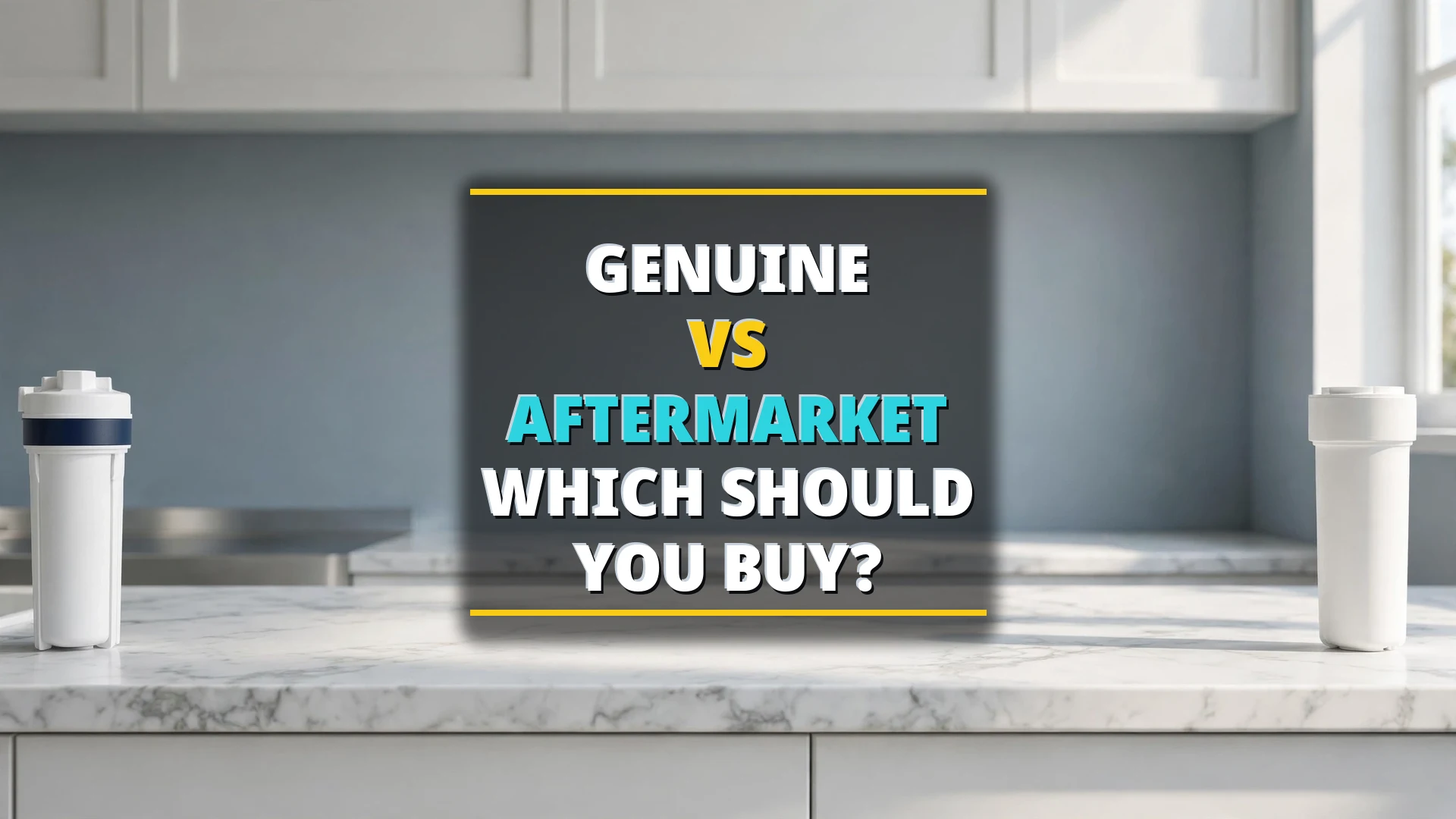

Genuine vs Aftermarket Refrigerator Water Filter (2026): Which Should You Buy?
The red light on your fridge is on again. The genuine filter costs around $50 — but online you find “compatible” replacements for half the price, some claiming the same filtration, some with thousands of positive reviews. Are you paying for the brand name, or for something real?
Here is the short answer: a genuine OEM filter buys you certified contaminant reduction, a guaranteed fit, and features like leak-detection chips that many third-party filters skip. A good certified aftermarket filter can be a genuine bargain — but an uncertified one is a gamble with your water and your kitchen floor. This comparison lays out the real differences, the certification gap, the yearly cost math, and the warranty question.
The smart bargain
Certified Aftermarket
~$15–25
Roughly half the yearly cost (~$30–50 a year) — if the exact model checks out in the NSF database.
The genuine top pick
EveryDrop EDR4RXD1
~$45–55
Certified to NSF/ANSI 42, 53 and 401 with a guaranteed fit — the safe default with zero guesswork.
The bottom line: buy the genuine filter (EveryDrop for Whirlpool-family fridges, GE for GE fridges) for certified contaminant reduction and zero fit or warranty drama. Buy a certified aftermarket filter — exact model number checked in the public NSF database — to cut the yearly cost in half with a little homework. Never buy the cheapest uncertified cartridge: GE cites industry testing that found counterfeits that can leak, add contaminants to water, and damage the filtration system.
Verdict: genuine is the safe default; certified aftermarket is the smart bargain; uncertified is a hard no.
Price checked at time of writing; it changes often — see the live price before you buy.
Our scores — genuine OEM fridge filters (EveryDrop as reference)
Table of Contents
Side-by-side comparison

“Aftermarket” covers a wide range, so think in three tiers: genuine OEM filters, certified aftermarket filters from established brands, and uncertified cheap or counterfeit cartridges. The first two can both be good buys. The third is the one to avoid.
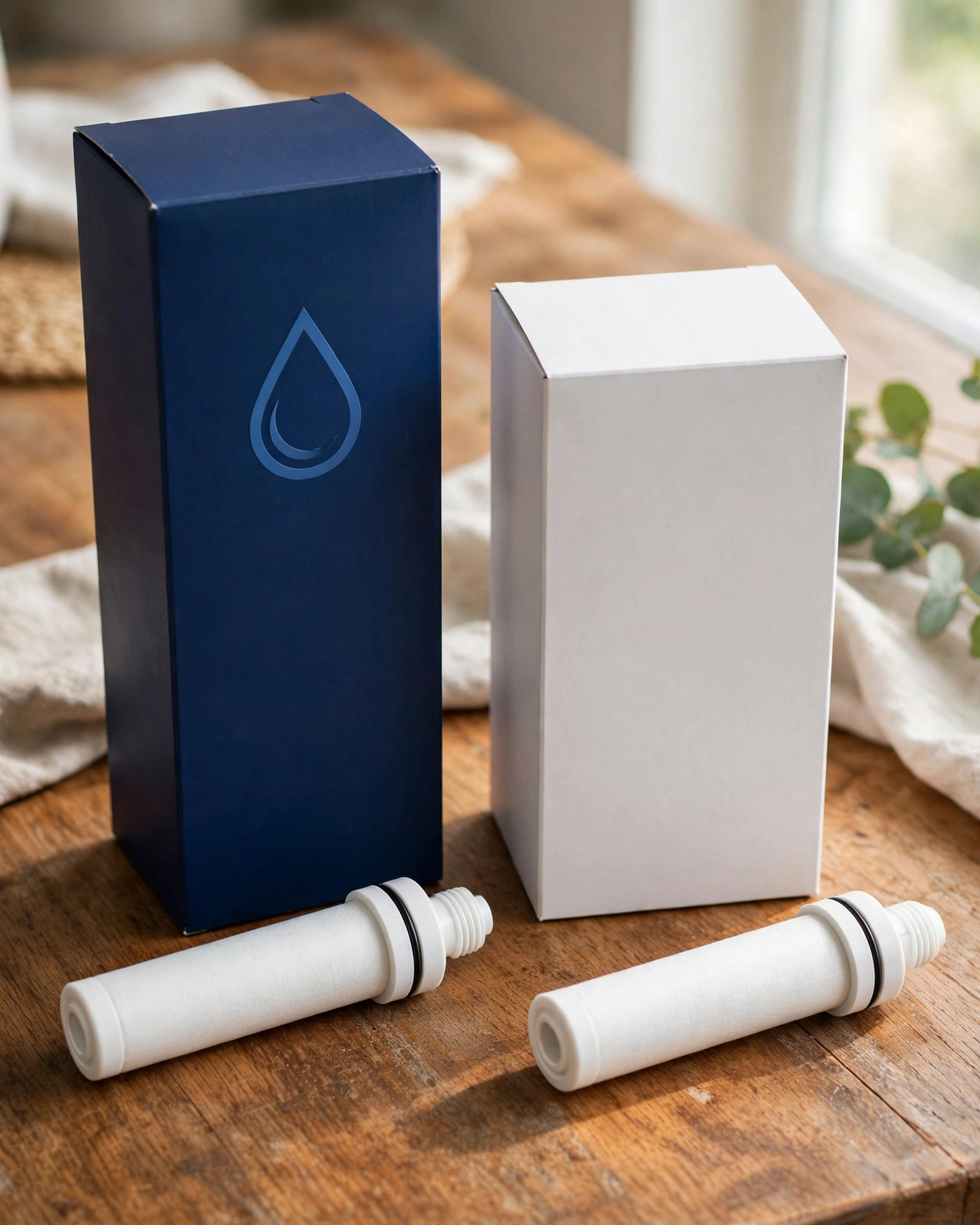
| Genuine OEM ★ Winner | Certified aftermarket | Uncertified / counterfeit | |
|---|---|---|---|
| Typical price per filter | ~$40–60 | ~$15–25 | Often under $15 |
| Who makes it | The appliance brand (Whirlpool, GE, Samsung, LG) | Third-party brands (e.g. Waterdrop, Glacier Fresh, FilterLogic) | Unknown sellers, often marketplace-only |
| Certifications | NSF/ANSI 42, 53, usually 401 (brand-stated) | Varies by model — some carry real NSF listings, some claim without proof | Claims on the box, rarely verifiable in any database |
| Fit & seal confidence | Engineered to the fridge’s exact housing tolerances | Usually fine; occasional slow-flow or seating complaints | Highest risk of poor seals and leaks |
| Filter-authentication chip | Yes, on newer models (e.g. GE XWFE’s RFID leak-detection chip) | Usually absent | Absent |
| Counterfeit risk | Low when bought from established retailers | Low for established brands | High — this is the danger zone |
| Best for | Certified filtration with zero guesswork | Budget buyers willing to verify certifications | Nobody — not worth the risk |
The middle column is where the real decision lives: brands like Waterdrop and Glacier Fresh sell widely with many satisfied owners, but certification coverage varies by exact model — which is why the Certifications section below matters more than brand reputation. For brand-by-brand matchups, see our Waterdrop vs genuine fridge filter comparison and our Glacier Fresh vs Samsung breakdown.
Why you should trust this comparison
We did not receive test units and we did not run a lab bench test. Claiming hands-on testing we never did would be dishonest, so we will not do it.
What we did instead was research and comparison: we read the manufacturers’ performance data sheets, checked certification claims against brand-published documentation, reviewed owner complaints for recurring patterns, and ran the yearly cost math from approximate street prices.
Certifications (database-checked)
This is the single biggest factual gap between the two camps: genuine OEM filters publish their certification details on downloadable performance data sheets, and every certification claim below is brand-stated with its source.
| Filter | Brand-stated certification | Source |
|---|---|---|
| EveryDrop EDR4RXD1 (genuine, Whirlpool-family) | Certified by NSF International to NSF/ANSI 42, 53 and 401 | Whirlpool product page; EveryDrop performance data sheet |
| GE XWFE (genuine) | Certified by IAPMO R&T to NSF/ANSI 42, 53, 401 and P473 | GE XWFE performance data sheet (system certified by IAPMO R&T; capacity 170 gallons) |
| Certified aftermarket models | Varies by model — brand-claimed; verify at info.nsf.org | See our certified compatible fridge filters roundup |
| Uncertified aftermarket | Box claims without database backing | Treat as unverified marketing |
A quick decoder for those standard numbers: NSF/ANSI 42 covers aesthetic effects (chlorine taste and odor); 53 covers health-effect contaminants (lead, mercury, cysts); 401 covers emerging contaminants (certain pharmaceuticals); P473 covers PFOA and PFOS. A filter certified only to 42 handles taste — it says nothing about lead. That is exactly the gap GE’s support page warns about: counterfeit filters, it says, “often only filter chlorine, taste and odor and are not certified to reduce harmful contaminants such as lead, mercury, arsenic, VOCs and pharmaceuticals.”
The honest rule: a certification claim on the box means nothing until you confirm the exact model number at info.nsf.org. Some aftermarket brands do carry real, verifiable NSF listings for specific models — our Waterdrop NSF certification check walks through how one major brand’s claims hold up. Not in the database? Treat the claims as unverified marketing.
Cost per year
The sticker price is the least important number here. What matters is the yearly cost — fridge filters are a twice-a-year subscription:
| Item | Genuine OEM | Certified aftermarket |
|---|---|---|
| Price per filter | ~$40–60 | ~$15–25 |
| Replacements per year | ~2 (every 6 months) | ~2 (every 6 months) |
| Estimated yearly cost | ~$80–120 | ~$30–50 |
| 3-year cost | ~$240–360 | ~$90–150 |
The savings are real: a certified aftermarket filter can cut yearly filter spending roughly in half — a couple of hundred dollars over three years. But the math only works if the cartridge actually lasts the full 6 months. A recurring theme in owner reviews is cheaper cartridges slowing down or needing earlier swaps in hard-water areas, which quietly eats the savings. Buy aftermarket for the price, but watch flow and taste closely — the moment a filter underperforms, the bargain disappears.
Fit and leak risks
A fridge filter lives under line pressure, 24 hours a day, inches from your kitchen floor. That is why fit is not a minor detail — it is the whole game. Genuine filters are engineered to the appliance’s exact housing tolerances; aftermarket filters reverse-engineer that fit, and most do it well — but “most” is doing heavy lifting in that sentence.

The counterfeit warning is real, not marketing. GE’s official support page states that AHAM (the Association of Home Appliance Manufacturers), working with NSF, IAPMO and WQA, tested counterfeit filters and “found counterfeit filters do not always meet the NSF/ANSI Drinking Water Treatment standards and can damage the Refrigerator’s filtration system.” The same page says counterfeits “have been known to burst and/or leak, potentially resulting in costly property damage” — with misleading labels, deceptive claims, potential to add contaminants to the water, and false NSF certification claims.
Then there is the chip. Newer GE filters like the XWFE carry an RFID chip with what GE calls Leak-Detecting Sensing Technology — the chip lets the fridge detect a wet filter and shut off the water valve. Aftermarket filters do not have this chip, and on fridges that authenticate the filter, a chip-less cartridge can stop the dispenser and trigger a “Leak Detected” warning. For newer GE models, the genuine filter is often the only one that works properly. (GE’s older genuine XWF line is commonly sold at lower street prices — but claims that the XWFE and XWF are identical apart from the chip are unverified owner speculation, and we do not repeat them.)
The honest middle ground: established aftermarket brands generally seat fine — good fit on first install is a recurring theme in owner reviews. Recurring complaints are slow flow after a few months and occasional seating trouble: annoying, not catastrophic. The catastrophic failures (burst housings, cracked seals) cluster around the cheapest no-name cartridges, which matches the industry testing.
The warranty question
This is the question that scares people into overpaying, so let us be precise.

What the brands actually say: GE’s official position is a recommendation — “We recommend that Refrigerators with water filtration systems only use genuine GE Appliances water filters” — paired with warnings about counterfeit damage. A recommendation is not a warranty threat, and we found no published policy from any major brand saying a third-party filter alone voids the appliance warranty.
US law, in general: under the Magnuson-Moss Warranty Act, a manufacturer generally cannot void your warranty just because you used a third-party part — they would typically have to show the part caused the failure. A leak caused by a bad aftermarket filter could plausibly be denied coverage; an unrelated compressor failure should not be. General information, not legal advice — rules differ outside the US.
The practical takeaway: if your fridge is brand new and expensive, the genuine filter is cheap insurance against any warranty argument. Out of warranty already? The concern disappears entirely. For the full legal deep dive, see do aftermarket filters void your warranty.
Which should you buy?
Buy the genuine filter if
- certified contaminant reduction with zero homework — certifications are on the manufacturer’s data sheet.
- Your fridge has filter authentication (e.g. newer GE models with the XWFE RFID chip) — aftermarket may not work.
- New and under warranty — no argument about third-party parts.
- You would rather pay more than think about it — twist it in twice a year and forget it.
Buy a certified aftermarket filter if
- You want to cut yearly filter costs roughly in half — the savings are real over three years.
- You are willing to verify the exact model number at info.nsf.org — five minutes of homework.
- You buy from established brands with real model numbers, not the cheapest marketplace listing.
- Out of warranty and no filter-authentication chip — the genuine filter’s advantages shrink.
Never buy the cheapest uncertified cartridge
- Counterfeit risk is highest here — industry testing found fake certifications, burst housings, and leaks.
- “Reduces lead” on the box means nothing without a database listing.
- A slow leak behind the fridge costs more than a decade of genuine filters.
The specs
- Brand
- EveryDrop (Whirlpool)
- Filter model
- EDR4RXD1 (Filter 4)
- Certifications
- NSF/ANSI 42, 53, 401 (brand-stated, NSF International)
- Rated life
- 6 months / 200 gallons (brand-stated)
- Fits
- Whirlpool, Maytag, KitchenAid, Amana, JennAir (brand-stated)
- Installation
- Twist-in, no tools
- Typical price
- ~$45–55 (estimate)
- Our rating
- 4.7 / 5
FAQs
Are aftermarket refrigerator water filters safe?
They can be — if they are genuinely certified. A filter with a verifiable NSF/ANSI 42 and 53 listing has been independently tested to reduce the contaminants it claims; an uncertified filter has not. GE cites AHAM testing that found counterfeits that can add contaminants to water and damage the filtration system. Our rule: check the exact model number at info.nsf.org before you buy aftermarket.
Do aftermarket filters void my refrigerator warranty?
No major brand we found publishes a policy saying a third-party filter alone voids the warranty — GE’s position is a recommendation for genuine filters, not a warranty threat. In the US, the Magnuson-Moss Warranty Act generally means a manufacturer has to show the part caused the failure. Read your manual — and see our full warranty breakdown for the details.
Will my fridge work with a filter that has no RFID chip?
It depends on the model. GE’s XWFE uses an RFID chip with Leak-Detecting Sensing Technology; on fridges that authenticate the filter, a chip-less cartridge can stop the dispenser and show a “Leak Detected” warning. Older models without authentication usually work with any compatible cartridge. Check your manual before buying aftermarket for a newer GE.
Why is the genuine filter so much more expensive?
Partly certification and testing, partly fit engineering and features like authentication chips, partly the brand margin. Genuine OEM filters run roughly $40–60 each versus $15–25 for aftermarket — about $80–120 versus $30–50 a year. You are paying for certified filtration and zero guesswork, not just a logo.
How do I check if an aftermarket filter is really NSF certified?
Look up the exact model number at info.nsf.org — NSF’s public certified-products database. If the model is not listed there, the certification claim is just words on a box. Only the database entry counts — not a logo-like graphic on the packaging.
How often should I replace my fridge water filter?
Every 6 months is the standard guidance — EveryDrop states 6 months or 200 gallons; GE’s XWFE data sheet lists a 170-gallon capacity on a 6-month cycle. Hard water, heavy ice use, or a large household shortens that. Slowing flow is the practical signal that a cartridge is spent.
Conclusion
The genuine-versus-aftermarket question is not about the brand name — it is about what you can verify. Genuine filters give you published certifications, a guaranteed fit, and leak-detection chips with no homework required: worth the premium if your fridge authenticates filters, is still under warranty, or you simply do not want to think about it. A certified aftermarket filter — model number checked in the NSF database — is the genuinely smart bargain for everyone else: roughly half the yearly cost for comparable filtration. The only wrong answer is the cheapest uncertified cartridge, where the industry’s own testing confirms the risks of leaks, fake certifications, and poor filtration. Know which buyer you are, verify what you buy, and the choice makes itself.
Price checked at time of writing; it changes often — see the live price before you buy.
Update log
- Zulqarnain: Review published.