
Do Shower Filters Work (2026): What Lab Tests Actually Show
Guide
Shower filter marketing promises a transformation: softer water, clearer skin, shinier hair, no more scale, chemicals gone. The box rarely says which of those claims anyone has ever measured. That makes “do shower filters work?” a badly posed question — work at what? A shower filter is a small cartridge asked to treat hot water moving fast, which rules out most filtration tricks before it starts. Some of the promises survive that reality and some never stood a chance, and the dividing line is not opinion: it is a certification standard, plus a handful of things a lab can measure in minutes. Here is where the line actually falls.
The short answer: yes, for one specific job — reducing free chlorine, which is exactly what NSF/ANSI 177 certification tests. For the rest of the marketing list — softening water, removing hardness minerals, stopping scale, stripping lead or chemicals — lab measurements say no: a shower filter does not do those things, and no shower-filtration standard certifies it to.
Table of Contents
The claim, unpacked
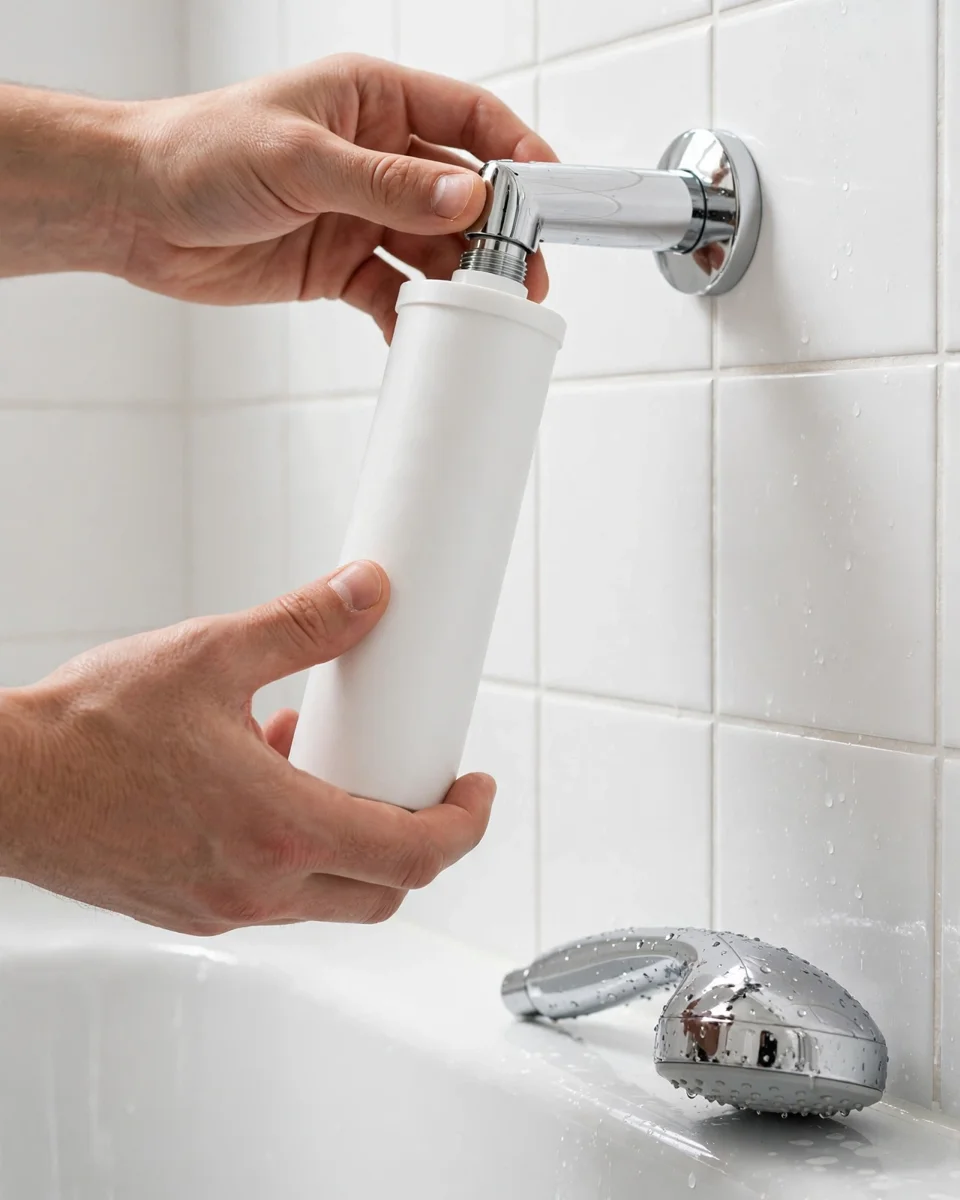
Strip a typical product page down and you find four different claims bundled into one purchase. First, chlorine reduction — the original and only certified job. Second, water softening and scale prevention, which would require removing calcium and magnesium. Third, broad chemical removal, borrowing language from drinking-water filters. Fourth, skin and hair benefits, which are really a downstream bet on claim one. The hardware itself hints at the truth: a fist-sized cartridge treating water at shower flow rates has seconds of contact time, at temperatures that defeat ordinary carbon. Whatever it does has to be fast chemistry, not slow filtration — and fast chemistry has a short menu.
What lab tests show

There is exactly one certification standard for this product category: NSF/ANSI 177, which covers the reduction of free available chlorine — nothing else. A filter certified to it has been lab-tested, at shower temperatures and shower flow rates, to reduce free chlorine across its rated cartridge life. That is a real, measurable effect, and chlorine is easy to verify independently with a simple drop test, which is why this claim is the solid ground. It is also why the media inside look different from a drinking-water filter: copper-zinc (KDF) media and similar fast-reacting materials are used because plain activated carbon struggles at shower temperatures and flow — the conditions the standard tests under.
Everything beyond free chlorine leaves certified ground. There is no NSF shower standard certifying removal of lead, VOCs, or other drinking-water contaminants, so any such claim rests on the maker’s own say-so. Hardness is clearer still: a shower filter does not remove calcium and magnesium, so the water’s measured hardness after the filter is the same as before it — which is why, as our hard water shower filter guide explains, these filters cannot soften water, whatever the box implies. We give the softening claim its own full hearing in do shower filters soften water. Chloramine — the disinfectant many cities use instead of chlorine — is a separate, tougher target that the free-chlorine standard does not certify either; our shower filter chloramine guide covers what applies there.
| The claim | What tests show |
|---|---|
| Reduces free chlorine | Supported — the one claim certified under NSF/ANSI 177, and easy to verify with a drop test |
| Softens water / removes hardness | Not supported — calcium and magnesium pass through; hardness readings are unchanged |
| Stops limescale | Not supported — the minerals that form scale are still in the water |
| Removes lead, VOCs, “chemicals” | Uncertified — no shower standard tests these claims; maker’s word only |
| Removes chloramine | Not covered by the free-chlorine standard; a harder target needing specific media and contact time |
| Better-feeling skin and hair | Plausible knock-on of chlorine reduction; reported by owners, not a certified measurement |
What owners report

Owner experience lines up with the lab picture more closely than marketing deserves. The most consistent reports are the chlorine ones: the pool-like smell fades, skin feels less tight and itchy after showering, and color-treated hair feels less stripped — exactly what reducing free chlorine would predict, and exactly what stops when a spent cartridge is left in too long. The most consistent disappointment is scale: in hard-water areas the crust keeps forming on glass and fixtures at the same rate, because the minerals causing it were never removed. The other recurring complaint is pressure — a clogged or restrictive cartridge can throttle flow, which is a maintenance and sizing issue our shower filter pressure drop fix walks through. Owners, in short, confirm the standard: chlorine yes, softening no.
Bottom line
What a good shower filter genuinely does
- Reduces free available chlorine — verifiably, when the model is certified to NSF/ANSI 177.
- Cuts the chlorine smell and the tight, dry feeling many people shower to escape.
- Installs in minutes with no plumbing, and costs little to run on a roughly six-month cartridge cycle.
What it never does
- Soften water or remove hardness minerals — calcium and magnesium pass straight through.
- Prevent limescale on glass, tiles, and fixtures.
- Deliver certified removal of lead, VOCs, or other drinking-water contaminants.
- Keep working past its cartridge life — an exhausted cartridge is just plumbing.
Buy one for the chlorine job and it earns its place — that is the whole deal, and for many households it is enough. The deeper dive on the chlorine claim itself, including how the home drop test works, is in our shower filters and chlorine article, and the models worth shortlisting are compared in our best shower filter roundup. And if the real problem is scale rather than chlorine, our shower filter vs water softener comparison shows what each technology actually does before you spend on either.
Conclusion
Do shower filters work? For free chlorine — the one job a lab standard exists to certify — yes, measurably, and you can confirm it yourself with test drops for a few dollars. For softening, scale, and the long chemical list borrowed from drinking-water marketing, no: the minerals and the claims both pass straight through. Judge any shower filter by that single certified claim, replace the cartridge on schedule, and the product is honest value. Judge it by the rest of the box, and disappointment is guaranteed.
Update log
October 2026: Article published. Framing per the scope of NSF/ANSI 177 (free available chlorine reduction) and our published hard-water guide’s position that shower filters do not soften water. No cartridge-degradation percentages are cited: the figures circulating on that point could not be verified against a primary source, so they are left out rather than repeated.
FAQs
Do shower filters really work?
For reducing free chlorine, yes — that is the claim certified under NSF/ANSI 177, and it can be verified at home with an inexpensive chlorine drop test. For softening water, removing hardness, or stripping drinking-water contaminants, no: no shower standard certifies those claims, and hardness measurements are unchanged by a shower filter.
What does a shower filter actually remove?
Certifiably, free available chlorine — that is the entire scope of NSF/ANSI 177, the shower-filtration standard. Some models also catch sediment and rust particles mechanically. Claims about lead, VOCs, or other dissolved contaminants are not tested under any shower standard, so treat them as unverified maker claims.
Will a shower filter soften my water?
No. Softening means removing calcium and magnesium, and a shower filter does neither — hardness readings before and after are the same, and limescale keeps forming. In hard-water areas a shower filter can still be worthwhile for chlorine, but actual softening requires an ion-exchange softener.
Do shower filters remove chloramine?
Not under any certification: NSF/ANSI 177 covers free chlorine, and chloramine — used by many cities instead — is a more stubborn compound that needs suitable media and contact time. Some media types handle it better than others; check whether your utility uses chlorine or chloramine before choosing a filter.
How long does a shower filter cartridge last?
Maker guidance is typically around six months per cartridge (for example, AquaSana lists about $52 per six-month cartridge and Sprite about $25–28, at maker-listed prices). The practical sign of exhaustion is the chlorine smell and dry-skin feeling returning — an overdue cartridge is the main reason owners conclude the filter “stopped working.”
Can I test whether my shower filter is working?
Yes — chlorine is one of the few claims you can check yourself. Use a pool-style free-chlorine drop or strip test on two samples: water that bypasses the filter and water through it. The unfiltered sample should show your supply’s chlorine level; the filtered sample should read clearly lower if the cartridge is doing its certified job.