Best Budget Whole House Water Filter (2026): Top Picks
★ BUDGET ROUNDUP 2026You want filtered water at every tap in the house — but the systems topping most “best of” lists cost $900 to $2,300 before a plumber even shows up. That sticker shock pushes a lot of people toward doing nothing, which is a shame, because the job most city-water households actually need (chlorine taste and odor gone, sediment out, appliances protected) does not require a four-figure tank system.
Here is the short answer: a 3-stage cartridge system like the iSpring WGB32B, at roughly $230–280 (estimate — re-check the live price), covers chlorine taste and odor for a typical city-water home at a fraction of a tank system’s price. Spend less than $100 and a bare filter housing like the SimPure DB10P gets you onto your main water line. On well water, the iron-fighting iSpring WGB32BM stays under $350. This roundup compares the four budget routes we researched and shows the honest yearly cost math — so you spend where it counts and skip what you do not need.
Table of Contents
- Quick picks
- Why you should trust this roundup
- How we researched
- Best overall (budget): iSpring WGB32B
- Cheapest way in: SimPure DB10P housing
- Best for well water (budget): iSpring WGB32BM
- Cheapest filter replacements: GE FXHTC
- Head-to-head comparison
- Buying guide: spend where it counts
- Replacement cost math
- FAQs
- Conclusion
Quick picks
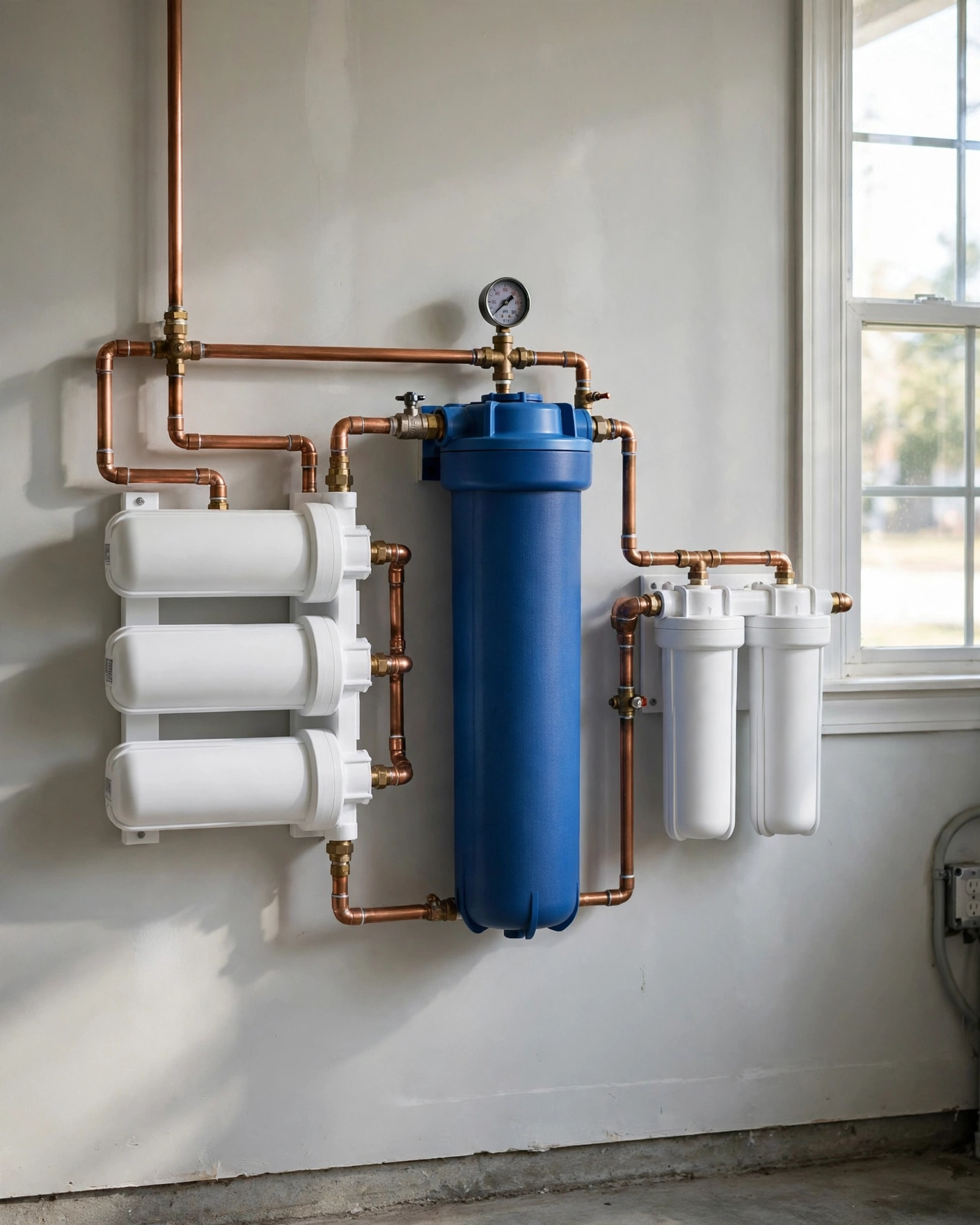
- Best overall (budget) — iSpring WGB32B (~$230–280): a 3-stage cartridge system rated at 15 GPM — the most complete filtration per dollar for city water in this price band.
- Cheapest way in — SimPure DB10P housing (~$60–100): a Big Blue shell you load with whatever cartridge your water needs. The lowest entry price; you buy the filter media separately.
- Best for well water (budget) — iSpring WGB32BM (~$280–350): the same 3-stage platform with a cartridge aimed at iron and manganese — the budget answer to orange stains and metallic taste.
- Cheapest filter replacements — GE FXHTC (~$25–35): the replacement cartridge for GE whole-house housings, among the lowest-cost filter swaps in the category.
Why you should trust this roundup
We did not receive test units and we did not run a lab bench. Claiming hands-on testing we never did would be dishonest, so we will not do it.
What we did instead was research and comparison: we pulled the manufacturers’ published specs, checked certification claims against what certifiers actually list (none of these budget picks carries a verified third-party certification in our sources — we say so plainly), read owner-review patterns for recurring complaints, and ran the replacement-cost math from published filter life and cartridge prices. Every price below is an estimate, and every contaminant claim is either brand-published or explicitly labeled as reported by an independent roundup.
How we researched
- Compared budget whole-house systems under ~$450 — cartridge-based systems and housings, not $1,000+ tank systems (those are covered in our main roundup).
- Checked certification claims at the source — we looked for NSF, WQA, and IAPMO listings for each pick. Where no listing was verified, the pick is presented without certification claims.
- Read owner-review patterns — across major retail listings, looking for recurring complaints (pressure drop, housing leaks, cartridge life in real water), not one-off bad experiences.
- Ran the yearly cost math — from published cartridge life and current replacement cartridge prices, because a cheap system with expensive cartridges is not actually cheap.
Best overall (budget): iSpring WGB32B

The WGB32B is the budget pick that behaves like a more expensive system. It is a 3-stage cartridge setup: a 5-micron sediment pre-filter followed by two coconut-shell carbon block cartridges, mounted in three 20-inch housings on your main water line. iSpring publishes a 15 GPM flow rating, which is enough headroom for a typical 2–3 bathroom home to run a shower and a washing machine at the same time without the pressure falling off a cliff.
What it is for: chlorine taste and odor, sediment, rust, and the general “city water” complaints. One independent roundup (purehousewater.com) reports up to 99% chlorine reduction for the unit — their reported figure, not a certified claim, since we found no verified NSF listing for this system. The cartridges are rated by the brand at about 100,000 gallons or roughly a year, and the housings use standard 20″ x 4.5″ cartridges, so you are not locked into one brand of replacements.
The honest limits: no verified third-party certification, so buy it for what owners report (better-tasting water, straightforward DIY install) rather than for badges. It does nothing for dissolved iron or hardness — well-water buyers should look at the WGB32BM below instead. And like every cartridge system, the “budget” story depends on you changing the cartridges on schedule; run them two years and flow rate will tell you about it.
Pros
- Most filtration per dollar — three full-size 20″ stages for roughly $230–280 (estimate).
- 15 GPM published flow — sized for a typical family home without pressure complaints when maintained.
- Standard-size cartridges — 20″ x 4.5″ replacements are widely available, not a proprietary lock-in.
- DIY-friendly — a straightforward main-line install for anyone comfortable with basic plumbing.
Cons
- No verified third-party certification — no NSF/WQA listing confirmed in our sources.
- Annual cartridge changes — three big cartridges a year is the real ongoing cost (see the math below).
- Not for well water problems — standard carbon does little for dissolved iron or sulfur smells.
- Bulky — three 20-inch housings need real wall space near your main line.
Price checked at time of writing; it changes often — see the live price before you buy.
Cheapest way in: SimPure DB10P housing

Not a system at all — a shell. The SimPure DB10P is a 10″ x 4.5″ Big Blue housing (roughly $60–100, estimate) with 1-inch brass NPT ports, a pressure-relief button, and a steel wall bracket. It ships without a cartridge: you load it with whatever your water needs — sediment, carbon block, or a specialty cartridge — which makes it the cheapest possible entry onto your main water line and a genuinely flexible one.
The specs that matter: food-grade polypropylene, rated for 25–90 psi and up to 20 GPM, cold water only, and the box includes the bracket, wrench, and Teflon tape. The catch is the obvious one — a housing filters nothing until you buy cartridges, so budget those too. With only 10 inches of cartridge (versus 20-inch Big Blue setups), you will change them more often in sediment-heavy water.
This is the right pick if your problem is narrow — say, sediment clogging your fixtures, or chlorine taste you want gone — and you like choosing the exact cartridge rather than accepting a bundled set. It is the wrong pick if you want an out-of-the-box system; “cheapest” here means cheapest shell, and the total with cartridges still lands well under a 3-stage system.
Pros
- Lowest entry price — onto your main line for roughly $60–100 (estimate) plus cartridges.
- Total cartridge freedom — run sediment now, carbon later, specialty media when you need it.
- 1″ brass ports, 20 GPM rating — no meaningful flow restriction for most homes.
- Install hardware included — bracket, wrench, and Teflon tape in the box.
Cons
- No cartridge included — out of the box it filters exactly nothing.
- Single stage — one housing means one job; multi-stage needs multiple housings.
- 10-inch cartridges — shorter service life than 20-inch Big Blue setups in dirty water.
Price checked at time of writing; it changes often — see the live price before you buy.
Best for well water (budget): iSpring WGB32BM

The WGB32BM is the WGB32B’s well-water sibling: the same 3-stage, 20-inch-housing platform, but with the carbon stages swapped for cartridges aimed at iron and manganese — the minerals behind orange toilet stains, metallic taste, and that rotten-egg-adjacent unpleasantness in well water. At roughly $280–350 (estimate), it is the cheapest credible whole-house answer to those problems we found.
Two things to get straight before buying. First, we claim no removal percentages and no ppm capacity figures for the iron/manganese stage — we found no certified numbers, and a budget post is exactly where inflated numbers do the most damage. What we can say is that it is purpose-built for the problem, which matters because standard carbon (like the WGB32B’s) does little for dissolved iron. Second, well water is the one case where you should test before you buy anything: a basic water test tells you whether you are dealing with iron, manganese, sediment, hardness, or bacteria — and a filter only fixes the ones it is designed for.
Ownership looks like the WGB32B: annual cartridge swaps and DIY-friendly install, with the same honest absence of verified third-party certification. If your test shows only mild iron staining, this is the value play; heavy iron plus sulfur plus hardness puts you outside “budget cartridge” territory.
Pros
- Purpose-built for iron and manganese — the well-water variant of a proven 3-stage platform.
- Stays under $350 — roughly $280–350 (estimate), far below tank-based well systems.
- Same DIY-friendly platform — standard 20″ x 4.5″ housings and widely available replacements.
Cons
- No certified removal figures — no verified percentages or capacity numbers; buy on purpose-fit, not specs.
- Not a full well-water treatment train — heavy iron, sulfur, or bacteria need more than one system.
- Annual cartridge swaps — iron loads exhaust cartridges faster than city-water sediment loads.
Price checked at time of writing; it changes often — see the live price before you buy.
Cheapest filter replacements: GE FXHTC

Here is the budget angle nobody advertises: the system price is a one-time number, but cartridges are forever. The GE FXHTC — the replacement cartridge for GE’s whole-house filter housings — runs roughly $25–35 (estimate), among the lowest per-cartridge prices in the whole-house category. If you already own a GE whole-house housing, staying in the family keeps your yearly upkeep genuinely cheap.
The honest framing: this is a replacement cartridge, not a system. It earns its place in a budget roundup for one reason — total cost of ownership. A $250 system with $90 yearly cartridges costs more over five years than a $150 setup with $30 cartridges. The cartridge is stocked just about everywhere, which matters when you need one on a Saturday.
The catch: you are buying into GE’s housing ecosystem, and a single-stage cartridge is lighter duty than the 3-stage iSpring above. But if your water problem is modest and your priority is the lowest possible yearly number, this is how you get there.
Pros
- Among the cheapest replacement cartridges — roughly $25–35 (estimate) per swap.
- Widely stocked — easy to find online and in stores when a change is due.
- Lowest yearly upkeep — the budget-ownership winner in our cost math below.
Cons
- Cartridge only — you need a compatible GE whole-house housing to use it.
- Single-stage filtration — lighter duty than a 3-stage system for complex water.
- More frequent swaps — smaller cartridges in dirty water mean changing on schedule matters more.
Price checked at time of writing; it changes often — see the live price before you buy.
Honorable mention — PRO+AQUA Elite PRO-100-E GEN2 (~$300–450, estimate): a 3-stage well-water line that independent roundups mention, but we could not verify its specs to our standard, so it stays a mention rather than a ranked pick.
Head-to-head comparison
| Pick | Upfront (est.) | Type | Best for | Cartridge rhythm | Certifications |
|---|---|---|---|---|---|
| iSpring WGB32B | ~$230–280 | 3-stage, 20″ housings | City water, chlorine taste/odor | ~Yearly (100k gal rated) | None verified |
| SimPure DB10P | ~$60–100 + cartridges | Single housing (no cartridge) | Cheapest entry; narrow problems | Depends on cartridge chosen | None verified |
| iSpring WGB32BM | ~$280–350 | 3-stage, iron/manganese | Well water, iron staining | ~Yearly (sooner in heavy iron) | None verified |
| GE FXHTC | ~$25–35 (cartridge) | Replacement cartridge | Lowest yearly upkeep | A few times a year | None verified |
About the “None verified” column: we checked for NSF, WQA, and IAPMO listings for each pick and confirmed none in our sources. That is normal at this price — budget cartridge systems compete on price and owner feedback, not certifications. If a listing claims a badge for one of these, ask which database it appears in before you believe it.
Buying guide: spend where it counts

Test your water first — especially on a well. A $25–50 water test (or your city’s free annual water quality report) tells you whether you are fighting chlorine, sediment, iron, hardness, or something a filter cannot fix at all. Buying blind is how budget shoppers end up with the wrong system twice. Our well-water picks walk through the full picture when the test shows more than one problem.
Size for flow, not for price — and budget the install, not just the box. A whole-house filter sits on your main line, so every gallon passes through it. Undersize it and you get the number-one owner complaint in the category: pressure drop when two taps run at once. The WGB32B’s 15 GPM rating suits a typical 2–3 bathroom home; a single Big Blue housing fits smaller demand but shows its limits sooner. On install: cartridge systems are DIY-friendly (basic plumbing skills and an afternoon), but plumber labor in the low hundreds of dollars can exceed the system price on the cheapest picks — our whole-house installation guide covers the process step by step.
Know what budget systems do not do. No cartridge system here softens hard water — softening needs a softener or salt-free conditioner, a separate purchase. None carries a verified certification for lead or PFAS reduction; those claims belong to premium systems like the ones in our main whole-house roundup. And chloramine (used by some cities instead of chlorine) is harder for standard carbon — check your water report first. For a premium tank-system reference point, our SpringWell CF1 review shows what the extra money buys.
Replacement cost math

The sticker price is the least important number on this page. Cartridge systems are a subscription you pay in replacements, so here is an illustrative 3-year ownership sketch. Assumptions: cartridge sets at typical street prices, changed on the brand’s rated schedule, average city water. Heavy sediment or iron shortens cartridge life and raises every number below.
| System | Upfront (est.) | Cartridges / year (est.) | 3-year total (est.) |
|---|---|---|---|
| iSpring WGB32B | ~$255 | ~$70–90 (one 3-pack) | ~$465–525 |
| SimPure DB10P + cartridges | ~$80 + ~$60 cartridges | ~$60–120 (cartridge of choice) | ~$320–500 |
| iSpring WGB32BM | ~$315 | ~$80–110 | ~$555–645 |
| GE housing + FXHTC | ~$70–100 all-in | ~$50–105 (2–3 cartridges) | ~$220–415 |
Two things jump out. First, the cheapest system to buy is also the cheapest to own — the GE route wins the 3-year math because its cartridges cost a third of a 3-stage set. Second, the WGB32B’s higher cartridge cost is the price of three full-size stages; you are paying for filtration capacity, not brand tax. And the anchor: even the priciest row here costs less over three years than the upfront price of most tank systems. (All figures are estimates; re-check cartridge prices before you buy.)
FAQs
How much does a budget whole house water filter cost all-in?
For the systems in this roundup: roughly $230–350 for a 3-stage cartridge system, or under $100 for a bare housing plus cartridges — all estimates, re-check live prices. Add install: DIY costs little beyond fittings, while third-party guides report plumber install labor in the low hundreds of dollars. Then budget cartridges yearly: roughly $50–110 a year depending on the system, with heavy sediment or iron raising that number.
Can I install a whole house water filter myself?
Cartridge systems like the ones here are among the most DIY-friendly: they mount on the main water line with basic plumbing fittings, and many owners do it in an afternoon. You need to be comfortable cutting into your main line and installing a shutoff valve and bypass. If that sentence made you nervous, hire a plumber — a flooded utility room costs more than the install. Our installation guide walks through the process step by step.
Will a whole house filter reduce my water pressure?
It can, and undersizing is the usual cause. Every filter adds some resistance; a system rated well above your household’s peak demand (the WGB32B’s 15 GPM suits a typical 2–3 bathroom home) shows little noticeable drop when maintained. Pressure complaints almost always trace to an undersized system or cartridges left in service long past their rated life — change them on schedule and the problem mostly disappears.
Do budget whole house filters remove lead or PFAS?
Not credibly. None of the budget picks in this roundup carries a verified third-party certification for lead or PFAS reduction — we checked NSF, WQA, and IAPMO sources and confirmed no listings. Certified lead and PFAS reduction at the whole-house level belongs to premium systems with published certifications, which cost several times more. If lead or PFAS is your concern, get a water test first and shop the certified tier, not the budget tier.
Will a whole house water filter soften hard water?
No. Filtration and softening are different jobs: filters remove particles, chlorine taste, and some dissolved contaminants, but the calcium and magnesium behind hard-water scale pass straight through. Softening needs a salt-based softener or a salt-free conditioner — a separate system. If your glasses come out spotty and your kettle furs up, budget for softening alongside (or instead of) filtration.
How often do the cartridges need replacing?
Follow the brand’s rated life as your baseline: about 100,000 gallons or roughly a year for the 3-stage iSpring cartridges in average city water, more often for the smaller GE cartridges. In practice, sediment-heavy or iron-heavy water exhausts cartridges faster — treat a noticeable pressure drop or returning taste as your early-change signal. A spent cartridge you keep using is just an expensive pipe fitting.
Should I buy a whole-house filter or an under-sink system?
Different jobs. A whole-house filter treats every tap — better-tasting water everywhere, plus protection for pipes, water heater, and appliances — but at this price it is a chlorine/sediment/iron answer, not a purification answer. An under-sink system (especially RO) gives you the purest drinking water at one tap for similar money. If your priority is drinking-water purity on a budget, go under-sink; if it is every tap tasting better and fixtures lasting longer, go whole-house.
Conclusion
Budget whole-house filtration is one of the rare corners of this category where the cheap option is genuinely good enough — provided your problem matches what these systems do. For city water with chlorine taste and sediment, the iSpring WGB32B gives you three full-size stages for the price of a nice dinner out. For the absolute lowest entry, the SimPure DB10P housing gets you onto your main line for under $100 plus cartridges. For well water with iron staining, the WGB32BM stays under $350. And the GE FXHTC is a standing reminder that cartridges, not the box, decide what “budget” really costs.
What none of them do: certified lead or PFAS reduction, softening, or miracles on complex well water. Test your water, size for your peak flow, change cartridges on schedule — do those three things and a budget system serves you well for years.
Price checked at time of writing; it changes often — see the live price before you buy.
Update log
- Zulqarnain: Review published.