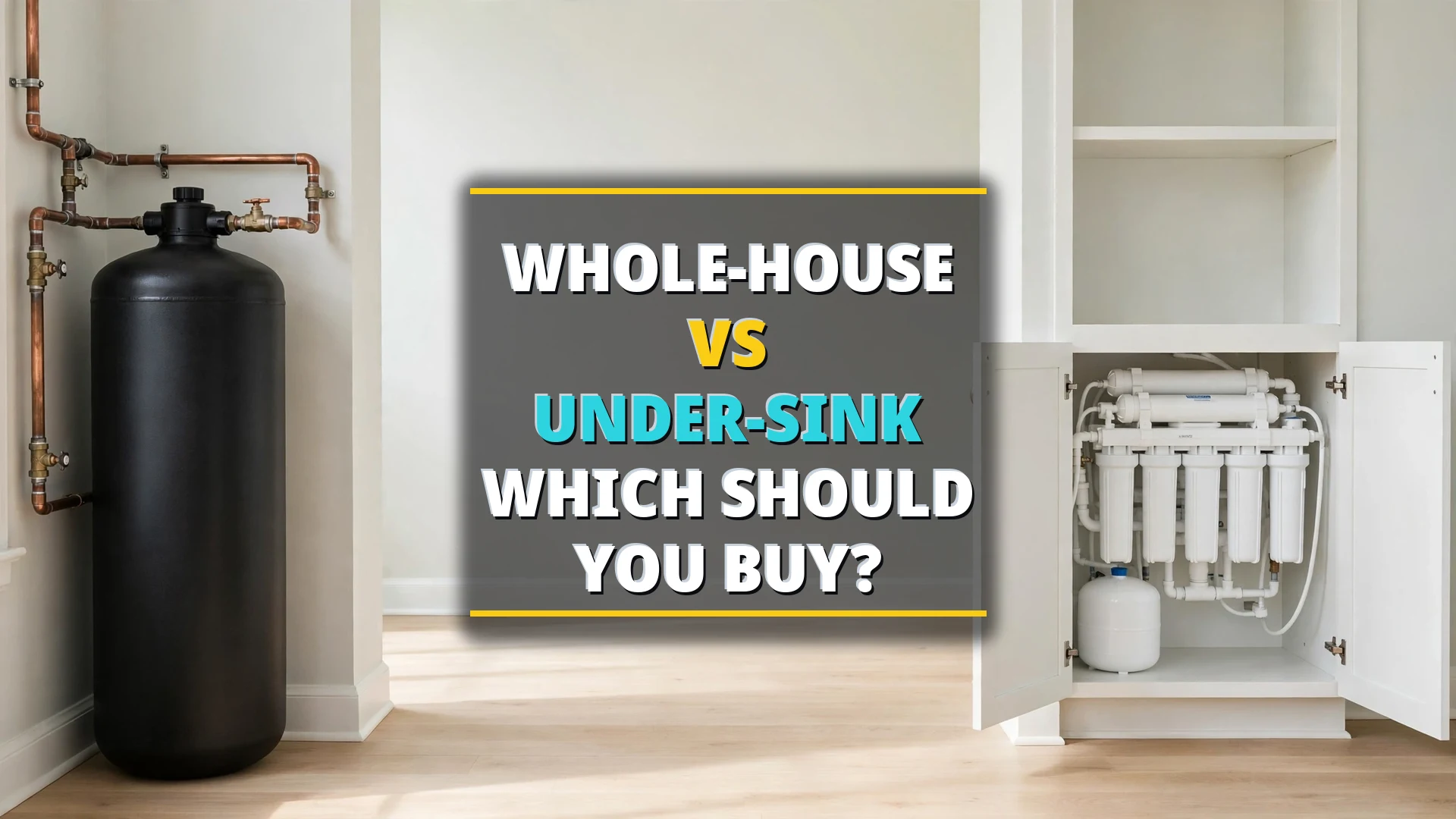

Whole House vs Under Sink Water Filter (2026): Which Should You Buy?
The shower smells faintly of a swimming pool. The kitchen water leaves a taste you cannot quite name. You have read enough about what hides in municipal supplies to want better — but now two very different products both claim to be the answer: a whole-house system that bolts onto your main water line, and a compact unit that hides under the kitchen sink. They are not upgrades of each other. They solve different problems.
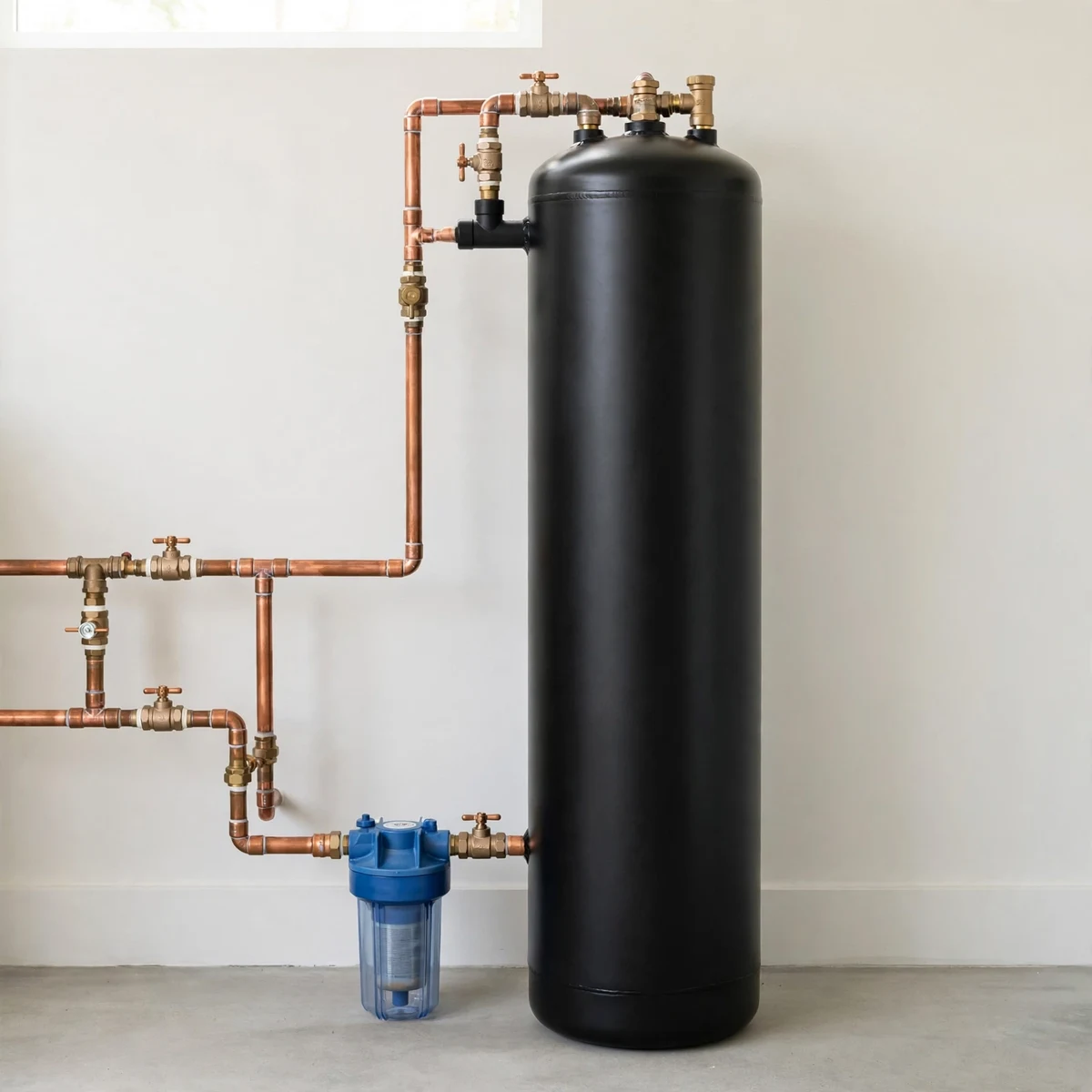
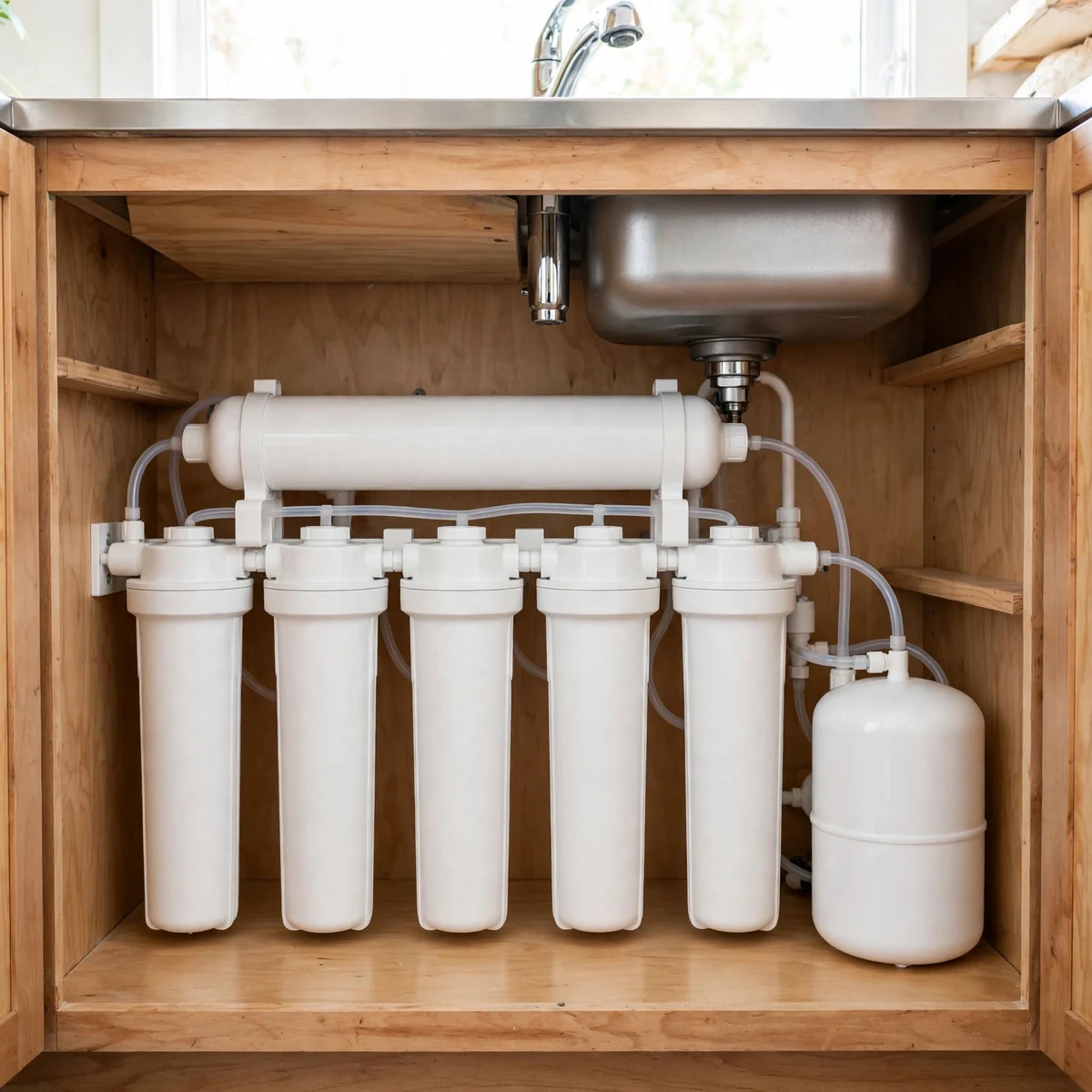
Here is the short answer: an under-sink system is the better buy when your problem is what you drink and cook with at one tap — and a reverse-osmosis unit handles the dissolved contaminants a filter cartridge never will. A whole-house system is the better buy when the problem shows up everywhere else — chlorine in the shower, sediment at every faucet, odors in the laundry. This comparison pits a representative of each side against the other — the SpringWell CF1 whole-house carbon tank and the Geekpure RO5 under-sink RO — across coverage, certifications, five-year cost, and owner feedback, so you can match the equipment to your problem instead of buying the wrong category twice.
The whole-home pick
SpringWell CF1
~$1,040–$1,240
Treats every tap, shower and appliance from the main line — chlorine, sediment, tastes and odors house-wide — but carbon does not remove dissolved minerals.
The drinking-water pick
Geekpure RO5
~$130–$220
Reverse osmosis removes dissolved contaminants like fluoride, arsenic, and high TDS that a whole-house carbon filter cannot touch, for the lowest total cost.
The bottom line: buy the under-sink RO if drinking-water quality is your main concern — it removes dissolved contaminants like fluoride, arsenic, and high TDS that a whole-house carbon filter cannot touch, for the lowest total cost. Buy the whole-house system if your problem is house-wide — chlorine odor in every shower, sediment clogging fixtures, bad taste at every tap.
Many households eventually do both — whole-house for comfort at every tap, under-sink RO for a final polish on the drinking faucet — but buy the one that solves the problem you actually have today.
Verdict: drinking-water problem → under-sink RO; whole-home problem → whole-house filter.
Prices checked at time of writing; they change often — see the live prices before you buy.
Table of Contents
Side-by-side comparison

The table below compares the two categories, anchored by the two products we researched for this guide — the SpringWell CF1 (a large whole-house carbon tank, ~$1,040–$1,240 estimate) and the Geekpure RO5 (a 5-stage under-sink RO, ~$130–$220 estimate). Figures are brand-stated or reviewer-reported, labeled as estimates where they are.
| Factor | Whole-house (SpringWell CF1) | Under-sink (Geekpure RO5) ★ Winner |
|---|---|---|
| Where it treats water | Point-of-entry: the main line, before water splits through the house | Point-of-use: one faucet, usually the kitchen sink |
| Coverage | Every tap, shower, toilet, and appliance | One dedicated drinking-water faucet only |
| What it removes | Chlorine, chloramine, sediment, tastes and odors (brand-stated; not system-certified) | Sediment, chlorine, plus dissolved solids — TDS, fluoride, arsenic, nitrate |
| What it cannot fix | Fluoride, arsenic, nitrate, high TDS — carbon does not remove dissolved minerals; will not soften water | Chlorine in the shower, sediment at bathroom taps, laundry odors |
| Flow and capacity | 9 GPM (CF1, suits 1–3 baths); ~1,000,000-gallon media life, ~10 years (brand-rated) | 75 GPD membrane output into a 2.8-gallon storage tank; one tap at a time |
| Installation | Main-line plumbing cut; bypass kit included; media needs 48-hour soak; many buyers budget a plumber | Under-sink hookup with drain-saddle; standard DIY job |
| Space needed | Tank plus pre-filter — basement, garage, or utility room | Inside the kitchen sink cabinet |
| Maintenance rhythm | Sediment pre-filter every 6–9 months (~$27–$40/yr); main media lasts ~a decade | Pre-filters every 6–12 months, membrane every 15–24 months (brand’s schedule) |
| System certification | No system-level NSF/WQA certification found | No system-level NSF certification found |
| Best for | House-wide chlorine, sediment, taste, and odor on city water | Drinking and cooking water — fluoride, PFAS-adjacent concerns, high TDS |
Neither system is certified at the system level by a third-party certifier — the Certifications section below spells out exactly what that means for each, so the table’s “removes” claims are read correctly.
How each system works
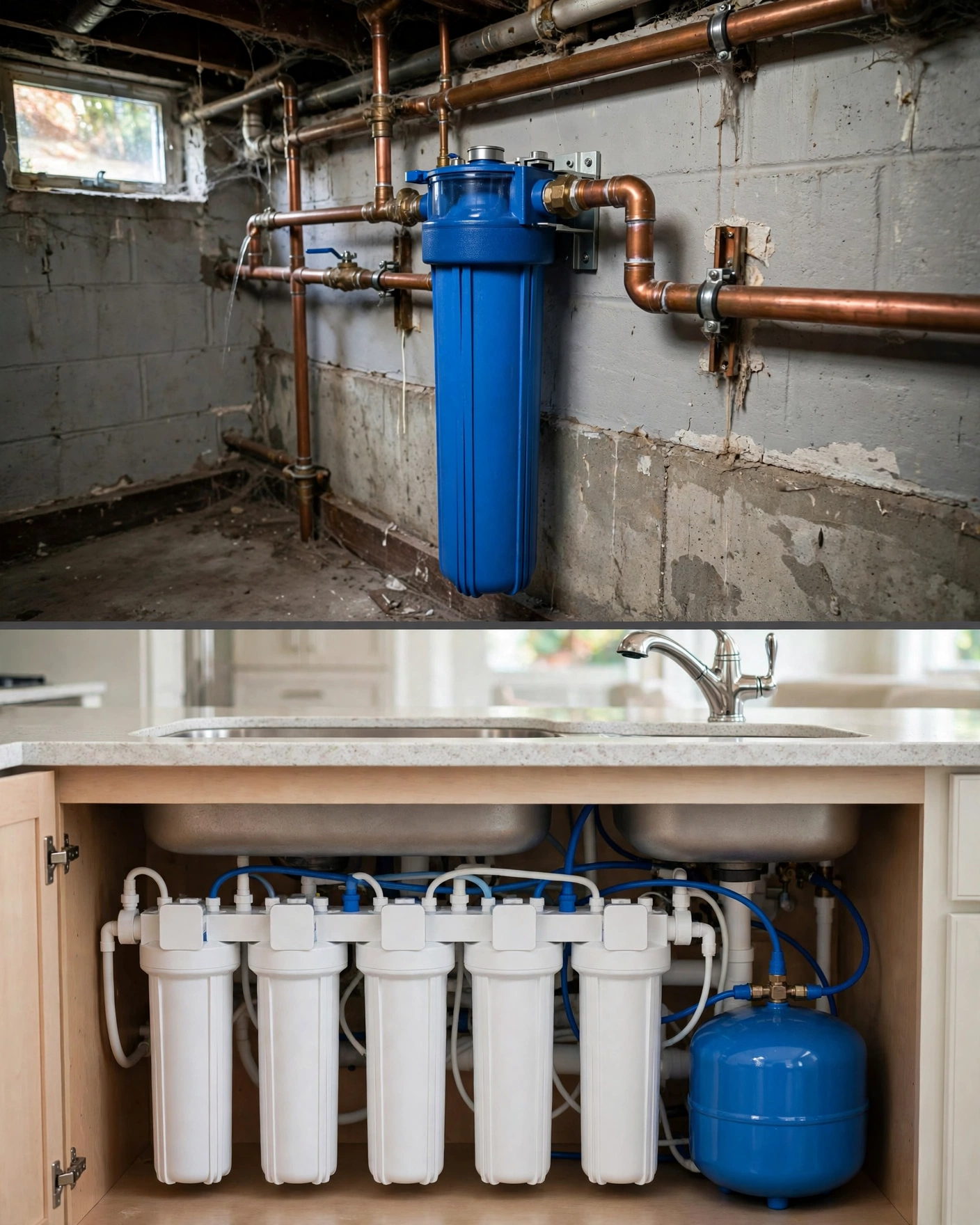
A whole-house filter sits where the water main enters your home and treats water before it reaches a single fixture. In the SpringWell CF1, water passes upward through a bed of catalytic coconut-shell carbon and KDF media, then through a 5-micron sediment post-filter. Carbon grabs chlorine, chloramine, tastes, and odors through adsorption — but it does not remove dissolved minerals. It is a broad, shallow cleanup across the whole house.
An under-sink RO system works the opposite way: it treats a small stream of water very deeply. In the Geekpure RO5, water passes through a sediment filter, two carbon filters, then a reverse-osmosis membrane that rejects dissolved solids — fluoride, arsenic, nitrate, most of the TDS — before a post-carbon stage polishes the taste into a 2.8-gallon storage tank. It is a narrow, deep cleanup at one faucet.
This is why the systems are complementary, not competing: the whole-house tank fixes what touches your skin, hair, and appliances, while the under-sink RO fixes what touches your lips. If you are still weighing which problem you actually have, our whole-house vs under-sink decision guide walks through it with a checklist.
Match the system to your water problem

Every ranking of these systems agrees on one thing: the buying mistake is choosing by price or filter size instead of by where your problem shows up. Use this table to locate your complaint, then buy the architecture that sits in its path.
| Your complaint | Better starting point |
|---|---|
| Chlorine smell in the shower or bath | Whole-house filter — only point-of-entry filtration reaches the shower |
| Sediment, rust, or dirty water at multiple faucets | Whole-house filter — sediment hits everything before it hits one tap |
| Well water with iron, odor, or sediment | Whole-house first (well-water homes need broad treatment) — see our whole-house filters for well water guide |
| Drinking and cooking water only | Under-sink system — cheapest way to fix one tap well |
| Fluoride, arsenic, nitrate, or chromium-6 on your water report | Under-sink RO — carbon does not remove these at any price |
| Lead or PFAS flagged at the tap | Under-sink with certified reduction (NSF/ANSI 53 or 401 for the specific contaminant) — more in the Certifications section below |
| Shower chlorine and a drinking-water concern | Both — whole-house for comfort, under-sink for the drinking faucet |
| Hard water scale on fixtures and glass | Neither — this is softener territory, covered in our whole-house filter vs water softener comparison |
Certifications that actually matter

Four NSF/ANSI standards decide what a filter is actually certified to do. NSF/ANSI 42 covers taste, odor, and particulates. 53 covers health-related reductions like lead, cysts, and many VOCs. 401 covers emerging contaminants, including several PFAS compounds. 58 covers reverse-osmosis systems as a whole. A brand statement without one of these listings is a marketing claim — not a fact.
| Product | System-level certification | What that means for you |
|---|---|---|
| SpringWell CF1 | None found; coverage described as component-level only | Its contaminant list — chlorine, chloramine, PFAS/PFOA/PFOS, pesticides, herbicides — is brand-stated, not certified. If PFAS is your reason to buy, pick a system certified to 53 or 401 for PFAS instead. |
| Geekpure RO5 | No system-level NSF certification found | The standard 5-stage RO recipe reduces dissolved solids, but on this unit the reductions are not certified. Verify the model yourself at info.nsf.org. |
Interactive certification directories could not be pulled by text fetch during research — so we printed no listing from memory. Look the exact model number up at info.nsf.org, wqa.org, or the IAPMO directory yourself before you buy; listings change.
One practical takeaway: if your water report flags lead, neither of these units is the right answer — you want something specifically certified to NSF/ANSI 53 for lead, like the under-sink options in our iSpring RCC7 and APEC ROES-50 reviews.
Cost per year

The sticker price is the least important number on this page. An independent July 2026 cost model from tapwaterdata.com puts an under-sink RO at $547–$694 over five years and a whole-house carbon install at $180–$1,600 for the plumber alone — yet whole-house carbon is the cheapest filtration of all per gallon treated, about $1.83 per 1,000 gallons, because it treats your entire supply. A layered setup (both systems) runs about $2,112 over five years in that model.
| Item | SpringWell CF1 (whole-house) | Geekpure RO5 (under-sink) |
|---|---|---|
| System (upfront, estimate) | ~$1,040–$1,240 | ~$130–$220 |
| Installation | DIY possible; many budget a plumber ($180–$1,600 per tapwaterdata.com) | DIY; standard under-sink hookup |
| Consumables | Pre-filter every 6–9 months (~$27–$40/yr); main media ~a decade | Pre-filters every 6–12 months, membrane every 15–24 months (~$60–$90/yr estimate) |
| 5-year total | ~$1,300–$2,900 incl. install (third-party: ~$1,371 hardware-only) | ~$430–$670 incl. install |
| Cost per gallon | Very low — treats every gallon in the home | Higher — treats only drinking water |
Two things jump out. First, the under-sink RO is dramatically cheaper to own — roughly a third of the whole-house system’s five-year cost. Second, that comparison is meaningless if it fixes the wrong problem: a $600 RO that leaves your shower reeking of chlorine solved half your complaint. Buy the architecture your problem requires first; the math only optimizes within the right category. Our whole-house filter roundup and budget whole-house guide cover cheaper point-of-entry options if the CF1’s price puts you off.
Owner voices

Across hundreds of owner reviews read during research, the same patterns repeat for each category — not one-off complaints, but the friction points that keep appearing:
Whole-house owners: chlorine disappearing from the shower is the most-reported satisfaction point, and the “forgot it existed” maintenance rhythm keeps people recommending tanks like the CF1. The recurring friction is the install — the CF1 ships unassembled and the media needs a full 48-hour soak before connection, so plan the location before delivery. Pressure complaints cluster around sizing mistakes (a 9 GPM system on a multi-shower household) rather than the media.
Under-sink RO owners: the most-reported win is the TDS drop and taste change — owners notice it most in coffee and cooking water. The recurring friction: the first fill is slow (a 75 GPD membrane fills a 2.8-gallon tank gradually), the drain-saddle install intimidates first-timers, and exhausted pre-filters from forgotten schedules cause sluggish output. Replacement filter sets on value units like the Geekpure are cheap enough that forgetfulness, not cost, is the real maintenance barrier.
FAQs
Can I run both a whole-house and an under-sink system together?
Yes — this is a common layered setup, and arguably the ideal one. The whole-house system handles chlorine, sediment, and odors at every tap, while the under-sink RO polishes the drinking faucet for dissolved contaminants. An independent cost model puts the layered setup at about $2,112 over five years. Buy the system that fixes your current problem first, add the other later.
Will a whole-house filter remove lead?
Most whole-house carbon systems are not certified for lead — the SpringWell CF1 has no system-level NSF/WQA certification and no certified lead claim. If lead in your plumbing is the concern, look for something specifically certified to NSF/ANSI 53 for lead, and verify the exact model at info.nsf.org. An under-sink RO or a 53-certified unit is the surer path.
Does an under-sink RO remove fluoride?
Reverse-osmosis membranes do reduce fluoride along with other dissolved solids — this is a capability of the RO category, not something a carbon filter can do at any price. Note that the specific reductions of any given unit are only meaningful where they are certified, so check the brand’s performance data for the exact figures.
Does a whole-house water filter soften water?
No. A carbon whole-house filter does not remove dissolved hardness minerals or lower TDS, so scale spots, dry shower glass, and hard-water buildup remain. Hardness is a separate problem with separate equipment — a softener or conditioner — not a more expensive filter.
How much does it cost to install a whole-house filter?
The unit itself (the CF1 runs about $1,040–$1,240 estimated) is only part of the bill. Confident DIYers do install whole-house systems themselves, but many budget a plumber — an independent 2026 cost model puts plumber installation at $180–$1,600. The CF1’s media also needs a 48-hour soak before you connect the tank, so it is not a same-day job.
Which is cheaper over five years — whole-house or under-sink?
Under-sink, by a wide margin. A representative under-sink RO runs about $547–$694 over five years in an independent cost model, while a whole-house tank system runs roughly $1,300–$2,900 including installation. The whole-house side is cheaper per gallon treated — about $1.83 per 1,000 gallons in that model — because it treats your entire supply, including water you never drink.
Is the Geekpure RO5 NSF certified?
We found no system-level NSF certification for the Geekpure RO5. Its specifications — 75 GPD membrane, 2.8-gallon tank, five stages — come from the brand’s own manual and product materials. Treat any reduction claim on this specific unit as brand-stated unless you verify a listing yourself at info.nsf.org.
Is the SpringWell CF1 certified to reduce PFAS?
No. SpringWell states that the CF1 targets PFAS (PFOA/PFOS), but this is a manufacturer claim, not a certified reduction — no third-party PFAS certification was found for this system. If PFAS is your main reason for buying, choose a system certified to NSF/ANSI 53 or 401 for PFAS and confirm the listing in the database before purchase.
Conclusion
These two systems are not fighting for the same job, so stop comparing them on price. If your complaint is what you drink and cook with — taste, fluoride, high TDS, a flagged water report at one tap — the under-sink RO is the right buy, and a value unit like the Geekpure RO5 gets you there for a few hundred dollars of ownership. If your complaint is what touches everything else — chlorine in the shower, sediment at every faucet, odors in the laundry — the whole-house system is the only architecture that reaches those problems, and a long-life tank like the SpringWell CF1 spreads its premium over a decade. Know where your problem shows up, buy the system that sits in its path, and layer the other later if you end up wanting both.
Prices checked at time of writing; they change often — see the live prices before you buy.
Update log
- Zulqarnain: Review published.