
Does A Whole House Water Filter Remove PFAS (2026): What the Evidence Says
Guide
You have read the headlines about PFAS — the “forever chemicals” turning up in tap water across the country — and now you are eyeing the big tank in your garage, wondering whether it already handles them. Or maybe you are shopping for a whole-house system and a salesperson just promised it “filters everything.” That is exactly the moment to slow down.
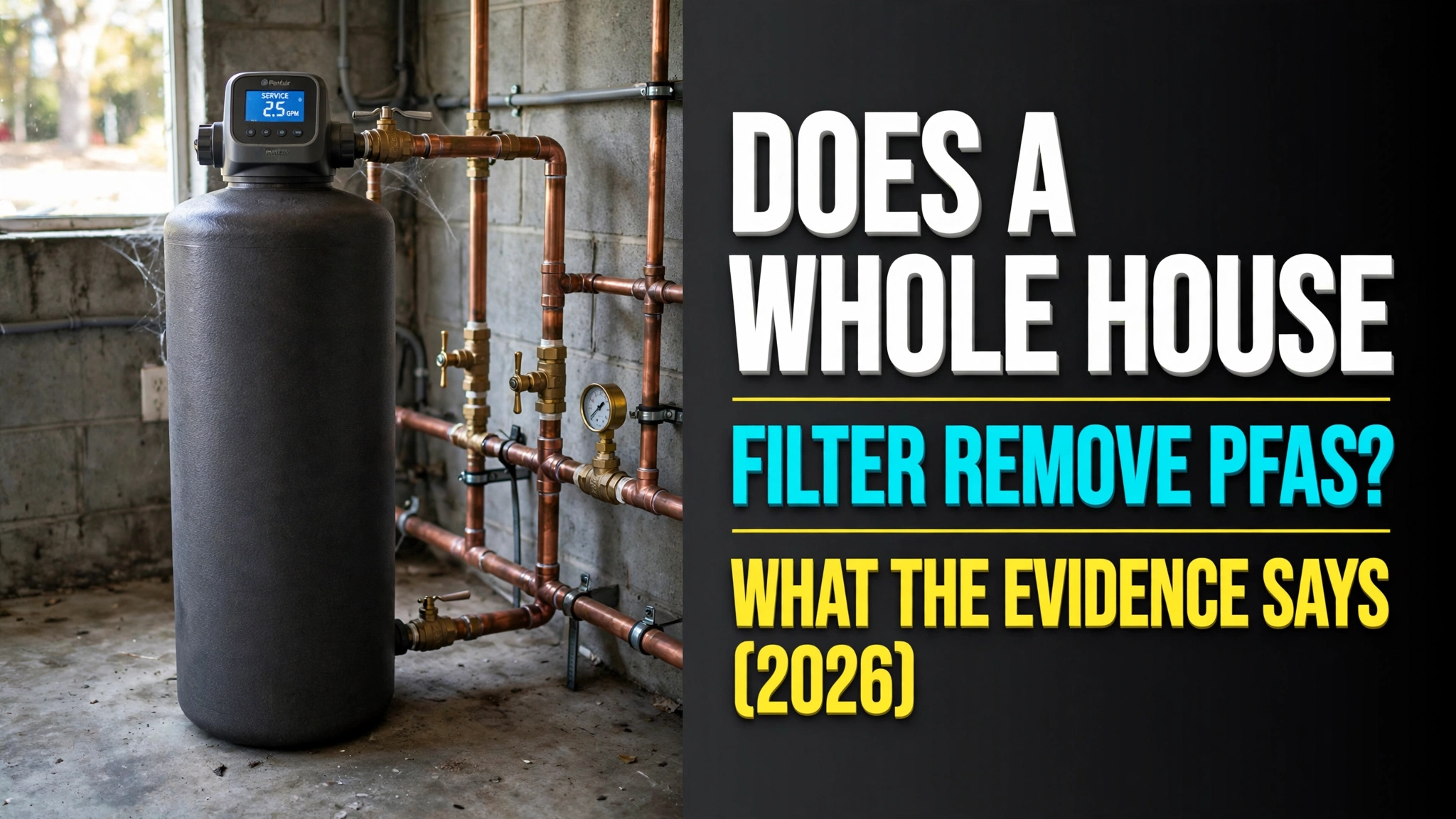
Here is the short answer, straight from what the evidence says: most whole-house water filters do NOT remove PFAS. They were designed for chlorine, sediment, and taste — a completely different job. Only a system that carries a specific, independently verified PFAS-reduction certification can be counted on for PFAS. This guide explains why that is, which certifications actually mean something, and what to do instead if PFAS is your real concern.
Table of Contents
Does a typical whole-house filter remove PFAS?
The Minnesota Department of Health — one of the few state agencies with a dedicated page on home PFAS treatment — is blunt about this. It states that filters with activated carbon or reverse osmosis membranes have been shown to be effective against PFAS, but that other common whole-house systems, “such as water softeners or iron filtration systems, are not likely to remove PFAS.” It adds that sampling data from homes with whole-house softening or iron filtration indicate those systems do NOT remove PFAS. Boiling your water does not remove PFAS either.
That is the core of the mismatch: a softener swaps hardness minerals for sodium (it does not filter in the PFAS sense at all — see our evidence guide on whole-house softening), and an iron filter targets a visible mineral, not dissolved forever chemicals. None of the standard whole-house workhorses touch PFAS by design.
So where do the other contaminants sit? PFAS is not the only thing people ask about. Lead and fluoride each have their own evidence picture — covered in our lead guide and fluoride guide — and the answer pattern is the same every time: the marketing promise is broad, the certified reality is narrow. For PFAS, the narrow reality is what follows.

The honest case for and against
The case for a PFAS-capable whole-house system
- Every tap is covered — drinking water, showers, baths, and appliances all get treated water, not just the kitchen sink.
- One system to maintain instead of filters scattered across the house.
- Large carbon beds last — a whole-house tank holds far more media than an under-sink cartridge, so certified units can go long stretches between media changes.
The case against counting on one
- Most whole-house filters carry no PFAS certification at all — the units people actually own were built for chlorine and taste.
- High flow rates work against carbon — carbon needs contact time to trap PFAS, and a whole-house system pushes a home’s entire water supply through in a hurry.
- Certified units cost real money — a brand-stated PFAS-certified whole-house system runs around $1,900–2,300 (estimate), versus ~$900–1,200 for a mainstream non-certified system.
- Maintenance is everything — an exhausted or overdue filter stops working, and research has found overdue carbon filters can even release captured contaminants back into the water.
What certifications actually prove PFAS removal
Here is the single most important sentence in this guide: the only proof that a filter removes PFAS is an independent certification listing for your exact model, with a PFAS-specific reduction claim. Not the brand’s website copy. Not “removes 99% of contaminants” on the box. A listing in a certifier’s public database, against your model number.
For PFAS, the Minnesota Department of Health says to look for products certified to NSF/ANSI 53 (for filters) or NSF/ANSI 58 (for reverse osmosis). NSF’s own history shows how this standard grew into the PFAS job: the 2018 edition of NSF/ANSI 53 added a performance reduction claim for PFOA and PFOS in activated-carbon devices, and the 2022 edition added five more compounds — PFHxS, PFNA, PFHpA, PFBS, and PFDA — under a “Total PFAS” claim. That is the lineage a legitimate PFAS certification descends from.
Two caveats keep this honest. First, the Minnesota Department of Health notes that the certification standards for PFAS filters, as of April 2024, did not yet guarantee a filter would bring water down to the levels in EPA’s drinking-water rule — the EPA was working with standards bodies to close that gap. A certified claim means the filter reduced PFAS under controlled lab test conditions, not that your tap will test below 4 parts per trillion.
Second, “NSF/ANSI compliant” is not the same as certified. Phrases like “tested to NSF/ANSI 53” or “designed to meet NSF standards” describe an internal test, not an independent listing. If the model is not in the certifier’s database, it is not certified — full stop.
It also helps to know what the common certifications do NOT cover. NSF/ANSI 42 — the standard on most basic carbon filters — covers taste and odor only; it says nothing about PFAS. Most whole-house systems that proudly carry NSF 42 are excellent at chlorine (see our chlorine and chloramine evidence guide) and silent on PFAS, because they were never tested for it.

| System | PFAS certification | What this means |
|---|---|---|
| Aquasana HealthShield (UV + softener + carbon) | Brand states WQA certification for PFAS reduction | The one mainstream whole-house system that claims PFAS certification. Brand-stated — re-check the WQA directory for the exact model before buying. Estimated price ~$1,900–2,300. |
| SpringWell CF1 | None | Not certified for PFAS — stated plainly. A well-regarded whole-house filter for its actual jobs (chlorine, taste), but not a PFAS solution. Estimated price ~$1,000–1,200. |
| Aquasana Rhino (EQ-1000) | None — NSF 42 brand-stated only | Not PFAS-certified. Note: “NSF 42/53/401” claims for the Rhino are refuted by Aquasana’s own certification page, which lists 42 and 61 only. Estimated price ~$900–1,100. |
Prices are estimates based on typical street pricing at research time; they change often. Certification statuses reflect brand-stated claims and public-database checks as of October 2026 — always re-verify the certifier’s directory against the exact model before you buy, because listings change.
What the science says
PFAS are called “forever chemicals” because the carbon–fluorine bond at their core barely breaks down — in the environment or in your body. They slip into water supplies from industrial discharge, firefighting foam, and wastewater, and they are dissolved and chemically stubborn, which is why the filter that fixes your chlorine taste does nothing for them.
The mechanism problem is contact time. Activated carbon traps PFAS as water flows past it — but a whole-house system moves a home’s entire water supply through its tank at high flow. Carbon needs time to grab PFAS molecules; the faster the water rushes through, the less grabbing happens. That is why carbon works far better in a slow under-sink cartridge than in a whole-house tank, and why peer-reviewed testing by Duke University and North Carolina State researchers found PFAS removal varied wildly across activated-carbon filters — some units removed effectively none.
The same research produced the warning that matters most for whole-house owners: filters that were not replaced on schedule didn’t just stop working — some measured higher PFAS in the filtered water than in the tap water going in, as exhausted carbon released what it had captured. The Minnesota Department of Health says it more gently: all treatment units require regular maintenance, and units that are not properly maintained lose effectiveness over time. Either way, the lesson is the same — a filter you neglect can become worse than no filter.
The regulatory backdrop has moved fast. In April 2024 the EPA set its first federal drinking-water limits for PFAS: PFOA and PFOS each capped at 4 parts per trillion, with a health goal of zero. In May 2026 the EPA proposed rescinding limits for four other PFAS compounds and letting water systems request a two-year compliance extension — but the 4 ppt PFOA/PFOS limits themselves remain unchanged. A 2023 USGS study estimated about 45% of U.S. tap-water samples contained one or more PFAS. In other words: the contamination is common, the legal limits are new and tightening, and most utilities still have years before they must comply.

Better options if a whole-house filter isn’t the answer
If PFAS is your concern, start where the EPA itself starts: find out whether you actually have a PFAS problem. The EPA’s guidance is plain — if PFAS have not been measured in your water, or are below federal limits, a filter may not be useful to you. Check your utility’s water-quality report or the EPA’s UCMR 5 monitoring results for your area. On a private well, no federal limit applies at all, so an independent lab test is the only way to know.
Once you know, here are the options that the evidence actually supports:
1. Under-sink reverse osmosis, certified to NSF/ANSI 58. This is the surest home PFAS option. An RO membrane physically blocks PFAS along with most other dissolved contaminants. It treats only the kitchen tap — drinking and cooking water — which is where most of your ingestion exposure happens. The Minnesota Department of Health notes RO is more practical as a point-of-use option than at whole-house scale.
2. Under-sink carbon filter with a certified PFOA/PFOS claim. A slow-flow carbon block certified to NSF/ANSI 53 with a specific PFAS reduction claim is the budget-friendlier point-of-use route. The certification — for your exact model — is the whole ballgame.
3. A whole-house system with a verified PFAS certification. If you want every tap and shower covered, this is the only whole-house path that counts — for example, the Aquasana HealthShield, whose WQA PFAS certification is brand-stated and should be re-checked in the WQA directory before buying (estimated ~$1,900–2,300). For whole-house systems in general, our ranked whole-house guide covers what each unit is actually built to do.
4. The combination play. Whole-house carbon for chlorine and taste across the home, plus an under-sink RO at the kitchen for PFAS. This is what the Minnesota Department of Health’s economics point to: point-of-use treatment tends to be more economical than point-of-entry, so you spend the big money only where the evidence says it matters.
| Typical whole-house filter | PFAS-certified whole-house system | Under-sink RO (NSF/ANSI 58) | |
|---|---|---|---|
| PFAS removal | No — not designed or certified for it | Yes, if the exact model is certified — verify the listing | Yes — the most reliable home option |
| Coverage | Every tap | Every tap | Kitchen tap only |
| What else it handles | Chlorine, taste, sediment | Chlorine, taste, plus PFAS per its certification | Most dissolved contaminants (PFAS, lead, fluoride, nitrates) |
| Estimated cost | ~$900–1,200 installed | ~$1,900–2,300 | A few hundred dollars, plus yearly filter costs |
| Best for | Chlorine and taste complaints | Homes that want whole-house coverage with PFAS handled too | Targeted PFAS protection for drinking and cooking water |


Key facts at a glance
- PFAS
- Per- and polyfluoroalkyl substances — “forever chemicals”
- EPA federal limits
- 4 ppt PFOA, 4 ppt PFOS (April 2024); health goal: zero
- Certifications that prove PFAS removal
- NSF/ANSI 53 (filters) or NSF/ANSI 58 (RO), model-specific listing
- “NSF/ANSI compliant”
- Not the same as certified — check the database
- What does NOT remove PFAS
- Softeners, iron filters, boiling (MN Dept. of Health)
- HealthShield (Aquasana)
- WQA PFAS cert: brand-stated — re-verify; ~$1,900–2,300 est.
- SpringWell CF1
- Not PFAS-certified; ~$1,000–1,200 est.
- Aquasana Rhino (EQ-1000)
- Not PFAS-certified (NSF 42 only); ~$900–1,100 est.
Conclusion
So: does a whole-house water filter remove PFAS? Almost always, no. The standard whole-house filter is a chlorine-and-taste machine, and nothing about its design targets forever chemicals. The exceptions are real but rare — systems with a model-specific PFAS certification listing — and the only way to know is to check the certifier’s database, not the marketing copy. If PFAS is your concern, test your water first, then buy the tool the evidence supports: a certified under-sink RO for drinking water, a certified whole-house unit if you want every tap covered, or both. Ignore the tank size and the promises; follow the certification.
FAQs
Can a standard whole-house carbon filter remove PFAS?
In practice, no — not reliably. A standard whole-house carbon filter is sized and certified for chlorine, taste, and sediment. Carbon can trap some PFAS, but peer-reviewed testing found performance varies wildly, with some units removing none, and high whole-house flow rates work against the contact time carbon needs. Minnesota’s health department notes that common whole-house treatments like softeners and iron filters are not likely to remove PFAS. Only a system with a specific PFAS-reduction certification, verified against your exact model, should be counted on.
What certification proves a filter removes PFAS?
Look for your exact model listed for a PFAS or PFOA/PFOS reduction claim under NSF/ANSI 53 (carbon-based filters) or NSF/ANSI 58 (reverse osmosis), from an ANSI-accredited certifier such as NSF, WQA, IAPMO, CSA, or UL. NSF’s 2018 edition added PFOA and PFOS claims; the 2022 edition added five more compounds as a “Total PFAS” claim. Marketing words like “NSF/ANSI compliant” or “tested to” are not the same as certification.
Does boiling water remove PFAS?
No. Boiling does not remove PFAS — Minnesota’s health department lists it explicitly among the things that will not help. If anything, boiling can concentrate dissolved contaminants as water evaporates, so it moves you in the wrong direction.
Will a whole-house filter remove PFAS from shower and bath water?
Only if the system is specifically certified for PFAS reduction. A standard whole-house carbon filter does not meaningfully reduce PFAS at any tap. One reason certified whole-house PFAS systems exist is exactly this: drinking-water filters don’t cover shower exposure, so some households pair a certified whole-house unit with an under-sink RO for drinking water.
Should I test my water for PFAS before buying a system?
Yes — this is the EPA’s own starting advice: if PFAS have not been measured in your water, or are below federal limits, a filter may not be useful to you. Check your utility’s water-quality report or the EPA’s UCMR 5 monitoring results for your area. If you’re on a private well, order an independent lab test — federal limits don’t cover wells at all, so testing is the only way to know.
Is reverse osmosis better than a whole-house filter for PFAS?
For the water you drink and cook with, yes — an under-sink RO certified to NSF/ANSI 58 is the most reliable home PFAS option, according to Minnesota’s health department guidance. A whole-house filter treats every tap but needs a specific PFAS certification to count. Many households do both: whole-house for chlorine and taste, RO at the kitchen sink for PFAS.