Does A Whole House Water Filter Remove Fluoride (2026): What the Evidence Says
Guide
You are shopping for a whole-house water filter — one system on the main line that cleans every tap, shower, and appliance in the home. Then you spot “fluoride” on your water report and wonder: will the big filter on the wall take that out too? It is a fair question, and the marketing around whole-house systems does not always answer it honestly.
Here is the short answer: a standard whole-house filter does not remove fluoride. Sediment, carbon, and KDF media — the workhorses of whole-house systems — are built to trap particles and strip chlorine taste and odor, not to catch dissolved fluoride ions. If fluoride reduction is your goal, you need a different technology: reverse osmosis, activated alumina, or distillation — and you can verify each one against real certifications, not sales copy. This guide walks through what the certifications actually prove, what the science says about why, and which options genuinely work.
Table of Contents
Does a whole house filter remove fluoride?
Open up a typical whole-house system and you will find two or three stages of workhorses. The sediment cartridge catches grit and rust. The carbon stage — granular activated carbon or carbon block — adsorbs chlorine, chloramine (on catalytic carbon), taste and odor compounds, and some organics. KDF media handles a portion of heavy metals and helps with chlorine. Every one of these is a proven, useful stage. None of them is a fluoride stage.
This is not a knock on the category: whole-house filters genuinely earn their place by removing chlorine and chloramine from every tap and protecting appliances from sediment. But sellers sometimes let buyers assume “filters everything” means fluoride too. If you need a refresher on what these systems do best, our best whole-house water filters guide covers the category honestly. Fluoride, though, needs its own tool.

There is one narrow exception, and it matters: a few specialty whole-house tanks are built with fluoride-reducing media such as activated alumina or bone char instead of plain carbon. These are a different product from a standard whole-house filter — and their fluoride claims deserve the certification scrutiny in the next section before you pay for one.
What certifications prove fluoride reduction
“Certified” is one of the most abused words in water filtration marketing. A system can be certified for material safety, for chlorine taste, or for lead reduction — and none of those says anything about fluoride. Here is what the standards actually mean, so you can read a spec sheet instead of a sales pitch:
| Standard | Covers | Proves fluoride reduction? |
|---|---|---|
| NSF/ANSI 42 | Aesthetic effects: chlorine taste and odor, particulates | No — taste and odor only |
| NSF/ANSI 53 | Health effects: lead, cysts, VOCs, and similar listed contaminants | No — fluoride is not in its scope |
| NSF/ANSI 58 | Reverse osmosis systems: TDS, and listed contaminant reductions including fluoride | Yes — this is the standard to look for |
| NSF/ANSI 61 | Material safety of system components | No — says nothing about what the system removes |
Two practical rules fall out of that table. First, fluoride-reduction claims belong under NSF/ANSI 58 — the reverse osmosis standard. When a brand says a system reduces fluoride, look for its listing in the public NSF database at info.nsf.org and check that fluoride appears under the system’s certified reductions. An NSF 42 or 53 badge on the box does not do that job.
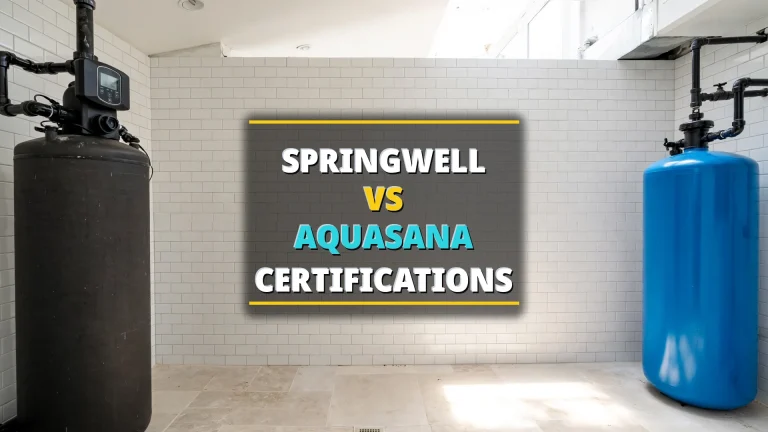
Second, watch for certification sleight-of-hand on whole-house systems. Take two real examples we researched. The Aquasana Rhino is often sold with “NSF 42/53/401” language, but Aquasana’s own certification page lists only 42 and 61 — the 42/53/401 claim is refuted, and the Rhino is not fluoride-certified. The SpringWell CF1, meanwhile, carries no third-party certification at all. Both are legitimate carbon-based whole-house systems for what they are designed to do; neither removes fluoride, and neither is certified to.

We apply this same database-first method across the site — for example, in our guide on whether whole-house filters remove PFAS. The habit takes two minutes and it is the only way to separate certified reduction from marketing language.
What the science says
Why does carbon fail where other technologies succeed? It comes down to what fluoride is: a very small dissolved ion, not a particle and not a reactive chemical like chlorine. Sediment cartridges strain out particles larger than their micron rating. Carbon adsorbs certain molecules onto its porous surface — chlorine, taste and odor compounds, some organics. KDF uses redox chemistry for a specific set of metals. None of these mechanisms is tuned to grab fluoride ions, which slip past essentially untouched.
The EPA’s Drinking Water Treatability Database — the agency’s reference on what works for each contaminant — names exactly two best available technologies for fluoride in drinking water: reverse osmosis and activated alumina. Not carbon. Not KDF. Reverse osmosis forces water through a semi-permeable membrane that rejects the great majority of dissolved ions, fluoride included — RO systems are typically rated around 85–95%+ fluoride reduction. Activated alumina works differently: fluoride ions adsorb onto the surface of aluminum-oxide granules, an ion-exchange-like process that carbon simply does not perform.
There is a catch with activated alumina worth knowing. Its effectiveness is sensitive to water chemistry: research on EPA’s design-manual approach finds the best fluoride uptake at moderately acidic pH (around 5.0–6.0), and performance drops at the higher pH typical of municipal supplies, especially where chlorine and bicarbonate compete. That is one reason activated alumina works best in engineered point-of-use designs rather than tossed into a generic whole-house tank.

There is also a physics problem with whole-house fluoride claims generally: contact time. A whole-house system must serve 10–15 gallons per minute so your showers stay strong, which means water races through the media in seconds. Fluoride-reducing media needs sustained contact to work — which is why the effective designs live at the kitchen tap, where flow is slow. A specialty whole-house fluoride tank has to fight both chemistry and flow rate, so its real-world numbers deserve extra scrutiny, not less.
For context on how other dissolved contaminants behave differently, see our guide on lead and whole-house filters — lead, unlike fluoride, can be addressed by some carbon systems, which is exactly why “one filter fixes everything” thinking breaks down.
Better options if it doesn’t
If you have confirmed fluoride in your water and want less of it, here is the honest menu — ranked by how reliably each option works:
| Option | How it works | Best for | Caveat |
|---|---|---|---|
| Under-sink reverse osmosis (NSF/ANSI 58 listed) | Semi-permeable membrane rejects ~85–95%+ of fluoride ions | Drinking and cooking water | Wastes some water per gallon produced; needs filter changes |
| Activated alumina point-of-use filter | Fluoride ions adsorb onto alumina granules | Targeted fluoride reduction at one tap | pH-sensitive; media must be replaced on schedule |
| Distillation | Boils water and condenses the steam, leaving ions behind | Small batches of drinking water | Slow and energy-hungry; strips all minerals |
| Specialty whole-house fluoride tank (alumina/bone char) | Fluoride-reducing media in a large tank | Reducing fluoride at every tap | Niche; verify the fluoride claim in a certification listing, not just the brochure |
For most households, the practical answer is a combination: keep a whole-house carbon system for chlorine-free water at every tap and shower, and add an under-sink RO unit certified under NSF/ANSI 58 for the kitchen sink where you drink and cook. You get the best of both without asking either system to do a job it wasn’t designed for.

One more honest boundary: a whole-house filter does not soften water either — if limescale is your other complaint, see our guide on whole-house filters and hard water before spending. Match the product to the problem, not the other way around.
Conclusion
A standard whole-house filter does not remove fluoride — full stop. Carbon, KDF, and sediment media are built for chlorine, taste, odor, and particles, and fluoride ions slip right through them. The EPA names two technologies that genuinely work — reverse osmosis and activated alumina — and the certification that proves a fluoride claim is NSF/ANSI 58, checked in a real database listing rather than a badge on a box.
So keep the whole-house filter for what it does best — clean, chlorine-free water at every tap — and put the fluoride solution where the chemistry works: an under-sink RO unit at the kitchen sink for the water you drink and cook with. That combination costs less than one oversized “does everything” tank, and unlike the tank, it actually answers the question on your water report.
FAQs
Do carbon whole-house filters remove fluoride?
No. Activated carbon, catalytic carbon, KDF, and sediment media are not designed to capture dissolved fluoride ions. They are excellent at chlorine taste and odor, particulates, and some organics — but fluoride passes through essentially unchanged. You need reverse osmosis, activated alumina, or distillation.
Will a bigger or more expensive whole-house system remove fluoride?
Size does not change the chemistry. A larger tank gives carbon more contact time for the things carbon can adsorb, but fluoride still needs a technology built for it: RO, activated alumina, or distillation. The only exception is a specialty tank engineered with fluoride-reducing media — and even then, verify its fluoride claim in a certification listing, not the brochure.
Do the Aquasana Rhino or SpringWell CF1 remove fluoride?
No. The Aquasana Rhino is NSF 42 brand-stated — Aquasana’s own certification page lists 42 and 61, and the often-repeated “NSF 42/53/401” claim is refuted — and it is not fluoride-certified. The SpringWell CF1 carries no third-party certification at all. Both are carbon-based systems designed for chlorine and sediment; neither reduces fluoride.
Should I remove fluoride from my shower water too?
That is a personal choice, not a requirement. The documented exposure route that matters most is drinking: you swallow far more fluoride than your skin absorbs in a shower. Most households that want fluoride reduction put an RO unit at the kitchen tap and leave showers on the whole-house filter — cheaper, and it targets the water you actually ingest.
How do I check whether my water even has much fluoride?
Start with your utility’s annual Consumer Confidence Report — it lists the fluoride level, since public systems must report it. The CDC’s recommended level for dental benefit is 0.7 mg/L, and the EPA’s enforceable limit is 4.0 mg/L. If you are on a private well, test with a fluoride-specific kit rather than a generic strip, since low-level fluoride needs the right chemistry to measure.
What certification should a fluoride filter carry?
For reverse osmosis systems, look for the fluoride reduction listed under NSF/ANSI 58 in the system’s entry at info.nsf.org. NSF 42 or 53 alone does not prove fluoride reduction, and NSF 61 is about material safety, not contaminant removal. If the fluoride claim is not in a certification listing, treat it as marketing.
Does boiling water remove fluoride?
No — boiling concentrates it. Like other dissolved minerals, fluoride does not evaporate with the steam, so as water boils off, the fluoride left behind ends up slightly more concentrated. If your goal is fluoride reduction, boiling works against you.