
What Does Reverse Osmosis Not Remove (2026): What the Evidence Says
Guide
Reverse osmosis has the best marketing department in water treatment: the word itself sounds total. And to be fair, the membrane’s removal list is genuinely long — lead, PFAS, fluoride, nitrate, most dissolved solids. But every RO owner eventually runs into the fine print: the rotten-egg whiff that survives the system, the chlorine question that turns out to belong to a different filter stage, the boil-water notice where the RO tap suddenly is not the safe tap. Knowing what RO does not remove is not a knock on the technology — it is the difference between a barrier you understand and a talisman you trust blindly.
The short answer: RO does not reliably remove dissolved gases (radon and hydrogen sulfide ride straight through), it does not remove chlorine itself — the carbon pre-filter does that job — some volatile chemicals depend entirely on that same carbon stage, and a standard home RO is not a microbiological purifier: it carries no certification to make bacteria- or virus-contaminated water safe. Everything else on the famous removal list is real; these are the gaps.
Table of Contents
How RO decides what to block

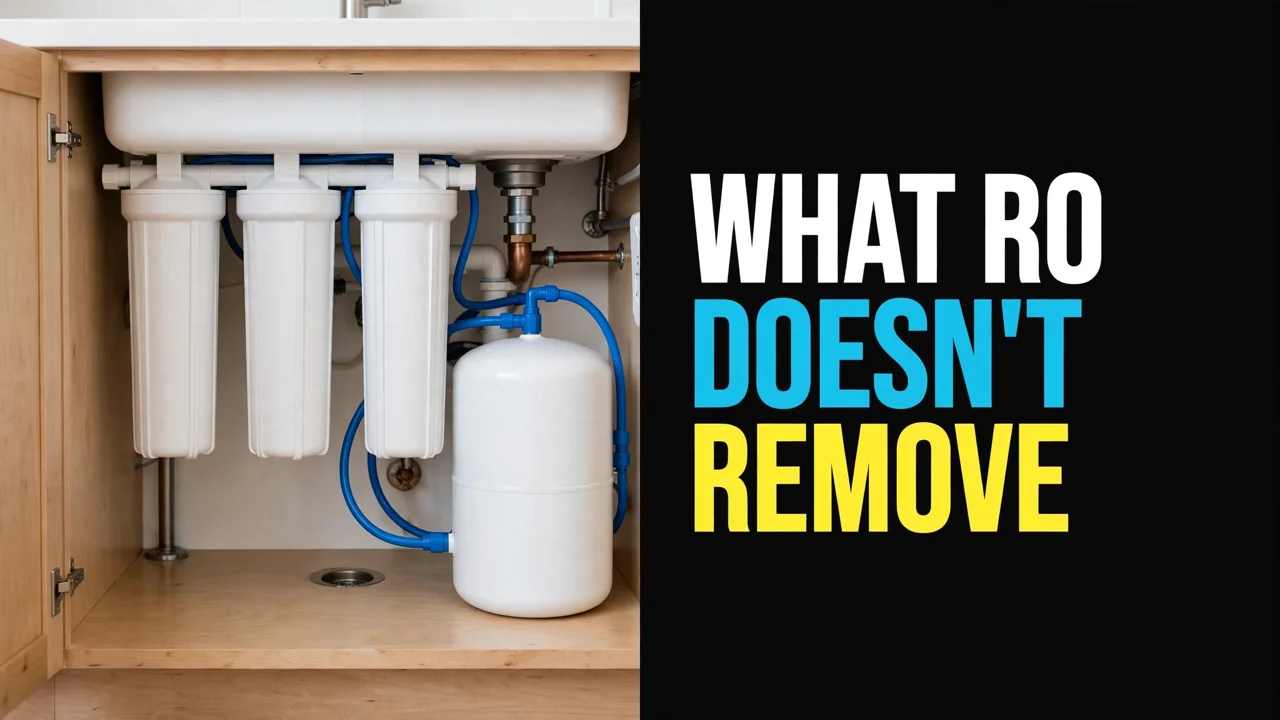
Every gap in RO’s performance falls out of one fact: the membrane separates by size and chemistry at the molecular scale. Water is pushed through a polymer layer so fine that dissolved ions and larger molecules are rejected — but anything that behaves like the water itself, or is small and uncharged enough to travel with it, has a route through. The membrane also does not work alone: a home RO is a team — sediment pre-filter, carbon pre-filter, membrane, storage tank, often a carbon post-filter — and several famous “RO removals” are actually performed by the teammates. When a teammate is exhausted or the contaminant ignores the membrane entirely, you have found one of the gaps below. One more framing note: an RO’s rated output (its gallons-per-day figure) is a laboratory number under ideal pressure and temperature; as a real-world estimate, expect actual production to run well below the rating — normal, and unrelated to what the membrane blocks.
Dissolved gases pass through

Gases dissolved in water are, from the membrane’s point of view, barely distinguishable from the water carrying them, so they pass. Three matter in practice. Radon — a radioactive gas that enters well water from bedrock — is not removed by RO; the recognized treatments work at the whole-house entry point (aeration, or granular activated carbon sized for the whole flow), because radon’s main risk is breathing it after it escapes into indoor air from showers and taps throughout the house, not just drinking it at one faucet. Hydrogen sulfide, the rotten-egg smell common in well water, likewise rides through the membrane largely untouched; it is handled by oxidation, aeration, or dedicated carbon ahead of — not inside — a typical RO. And humble carbon dioxide passes freely, which is why RO water often measures slightly acidic and why tiny bubbles bead on the glass: harmless, but a neat demonstration that “through the membrane” and “removed” are different lists.
Chlorine is the carbon filter’s job
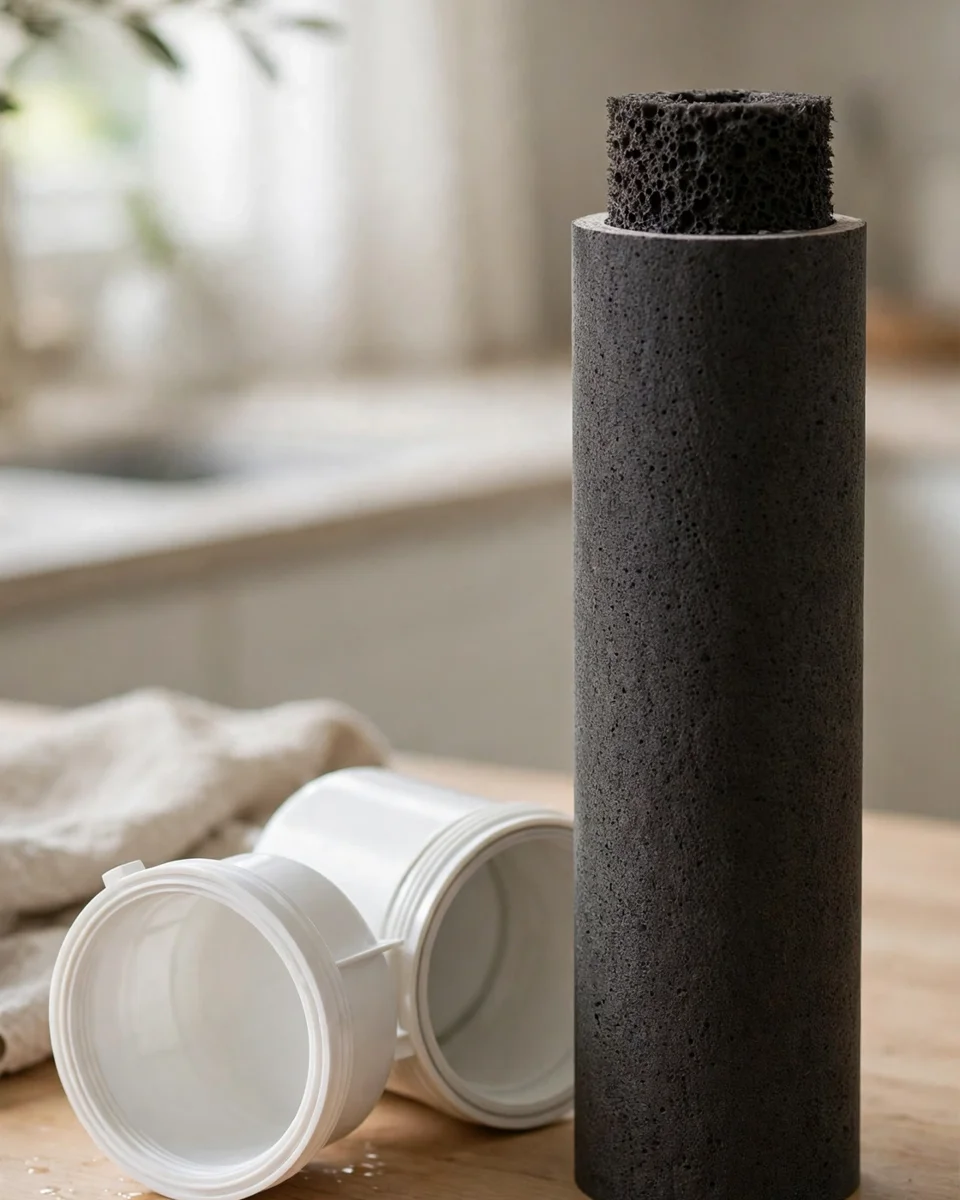
Ask most owners which part of their RO removes chlorine and they will point at the membrane. The truth is more interesting: the membrane cannot stand chlorine. The polyamide layer that does RO’s fine separation is chemically damaged by it, which is exactly why every standard system puts an activated carbon pre-filter upstream — the carbon strips out chlorine (and reduces chloramine, its stubborner municipal cousin, given the right carbon and contact time) before the water ever reaches the membrane. So chlorine removal in an “RO system” is real, but it is a carbon achievement with an expiry date. Let the pre-filter run far past its service life and two things happen quietly: chlorine starts reaching the membrane it can degrade, and the chlorine taste the system used to erase can reappear at the tap. Neither failure announces itself. This is the most practical item on this whole page: the not-remove list grows by one chlorine-shaped entry the day your carbon cartridge wears out.
VOCs depend on the carbon stage
Volatile organic chemicals — solvents, fuel components, some industrial chemicals — sit in the conditional column. The membrane alone is an inconsistent barrier for small organic molecules; the system’s real VOC defense is adsorption in its carbon stages, and carbon performance depends on the compound, the carbon type, and how fresh the cartridge is. Some RO systems are certified for specific VOC reduction claims under NSF/ANSI 58, and that listing — for the exact compounds named — is again the only version of the claim worth trusting. The general rule for a homeowner is simple: if a specific solvent or chemical is your concern (a known spill, a dry cleaner upgradient of your well), do not accept “it’s an RO, it removes everything” as an answer. Look for the compound on a certification claim list, or test the water and let a lab settle it.
Not a purifier: bacteria and viruses
This is the gap with safety consequences, so it deserves bluntness: a standard home RO system is not a microbiological purifier, and you should never rely on one to make biologically contaminated water safe. There is a certification for that job — NSF Protocol P231, the microbiological purifier standard, which requires demonstrated reduction of bacteria, viruses, and cysts — and ordinary under-sink RO units do not carry it. Yes, an intact membrane’s pores are physically smaller than bacteria, and in practice membranes block a great deal; but a purifier claim is about the whole device under test conditions — seals, housings, the storage tank where treated water sits, and performance as parts age. None of that is sterile, and none of it is verified for a home RO. The practical translations: during a boil-water advisory, follow the utility’s guidance rather than trusting the RO tap; on a well with coliform findings, the fix is disinfection (a UV stage is the common add-on, plus finding the contamination source), not faith in the membrane; and if untreated surface water is the scenario, RO alone was never the right tool.
For contrast: what RO does remove
The gaps above are exceptions to a genuinely long list. The contaminants RO is famous for are famous because the membrane really does reject them — provided, as always, the model carries the claim and the system is maintained:
| Removed by the membrane (with certified models) | Not reliably removed / not the membrane’s job |
|---|---|
| Lead — a formal NSF/ANSI 58 claim; see our RO and lead evidence check | Dissolved gases — radon, hydrogen sulfide, carbon dioxide pass through |
| PFAS — an EPA-cited treatment technology; see does RO remove PFAS | Chlorine — removed by the carbon pre-filter, and only while that cartridge lasts |
| Fluoride, nitrate (EPA MCL 10 mg/L), sodium, arsenic (pentavalent), chromium, and most dissolved solids generally | Some VOCs — performance lives in the carbon stages and specific certification claims |
| Most minerals — the removal behind the taste debate in our RO water vs alkaline water comparison | Bacteria and viruses — no NSF P231 purifier certification on standard home RO |
Read the two columns together and the technology comes into focus: RO is an outstanding barrier against dissolved chemical contamination — the metals, salts, and synthetic compounds that dominate modern water worries — and a partial or absent one against gases, anything delegated to its carbon teammates, and living organisms it was never certified to stop.
Choosing a system for the left-hand column? Our best reverse osmosis system guide compares the certified candidates.
Conclusion
What does reverse osmosis not remove? Dissolved gases like radon and hydrogen sulfide; chlorine by the membrane’s own hand (that is the carbon pre-filter’s job, on a cartridge clock); an uncertain slice of volatile chemicals that likewise depends on carbon; and — the one to remember — it is not a certified purifier, so bacteria and viruses are outside its promise. None of this dents RO’s real record on lead, PFAS, fluoride, and dissolved solids. It just defines the honest shape of the tool: a superb chemical barrier with named blind spots, each of which has its own proper fix once you know it exists.
Update log
October 2026: Article published; purifier framing per NSF Protocol P231 (standard home RO carries no microbiological purifier certification); nitrate reference per the EPA MCL of 10 mg/L. Output figures are described as real-world estimates, not rated specifications.
FAQs
Does RO remove bacteria from water?
Not in any certified sense. An intact membrane physically blocks most bacteria by size, but standard home RO systems are not tested or certified as microbiological purifiers (that is NSF Protocol P231), and the storage tank and fittings are not sterile. If your water has a bacterial problem — a failed well test, a boil advisory — the correct responses are disinfection such as a UV stage and fixing the source, not relying on the RO.
Does RO remove radon?
No. Radon is a dissolved gas and passes through the membrane with the water. Because the main radon risk from water is inhaling it after it escapes into household air, treatment is sized for the whole house at the entry point — aeration systems or large activated-carbon tanks — not a single drinking tap.
Why does my RO water sometimes smell like rotten eggs?
That smell is hydrogen sulfide, a dissolved gas RO does not reliably remove — and a system can even seem to make it more noticeable by stripping away competing tastes. Persistent rotten-egg odor calls for treatment aimed at the gas itself (oxidation, aeration, or sulfur-rated carbon upstream), and on well water it is worth a full water test, since the gas often travels with iron and manganese issues.
Does RO remove chlorine, or is that the carbon filter?
The carbon filter. Chlorine is removed by the activated carbon pre-filter that sits ahead of the membrane — partly for your taste buds and partly because chlorine chemically damages the membrane itself. This is why pre-filter changes are not optional maintenance: an exhausted carbon cartridge quietly removes both the chlorine protection and, over time, the membrane’s performance.
Does RO remove all chemicals, like solvents or gasoline compounds?
No — volatile organic chemicals are the conditional category. Some are adsorbed by the system’s carbon stages, some pass the membrane more easily than the famous contaminants do, and performance fades as carbon exhausts. If a specific chemical is your concern, look for it by name on the system’s NSF/ANSI 58 claim list, and verify with a lab test rather than assuming the membrane covers it.
Can I drink RO water during a boil-water advisory?
Do not rely on it. A home RO is not a certified microbiological purifier, and advisories are issued precisely because the water may carry bacteria or viruses. Follow the utility’s instructions — boil water as directed or use bottled water — until the advisory lifts, and check your system’s manual about sanitizing or replacing cartridges afterward, since contaminated feed water is hard on every stage.