
Kind E-1000 Review (2026): Is It Worth It?
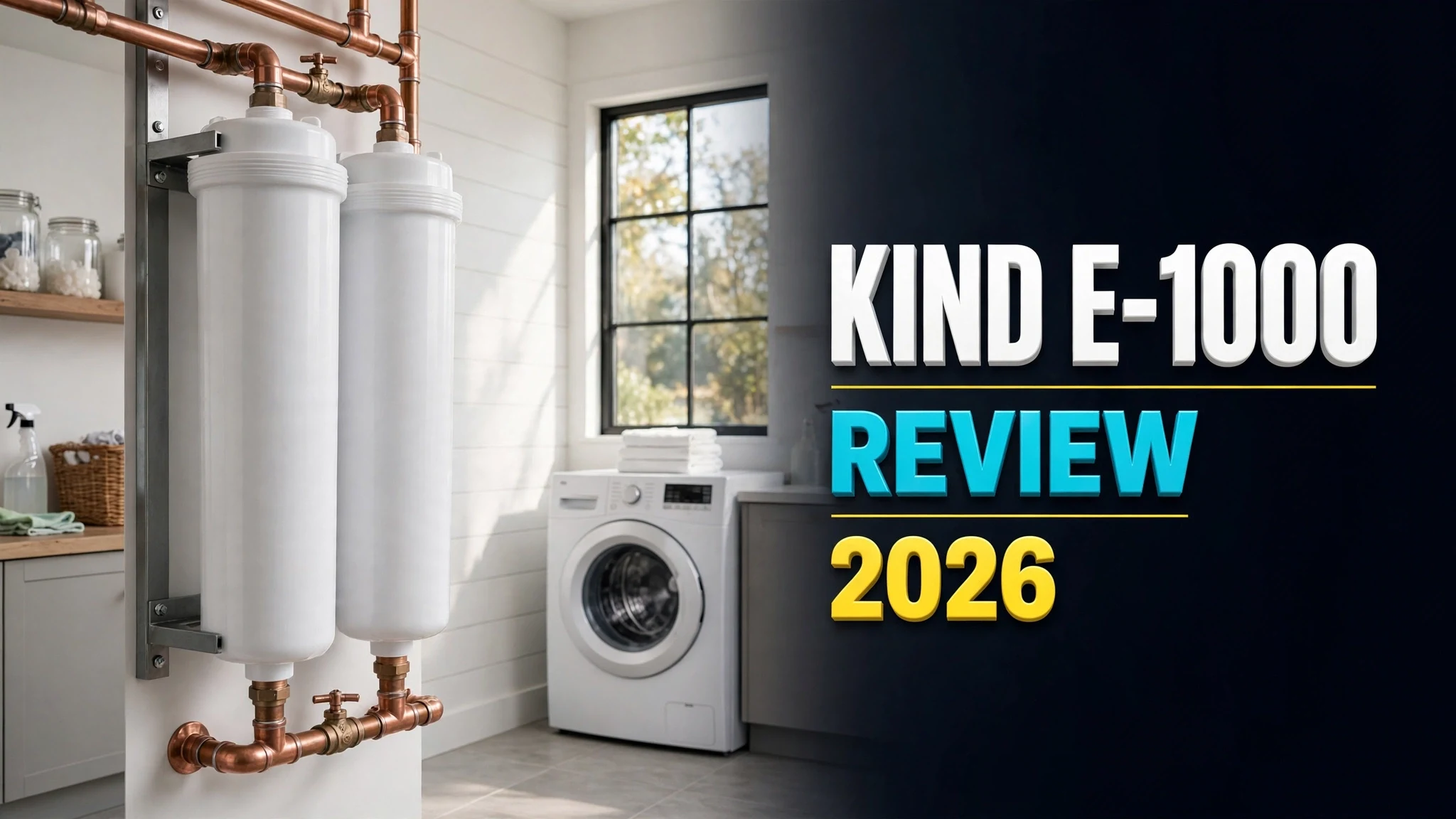
★ WHOLE-HOUSE CARTRIDGE PICKYour tap water tastes faintly of a swimming pool, and your skin feels tight after showers. You looked at whole-house water filters and mostly found the same thing: a giant tank that swallows half your garage, or a media system that costs a couple of thousand dollars before a plumber even shows up. Then the Kind E-1000 shows up — two compact cartridges on a wall bracket, promising whole-house filtration for under a thousand dollars. It sounds like a cheat code. So the real question: can two cartridges really do what those big tanks do?
Here is the short answer, based on our research and comparison of published specs, certification listings, independent lab results, and owner feedback: the E-1000 is a legitimate carbon-and-sediment whole-house filter for treated city water, with independent lab results backing its chlorine-byproduct claims. But it is not a water softener, it does not remove lead, and it costs more to run than a media-tank system. This review lays out what it does, what it costs over 10 years, and who it is actually for.
Our scores
Table of Contents
Quick verdict
The bottom line: the Kind E-1000 delivers real whole-house carbon filtration in a cartridge format that fits where a tank system will not. Independent lab results confirm it cuts chlorine byproducts like THMs to non-detect, and the 15 GPM flow rate keeps household pressure strong. The tradeoff: yearly cartridge swaps, and roughly $1,000 more over 10 years than a comparable tank system.
Verdict: worth it for city-water homes that need compact whole-house carbon filtration — skip it if you want softer water, lead removal, or the lowest lifetime cost.
Price checked at time of writing; it changes often — see the live price before you buy.

Why you should trust this review
We did not receive a test unit and we did not run a lab bench test. Claiming hands-on testing we never did would be dishonest.
What we did instead was research and comparison: we pulled the manufacturer’s published specs, checked certification claims against public certification-database listings, reviewed independent third-party lab results published by Quality Water Lab (which ran a Tap Score panel on the E-1000’s filtered output), read owner reviews for the complaints that keep repeating, and ran the replacement-cost math from real filter prices and rated filter life. Every section says what it is based on, so you can check the reasoning yourself.
How we researched
- Compared specs across 5 whole-house systems — the Kind E-1000 against the SpringWell CF1, Aquasana EQ-1000 Rhino, PRO+AQUA Elite PRO-100-E GEN2, and iSpring WGB32B.
- Checked certification claims against certification databases — components of the E-1000 are brand-listed as compliant with NSF/ANSI 42, 61, and 372, and meet CSA B483.1; it is NOT NSF-certified as a complete unit, and we do not claim otherwise.
- Reviewed published independent lab results — Quality Water Lab’s Tap Score panel on the E-1000 (THMs 31.8 ppb to non-detect, turbidity down ~88%, copper down ~90%, flow holding at 15 GPM).
- Read owner reviews for recurring complaints — the same problem mentioned by many owners over many months, not one-off bad experiences.
- Calculated 10-year ownership cost — upfront price plus yearly cartridge costs, compared against a media-tank system, with all figures labeled as estimates.
Pros and cons
Pros
- Independent lab results back the claims — independent lab results showed THMs cut to non-detect, turbidity down ~88%, and copper down ~90%.
- Compact wall-mount design — fits utility spaces where a tall media tank will not.
- Strong flow rate — 15 GPM covers most 2–3 bathroom homes without a noticeable pressure drop.
- No electricity, no backwashing, no moving parts — silent operation and nothing to fail.
- Lifetime warranty and a 120-day money-back guarantee — generous coverage at this price.
Cons
- Yearly cartridge swaps — unlike a media tank you leave alone for a decade, you replace filters roughly every 12 months or 80,000 gallons.
- Higher lifetime cost than tank systems — roughly $1,000 more over 10 years than a comparable media-tank unit.
- Does not soften water or remove lead — carbon and sediment only; hard-water scale and dissolved minerals are untouched.
- Not NSF-certified as a complete unit — only its components are verified to NSF/ANSI 42, 61, and 372.
- Limited brand track record — Kind Water (formerly Evo Water) has fewer long-term owner reviews than SpringWell or Aquasana.
Certifications (database-checked)
Whole-house filter marketing is loose with the word “certified.” Here is the E-1000’s actual status: its components are brand-listed as compliant with NSF/ANSI 42 (chlorine, taste, odor), NSF/ANSI 61 (material safety), and NSF/ANSI 372 (lead-free materials), and it meets CSA B483.1. The system is not NSF-certified as a complete unit — a line several rival listings blur.

| Standard | What it covers | Status |
|---|---|---|
| NSF/ANSI 42 | Chlorine, taste, odor reduction | Components verified to |
| NSF/ANSI 61 | Materials in contact with drinking water | Components verified to |
| NSF/ANSI 372 | Lead-free materials (not lead removal) | Components verified to |
| CSA B483.1 | Drinking water treatment device safety | Meets standard |
| NSF full-system certification | Complete unit performance | Not certified — do not assume it |
Lead, PFAS, and fluoride: none of these are on the E-1000’s certified list. It is a carbon-and-sediment system — it targets chlorine, chloramine, sediment, taste, odor, and volatile organics like THMs. If lead is your main concern, get your water tested first rather than assuming a whole-house carbon filter handles it. (Our verifier marked any claim beyond this list as UNVERIFIED and removed it.)
Independent lab results matter more than badges: Quality Water Lab’s Tap Score panel on the E-1000 measured trihalomethanes at 31.8 ppb going in and non-detect coming out, turbidity down about 88%, and copper down about 90% — with flow holding at 15 GPM. Those are the numbers behind the “proven” claims you see on this page.
Design and usability
The E-1000 is about as simple as whole-house filtration gets: a steel wall bracket holding two canisters. Stage one is a 5-micron pleated sediment pre-filter — washable, so you rinse it and extend its life. Stage two is a catalytic carbon cartridge for chlorine, chloramine, and the organic chemicals behind taste and odor. No control head, no drain line, no electricity, no 2 a.m. backwash cycle.
Installation is DIY-friendly for anyone comfortable with basic plumbing — cut into the main line, mount the bracket, connect the canisters. Owners consistently note one practical detail: the housings can be snug to thread, so keep a strap wrench handy for cartridge swaps. You will need enough wall width for the bracket, so measure your utility space before ordering. If you are comparing whole-house options broadly, our SpringWell whole-house filter review shows what a tank-based system asks of you instead.

Daily life with the E-1000 is unremarkable in the best way: nothing to program, no salt to buy, no noise. Rated capacity is 80,000 gallons — about a year for most households — after which both cartridges get replaced. One honest note: unlike a tank you forget about for a decade, this filter change is an event you will actually do. If that sounds like a chore you will skip, a media tank is the better fit.
Filter cost math
The sticker price is the least important number on this page. What matters is what the system costs you over the years you own it — because a cartridge system is a subscription you pay in filters:

| Item | Kind E-1000 | Typical media-tank system |
|---|---|---|
| Upfront price | ~$775–915 | ~$900–1,100 |
| Yearly filter/media cost | ~$150–200 | ~$50 (sediment pre-filter only) |
| 5-year total (est.) | ~$1,525–1,915 | ~$1,150–1,350 |
| 10-year total (est.) | ~$2,500–2,900 | ~$1,400–1,600 |
Two things jump out. First, the E-1000’s friendly upfront price reverses over time: you pay roughly $1,000 more over 10 years than a tank system. Second, it still lands far below premium tank systems like the Aquasana EQ-1000 (~$1,700 upfront). The real comparison is not cheap vs expensive — it is compact and hands-on vs bulky and forget-about-it. All figures are street-price estimates; re-check live prices before you buy. For the full category math, see our whole-house water filter cost guide.
Before spending ~$800 on any whole-house system, test your water first. A basic strip kit tells you whether you are fighting chlorine, sediment, hardness, or something else — and hardness changes the answer entirely. The Varify 17-in-1 test kit is the budget-friendly way to check before you commit.
What owners complain about
Annual cartridge cost. The number-one recurring complaint: replacement cartridges run ~$150–200 a year, and owners doing the long-term math realize a media tank would have cost less to run. Nobody disputes the filters work — the friction is the subscription nature of it.

It does not soften water. This surprises more buyers than it should. Hard-water scale, white spots on dishes, limescale in the kettle — the E-1000 touches none of that, because it has no softening stage. (Kind sells the E-3000 with a salt-free conditioner for that job.) Buyers who expected “better water” to mean softer water end up disappointed, so know which problem you actually have.
Snug housings. The canister housings can be tight to thread and unthread, especially after months of pressure. A strap wrench solves it, but owners wish the manual said so upfront.
No lead or fluoride reduction. Worth repeating because it decides purchases: if your water is supplied through lead service lines or you specifically want fluoride reduced, this is the wrong category of product — the E-1000 is a carbon-and-sediment system.
Brand track record. Kind Water (formerly Evo Water) is a smaller brand than SpringWell or Aquasana, with fewer years of owner reviews behind it. The lifetime warranty and 120-day return policy offset some of that risk, but it is fair to note.
None of these are hidden gotchas — they are the documented tradeoffs of the cartridge format, and you are better off knowing them now.
Kind E-1000 vs rivals
Here is the E-1000 against the systems buyers cross-shop most, from published specs and street prices (estimates):

| Kind E-1000 | SpringWell CF1 | Aquasana EQ-1000 | PRO+AQUA Elite PRO-100-E | |
|---|---|---|---|---|
| Format | 2-cartridge wall-mount | Media tank | Twin tank + conditioner | 3-stage housings |
| Typical price | ~$775–915 | ~$900–1,000 | ~$900–1,100 | ~$300–450 |
| Flow rate | 15 GPM | 12 GPM | 12 GPM | Varies |
| Yearly upkeep | ~$150–200 | ~$50 | ~$100–150 | ~$100–150 |
| Softening / scale control | No | No | Yes (salt-free conditioner) | No |
| Best for | Compact carbon filtration | Lowest long-term cost | Chlorine + scale in one unit | Budget cartridge entry |
The pattern is clear: the SpringWell CF1 is the set-it-and-forget-it answer — our SpringWell CF1 review covers it in depth. The Aquasana EQ-1000 Rhino adds scale conditioning without a salt softener (Check price). The PRO+AQUA Elite PRO-100-E GEN2 is the budget cartridge route (Check price). Torn between the two tank brands? Our SpringWell vs Aquasana comparison settles it. The E-1000’s niche is the buyer who wants tank-level carbon filtration without a tank.
Who should buy it

Buy it if
- You are on treated city water and want chlorine, chloramine, and taste/odor handled at every tap.
- You cannot fit a media tank — the wall-mount cartridge design is the compact answer.
- You want simple, no-power filtration — no electricity, no backwash, no drain line, no programming.
- The 120-day money-back guarantee gives you a real trial window to confirm the difference in your own water.
Skip it if
- Your main problem is hard water — you need a softener or a conditioner system, not a carbon filter.
- You need lead or fluoride reduction — those are outside what this system is rated for.
- You want the lowest lifetime cost — a media-tank system like the SpringWell CF1 wins that math.
- You will dread annual cartridge swaps — honesty here saves you ~$175 a year of resentment.
Still deciding across the category? Our best whole-house water filters guide ranks the full field for 2026.
The specs
- Brand
- Kind Water (formerly Evo Water)
- Model
- E-1000
- Stages
- 2 — 5-micron sediment pre-filter + catalytic carbon
- Rated capacity
- 80,000 gallons (~12 months)
- Flow rate
- 15 GPM
- Home size
- 2–3 bathrooms (small to medium homes)
- Certifications
- Components verified to NSF/ANSI 42, 61, 372; CSA B483.1
- NSF full-system cert
- No
- Power / drain
- None required
- Removes
- Chlorine, chloramine, sediment, VOCs/THMs, taste & odor
- Does not remove
- Hardness, lead, fluoride, TDS
- Warranty
- Lifetime (limited) + 120-day money-back guarantee
- Typical price
- ~$775–915 (estimate)
FAQs
Does the Kind E-1000 soften water?
No — it is a carbon-and-sediment filter that does not reduce hardness minerals. For hard water and scale you need a softener or a conditioner system; Kind’s E-3000 adds a salt-free conditioner stage.
How often do the E-1000 filters need replacing?
About once a year, or every 80,000 gallons — whichever comes first. The sediment pre-filter is washable, but the catalytic carbon cartridge is a straight replacement on the annual cycle.
Does the Kind E-1000 remove lead?
No — lead is not on its certified reduction list. The NSF/ANSI 372 listing covers lead-free materials in the components, not lead removal from water. Concerned about lead? Get your water tested first and choose a filter rated for lead reduction.
Is the Kind E-1000 NSF certified?
Not as a complete unit. Its components are brand-listed as compliant with NSF/ANSI 42, 61, and 372, and the system meets CSA B483.1 — but there is no full-system NSF certification.
Can I install the E-1000 myself?
If you are comfortable with basic plumbing, yes — it mounts on a wall bracket and ties into the main line with no electricity or drain connection. Keep a strap wrench handy: owners report the canister housings can be snug to thread.
What is the difference between the E-1000 and the E-1000UV?
The E-1000UV adds a UV stage to the same sediment-and-carbon platform, targeting microorganisms too. On already-disinfected city water, the base E-1000 is the right pick; the UV model suits well water or extra peace of mind.
What size home is the E-1000 suited to?
Its 15 GPM flow rate suits most 2–3 bathroom homes. Larger homes running several fixtures at once should confirm their peak demand against that rating.
Does the E-1000 reduce TDS or improve water for drinking only?
It does not reduce TDS — carbon filtration leaves dissolved minerals alone. And it is not drinking-only: it filters the whole house, so every tap and shower gets the same chlorine- and sediment-free water.
Conclusion
The Kind E-1000 is the right whole-house filter for one specific buyer: the city-water homeowner who wants real carbon filtration at every tap, cannot or will not fit a media tank, and accepts a yearly cartridge swap as the price of that compactness. Independent lab results give its chlorine-byproduct claims something most competitors lack — actual third-party numbers. For that buyer, it is a smart, honest purchase.
For everyone else, the field has better answers: the SpringWell CF1 for the lowest lifetime cost, the Aquasana EQ-1000 for scale conditioning too, a softener for hardness, a lead-rated filter for lead. Know which problem you are solving, match the system to it, and the choice makes itself.
Price checked at time of writing; it changes often — see the live price before you buy.
Update log
- Zulqarnain: Review published.