
Best Whole House Water Filter (2026): Compared & Ranked
★ 2026 WHOLE-HOUSE ROUNDUPYour tap water smells faintly of chlorine, the shower leaves your skin dry, and every roundup you open names a different “best” whole-house filter — most of them repeating whatever the brand’s marketing page says. Picking wrong here is expensive: these systems cost hundreds to thousands of dollars, get plumbed into your main water line, and stay there for years.
The short answer: if certified PFAS reduction from every tap is the goal, the Aquasana HealthShield is the only whole-house system we found with third-party WQA certification for it. For everyone else, the SpringWell CF1 is the value king on city water, and the iSpring WGB32BM covers the budget end. We researched and compared spec sheets, certification listings, and owner-review patterns — and everything below is honest about what each system is actually certified to do.
Table of Contents
- Quick picks
- Why you should trust this roundup
- How we researched
- Best overall: Aquasana HealthShield
- Best value: SpringWell CF1
- Best budget: iSpring WGB32BM
- Best for well water: PRO+AQUA Elite PRO-100-E GEN2
- Cheapest DIY route: SimPure DB10P housing
- Before you buy: test your water
- Head-to-head comparison
- Buying guide: size it right
- Replacement cost math
- FAQs
- Conclusion
Quick picks
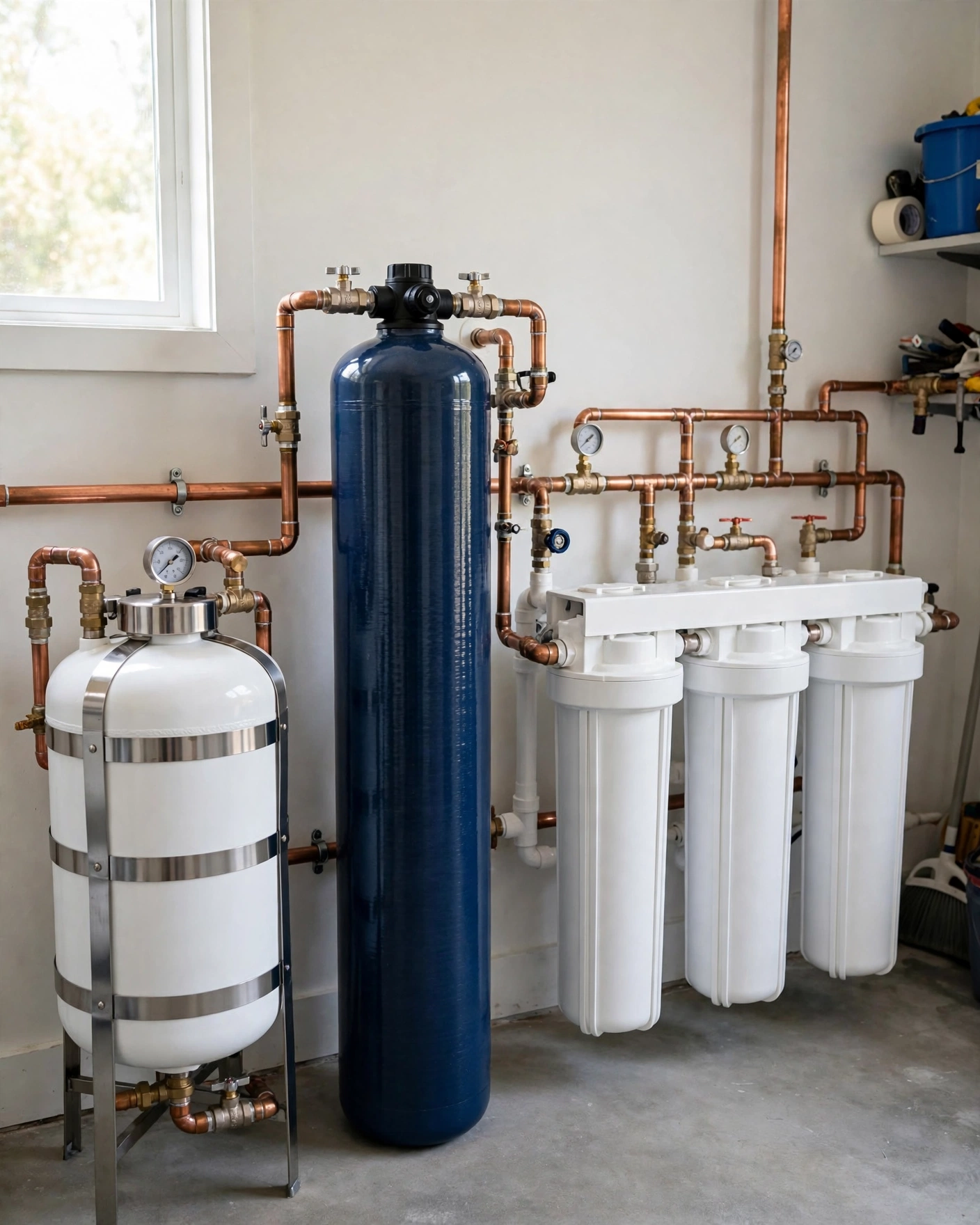
- Best overall — Aquasana HealthShield (~$1,900–2,300): the only whole-house system we found with WQA certification to NSF/ANSI 53 for PFAS reduction, plus VOC and NSF/ANSI 401 coverage.
- Best value — SpringWell CF1 (~$1,100): a 1,000,000-gallon catalytic-carbon tank at 9 GPM with a lifetime tank warranty — the most filtration per dollar on city water.
- Best budget — iSpring WGB32BM (~$300): a 3-stage cartridge system at 15 GPM that also tackles iron and manganese, with DIY-friendly installation.
If none of those three fits your situation, keep reading: a well-water specialist and the cheapest DIY route are below, along with the honest certification picture for every pick.
Why you should trust this roundup
We did not receive test units and we did not run a lab bench — claiming hands-on testing we never did would be dishonest, so we will not do it. Instead we researched and compared: manufacturers’ spec sheets and published FAQs, certification claims checked against what certifiers and independent reviewers actually list, owner-review patterns for recurring complaints, and replacement-cost math from published prices. Every contaminant claim below is either tied to a certification listing or explicitly labeled as a brand statement — and where a figure could not be verified at a primary source, we left it out.
How we researched
- Compared 5 whole-house systems across the three ways these products are built: media-tank systems (Aquasana HealthShield, SpringWell CF1), multi-stage cartridge systems (iSpring WGB32BM, PRO+AQUA Elite PRO-100-E), and the bare-housing DIY route (SimPure DB10P).
- Checked certification claims against published sources — Aquasana’s own HealthShield FAQ and certification pages, Aquasana’s August 2026 launch release, and independent reviews from qualitywaterlab.com and kindwater.com for the systems without certification listings.
- Read owner-review patterns for recurring complaints (install difficulty, pressure drop, cloudy water after install) rather than one-off bad experiences.
- Calculated yearly upkeep from published prices — replacement packs, rated capacities, and equipment cost spread across each system’s service life. Every price below is an estimate, labeled as one.
Best overall: Aquasana HealthShield

The HealthShield is Aquasana’s newest whole-house system, launched in August 2026, and it is the reason this category has a “best overall” with a genuine certification story. It is WQA-certified to NSF/ANSI 53 for PFAS reduction — 99.9% to below 4 parts per trillion, covering PFOA, PFOS, PFNA, PFHxS, and PFHpA — plus 99.8% VOC reduction under the same standard, and NSF/ANSI 401 certification for BPA and ibuprofen reduction at 94.7%. Aquasana’s launch materials describe 61 contaminants reduced at up to 99.9%.
Two honest notes. First, Aquasana’s published chlorine and chloramine figures are internally measured, not certified — the WQA certifications cover PFAS, VOCs, and the 401 compounds, and this section says so plainly. Second, the replacement tank price is not published: launch pricing started at $2,099 for the base system, and the 165,000-gallon / ~2-year tank cycle means you will be buying tanks, so confirm that price before you commit.
Pros
- The only WQA-certified PFAS whole-house system we found — NSF/ANSI 53 for PFAS, plus VOC and 401 coverage, all from published certification statements.
- Compact single-tank footprint with a flow meter that shows remaining capacity — no guessing when the tank is spent.
- No drain line, no backwashing, no water wasted — it is a straight media tank, not a softener.
- Clear install guidance — Aquasana publishes the requirements (outlet within 10 feet, plumber strongly recommended) instead of burying them.
Cons
- Replacement tank price is unpublished — the biggest unknown in the ownership math; get it in writing before you buy.
- Premium price — around $2,099 to start, several times the cost of a cartridge system.
- Needs a 120V outlet within 10 feet for the flow meter — plan the install location around it.
- Chlorine/chloramine figures are internally measured, not third-party certified.
Price checked at time of writing; it changes often — see the live price before you buy.
Best value: SpringWell CF1
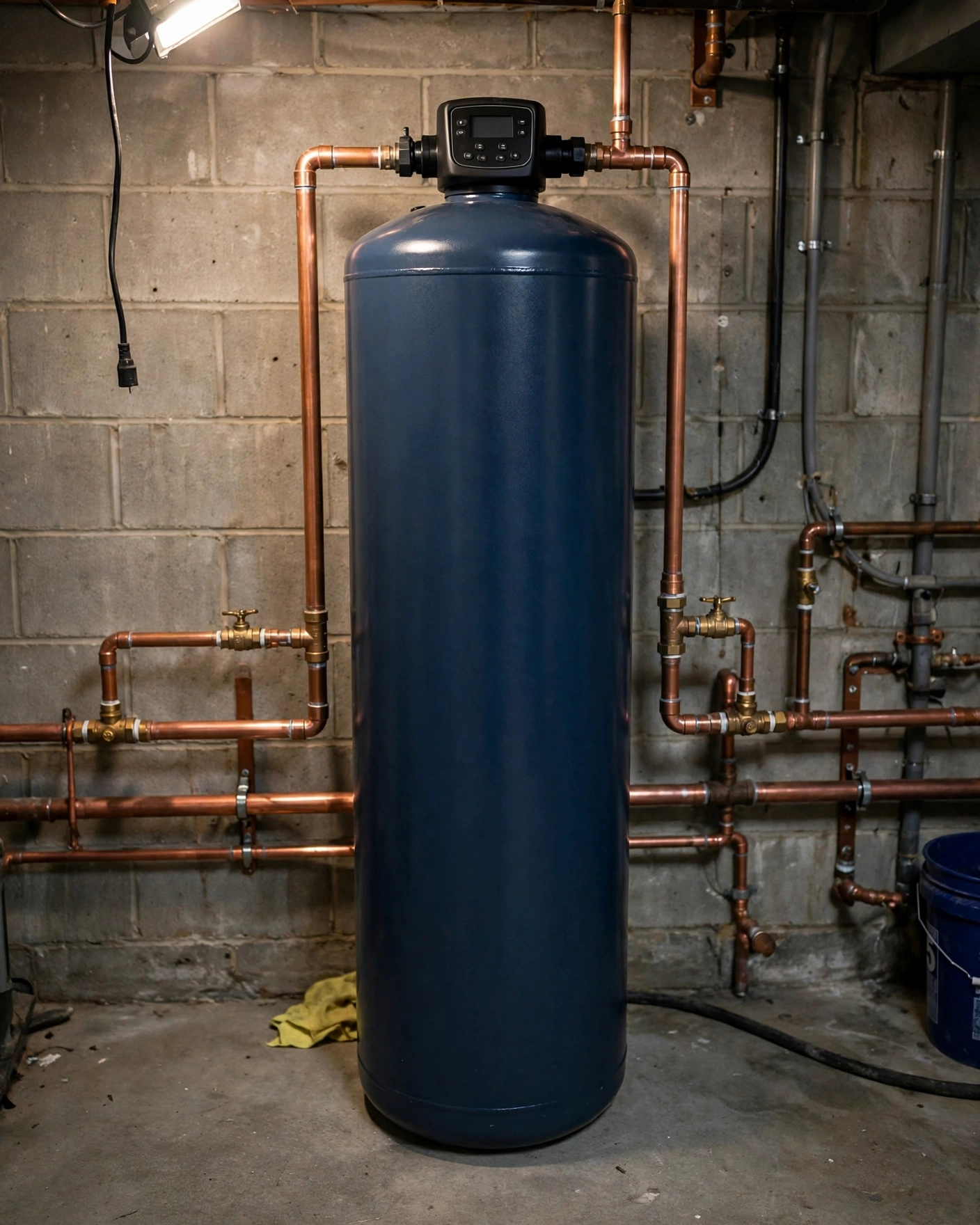
The CF1 is the value argument in one number: 1,000,000 gallons of media capacity — roughly 6 to 10 years for a typical household — for around $1,100. It is a catalytic coconut-shell carbon tank with KDF media and a 5-micron sediment pre-filter, rated at 9 GPM, targeting chlorine, chloramine, VOCs, pesticides, and sediment on city water. The tank and valve carry a lifetime warranty.
The certification picture is where honesty matters. The CF1 is not system-level NSF certified: independent reviewers (qualitywaterlab.com, September 2026; kindwater.com) report component-level NSF/ANSI 42 and 53 certifications only, so its contaminant list is brand-stated. That does not make it a bad system — it makes it one you buy for capacity, flow rate, and warranty, not for a certification listing. Two more things: it does not soften hard water, and SpringWell sells a separate PFAS add-on rather than building PFAS certification into the CF1.
Pros
- Enormous capacity per dollar — 1,000,000 gallons means the tank can outlast most ownership periods.
- Lifetime warranty on the tank and valve.
- 9 GPM flow rate handles a 1–3 bathroom home without choking showers.
- Low upkeep — roughly $40–70 a year in maintenance (waterfilters.systems estimate), with an easy sediment post-filter swap every 8–9 months.
Cons
- No system-level NSF certification — component-level only; contaminant claims are brand-stated.
- Does not soften hard water — a filter, not a softener.
- No certified PFAS reduction in the base CF1.
- Heavy install — a media tank is a bigger plumbing job than swapping cartridges.
Our full breakdown of this system lives in the SpringWell CF1 review — capacity math, the certification fine print, and what owners say after years of use.
Price checked at time of writing; it changes often — see the live price before you buy.
Best budget: iSpring WGB32BM
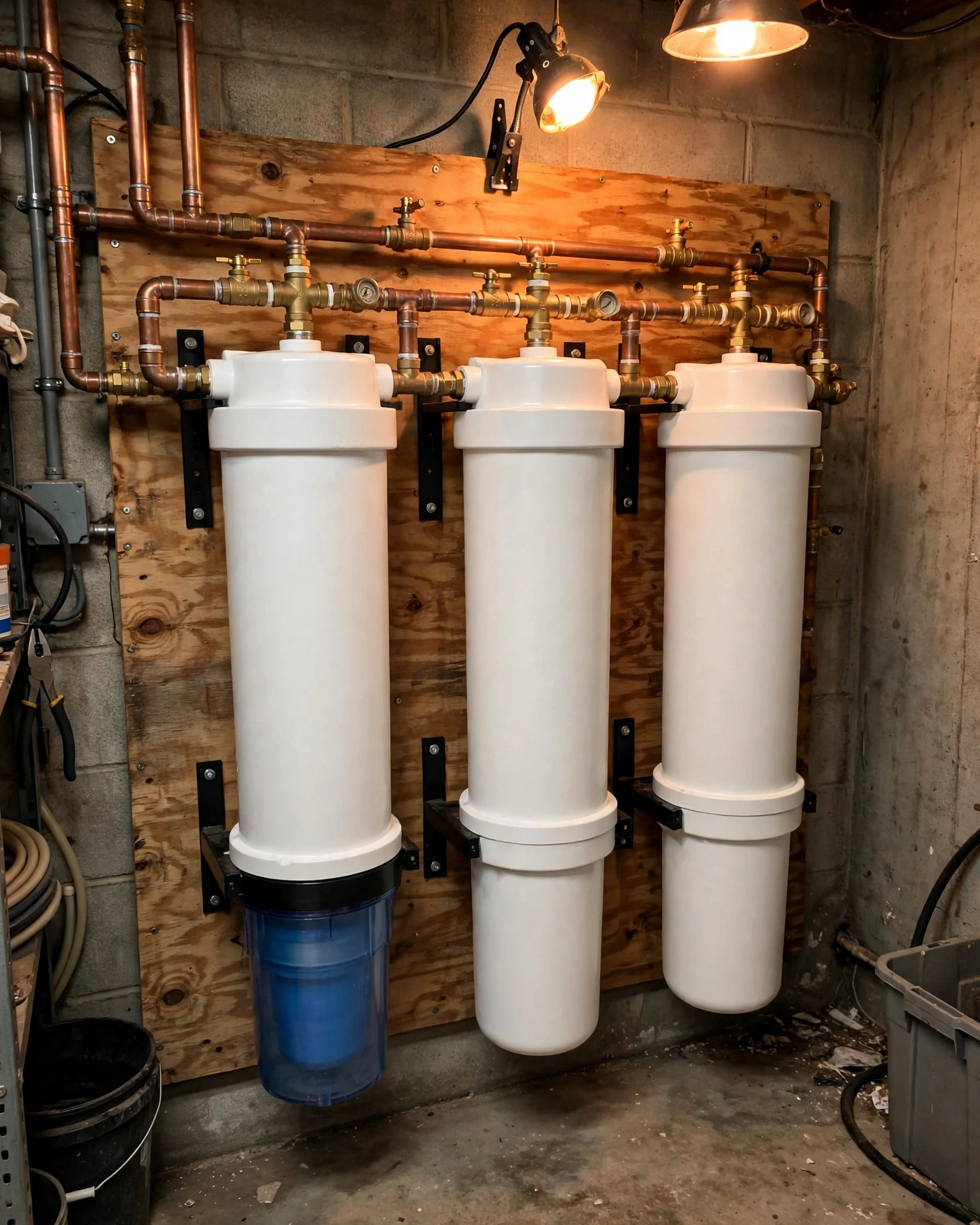
At roughly $300, the WGB32BM is the cheapest way to put real multi-stage filtration on your main line. It is a 3-stage cartridge system rated at 15 GPM with a 100,000-gallon cartridge capacity (about a year for a family of four): a 5-micron sediment filter, a coconut-shell carbon block, and a dedicated iron and manganese stage rated to bring iron from up to 3.0 ppm and manganese from up to 1.0 ppm down to 0.01 ppm, per iSpring’s published figures.
On certifications, read the fine print the way we did: iSpring’s own wording is that the filters were evaluated by an independent third party against NSF/ANSI standards. That is the brand’s phrasing — it is not a certification listing you can look up in a public database, and this roundup will not present it as one. Also worth knowing straight from iSpring: unlike an RO membrane, these filters do not reduce total dissolved solids (TDS).
Pros
- Real iron and manganese reduction at a budget price — the well-water feature most cheap systems skip.
- 15 GPM flow keeps pace with medium-to-large households.
- DIY-friendly — standard 20″ x 4.5″ housings, a published manual, and US-based lifetime tech support.
- Transparent yearly cost — a full 3-stage replacement pack runs about $160 (estimate), so the math is simple.
Cons
- No certification listing — “independently evaluated against NSF/ANSI standards” is brand wording, not a database entry.
- Yearly cartridge swaps — 100,000 gallons goes faster than a tank system’s million.
- 1-year warranty — shorter than the tank systems’ lifetime coverage.
- No TDS reduction — by the brand’s own statement.
If the budget is the whole decision, our best budget whole-house filter guide goes deeper on the sub-$400 end of the market.
Price checked at time of writing; it changes often — see the live price before you buy.
Best for well water: PRO+AQUA Elite PRO-100-E GEN2
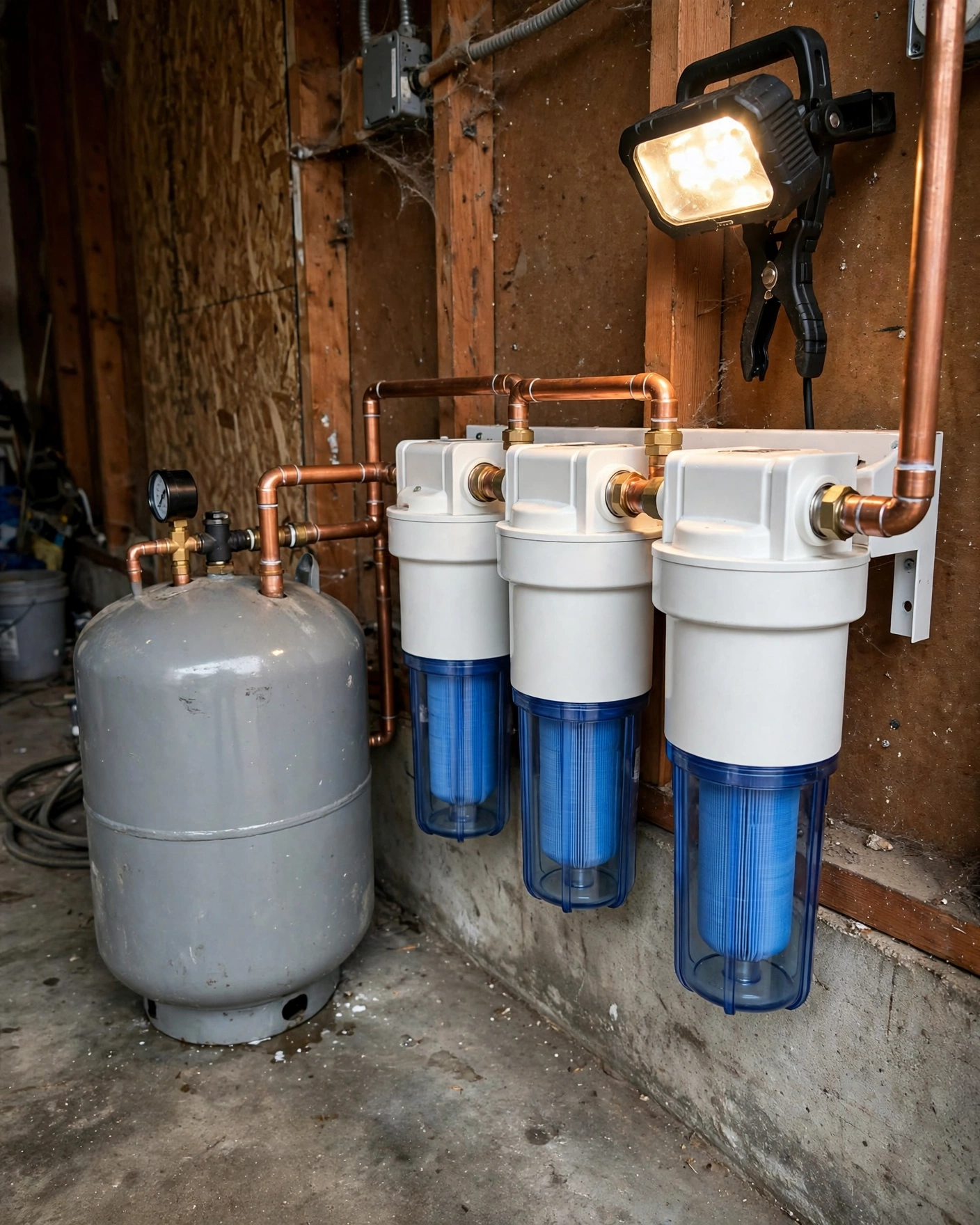
Private wells bring a different problem set — iron, manganese, sediment, sometimes sulfur — and the PRO+AQUA Elite PRO-100-E GEN2 is a budget 3-stage answer for exactly that, in the same price band as the iSpring (roughly $300–450, estimate).
The honest version of this pick: we found no verifiable third-party certifications for it. You are buying this one for the price, the well-water staging, and the standard 20-inch housing format that takes widely available replacement cartridges — not for a certification listing. Pair it with a water test (below) so you know the iron and manganese levels you are actually treating.
Pros
- Well-water staging at a budget price — iron/manganese/sediment focus without the tank-system price.
- Standard 20″ x 4.5″ housings — replacement cartridges are easy to find from many brands.
- Straightforward to service — spin off a sump, swap the cartridge, spin it back on.
Cons
- No verifiable third-party certifications found — all performance claims are brand-stated.
- Brand support is thinner than the big names’ US-based phone lines.
- Still needs a plumber or confident DIYer — it goes on the main line like everything else here.
On a private well, start with our whole-house filter for well water guide — it covers what to test for before you buy anything.
Price checked at time of writing; it changes often — see the live price before you buy.
Cheapest DIY route: SimPure DB10P housing
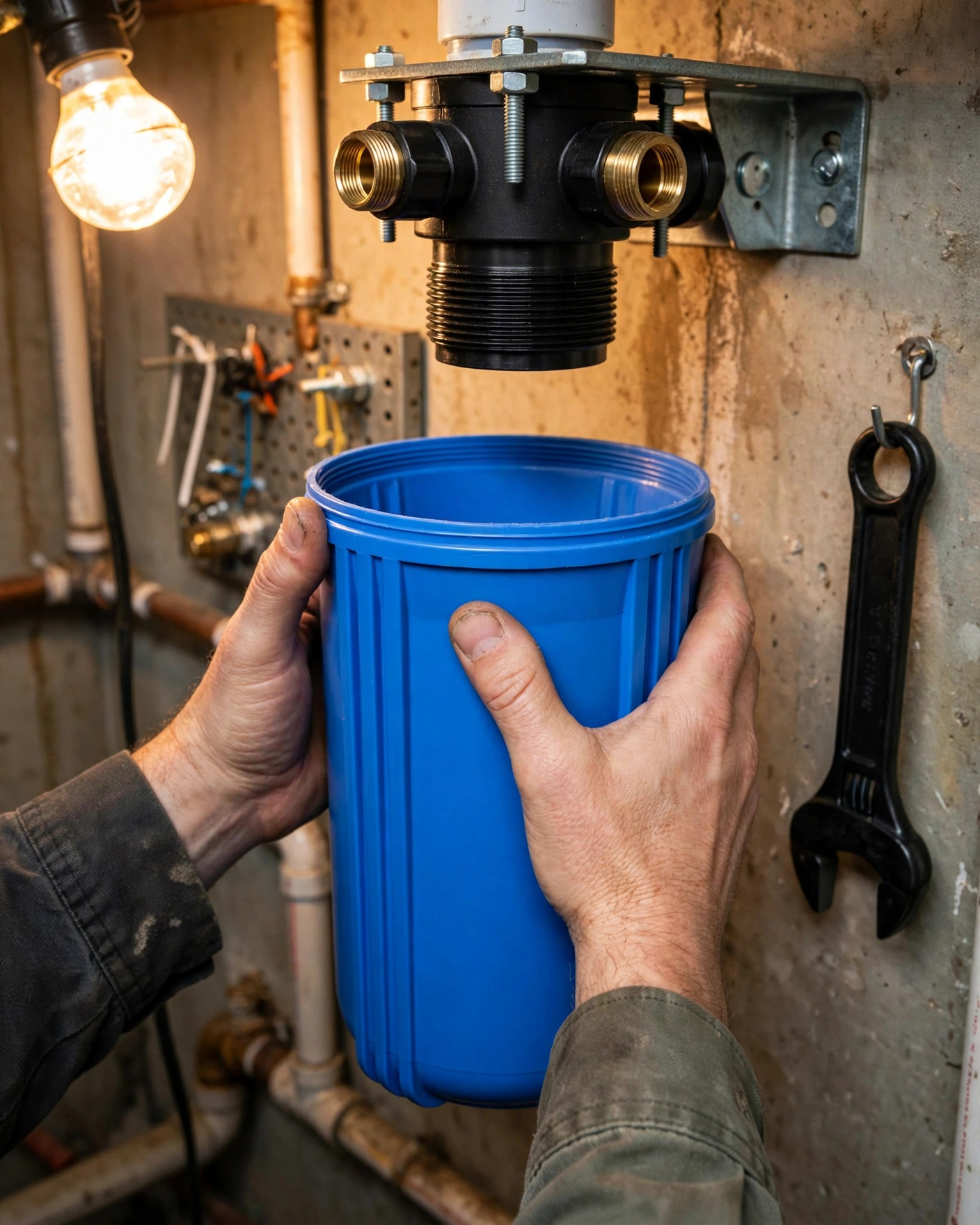
Not a system at all — a shell. The SimPure DB10P is a 10″ x 4.5″ Big Blue housing (roughly $60–100, estimate) with 1-inch brass NPT ports, a pressure-relief button, and a steel wall bracket. It ships without a cartridge: you load it with whatever your water needs — sediment, carbon block, or a specialty cartridge.
The specs that matter: food-grade polypropylene, rated for 25–90 psi and up to 20 GPM, cold water only. The catch is the obvious one — a housing filters nothing until you buy cartridges, so budget those too, and consider the 20-inch version if your household runs multiple taps at once.
Pros
- Cheapest way onto your main line — the housing costs less than one tank-system service call.
- Total cartridge freedom — run sediment now, carbon later, specialty media when you need it.
- 1″ brass ports and 20 GPM rating — no meaningful flow restriction for most homes.
- Comes with the install tools — bracket, wrench, and Teflon tape in the box.
Cons
- No cartridge included — out of the box it filters exactly nothing.
- Single stage — one housing means one job; multi-stage needs multiple housings.
- 10-inch size — shorter cartridge life than 20-inch Big Blue setups.
Price checked at time of writing; it changes often — see the live price before you buy.
Before you buy: test your water

Every pick above assumes you know what is in your water — and most buyers do not. A 150-strip hardness test kit (about $12–20, estimate) takes two minutes: dip a strip, match the colors, and you will know your hardness, pH, and chlorine levels. That is enough to answer the question that decides this whole purchase: do you need a filter (chlorine, sediment, taste) or a softener (hardness, scale)?
Strips are a rough screen, not a diagnosis. If you suspect lead, PFAS, or bacteria — or you are on a private well — get a certified lab test instead of guessing from a color square.
Price checked at time of writing; it changes often — see the live price before you buy.
Head-to-head comparison
| System | Best for | Capacity | Flow | Certification status (honest) | Price (est.) | Our score |
|---|---|---|---|---|---|---|
| Aquasana HealthShield | Certified PFAS reduction | 165,000 gal / ~2 yrs | 5.7 GPM | WQA: NSF/ANSI 53 (PFAS, VOCs), 401 (BPA, ibuprofen) | ~$2,099 | 4.7 |
| SpringWell CF1 | Best value, city water | 1,000,000 gal / ~6–10 yrs | 9 GPM | Component-level 42/53 only — no system-level cert | ~$1,100 | 4.5 |
| iSpring WGB32BM | Budget + iron/manganese | 100,000 gal / ~1 yr | 15 GPM | Brand-stated independent evaluation claim — no listing | ~$300 | 4.4 |
| PRO+AQUA PRO-100-E | Well water, budget | Cartridge-dependent | Not published | No verifiable third-party certifications found | ~$375 | 4.0 |
| SimPure DB10P | Cheapest DIY shell | Cartridge-dependent | Up to 20 GPM | Housing only — cert depends on the cartridge you load | ~$80 | 3.8 |
Scores are our editorial judgment from the research above — capacity, certification transparency, flow rate, and yearly cost — not lab results. Prices are street-price estimates and move often.
Buying guide: size it right
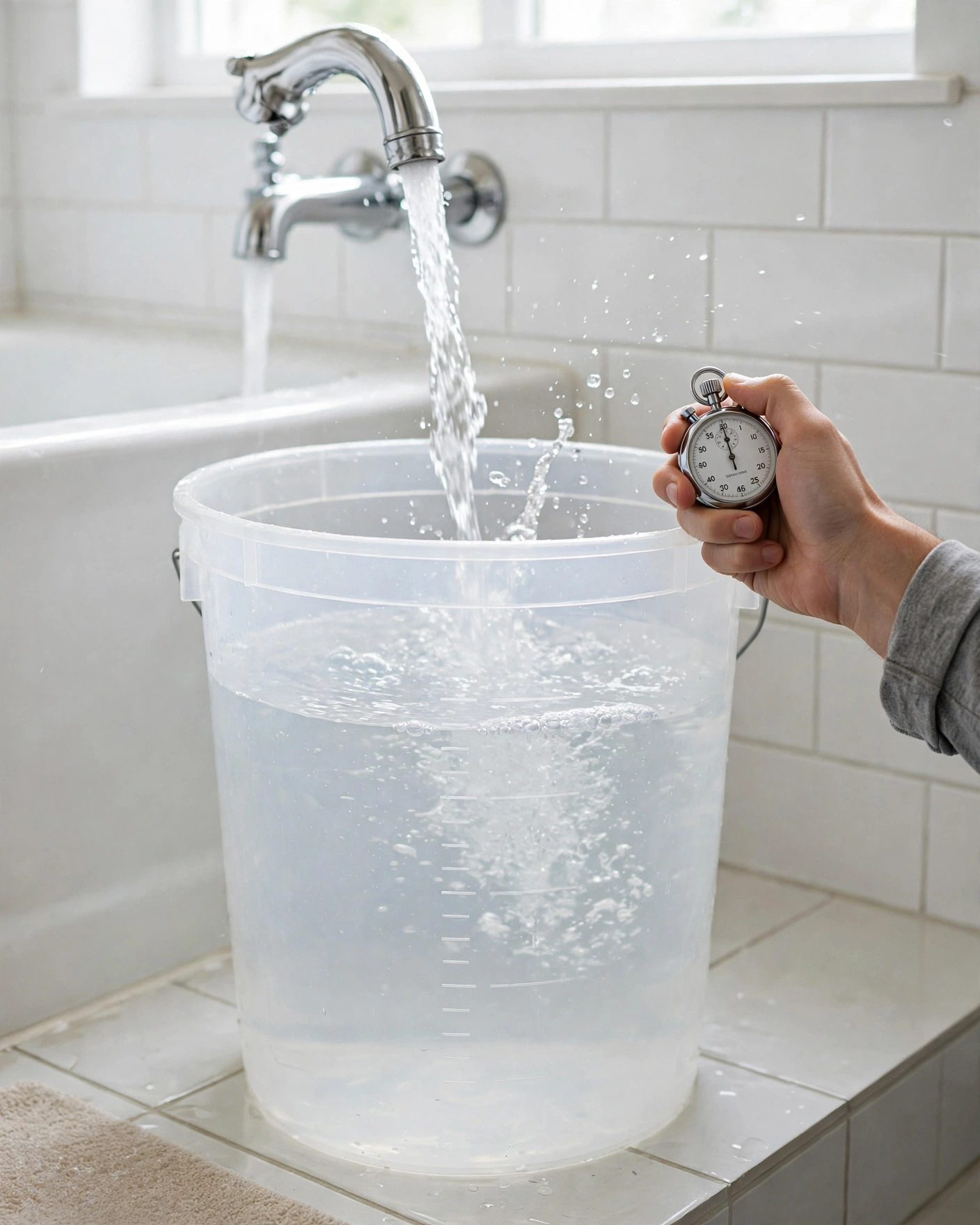
Match the flow rate to your peak demand. A whole-house filter that cannot keep up with your household becomes a bottleneck — weak showers, slow-filling appliances, and pressure drops when two taps run at once. A 1–2 bathroom home is typically fine at 9 GPM; larger homes or simultaneous heavy use should size up toward 12–15 GPM. The bucket test above gives you your real number in two minutes.
Bigger cartridges last longer and flow better. The industry’s Big Blue standard is 4.5 inches wide; a 20″ x 4.5″ cartridge holds roughly three and a half times the media of a slim-line cartridge (engineerfix.com) — longer service life and steadier pressure. This is the quiet reason tank systems and 20-inch housings beat compact units on cost per year.
Match the system to the water, not the marketing. City water with chlorine taste and odor is a carbon-tank or carbon-cartridge job (SpringWell, iSpring). Iron, manganese, or sulfur from a well points to an iron/manganese stage (iSpring WGB32BM, PRO+AQUA). PFAS with proof points to the HealthShield’s WQA certification — and note the pattern: several brands publish PFAS figures no certifier lists, which we treat as brand claims, not verified performance.
A filter is not a softener. Standard carbon whole-house filters do not remove the calcium and magnesium that cause scale and spots — SpringWell lists “does not soften hard water” as a limitation, and independent testing guides say the same. If your test strips show high hardness, you need a softener (ion exchange) or a salt-free conditioner alongside or instead of a filter.
Renters and tight spaces should sit this one out. Every system here installs on the main water line where it enters the home — cutting pipe, a shutoff plan, and usually a plumber. If you rent, or your main line is buried in a finished wall with no access, a point-of-use filter is the realistic answer.
Comparing the two big tank names head to head? Our Aquasana Rhino review explains why the Rhino line carries NSF/ANSI 42 and 61 only — no PFAS — and how it differs from the HealthShield. For the full SpringWell lineup beyond the CF1, see our SpringWell whole-house review.
Replacement cost math

The sticker price is the least important number on this page. What matters is the yearly cost of running the thing:
| System | Upfront (est.) | Yearly upkeep (est.) | Notes |
|---|---|---|---|
| Aquasana HealthShield | ~$2,099 | ~$1,050/yr equipment | $2,099 spread across the 2-year tank cycle — before install, UV add-on, or tank replacement (tank price unpublished) |
| SpringWell CF1 | ~$1,100 | ~$40–70/yr | Maintenance estimate from waterfilters.systems; sediment post-filter swaps every 8–9 months |
| iSpring WGB32BM | ~$300 | ~$160/yr | Full 3-stage replacement pack per 100,000 gallons / ~12 months |
| PRO+AQUA PRO-100-E | ~$375 | Varies | Replacement cartridge pricing is not published as clearly — check current pricing |
| SimPure DB10P | ~$80 | Cartridge of choice | Housing only — your yearly cost is whatever cartridge you load |
Two things jump out. First, the tank systems win the long game: the SpringWell’s million-gallon media means its yearly equipment cost is a fraction of a cartridge system’s. Second, the HealthShield is the most expensive to own by a wide margin — you are paying for certified PFAS reduction, and there is no cheap way to get that from a whole-house system.
You may see a “$7,211 five-year upkeep” figure quoted for the HealthShield on some sites. We could not verify that number at any primary source — not Aquasana, not a certifier, not a published price sheet — so we do not repeat it here. Our whole-house filter cost guide breaks the ownership math down further.
FAQs
Do I need a whole-house filter, or is an under-sink filter enough?
A whole-house filter treats water where the main line enters your home – every tap, shower, and appliance. An under-sink filter treats drinking water at one faucet only. Chlorine in showers and sediment in appliances: go whole-house. Lead or PFAS at the kitchen tap: a certified point-of-use filter is cheaper and more targeted – many homes use both.
Will a whole-house water filter soften hard water?
No. Standard carbon whole-house filters do not remove the calcium and magnesium that cause scale and spots – SpringWell lists “does not soften hard water” as a limitation of the CF1, and independent testing guides say the same. Hard water needs a softener (ion exchange) or a salt-free conditioner; a filter will not fix spots or scale buildup.
Which whole-house filter is certified to reduce PFAS?
The Aquasana HealthShield is the only whole-house system we found with third-party WQA certification to NSF/ANSI 53 for PFAS reduction – 99.9% to below 4 parts per trillion, per Aquasana’s published FAQ. Several competitors publish PFAS-reduction figures with no certifier listing them; treat those as brand claims, not verified performance.
How much does a whole-house water filter cost per year?
It depends on the design. A tank system like the SpringWell CF1 runs roughly $40-70 a year in upkeep (waterfilters.systems estimate). A 3-stage cartridge system like the iSpring WGB32BM costs about $160 a year in replacement cartridges. The Aquasana HealthShield works out to about $1,050 a year in equipment cost across its 2-year tank cycle (from the $2,099 launch price, before installation). All figures are estimates – check current prices.
Can I install a whole-house water filter myself?
Cartridge systems and bare housings (iSpring, SimPure) suit DIY if you are comfortable cutting into the main water line. Tank systems and the HealthShield are heavier plumbing jobs – Aquasana strongly recommends a licensed plumber, and local codes may require one. If you rent, you likely cannot install one at all.
How often does a whole-house filter need maintenance?
Tank media (SpringWell CF1) can run years – its 1,000,000-gallon rating works out to roughly 6-10 years for a typical household – with only a sediment post-filter to swap every 8-9 months. Cartridge systems need new cartridges about once a year (100,000 gallons). The HealthShield’s tank is rated at 165,000 gallons, about 2 years, and its flow meter tells you when it is spent.
Do whole-house filters remove fluoride?
No. Standard carbon media does not reduce fluoride, and none of our picks claim to. If fluoride is your concern, add a reverse-osmosis unit at the kitchen tap instead of sizing up the whole-house system.
What size whole-house filter do I need?
Match the flow rate (GPM) to your household’s peak demand – an undersized system causes noticeable pressure drops when multiple taps run. A 20″ x 4.5″ Big Blue cartridge holds about 3.5 times the media of a slim-line cartridge (engineerfix.com), so bigger housings mean longer life and steadier pressure. A 1-2 bathroom home is typically fine at 9 GPM; larger homes should size up.
Conclusion
The right whole-house filter is the one matched to your water, not the one with the longest feature list. Certified PFAS reduction from every tap points to the Aquasana HealthShield. City water on a budget points to the SpringWell CF1 or the iSpring WGB32BM. Test your water first and size for your peak flow — your main water line deserves better than marketing.
Price checked at time of writing; it changes often — see the live price before you buy.
Update log
- Zulqarnain: Review published.