
SpringWell CF1 vs CF4 (2026): Which Should You Buy?
You searched for “SpringWell CF1 vs CF” — and instead of a straight answer, you got a wall of model numbers. CF1, CF4, CF+… which one is the “CF,” and which one belongs in your house? If the alphabet soup has you stuck, you are not alone: SpringWell’s naming is the single most confusing thing about an otherwise straightforward product line.
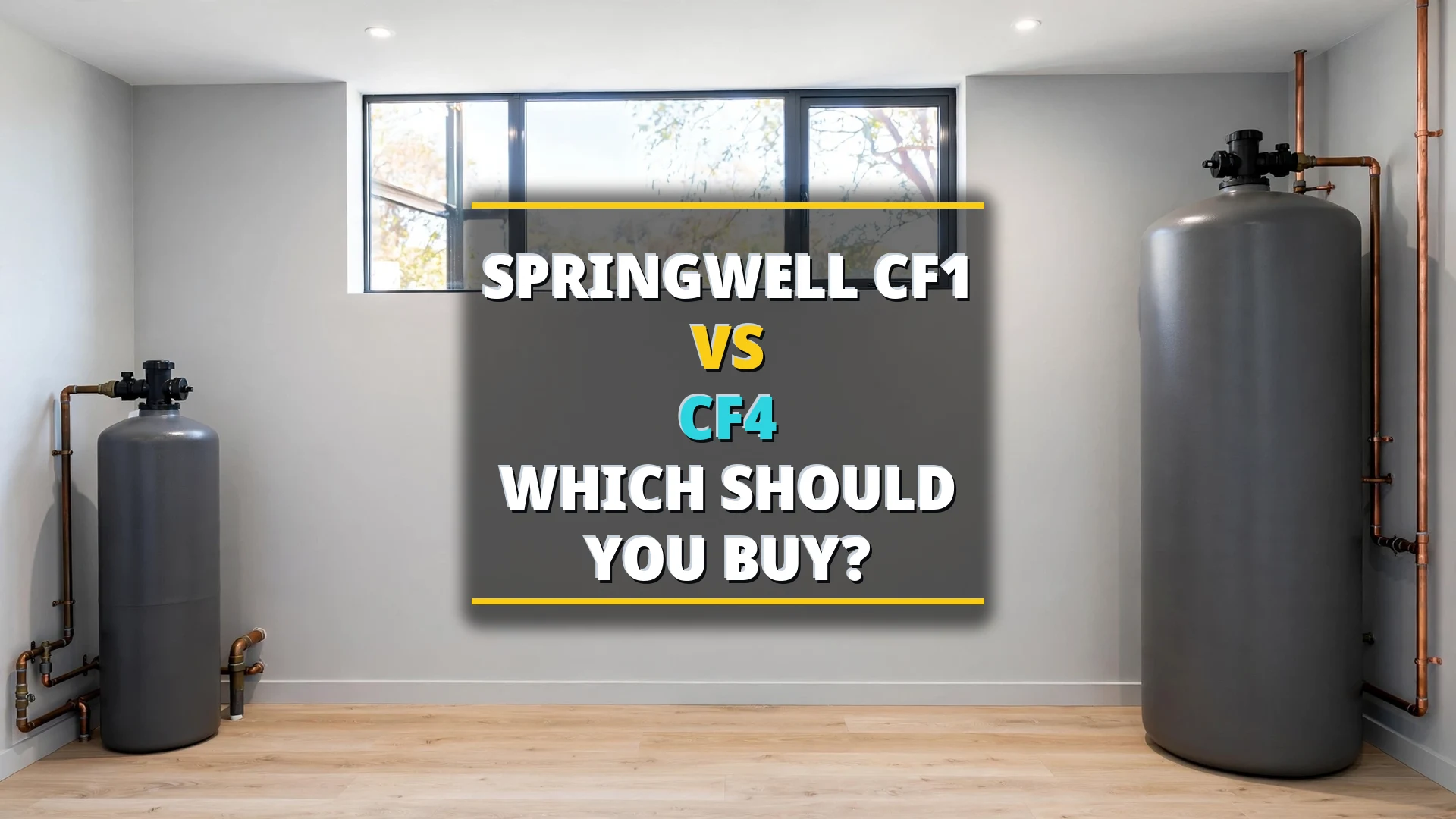
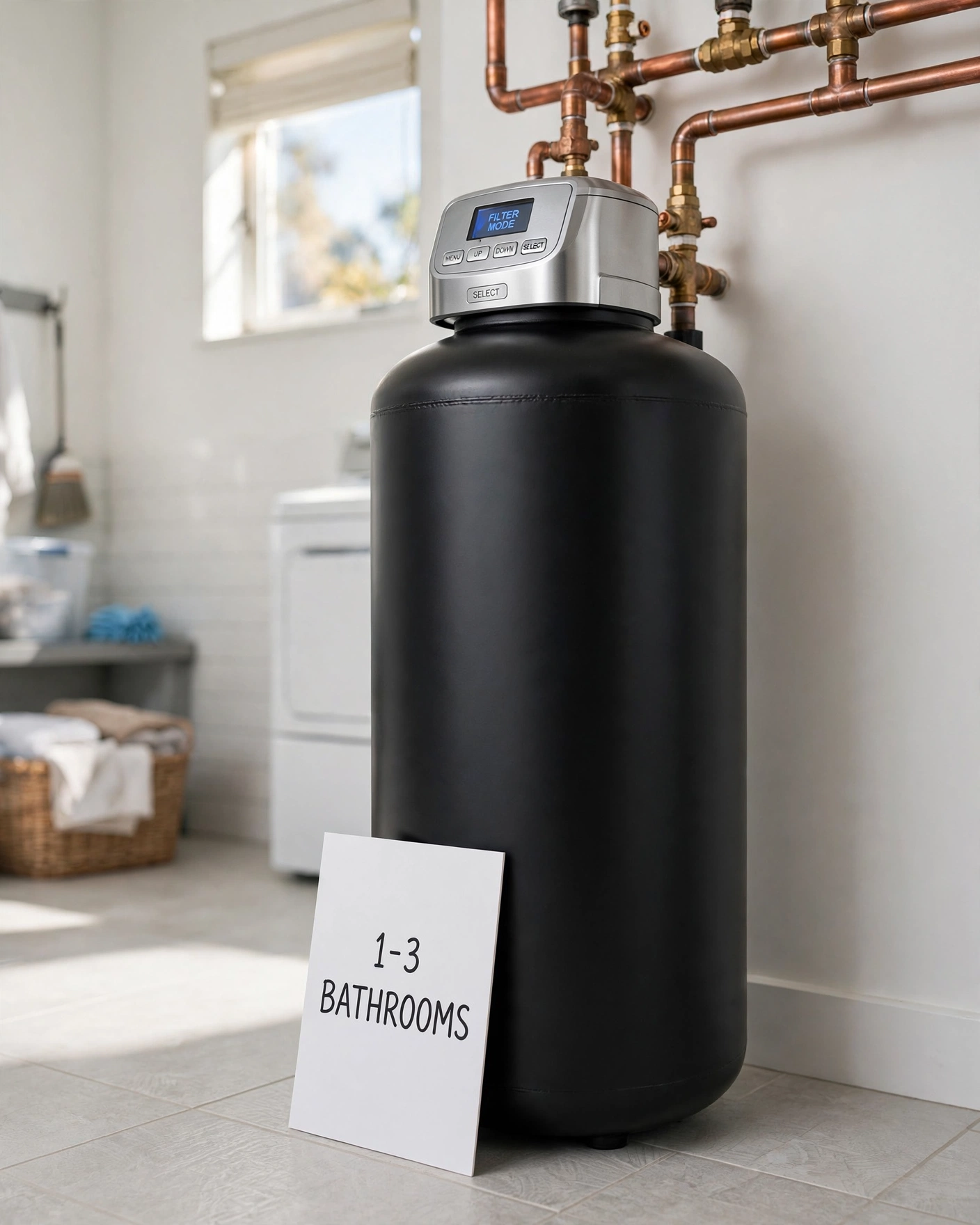
Here is the short answer: CF1, CF4 and CF+ are the same filter in three sizes. The CF1 fits homes with 1–3 bathrooms (9 GPM), the CF4 fits 4–6 bathrooms (12 GPM), and the CF+ is for 7+ bathrooms (20 GPM). The filtration technology, media capacity and warranty are identical — you are choosing a size, not a quality tier. This comparison lays out the side-by-side specs, what is and is not certified, the real yearly cost, and what owners complain about, so you can pick the right size the first time.
The size for 4–6 bathrooms
SpringWell CF4
~$1,200–1,300
The same filter in a bigger tank — 12 GPM for 4–6 bathrooms, with identical media, capacity and warranty.
The size for 1–3 bathrooms
SpringWell CF1
~$1,000–1,200
The same filter in the smallest tank — 9 GPM for 1–3 bathrooms, with identical media, capacity and warranty.
The bottom line: buy the CF1 if your home has 1–3 bathrooms and city water; buy the CF4 if it has 4–6. There is no “better” filter here — an oversized unit wastes a few hundred dollars, and an undersized one risks pressure drops when several fixtures run at once. If independently certified contaminant reduction is a dealbreaker for you, neither model is the right pick.
Verdict: a sizing decision, not a quality decision — match the model to your bathroom count.
Price checked at time of writing; it changes often — see the live price before you buy.
Our scores — SpringWell CF1
Table of Contents
The CF lineup: what CF1, CF4 and CF+ actually mean
“CF” is the family name — older reviews call the whole line the “SpringWell CF system.” The numbers after it are just sizes. SpringWell sells one whole-house city-water platform in three tank sizes, and everything that matters about filtration is shared across all three:
- Same 4-stage media: catalytic carbon plus KDF (copper-zinc) media, targeting chlorine, chloramine and organic chemicals per SpringWell’s own materials.
- Same capacity: 1,000,000 gallons of media life across the line.
- Same upkeep: a 5-micron sediment pre-filter changed every 6–9 months on every model.
- Same warranty: lifetime coverage on tanks, valves and housings, plus a 6-month money-back guarantee.
- Same design: upflow tank, no backwashing, no electricity, no drain line needed.
What changes is only the plumbing math — flow rate, tank dimensions and the number of bathrooms each size supports:
- CF1 — 1–3 bathrooms, 9 GPM, the smallest (and cheapest) tank.
- CF4 — 4–6 bathrooms, 12 GPM, a step up in size and price.
- CF+ — 7+ bathrooms, 20 GPM, the largest tank for very large homes.

The confusion is understandable. Retailers list each size as if it were a separate product, and the generic “CF” name on older reviews makes it sound like there is a base model hiding somewhere. There isn’t — if a listing just says “SpringWell CF,” check which size it actually is before you buy. For the full brand picture, see our SpringWell whole-house water filter review; if you are still choosing between brands rather than sizes, our Aquasana Rhino vs HealthShield comparison covers the other big whole-house name.

Side-by-side comparison
All figures below come from SpringWell’s published installation materials and current dealer listings (prices are approximate street figures — always check the live price). The CF+ column is included so you can see the full ladder.
| CF1 ★ Winner | CF4 | CF+ | |
|---|---|---|---|
| Bathrooms | 1–3 | 4–6 | 7+ |
| Flow rate | 9 GPM | 12 GPM | 20 GPM |
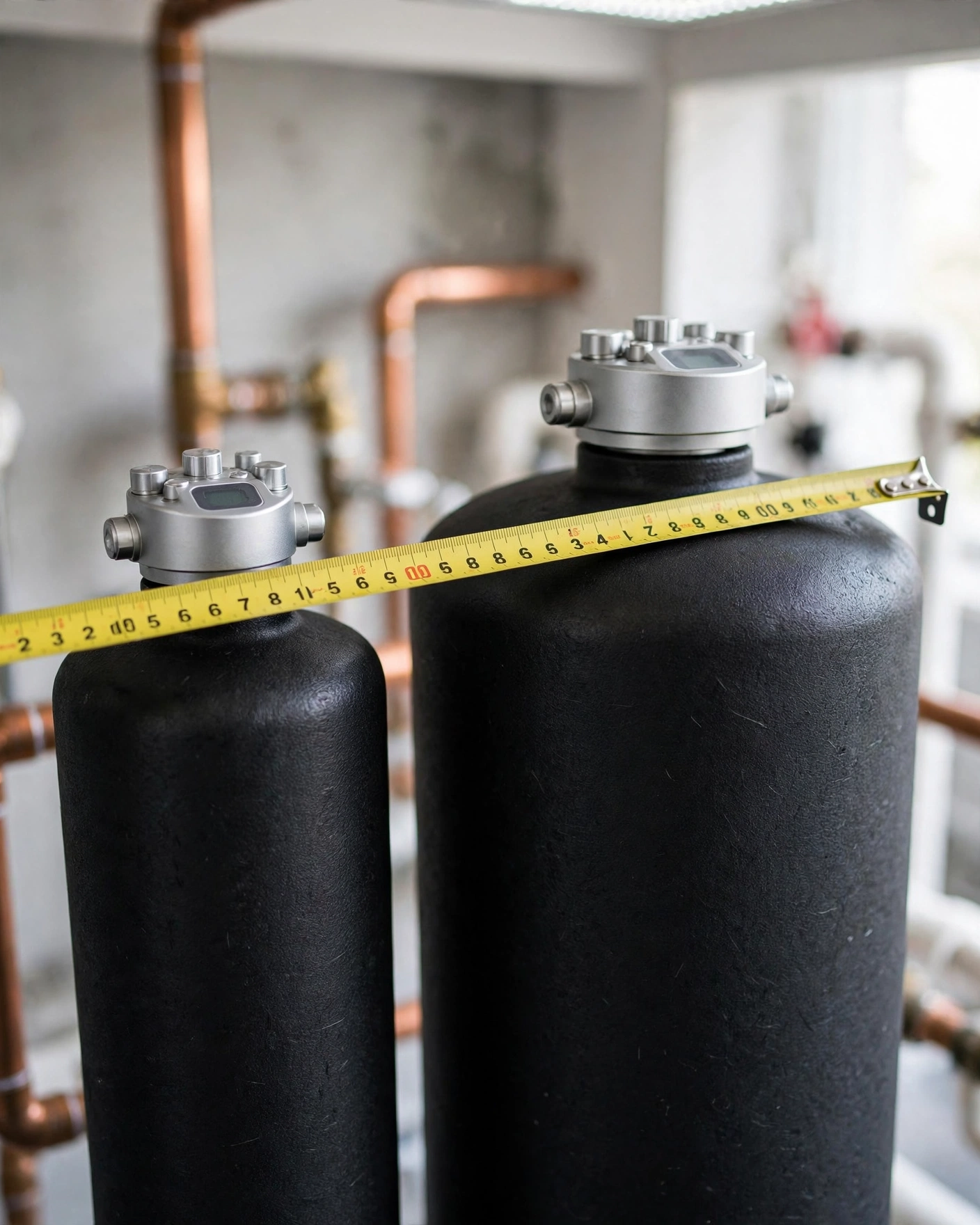
| Tank size | 9″ × 52″ (48″ + head) | 10″ × 58″ (54″ + head) | 13″ × 58″ |
| Connection size | 1″ | 1″ | 1″ |
| Media capacity | 1,000,000 gallons | 1,000,000 gallons | 1,000,000 gallons |
| Pre-filter | 5-micron sediment, every 6–9 months | Same | Same |
| Upfront price (approx.) | ~$1,000–1,200 | ~$1,200–1,300 | ~$1,700–2,100 |
| Warranty | Lifetime (tanks, valves, housings) | Same | Same |
| Best for | Smaller city-water homes | Larger homes, no pressure drop | Very large homes |
What does 9 vs 12 GPM mean in practice? A shower runs about 2–2.5 GPM, so the CF1 comfortably handles two showers plus a dishwasher or washing machine running at the same time. The CF4’s extra headroom matters in 4–6 bathroom homes where three showers, laundry and a dishwasher can all fire at once during the morning rush — that is the moment an undersized unit shows up as a pressure drop. Our SpringWell CF1 review goes deeper on the base model if you want the full picture.
Between sizes? SpringWell’s guidance is bathroom count, but real life is about simultaneous use. If your household regularly runs many fixtures at once, sizing up to the CF4 is cheaper than regretting the CF1 later — the price gap between sizes is a few hundred dollars, one time.
Certifications (what is and is NOT certified)
Let’s be blunt, because this is where whole-house marketing gets slippery: we could not verify any current NSF, WQA or IAPMO system listing for the SpringWell CF line, and SpringWell’s own materials don’t claim one. Independent reviewers say the same — one buyer’s guide puts it plainly: “No certifier lists it, so treat those as maker claims,” while another confirms the catalytic carbon media but notes there is no system certification. So here is the honest table:

| Claimed reduction | Basis | Certification status |
|---|---|---|
| Chlorine taste & odor | Catalytic carbon (maker-stated) | No independent system cert |
| Chloramine | Catalytic carbon (maker-stated) | No independent system cert |
| PFOA / PFOS (“forever chemicals”) | Maker-stated | No independent system cert |
| VOCs, pesticides, herbicides | Maker-stated | No independent system cert |
| Heavy metals (via KDF media) | KDF copper-zinc media (maker-stated) | No independent system cert |
| Lead | Not claimed by the maker | Not certified |
One independent data point does exist: Quality Water Lab’s long-term field test of a CF1 reported total THMs (disinfection byproducts) at non-detect after more than three years of daily use. That is one lab’s result on one unit — encouraging, but not a certification, and it shouldn’t be read as one.
Maker claims are not the same as certified performance. Without an independent listing, treat the contaminant list above as SpringWell’s marketing specification, not a verified reduction table. If certified proof is a must for you, shop the certified category instead — our Aquasana Rhino review covers a rival that is NSF/ANSI 42 certified for chlorine reduction.
Cost per year
The sticker price is the least important number on this page. What matters is the yearly cost of running the thing — and this is where the CF line earns its reputation. The main media is rated for 1,000,000 gallons: SpringWell’s product page says up to 10 years, while the manual and carbon guarantee say 6. Either way, most households replace the media once a decade, not once a year.

| Item | CF1 | CF4 |
|---|---|---|
| System (approx. street price) | ~$1,160 | ~$1,294 |
| Sediment pre-filters (~$21 each, ~2/year, 10 years) | ~$420 | ~$420 |
| Media replacement within 10 years | $0 (rated lifespan covers it) | $0 (rated lifespan covers it) |
| Estimated 10-year total | ~$1,580 | ~$1,710 |
| Works out to per year | ~$150–160 | ~$165–175 |
Three honest caveats. First, the bypass valve is sold separately — budget for it if you want one. Second, if the media ever does need rebedding down the road, one detailed owner review reported a media rebed costing roughly $352 — far less than buying a whole new system, which is exactly the point of a tank design. Third, there is no electricity cost and no drain line to install, unlike backwashing systems. If you are comparing upkeep models across brands, our Aquasana HealthShield review covers a system with a very different replacement philosophy.
All figures are approximate street prices from dealer listings and independent reviews, and they move — re-check the current price before you buy. The CF4’s yearly upkeep is identical to the CF1’s; the price gap between sizes is a one-time difference.
Owner voices
We researched and compared hundreds of owner reports across retail listings, forums and long-form reviews. The same themes repeat often enough to trust:
What owners like
- Noticeable taste and odor improvement — the most consistent praise: chlorine taste gone, better showers, better ice cubes.
- No pressure drop — correctly sized units hold pressure even with multiple fixtures running.
- Set-and-forget upkeep — beyond the twice-a-year sediment filter, owners report years of no maintenance.
- The guarantee and warranty — the 6-month money-back window plus lifetime tank/valve/housing warranty come up repeatedly as the reason buyers took the leap.
- DIY-friendly install — the optional installation kit with push-fit components gets credit for saving plumber bills.
What owners complain about
- Footprint — these are tall floor-standing tanks (up to 58″ with the head) plus a sediment housing. Measure your vertical clearance and floor space before ordering.
- The 48-hour presoak — the media must soak for 48 hours before first use, per the installation instructions. Plan for it; the system isn’t “install and drink.”
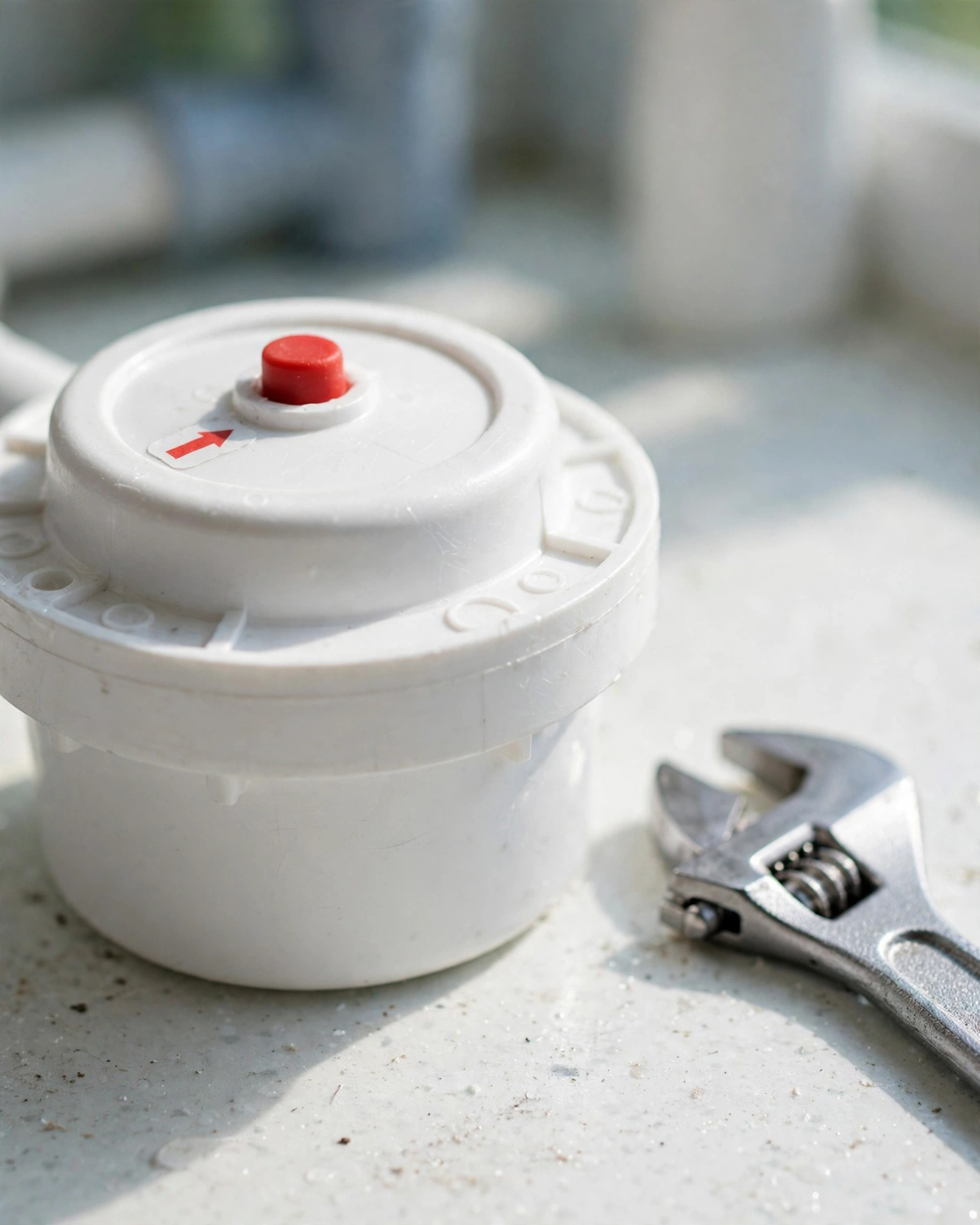
- Fragile pressure-relief button — one detailed video review reported the sediment housing’s plastic pressure-relief button snapping during installation (fixed with a brass cap). Go easy on it.
- The head is permanent — the installation manual warns that once the tank head seats onto the internal pipe, it cannot be removed without damaging the unit. Get it right the first time.
- No softening — hard-water owners are sometimes surprised that scale buildup continues. This is a filter, not a softener.
- Upfront cost — a few hundred more than cartridge-based systems. The payback is in the near-zero upkeep, but the sticker still stings.
None of these are hidden gotchas, and none are unique to SpringWell — tall tanks, presoak steps and hard-water limits show up across the whole-house category. But they are the real-world friction points, and you are better off knowing them now.
FAQs
Is the SpringWell CF1 the same as the SpringWell CF?
CF is the family name for SpringWell’s whole-house line — older reviews call it the ‘CF system.’ CF1, CF4 and CF+ are the three sizes within that family. If a listing just says ‘SpringWell CF’ without a number, check which size it actually is before you buy.
What is the difference between the SpringWell CF1 and CF4?
Size only. The CF4 handles 4–6 bathrooms at 12 GPM versus the CF1’s 1–3 bathrooms at 9 GPM, in a bigger tank, for a few hundred dollars more upfront. The media, the 1,000,000-gallon capacity, the pre-filter schedule and the warranty are identical.
Is the SpringWell CF1 NSF certified?
No. We could not verify any current NSF, WQA or IAPMO system listing for the CF line, and SpringWell’s own materials don’t claim one. Its contaminant claims — chlorine, chloramine, PFOA/PFOS and others — are manufacturer-stated, not independently certified.
What size SpringWell do I need for my house?
Count your full bathrooms: 1–3 means the CF1, 4–6 means the CF4, and 7 or more means the CF+. If you sit between sizes and your household regularly runs many fixtures at once, size up — the one-time price gap is smaller than the regret.
How often do you change SpringWell filters?
The 5-micron sediment pre-filter gets changed every 6–9 months at roughly $21 each. The main tank media is rated for 1,000,000 gallons — SpringWell’s product page says up to 10 years while the manual and carbon guarantee say 6 — so most households go many years before touching it.
Does the SpringWell CF1 work with well water?
SpringWell says to call them before installing on well water, and the system doesn’t disinfect — so a well with bacteria needs UV treatment alongside it. It’s designed as a city-water system.
Does the SpringWell CF1 soften hard water?
No. It doesn’t remove hardness minerals, so scale buildup continues in hard-water homes. Pair it with a softener — or SpringWell’s salt-free conditioner — if scale is your problem.
Conclusion
The CF1 vs CF4 question has a boring answer, and boring is good here: count your bathrooms. One to three — CF1. Four to six — CF4. Seven or more — CF+. The filtration is identical, the warranty is identical, and the yearly upkeep is identical. The only wrong move is buying blind on the alphabet: an undersized unit throttles your showers at the worst possible moment, and an oversized one spends your money on flow you will never use. And if certified contaminant reduction or water softening is what you are actually shopping for, neither CF is your answer — shop the certified category instead.
Price checked at time of writing; it changes often — see the live price before you buy.
Update log
- Zulqarnain: Review published.