Best Water Filter Pitcher (2026): Tested, Compared & Ranked
★ 2026 ROUNDUP — PITCHER FILTERSYour tap water has that faint swimming-pool note of chlorine, or maybe you have read one too many headlines about lead in older plumbing — so you open a shopping tab and face a wall of pitchers that all promise the same thing. Ten cups, white plastic, a filter cartridge, a blue lid. They are not the same thing, and the difference that matters most is not the pitcher at all: it is the cartridge inside it, what it is certified to reduce, and how long it lasts before you have to buy another one.
Here is the short answer: for most buyers, the best water filter pitcher in 2026 is the Brita Elite 10-cup — certified lead reduction and a 120-gallon filter life that means only two cartridge changes a year. If you just want better-tasting water and the lowest starting price, the 6-cup Brita Metro (~$21–25) gets you going. And if lead in older pipes is your specific concern, the PUR PLUS 11-cup certifies a similar lead-reduction scope on a shorter 40-gallon cycle. We researched and compared six pitchers — Brita Elite, Brita Everyday, Brita Metro, PUR PLUS, ZeroWater, and the Brita UltraMax dispenser — on certified coverage, rated filter life, real replacement cost, and recurring owner complaints. Here is how each one earns its place.
Table of Contents
- Quick picks
- How we researched
- Best overall: Brita Elite 10-cup pitcher
- Best budget: Brita Metro 6-cup
- Best for lead reduction: PUR PLUS 11-cup
- Best for the purest taste: ZeroWater 10-cup
- Best for families: Brita UltraMax 27-cup dispenser
- Best basic taste-only pick: Brita Everyday 10-cup
- Head-to-head comparison
- Buying guide: pick by your water goal
- Replacement cost math
- FAQs
- Conclusion
Quick picks
The bottom line: the Brita Elite 10-cup is the best water filter pitcher for most households — certified lead reduction (NSF/ANSI 53) with a 120-gallon cartridge that lasts about 6 months. The 6-cup Brita Metro is the cheapest honest start (~$21–25) for taste-only buyers. The PUR PLUS 11-cup matches the Elite on lead certification for buyers who want a cheaper per-cartridge option on a shorter 40-gallon cycle.
Verdict: Elite for certified coverage and convenience, Metro for the lowest entry price, PUR PLUS for lead-conscious value.

Top 3 quick picks
- Best overall — Brita Elite 10-cup (~$37–45). NSF/ANSI 42 + 53 including lead; 120-gallon / 6-month cartridges; two changes a year.
- Best budget — Brita Metro 6-cup (~$21–25). Compact 6-cup size; SmartLight filter indicator; standard 40-gallon cartridges for chlorine taste and odor.
- Best for lead reduction — PUR PLUS 11-cup (~$30–37). NSF/ANSI 42, 53 and 401 certified with a lead-reducing cartridge on a 40-gallon / 2-month cycle.
The catch
- Filter-life ratings are lab numbers. Hard water clogs cartridges sooner than the label says — for every brand.
- Prices are estimates, not promises. Every dollar figure on this page is an estimate; check the live price before you buy.
- No pick here is a softener or a PFAS-certified device. We did not verify a fluoride or PFAS certification at a certification database for any of these six, so do not buy one for that purpose without checking the specific model’s database entry.
How we researched
We did not run lab bench tests, so this guide will not pretend we did. What we did instead was research and comparison — and we can show our work:
- Compared six pitchers and dispensers on five factors — Brita Elite, Brita Everyday, Brita Metro, PUR PLUS, ZeroWater, and the Brita UltraMax dispenser — on certified contaminant scope, rated filter life, cartridge availability, replacement cost, and recurring owner complaints.
- Checked certification claims against primary sources — brand performance data sheets and the public NSF certification database listings, not review-blog summaries. Where a claim could not be verified at a primary source, we say so instead of repeating it.
- Treated every price as an estimate — pitcher prices swing weekly, so check the live price before you buy.
- Read owner feedback for recurring complaints — black carbon specks, dripping lids, hard-water clogging, and sour-taste-at-exhaustion mentioned again and again, not one-off bad reviews.
Best overall: Brita Elite 10-cup pitcher

The Brita Elite wins this roundup on the two things that matter most in a pitcher: what the cartridge is certified to do, and how long you get to live with it. Per Brita’s published Performance Data Sheet for the Elite (OB06) filter, it is certified against NSF/ANSI 42 (chlorine taste and odor) and NSF/ANSI 53 — including lead, benzene, asbestos, and mercury. The standard Brita filter is not lead-certified; that is the single biggest difference between the two, and it is why the Elite costs more.
The second reason is the 120-gallon / about-6-month rated life — three times the 40-gallon cycle of a standard Brita or PUR PLUS cartridge. Over a year that is roughly two filter changes instead of six, which is less shopping, less plastic, and less chance of running a spent cartridge you forgot about. Owners consistently report chlorine taste and off-odors disappearing, and Elite cartridges are stocked at most big-box retailers and online. Our full breakdown lives in our Brita Elite pitcher review, where the certifications, costs, and owner complaints get the deep-dive treatment.
Pros
- Certified lead reduction — NSF/ANSI 53 certified per Brita’s OB06 Performance Data Sheet; the thing that separates it from the standard filter.
- Longest rated filter life here — 120 gallons / about 6 months means only ~2 changes a year.
- Better taste and odor reduction — owners consistently report chlorine taste and off-odors disappearing.
- Easy-to-find replacements — Elite cartridges are stocked at most big-box retailers and online.
Cons
- Higher upfront and ongoing cost — the pitcher and each replacement cartridge cost more than the standard-filter versions.
- Black carbon specks — tiny carbon fines show up in the first pitchers from a new filter; rinse briefly and discard the first two or three pitchers per the setup instructions.
- Bulky when full — 10 cups of water plus the pitcher weighs close to 6 pounds and takes real refrigerator shelf space.
Price checked at time of writing; it changes often — see the live price before you buy.
Best budget: Brita Metro 6-cup
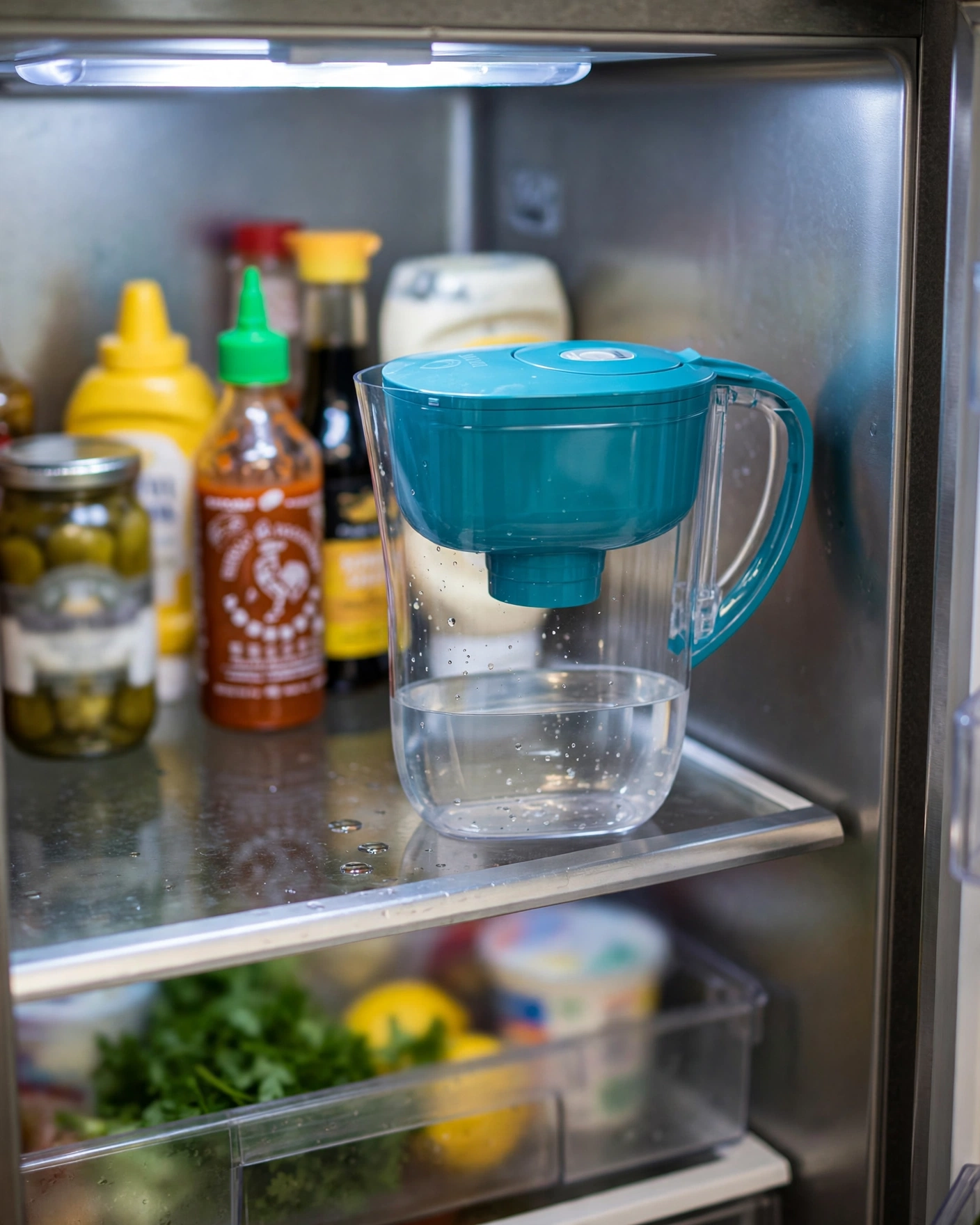
The Brita Metro is for the buyer who wants better-tasting tap water for the least money — a single person, a dorm room, a tight refrigerator. At roughly $21–25 it is the cheapest pitcher on this page, and the 6-cup size fits where 10-cup pitchers do not: fridge doors and crowded shelves. It uses the standard Brita filter cartridge (40 gallons / about 2 months), with an easy-fill locking lid and a SmartLight electronic indicator that tells you when the cartridge is due.
The honest trade: the standard filter is a taste-and-odor product, not a lead filter. It is certified against NSF/ANSI 42 and a narrower NSF/ANSI 53 scope (chlorine, mercury, cadmium, copper, zinc, particulates — not lead), so this is the pick for water that tastes off, not water you worry about. You will also swap cartridges about six times a year — the filter itself is cheap (multi-packs bring each cartridge down to roughly $5–8), but the routine is real.
Pros
- Lowest entry price here — about $21–25, often discounted further.
- Compact 6-cup size — fits refrigerator shelves and doors that reject 10-cup pitchers.
- SmartLight filter indicator — electronic reminder, so no calendar math.
- Cheap replacement cartridges — standard Brita filters in multi-packs run roughly $5–8 each.
Cons
- No lead certification — the standard filter is mainly a chlorine-taste product; want lead coverage? Step up to the Elite.
- Small capacity — 6 cups empties fast with more than one or two drinkers; expect frequent refills.
- Six swaps a year — the 40-gallon / 2-month cycle is the most babysitting in this roundup.
Price checked at time of writing; it changes often — see the live price before you buy.
Best for lead reduction: PUR PLUS 11-cup
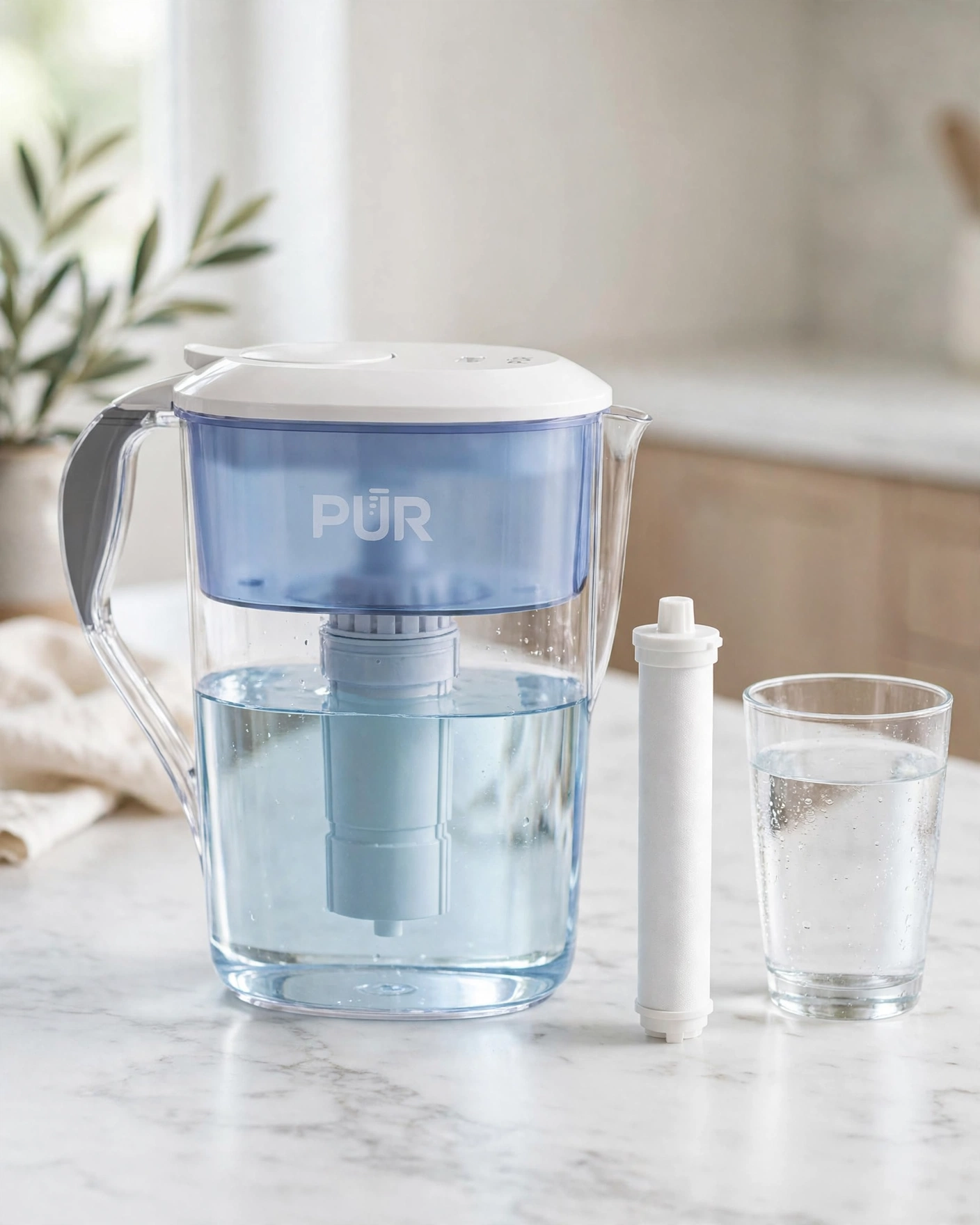
If your concern is lead — older plumbing, an older house, a municipal lead-service-line program — the PUR PLUS 11-cup is the lead-focused value pick. PUR’s published Performance Data Sheet states the PLUS pitcher systems are tested and certified by NSF International and WQA against NSF/ANSI 42, 53, and 401, and the CRF-950Z lead-reducing cartridge appears in the public NSF database listing for PUR pitcher systems. That puts its certified scope right beside the Brita Elite’s — with 401 (emerging contaminants) in the mix — at a similar or slightly lower pitcher price (~$30–37).
The trade is filter life: the CRF-950Z is rated at 40 gallons / about 2 months, so you will swap roughly six cartridges a year. Replacement cartridges run about $10–13 each in single packs (multi-packs are cheaper), which makes the yearly filter cost meaningfully higher than the Elite’s two-change year — our cost math section lays that out. The 11-cup size is also the largest pitcher reservoir in this roundup, which families may like. For the direct head-to-head on certifications, taste, and cost, see our Brita vs PUR comparison.
Pros
- Strong lead-certification story — NSF/ANSI 42, 53, and 401 certified per PUR’s published Performance Data Sheet; CRF-950Z listed in the NSF database.
- 11-cup capacity — the largest pitcher reservoir here; fewer refills.
- Good value per pitcher — similar certified scope to the Elite at a similar or lower starting price.
Cons
- Short filter cycle — 40 gallons / 2 months means ~6 cartridge changes a year.
- Higher yearly filter cost — more swaps at ~$10–13 each adds up; the Elite’s long-life year is cheaper to run.
- Tall 11-cup body — measure your refrigerator shelf before you buy.
Price checked at time of writing; it changes often — see the live price before you buy.
Best for the purest taste: ZeroWater 10-cup

The ZeroWater 10-cup is the odd one out, and deliberately so: instead of polishing taste, its 5-stage ion-exchange system strips nearly all total dissolved solids — the water reads 000 on the included TDS meter when the cartridge is fresh. It is IAPMO-certified against NSF/ANSI 42 and 53 (covering lead, chromium, cadmium, and mercury), and the TDS meter is the most honest replacement indicator in the category: when the reading climbs past 006, the cartridge is done. No guessing.
The honest trade, and it is a big one: filter life is TDS-dependent. ZeroWater rates the cartridge at about 40 gallons, but in hard water (200+ TDS) owners routinely report 15–25 gallons — which can mean a new cartridge every few weeks and a yearly filter cost of $100–150 or more. The stripped-down water also tastes flat to some people who are used to mineral-rich tap water, and a spent cartridge can taste sour or acidic — the meter tells you before that point. We could not verify a PFAS or fluoride certification at a certification database for this pitcher, so we count only the 42/53 certifications here; ZeroWater’s own materials claim broader reductions, and we leave those for you to check at the source.
Pros
- Near-zero TDS — the purest-tasting water of any pitcher here; removes dissolved metals and salts other pitchers leave.
- Included TDS meter — an objective replacement signal; change at 006 instead of guessing.
- NSF/ANSI 42 + 53 certified — including lead, chromium, cadmium, and mercury per the certification.
Cons
- Highest running cost in hard water — cartridges can last weeks, not months, in high-TDS water; $100–150+/year is realistic there.
- Tastes flat to some — stripping minerals changes taste; fans of mineral-rich water may dislike it.
- Sour taste at exhaustion — a spent cartridge can taste acidic; watch the meter.
Price checked at time of writing; it changes often — see the live price before you buy.
Best for families: Brita UltraMax 27-cup dispenser
The Brita UltraMax is not really a pitcher — it is a 27-cup (~1.7 gallon) dispenser that sits on the counter or in the refrigerator with a precision-pour spigot. For a household that empties a 10-cup pitcher twice a day, it ends the refill treadmill: fill it once in the morning and everyone drinks. It comes in two versions — with the standard filter (~$38.99 MSRP) or with the Elite filter (~$49.99 MSRP), with street prices usually landing around $38–50.
The clever part is that it uses the same cartridges as the pitchers: pick the Elite-filter version and you get the same certified lead reduction (NSF/ANSI 53) and 120-gallon / 6-month cartridge life as the Elite pitcher, just in a much bigger body. The catch is size — at about 10.5 inches tall and 14 inches long it is bulky, heavy when full, and you should measure your refrigerator shelf before assuming it fits. The standard-filter version runs the same 40-gallon cartridge economics as the Everyday pitcher; only the Elite version buys you the long-life advantage.
Pros
- 27-cup capacity — roughly 3x a 10-cup pitcher; one fill covers a family’s day.
- Elite-filter version available — same certified lead reduction and 120-gallon life as the Elite pitcher.
- Spigot dispensing — no lifting a heavy full pitcher; pours straight into glasses.
- Slim and fridge-friendly — designed to fit in a refrigerator despite the capacity.
Cons
- Bulky footprint — 10.5″ tall and heavy when full; measure before you buy.
- Higher upfront price — about $38–50, roughly double the cheapest pitchers.
- Standard-filter version is just a big Everyday — only the Elite-filter version gets the long-life and lead certifications.
Price checked at time of writing; it changes often — see the live price before you buy.
Best basic taste-only pick: Brita Everyday 10-cup
The Brita Everyday 10-cup is the plain, honest workhorse: ~$25–31, a 10-cup reservoir, and the standard Brita filter cartridge (40 gallons / about 2 months). It fixes the number-one reason people buy pitcher filters — chlorine taste and odor — and otherwise stays out of your way. Replacement standard filters are the cheapest cartridges in this roundup in multi-packs (~$5–8 each), and they are stocked everywhere.
So why does it sit behind the Metro in our ranking? It does exactly the same filtration as the Metro — same cartridge, same certified scope (NSF/ANSI 42 and narrower 53, no lead) — but it is bigger, bulkier, and usually a few dollars more than the compact Metro without any functional advantage. Buy it if you want 10 cups at the lowest possible price and do not mind six cartridge swaps a year; skip it if a smaller fridge or a smaller budget points you at the Metro, or if lead certification points you at the Elite. Two recurring owner gripes across the whole Brita pitcher line — tiny carbon specks in the first pitchers and drips from the lid when pouring full — are documented with fixes in our Brita pitcher leaking and drips guide.
Pros
- Cheapest 10-cup start — about $25–31 for the full-size reservoir.
- Handles the #1 complaint — chlorine taste and odor, reliably fixed.
- Cheapest replacement cartridges — standard filters in multi-packs run roughly $5–8 each.
Cons
- No lead certification — taste-only product; certified lead coverage needs the Elite.
- Six swaps a year — the 40-gallon cycle is the most maintenance here alongside the Metro and PUR PLUS.
- Functionally identical to the cheaper Metro — same cartridge, bigger body, a few dollars more.
Price checked at time of writing; it changes often — see the live price before you buy.
Head-to-head comparison
Side by side, the pattern is simple: you pay for certified scope and cartridge life. The two certified-lead picks cost more to buy or run; the taste-only picks cost the least; and the TDS specialist costs the most to keep fed in hard water.
| Pitcher | Typical pitcher price | Filter rated life | Certifications (verified or brand-stated) | Est. yearly filter cost | Best for |
|---|---|---|---|---|---|
| Brita Elite 10-cup | ~$37–45 | 120 gal / ~6 months | NSF/ANSI 42 + 53 incl. lead (OB06 Performance Data Sheet) | ~$35–40 (2 changes) | Most households; certified lead reduction + convenience |
| Brita Metro 6-cup | ~$21–25 | 40 gal / ~2 months | NSF/ANSI 42 + 53, narrower scope, no lead | ~$30–50 (6 changes) | Singles, dorms, tight fridges; lowest entry price |
| PUR PLUS 11-cup | ~$30–37 | 40 gal / ~2 months | NSF/ANSI 42 + 53 + 401 incl. lead (brand Performance Data Sheet) | ~$60–80 (6 changes) | Lead-concerned buyers on a pitcher budget |
| ZeroWater 10-cup | ~$35–45 | Rated 40 gal; 15–25 gal in hard water | NSF/ANSI 42 + 53 (IAPMO) | ~$60 soft water; $100–150+ hard water | Purest taste; near-zero TDS; high-TDS water |
| Brita UltraMax 27-cup | ~$38–50 | 40 gal or 120 gal, by filter version | Depends on version — Elite version same as Elite pitcher | ~$30–50 standard; ~$35–40 Elite | Families; offices; refill haters |
| Brita Everyday 10-cup | ~$25–31 | 40 gal / ~2 months | NSF/ANSI 42 + 53, narrower scope, no lead | ~$30–50 (6 changes) | Budget 10-cup taste improvement |
Buying guide: pick by your water goal
Four questions sort this roundup faster than any spec sheet:
1. What problem are you actually solving? Chlorine taste only? A standard-filter pitcher (Metro, Everyday) is all you need — do not pay for certifications you will never use. Worried about lead in older plumbing? Buy on the certification line: the Elite or the PUR PLUS, then confirm the exact model in the public NSF database before relying on it. Want the purest-tasting water? That is ZeroWater’s lane.
2. How much water do you drink at home? One or two people: 6–10 cups is fine. Three or more: the UltraMax dispenser’s 27 cups ends the refill loop, and heavy drinkers should avoid high-TDS pitchers like ZeroWater — the cartridges die fast when the whole family drinks.
3. Will it fit? A 10-cup pitcher is roughly 10 inches tall when assembled; 11-cup and dispenser bodies are taller still. Measure your refrigerator shelf — this is the single most common “wish I had checked” regret in owner reviews.
4. How much babysitting will you do? The Elite’s two changes a year versus six for everything else is the quality-of-life gap. If you know you are the type to ignore a 2-month schedule, buy the long-life cartridge — a spent filter you keep using is just an expensive funnel.
One rule for every pick on this page: a certification claim is only as good as its database entry. If a contaminant matters to you, look up the exact model at info.nsf.org (or the WQA/IAPMO directory) and read the contaminant list — do not trust the box bullet points alone.
Replacement cost math
The sticker price is the least important number in this roundup. What matters is the yearly cost of running the thing, because pitcher filters are a subscription you pay in cartridges. The math below assumes a household filtering about 1–2 gallons a day for drinking and cooking — drink more, and every number scales up.
| Pitcher | Cartridges per year | Typical cartridge price | Est. yearly filter cost |
|---|---|---|---|
| Brita Elite 10-cup | ~2 | ~$17–20 (singles; ~$16.50 in 2-packs) | ~$35–40 |
| Brita Metro 6-cup | ~6 | ~$5–8 in multi-packs | ~$30–50 |
| PUR PLUS 11-cup | ~6 | ~$10–13 (singles; cheaper in 3-packs) | ~$60–80 |
| ZeroWater 10-cup | 3–4 (soft water) up to 12+ (hard water) | ~$15 (~$60 4-packs) | ~$60 soft water; $100–150+ hard water |
| Brita UltraMax (Elite version) | ~2 | ~$17–20 | ~$35–40 |
| Brita UltraMax (standard version) | ~6 | ~$5–8 in multi-packs | ~$30–50 |
| Brita Everyday 10-cup | ~6 | ~$5–8 in multi-packs | ~$30–50 |
Two things jump out. First, the Elite is the cheapest certified-lead option to run per year — its long life offsets the pricier cartridge. Second, the ZeroWater’s cost is entirely hostage to your water: in soft water it is ordinary; in hard water it can be the most expensive pitcher on this page to keep running. Hard-water households should budget for that before falling for the 000 reading. For a longer-horizon version of this math — including 5-year ownership — see our Brita filter cost per year breakdown.
FAQs
What is the best water filter pitcher overall?
For most households, the Brita Elite 10-cup: certified lead reduction under NSF/ANSI 53 per its OB06 Performance Data Sheet, plus a 120-gallon cartridge that lasts about 6 months, so you change it roughly twice a year. Taste-only buyers get better value from the cheaper Brita Metro; high-TDS water is ZeroWater’s lane.
Do water filter pitchers remove lead?
Some do. The Brita Elite is certified to NSF/ANSI 53 for lead per its Performance Data Sheet, and the PUR PLUS is certified against NSF/ANSI 42, 53, and 401 per PUR’s published data. The standard Brita filter (Everyday, Metro) is not lead-certified. If lead is your main concern, look up the exact model’s database entry at info.nsf.org and get a water test first.
Which water filter pitcher removes fluoride?
We did not verify a fluoride certification at a certification database for any of the six pitchers here, so we cannot recommend buying one for that purpose. Brands sometimes state fluoride reductions on their own materials — if fluoride matters to you, ask for the exact certification listing at info.nsf.org rather than trusting box bullet points.
How often do you really need to change a pitcher filter?
The Brita Elite is rated at 120 gallons or about 6 months; the standard Brita, PUR PLUS cartridges are rated at 40 gallons or about 2 months. ZeroWater’s rule is simpler: change it when the included TDS meter climbs past 006. In hard water, every rating runs short — treat the indicator or meter as your real schedule.
Why does my filtered water taste flat?
Probably TDS removal. ZeroWater strips nearly all dissolved minerals, and many people read mineral-free water as “flat” after years of mineral-rich tap water. If the flat taste bothers you, a carbon-only pitcher like the standard Brita filters removes chlorine taste while leaving more of the familiar water character.
Are the black specks in my Brita pitcher dangerous?
Those specks are carbon fines — tiny particles of filter media from a new cartridge — and the most common owner complaint about Brita pitchers. The manufacturer’s guidance is to rinse the new filter briefly and discard the first two or three pitchers before first use; owners who follow the rinse instructions generally report the specks clearing quickly.
Is a pitcher filter enough, or do I need an RO system?
For chlorine taste and basic heavy-metal concerns, a certified pitcher is enough for most municipal water. If you need broad contaminant reduction — high TDS, serious well-water problems, or fluoride as a certified target — a pitcher is the wrong category, and a countertop or under-sink RO system is the honest upgrade. Get a water test before deciding.
Conclusion
The best water filter pitcher is the one that matches your water, not the one with the most bullet points. The Brita Elite is the right default for most buyers — certified lead reduction with only two filter changes a year. The Metro wins on budget, the PUR PLUS wins on lead-conscious value, and the ZeroWater wins on purity if your water’s TDS justifies the cartridge bills. Know which buyer you are, check the database entry before you rely on any claim, and buy the pitcher you will actually keep filtered.
Price checked at time of writing; it changes often — see the live price before you buy.
Update log
- Zulqarnain: Review published.