British Berkefeld Review (2026): Is It Worth It?
★ GRAVITY PICK — CERAMICYou want a gravity filter that does not need power or plumbing — but the biggest name in the category has spent years tangled in regulatory trouble, and half the rival systems cannot show you a single certification. So you land on the British Berkefeld: a British-made stainless urn with ceramic candles and a long history. Is it the careful buyer’s gravity filter, or just a slow one with a famous name?
Here is the short answer: the British Berkefeld is the gravity system for buyers who put certification paperwork first. Doulton states its Ultra Sterasyl ceramic candles are certified to NSF/ANSI 42, 53, and 372 — real standards, attached to a specific candle model, in a category where rivals often publish no certification at all. The trade-off is speed: independent reviewers measured it as one of the slowest gravity systems they have measured, at roughly 0.3 to 0.4 gallons per hour. This review lays out what Doulton claims, what independent testing found, what the candles cost per year, and what owners actually complain about — so you can decide if slow and certified beats fast and vague.
Our scores
Table of Contents
Quick verdict
The bottom line: the British Berkefeld is the right buy if you want a gravity filter whose maker names real NSF/ANSI standards for its filter candles, in stainless steel, at a mid-range price. It is the wrong buy if you need water fast — ceramic filtration is patient work, and no add-on changes that.
Verdict: the certification-first gravity pick — buy it for the paperwork and the build, accept the slow flow.
Price is an estimate at time of writing; it changes often — see the live price before you buy.
Why you should trust this review
We did not receive a test unit and we did not run a lab bench test. Claiming hands-on testing we never did would be dishonest, so we will not do it.
What we did instead was research and comparison: we read Doulton’s own product pages and candle manuals, checked what independent reviewers found when they sent this system to a lab, read owner reviews to find the complaints that keep repeating, and ran the yearly candle-cost math from rated candle life and current retail prices. Where a claim comes only from Doulton, this review says so — and where independent testing disagreed with the brochure, we say that too.
How we researched
- Read Doulton’s primary sources — the official British Berkefeld system pages (sizes, candle types, dimensions) and the Doulton candle instruction manual (rated capacity per candle grade).
- Checked the certification wording carefully — Doulton and its retailers state NSF/ANSI 42, 53, and 372 for the Ultra Sterasyl candle. We phrase these as Doulton’s stated certifications throughout, because a certification belongs to one exact candle model and listing — not to a brand in general.
- Used independent lab reviews for performance reality — published hands-on reviews that sent filtered water to laboratories, including their measured flow rates and the contaminants that increased after filtration.
- Read owner reviews across retailers — looking for recurring complaints (the same problem from many owners over many months), not one-off bad experiences.
- Calculated yearly running costs — from the rated candle capacity in Doulton’s manual and current candle prices.
Pros and cons
Pros
- Certifications are actually stated — Doulton names NSF/ANSI 42, 53, and 372 for the Ultra Sterasyl candle, which is more paperwork than most gravity rivals offer.
- Ceramic candles can be cleaned — a gentle scrub restores flow, so a slowing candle is not automatically a dead candle.
- Three useful sizes — 6L, 8.5L, and 12L stainless systems cover singles through larger families.
- All-stainless build, UK-made — polished 304 stainless chambers that nest together for storage.
Cons
- Slow — genuinely slow — independent measurements put flow at roughly 0.3 to 0.4 gallons per hour, the slowest class of gravity system.
- Six-month candle cycle — rated candle capacity works out to changes about twice a year, more often than carbon-block rivals.
- Two candle types, one choice — Ultra Sterasyl or Ultra Fluoride, never mixed; fluoride coverage means swapping the whole candle set.
- Independent lab results were mixed — one lab review flagged contaminants that increased after filtration with both candle types.
Certifications (database-checked)
This section is why most buyers choose the Berkefeld, so it deserves precision. Doulton states that its Ultra Sterasyl ceramic candle is certified to NSF/ANSI 42, 53, and 372. Retail listings for the system repeat the same three standards. We present them below as Doulton’s stated certifications — the honest label, because certification applies to a specific candle model in a specific listing, and the wise move is to confirm the current listing for the exact candle in your cart before you buy.
| Claim | Standard | Status |
|---|---|---|
| Chlorine taste and odor | NSF/ANSI 42 | Brand-stated (Doulton) |
| Lead and cysts | NSF/ANSI 53 | Brand-stated (Doulton) |
| Lead-free materials | NSF/ANSI 372 | Brand-stated (Doulton) |
| Fluoride reduction | Ultra Fluoride candle only | Brand-stated; not an Ultra Sterasyl claim |
Two cautions belong here. First, a standard number is not a contaminant list: NSF/ANSI 53 covers only the specific contaminants in the listing, under test conditions. Second, independent lab testing of this system was not a clean sweep — one published lab review reported potential leaching signals with both candle types and a short certified contaminant list. That does not erase the value of having certifications at all — most gravity rivals have none — but it does mean the Berkefeld’s paperwork is a starting point, not a guarantee. Our head-to-head British Berkefeld vs Berkey comparison puts the two systems’ regulatory stories side by side, and it is essential reading if you are choosing between the old guard names.
Certification covers only the contaminants in the listing, and only under the standard’s test conditions. If your water concern is a specific contaminant, match it against the candle’s listing — not against the brand name.
Design and usability
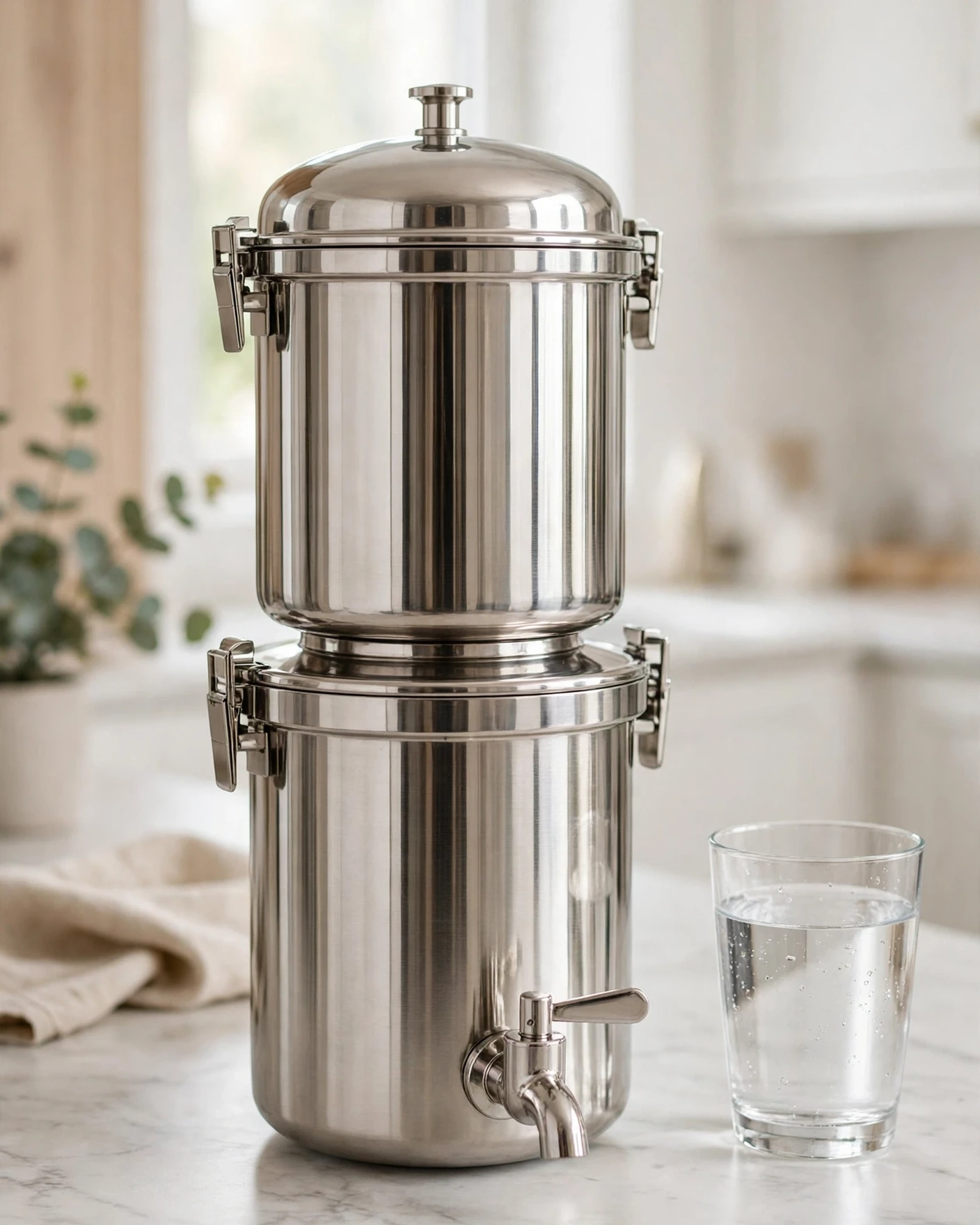
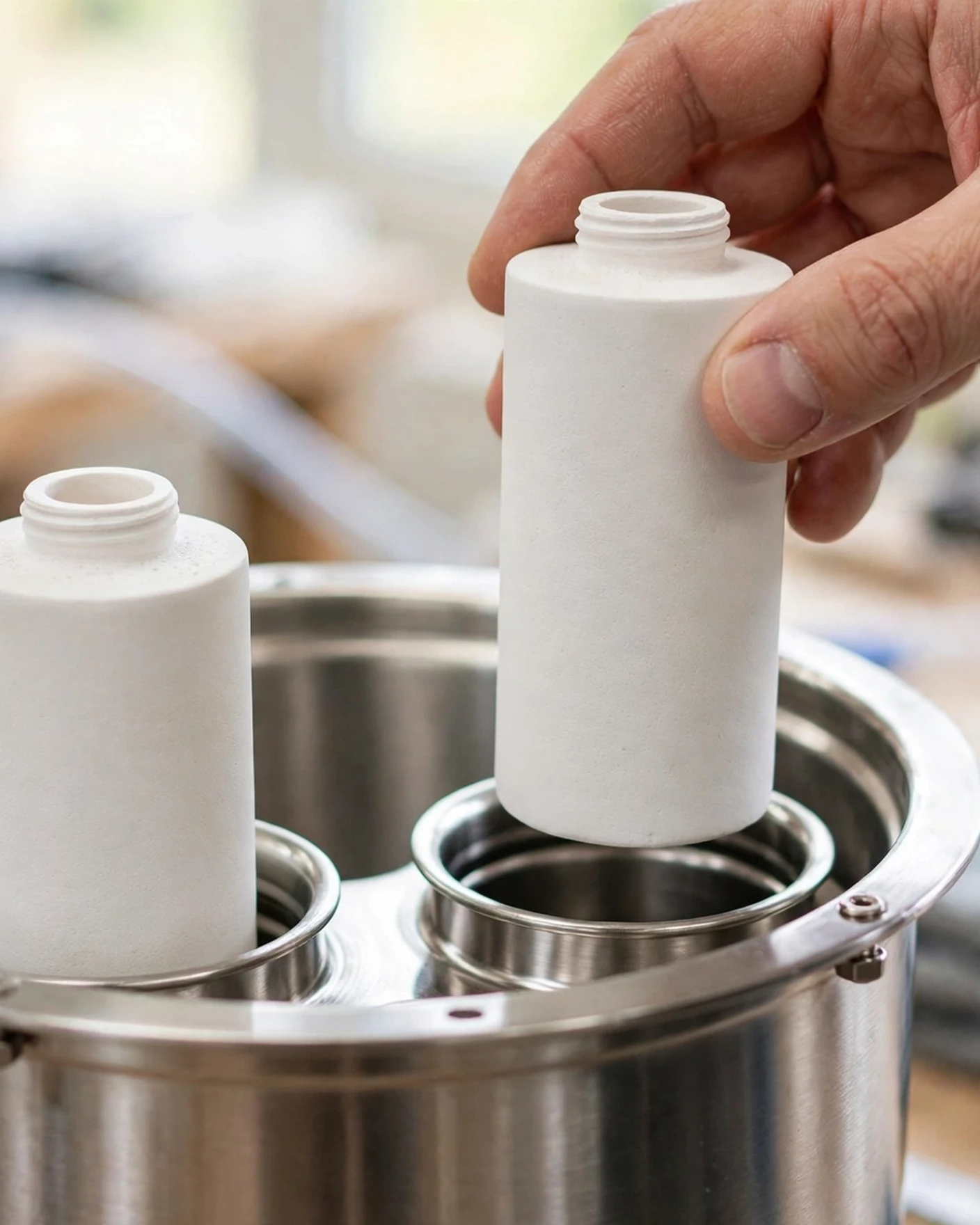
The system is two polished stainless steel chambers that stack: water goes in the top, filters through the ceramic candles, and collects below, ready at the spigot. Doulton lists three sizes — 6 liters, 8.5 liters, and 12 liters — with filtered-water capacities a little below the headline numbers (about 7.8 liters stored in the 8.5L model, about 11.5 liters in the 12L). The chambers nest inside each other for storage, which owners genuinely use for camping and small kitchens.
Daily life with it is simple but slow. There is no power, no plumbing, and almost nothing to break — but there is also no filter-life indicator, and the standard spigot is a basic plastic tap (a stainless upgrade and a water-level spigot are sold as extras). Refilling needs a little care: top up the upper chamber only when the lower chamber has room, or gravity will happily overflow your counter. Owners who want a different take on the same countertop footprint should look at our Boroux Legacy review — a stainless gravity system built around black carbon elements instead of ceramic candles.

Filter cost math
The urn is a one-time cost. The candles are the subscription, so run the numbers before the steel charms you:

| Item | British Berkefeld | Carbon-block gravity rival |
|---|---|---|
| System upfront (estimate) | ~$180–260 | ~$250–350 |
| Element rated life | ~400 gallons per candle (Doulton manual) | Varies widely by brand |
| Typical change cycle | About every 6 months | About every 6–12 months |
| Yearly running cost (estimate) | ~$90–180 | ~$60–150 |
The honest summary: the Berkefeld is cheaper to buy than the big carbon-block names, but its candles cycle faster, so the yearly cost lands in the same band — sometimes above it. Cleaning the ceramic extends real life between changes, which is the one lever owners have, and it is why the running-cost range above is wide. If lifetime cost is your deciding factor, our Boroux Legacy vs ProOne comparison shows how the two most-shopped alternatives price their elements per gallon — the same arithmetic applies here.
What owners complain about
The speed. This is the complaint, in bold. Independent reviewers measured roughly 0.27 gallons per hour with Ultra Sterasyl candles and 0.38 with Ultra Fluoride — the slowest results in their gravity-system testing. Filtering a full upper chamber takes hours, not minutes. Owners adapt by topping up little and often; buyers who expected pitcher-like speed feel misled.
Black particles at first. New candles shed carbon fines into the first filtered water. Doulton’s own manual tells you to discard the first batches and keep running water through until it clears. It is normal, documented, and still the most common “is mine broken?” post from new owners.
The basic spigot. The standard tap handle is fiddly, per both reviewers and owners, and the nicer stainless and sight-glass spigots cost extra. Budget for the upgrade if small daily annoyances grate on you.
No way to know when candles are done. There is no indicator. You judge by flow rate and the calendar — and because ceramic can be scrubbed back to life, owners disagree about when a candle is truly spent.
Who should buy it
Buy it if
- You want stated NSF/ANSI certifications on your gravity filter’s candles — a claim most rivals in this category simply do not make.
- You like cleanable ceramic — scrubbing a candle back to full flow instead of buying a new element.
- You want a mid-priced stainless system in 6L, 8.5L, or 12L, made by a company that has made filters for generations. The ProOne Big+ review covers the other certification-led option in this class, if you want the closest alternative checked the same way.
Skip it if
- You need fast water — at roughly 0.3 to 0.4 gallons per hour, this is the wrong tool for a thirsty household in a hurry.
- You want the longest possible filter cycle — six-month candle changes will feel constant next to long-life carbon systems; start with our ProOne vs Berkey comparison instead.
- You want fluoride coverage and everything else in one candle — the Berkefeld makes you choose a candle type, not combine them.
The specs
- Brand
- British Berkefeld (Doulton)
- System type
- Stainless steel gravity
- Sizes
- 6L / 8.5L / 12L
- Filter candles
- Ultra Sterasyl or Ultra Fluoride
- Candle rated capacity
- ~400 gallons (1,500 L) each
- Measured flow (independent)
- ~0.3–0.4 gal/hour
- Certifications
- NSF/ANSI 42, 53, 372 (brand-stated)
- Typical price (estimate)
- ~$180–260
FAQs
Is British Berkefeld the same as Berkey?
No. They are different companies with different filters. British Berkefeld is made by Doulton in the UK and uses ceramic filter candles. Berkey uses carbon block elements. The steel housings look similar, but the companies, the filters, and the certification stories are all different.
How long do British Berkefeld filters last?
Doulton’s manual rates each Ultra Sterasyl candle at about 1,500 liters (400 gallons). A pair treats about 3,000 liters. For most households that works out to roughly six months of use. When flow slows down, scrubbing the candle usually restores it — replace the candle when cleaning stops helping.
Does British Berkefeld remove fluoride?
Only with the Ultra Fluoride candles, not with Ultra Sterasyl. Doulton states the Ultra Fluoride element is made to reduce fluoride. The two candle types are never mixed in one setup — you choose one type for the whole system.
Is British Berkefeld NSF certified?
Doulton states its Ultra Sterasyl candles are certified to NSF/ANSI 42, 53, and 372, and retailer listings repeat those standards. We label them as the manufacturer’s stated certifications in this review, because a certification belongs to one exact candle model and listing. Check the current listing for the candle in your cart before you buy.
Why is British Berkefeld water so slow?
Ceramic is a very fine filter, and fine filters are slow. Independent reviewers measured roughly 0.3 to 0.4 gallons per hour — the slowest results in their gravity testing. Adding more candles speeds things up, and keeping the upper chamber full keeps the pressure steady.
Can you clean British Berkefeld ceramic candles?
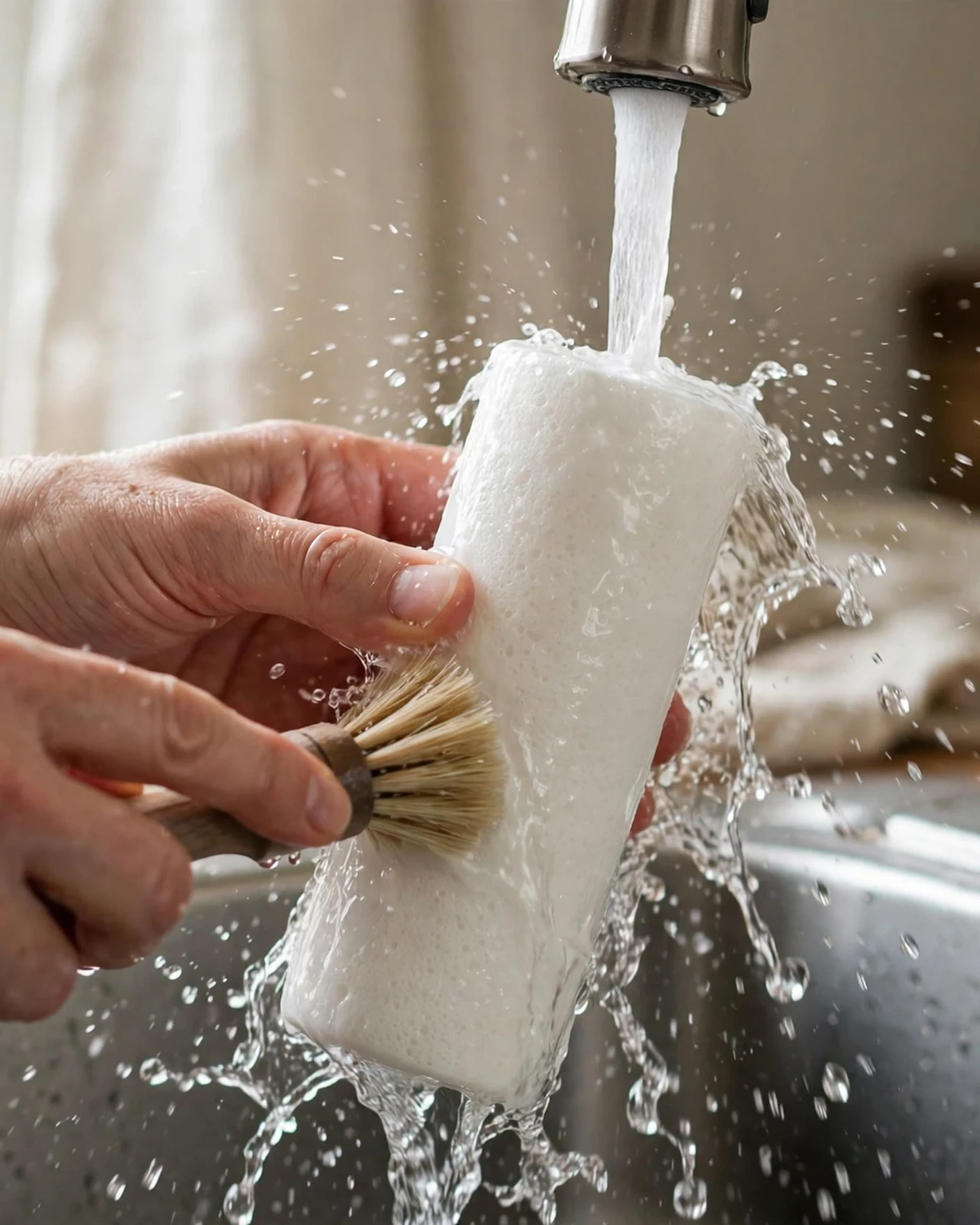
Yes. When the flow slows, gently scrub the outside of the candle under running water to remove the built-up layer. That restores flow and is normal care for ceramic candles. It is one of the main reasons owners choose ceramic over sealed carbon elements.
What sizes does British Berkefeld come in?
Doulton lists 6-liter, 8.5-liter, and 12-liter stainless steel systems. The 8.5-liter suits most small households. The 12-liter suits larger families, or anyone who hates refilling a gravity system twice a day.
Does British Berkefeld work without electricity?
Yes. It is a gravity system: no power, no plumbing, and no water pressure needed. Fill the top chamber and gravity does the rest. That is why owners also rely on it during power cuts and boil notices.
Conclusion
The British Berkefeld earns its place the old-fashioned way: a steel urn, cleanable ceramic candles, and certification claims its maker is willing to state out loud — in a category full of systems that state nothing. You pay for that honesty with speed, and with a six-month candle rhythm. If paperwork matters more to you than pace, this is the gravity filter to buy. If pace matters more, buy something else with your eyes open about what its paperwork does not say.
Price is an estimate at time of writing; it changes often — see the live price before you buy.
Update log
- Zulqarnain: Review published.