Aquagear Pitcher Review (2026): Is It Worth It?
★ PREMIUM PITCHER PICKYou want more from a pitcher than better taste. You have read about lead in older pipes, your city adds fluoride, and your basic pitcher feels too basic. AQUAGEAR promises exactly the upgrade you are picturing: a premium pitcher whose filter targets lead and fluoride and lasts 150 gallons — two to three times longer than a standard cartridge. But it costs two to three times as much as a BRITA, and its certification story has a catch most reviews skip. Is it worth it?
Here is the short answer. The filter life is real, owners like the water, and the brand publishes lab reports covering the hard contaminants. But the AQUAGEAR pitcher is not NSF certified. The brand pays an independent lab to check the filter against NSF/ANSI 42 and 53 methods, then markets the results — and no AQUAGEAR system appears in the public NSF, WQA, or IAPMO databases. Below: what that gap means, what it costs to run for a year, and what owners complain about.
Our scores
Table of Contents
How we researched: we did not receive a unit and we ran no lab bench work of our own. Instead, we researched and compared — the brand’s published specs and lab claims, the public NSF, WQA, and IAPMO certification databases, hundreds of owner reviews across retail listings, and current prices. Every claim below says where it came from, so you can check the reasoning yourself.
Bottom line
The bottom line: the AQUAGEAR pitcher is the right buy if you want the longest filter life in the pitcher category and brand-reported reduction of lead and fluoride, and you are comfortable trusting the brand’s own lab reports. It is the wrong buy if third-party certification is the whole point for you — on paper, this filter is checked against tough standards, but no certifier stands behind the numbers.
Verdict: a strong filter sold on trust instead of certification. Buy it for the filter life and the fluoride claim, with your eyes open about the paperwork.
Price checked at time of writing; it changes often — see the live price before you buy.

If certified paperwork matters more than filter life, the alternative sits one shelf down in price: our BRITA ELITE PITCHER review covers a filter whose lead claim is certified and listed in a public database.
Pros and cons
Pros
- Longest filter life in its class — 150 gallons per cartridge (brand-stated), roughly two changes a year instead of six.
- Targets the hard contaminants — the brand’s lab reports cover lead, fluoride, chlorine, chloramine, and chromium 6, a list most pitchers never attempt.
- Keeps your minerals — the brand designs the filter to leave calcium and magnesium in the water, so it does not taste flat.
- Lifetime guarantee — if the pitcher ever breaks, the brand says it replaces it free.
- Recyclable filters — spent cartridges go back with a postage-paid label instead of into the trash.
Cons
- Not certified — no AQUAGEAR listing in the NSF, WQA, or IAPMO databases; every number rests on brand-paid lab reports, and the brand does not name its lab.
- Premium price — roughly $85–110 for the pitcher and about $50 per replacement filter (estimates).
- Slow filtering — the most repeated owner complaint; flow varies from cartridge to cartridge.
- No filter-change indicator — you track the swap date yourself or run a spent filter.
- Small body for the money — 8 cups is modest next to 10-cup rivals at half the price.
Certifications (database-checked)
This section is the whole review, so read it carefully. AQUAGEAR’s marketing leans hard on the phrase “NSF/ANSI 42 and 53.” Two very different things hide behind that phrase:
- Certified to NSF/ANSI 42 & 53 means an accredited certifier (NSF, WQA, or IAPMO) checked the product, lists it in a public database, and keeps auditing it. You can look the listing up yourself.
- Checked against NSF/ANSI 42 & 53 methods means a lab ran the standard’s procedures on the product once and reported the results. Nobody lists it, nobody re-checks it, and the brand chooses what to publish.
AQUAGEAR is the second one. The brand states that an independent, ISO 17025-accredited lab checked its filter against NSF/ANSI 42 and 53 methods. That beats no lab work at all — but in October 2026 we searched the certified-product databases at info.nsf.org, WQA, and IAPMO, and no AQUAGEAR pitcher or cartridge appears in any of them, and the brand does not name its lab. So every figure below is a brand claim, labeled as such.

| Contaminant | Brand claim | Database status |
|---|---|---|
| Lead | Reduced, per brand lab reports using NSF/ANSI 53 methods | No listing found — NOT certified |
| Fluoride | About 90% reduction (brand-stated) | No listing found — NOT certified |
| Chlorine taste and odor | Reduced, per brand lab reports using NSF/ANSI 42 methods | No listing found — NOT certified |
| Chloramine, chromium 6, mercury | Reduced (brand-stated) | No listing found — NOT certified |
| PFOA / PFOS | Listed among the brand’s target contaminants; no certified figure published | No listing found — NOT certified |
Repeat the check yourself: search info.nsf.org’s certified drinking-water listings for the brand name. If a listing appears after this review, the picture changes. And note that several roundup sites call AQUAGEAR “NSF certified” — on the database evidence, that wording is wrong.
Design and usability
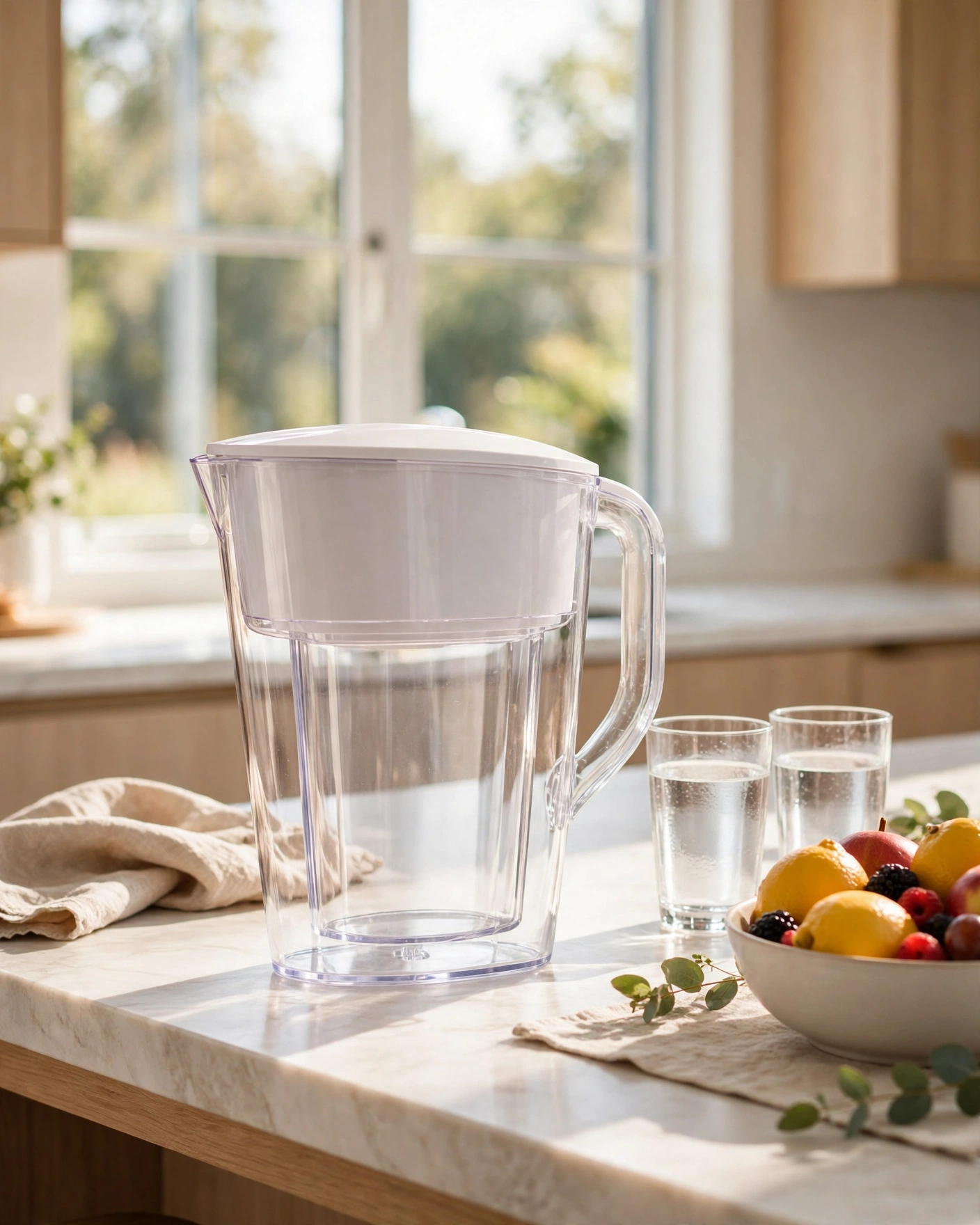
The pitcher is a simple pour-through design: a clear body, a white lid, and a top reservoir that holds a full half-gallon fill, so one trip to the tap fills the whole pitcher. Total capacity is about 8 cups (0.5 gallon) — smaller than the 10-cup bodies on most BRITA models. The clear body makes the water level easy to read, the plastic is BPA-free (brand-stated), and the brand says the filter media is made in the USA.
Day-to-day, three quirks show up in owner feedback. First, there is no filter-change indicator — with a 6-month cartridge, a calendar note is the only reminder you get. Second, the lid does not lock down hard; owners report steadying it with a thumb when pouring the final cups. Third, a full pitcher weighs a little over 5 pounds, which is manageable for most adults but noticeable for kids and anyone with grip trouble.

The specs
- Brand
- AQUAGEAR
- Pitcher capacity
- About 8 cups (0.5 gallon)
- Filter type
- 5-stage cartridge (brand-stated)
- Filter rated life
- 150 gallons / about 6 months (brand-stated)
- Certifications
- None listed — checked against NSF/ANSI 42 & 53 methods by the brand’s lab
- Filter-change indicator
- None
- Typical pitcher price
- ~$85–110 (estimate)
- Warranty
- Lifetime guarantee (brand-stated)
Filter cost math
Pitchers are a cartridge subscription, so run the year, not the box. AQUAGEAR flips the usual math: the most expensive filter in the category, changed the least often.

| Item | AQUAGEAR | BRITA ELITE | BRITA STANDARD |
|---|---|---|---|
| Pitcher (upfront) | ~$85–110 | ~$37–45 | ~$25–31 |
| Filter rated life | 150 gallons / ~6 months | 120 gallons / ~6 months | 40 gallons / ~2 months |
| Filters per year | ~2 | ~2 | ~6 |
| Replacement filter price (each) | ~$50 (~$40 on subscription) | Moderate | Low |
| Estimated yearly filter cost | ~$80–100 | Lower than AQUAGEAR | Lower per filter, more swaps |
| Filter cost per gallon | ~33 cents | Lower | Lower |
AQUAGEAR never wins on cost: two swaps a year at roughly $50 each (estimates) still lands around $80–100 a year, above a BRITA household’s bill. What the money buys is time — and a brand-stated fluoride target no BRITA cartridge claims. Still deciding between BRITA’s own two cartridges first? Our BRITA ELITE VS STANDARD FILTER breakdown runs that comparison in full.
What owners complain about
Slow, uneven flow. The number-one complaint by a wide margin: owners report waiting a long time for a full reservoir to filter, and say the pace varies from one cartridge to the next — a fresh filter can run noticeably slower than the one it replaced. Dense multi-stage media is the likely cause, and the pace drops further as the cartridge loads with sediment.

The price of staying in the system. Owners like the pitcher and still flinch at roughly $50 per replacement (estimate). There are no third-party cartridges for this body, so the brand’s price is the only price — the subscription discount (about $40 per filter, estimate) is the one lever owners use.
Weight and the lid. A full pitcher tops 5 pounds, and the lid’s loose fit means a thumb on top while pouring the final cups. Neither is a deal-breaker, but both come up often enough that small households and older owners should know before buying.
No reminder, forgotten filters. With no indicator and a 6-month cycle, owners admit to running cartridges months past their rated life. A phone reminder set at purchase fixes this for free.
None of these suggest a badly made product — just a dense, premium filter with premium running costs and a few ergonomic shortcuts.
Who should buy it
Buy it if
- Fluoride is your main concern and you accept a brand-stated claim — few pitchers even attempt fluoride, and AQUAGEAR’s lab reports put reduction at about 90%.
- You hate changing filters — two swaps a year is the fewest in the pitcher category.
- You want minerals left in — the brand designs the filter to keep calcium and magnesium, unlike zero-TDS pitchers.
- You value the lifetime guarantee and the filter-recycling program.
Skip it if
- Certification is non-negotiable — no database lists this filter. A certified rival is the honest pick; the ELITE above is the closest one.
- You are budget-first — the BRITA EVERYDAY PITCHER handles chlorine taste for a third of the upfront price.
- You want water as you pour, with no wait — the BRITA STREAM PITCHER filters on the way out instead of in a reservoir.
- You need family-size capacity — the BRITA GRAND PITCHER holds more per fill and costs far less.
FAQs
Is the AQUAGEAR pitcher NSF certified?
No. AQUAGEAR says an independent lab checked its filter against NSF/ANSI 42 and 53 methods, but that is not the same as certification. When we searched the public NSF, WQA, and IAPMO certification databases in October 2026, no AQUAGEAR pitcher system appeared in any of them. Treat every reduction number on the box as a brand claim backed by the brand’s own lab reports, not a certified result.
How long does an AQUAGEAR filter last?
The brand rates each filter at 150 gallons, which works out to about 6 months in a typical home. That is roughly two to three times the life of a standard pitcher filter. There is no change indicator on the pitcher, so mark the swap date on a calendar — an overdue cartridge quietly stops doing its job.
Does the AQUAGEAR pitcher reduce fluoride?
The brand’s lab reports show roughly 90% fluoride reduction, and fluoride is the main reason many buyers pick this pitcher. But because the filter carries no third-party certification, that figure stays a brand-stated claim — there is no database listing to confirm it. If fluoride is a must-have for you, weigh that gap before paying the premium.
Why does my AQUAGEAR filter so slowly?
Slow flow is the most common owner complaint. The cartridge packs dense, multi-stage media into a small body, and owners report that flow varies from filter to filter and slows further as the cartridge loads up with sediment. Priming a new filter exactly as the manual describes helps; if a fresh cartridge still crawls after priming, owners say customer support usually replaces it under the lifetime guarantee.
How much do AQUAGEAR replacement filters cost?
About $50 each at typical retail prices (estimate), or roughly $40 each on the brand’s subscription plan (estimate). At the rated 150-gallon life, most homes need about two filters a year, so budget around $80–$100 a year in cartridges — more per filter than BRITA, but fewer swaps.
Does AQUAGEAR strip out healthy minerals?
The brand says no: its filter is designed to leave calcium and magnesium in the water while targeting contaminants. That is a brand-stated design claim rather than a certified one, but it matches owner reports that the water tastes like normal mineral water rather than the flat taste of a zero-TDS pitcher.
Is the AQUAGEAR pitcher worth it over a BRITA?
It depends on what you are buying. AQUAGEAR gives you a much longer filter life and brand-reported fluoride and lead reduction, but no certification listing and a much higher price. The BRITA ELITE costs less, and its lead claim is certified and listed in a public database. Pick AQUAGEAR for filter life and fluoride; pick the certified option if paperwork matters more than promises.
Conclusion
The AQUAGEAR pitcher is easy to like as hardware: the longest filter life in the pitcher category, a simple clear body, a lifetime guarantee, and water owners consistently enjoy. Its certification story asks for trust it has not fully earned — lab work exists, but no certifier lists it and the lab goes unnamed. Buy it for the 150-gallon filter and the brand-stated fluoride reduction, and set that calendar reminder, because the pitcher will not remind you itself.
Price checked at time of writing; it changes often — see the live price before you buy.
Update log
- Zulqarnain: Review published.