
Do Brita Filters Remove Lead (2026): What the Evidence Says
Guide
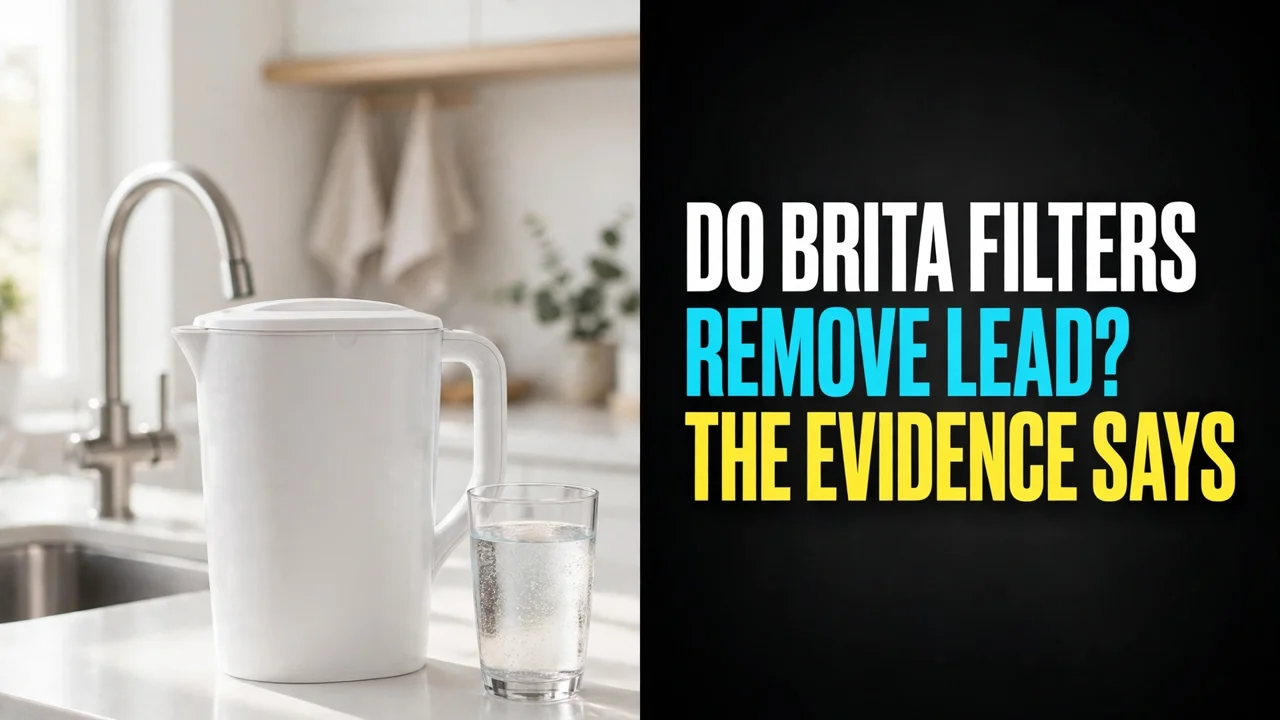
“Brita” is not one filter. The name sits on millions of pitchers, but the water inside yours passes through one of two very different cartridges — a standard white one or a dark blue premium one called Elite — and they are not certified to do the same jobs. So the honest answer to “does Brita remove lead?” splits in two, and picking the wrong half matters: lead is exactly the contaminant where guessing wrong has real consequences for a household with older plumbing.
The short answer: with the standard white cartridge, no — it is not certified for lead reduction. With the Elite cartridge, yes — Brita lists the Elite as certified to NSF/ANSI 42, 53 and 401, and the 53 listing is the one that covers lead. Everything below is how that certification works and how to check it yourself.
Table of Contents
Quick verdict
If your pitcher runs the standard cartridge and lead is why you bought it, the pitcher is doing less than you think — swap in an Elite cartridge (it fits the same pitchers) or move to a filter that is certified for lead at the system level. If your pitcher already runs Elite cartridges and you change them on schedule, you are using the one Brita cartridge whose listing covers lead. Either way, confirm your actual water first: lead comes from your home’s plumbing, not the treatment plant, so a lab test on your own tap beats any general answer — the same test-first logic behind our guide to whether pitchers remove PFAS.
One brand, two cartridges

The standard cartridge (the white one, sold everywhere in multipacks) is Brita’s taste-and-odor cartridge. Its certification is under NSF/ANSI 42 — the “aesthetic effects” standard — which covers chlorine taste and odor and similar quality complaints. Lead is not an aesthetic effect; it is a health contaminant, and health claims live under a different standard the standard cartridge does not carry. The Elite cartridge (dark blue, formerly sold as Longlast+) is the premium sibling: Brita lists it as certified to NSF/ANSI 42, 53 and 401. Standard 53 is the health-effects standard, and lead is one of the contaminants a 53 listing can cover — for the Elite, per Brita’s listing, it does. Both cartridges fit the same pitchers and dispensers; the difference is entirely in what the cartridge inside is certified to do, and in lifespan: Brita rates the standard cartridge at about 2 months (40 gallons) and the Elite at about 6 months (120 gallons).
What the certifications prove

Certification is the only language that settles this question, because it is testable: an accredited lab runs the cartridge against the standard’s protocol — challenge water dosed with the contaminant at a set concentration, a set flow, for the cartridge’s full rated life — and the listing stands only if the output stays under the standard’s limit. You can verify any of it yourself in the public NSF listings database (info.nsf.org) by searching the manufacturer and model; if a cartridge’s listing shows only Standard 42, no lead claim exists, whatever the box art implies. The practical comparison:
| Cartridge | Standards listed | Lead? | Rated life |
|---|---|---|---|
| Standard (white) | NSF/ANSI 42 — aesthetic (chlorine taste & odor) | Not listed | ~2 months / 40 gal |
| Elite (dark blue) | NSF/ANSI 42, 53, 401 — per Brita’s listing | Yes — under the 53 listing | ~6 months / 120 gal |
Two habits protect the claim once you have the right cartridge. First, treat the rated life as a hard limit: a 53 listing holds for the cartridge’s certified capacity, and an exhausted cartridge run for month nine is no longer the product the lab tested. Second, ignore front-of-box language like “reduces impurities” — the listing, not the adjective, is the evidence. The same check-before-you-trust approach applies to Brita’s other cartridges and claims, including the fluoride question covered in does Brita remove fluoride.
What the science says

Lead in tap water is almost always a plumbing story: it leaches from lead service lines, pre-1986 lead solder, and older brass fixtures, and it leaches most into water that has sat still in the pipes for hours. That is why the EPA’s reference point — an action level of 15 micrograms per liter for water systems, tightening to 10 under the 2024 rule updates — is measured at the tap, and why two houses on the same street can have completely different numbers. Carbon cartridges reduce dissolved lead by adsorption and ion exchange, which is real chemistry — but capacity is finite, flow through a pitcher is fast, and performance falls off as the cartridge ages, which is precisely why the certification protocol tests across the full rated life instead of a fresh cartridge’s first gallon. Two myths deserve direct answers. Boiling does not remove lead — the CDC and EPA are explicit that boiling concentrates it as water evaporates. And a clear, good-tasting glass proves nothing: lead is tasteless and invisible at the levels that matter, so the only honest sequence is test, then filter with a certified cartridge, then maintain it.
Better options if lead is the concern
Steps that genuinely address lead
- Keep the pitcher, upgrade the cartridge: Elite is the in-brand fix and fits the pitchers most households already own.
- Choose any replacement filter by its NSF/ANSI 53 lead listing for that exact model — the roundup of the best water filter pitchers tracks which ones carry it.
- Flush the tap for 30 seconds to 2 minutes after water has sat for hours, and use cold water for drinking and cooking — hot water leaches more lead.
- For a confirmed high result, step up a category: an under-sink or countertop reverse osmosis system certified under NSF/ANSI 58 removes lead as part of a much broader barrier.
What does not solve it
- Running the standard white cartridge and assuming “filtered” means “lead-free” — its listing never made that claim.
- Stretching any cartridge past its rated life to save money; the certification expires with the capacity.
- Boiling the water — it concentrates lead rather than removing it.
- Judging by taste or clarity, neither of which changes at lead levels of concern.
Well owners face the same certification logic with different source risks; our pitcher guide for well water covers how the priorities shift when the water is untreated to begin with.
Conclusion
Do Brita filters remove lead? The brand-level question has a cartridge-level answer: the standard white cartridge is a taste-and-odor filter with no lead listing, while the Elite cartridge is listed by Brita under NSF/ANSI 53 — the standard that covers lead. Match the cartridge to the concern, respect its rated life, and let a lab test of your own tap make the final call. That is the whole of the evidence, and it fits on the cartridge box — you just have to read the listing, not the logo.
Update log
October 2026: Article published. Certification statements reflect the manufacturers’ published NSF/ANSI listings as of this date; verify current listings at info.nsf.org before purchase, as certifications change.
FAQs
Does the standard Brita cartridge remove any lead at all?
It may incidentally catch some — carbon media does interact with lead — but it is not certified for lead reduction, which means no accredited lab has verified a number you can rely on across the cartridge’s life. For a health contaminant, “probably some” is not a standard worth drinking to; use the cartridge whose listing covers lead.
How do I check a filter’s lead certification myself?
Search the NSF listings database (info.nsf.org) or the IAPMO/WQA directories for the exact cartridge model, and look for NSF/ANSI 53 with “lead” among the listed claims. Check the model, not the brand: certification attaches to a specific cartridge, and brands sell both certified and uncertified cartridges under the same logo — Brita included.
Does the Elite cartridge fit my existing Brita pitcher?
Yes — Elite cartridges are made for the same Brita pitchers and dispensers that take the standard cartridge; Brita lists the fit as interchangeable across its current pitcher line. The swap is the cheapest lead upgrade available to most Brita owners, since no new hardware is involved.
What lead level is considered a problem?
The EPA’s action level for public water systems is 15 micrograms per liter (parts per billion), scheduled to tighten to 10 under the 2024 Lead and Copper Rule Improvements, and the EPA’s health-based goal for lead in drinking water is zero — lead is treated as a no-safe-threshold contaminant, especially for children. Any confirmed elevated result at your own tap is worth acting on.
If I boil water, does that remove the lead?
No — the opposite. Boiling kills microbes but leaves lead behind, and as water evaporates the lead concentration in what remains actually rises. The CDC and EPA both state this plainly. Boiling is a bacteria answer, never a lead answer.
Is reverse osmosis better than a pitcher for lead?
For confirmed lead, yes: an RO system certified under NSF/ANSI 58 puts a membrane barrier between you and the water that reduces lead along with a far wider range of contaminants than any gravity pitcher cartridge. The pitcher-with-Elite route is a reasonable, certified first step; RO is the step up when test results or peace of mind demand more.