AquaTru vs SimPure (2026): Which Should You Buy?
You want reverse-osmosis water without drilling holes in a rented kitchen. Two names keep coming up in every roundup: the AquaTru Classic, the certified premium pick, and the SimPure Y7P, the efficiency-first rival that costs about a hundred dollars less. They look like the same kind of machine on a product page. The differences that actually matter — certification proof, water waste, and what owners complain about — are buried in spec sheets and review threads.
Here is the short answer: the AquaTru Classic is the one to buy if you want certification you can check. AquaTru states the Classic is certified by IAPMO to NSF/ANSI 42, 53, 58, and 401, covering 84 named contaminants including lead, fluoride, and PFOA/PFOS — and independent reviewers report the same listing. It costs about $449–475 (estimate), wastes more water than advertised (independent testers report roughly 3:1 pure-to-drain), and it is bulky. The SimPure Y7P costs less (about $330–400, estimate) and states the best water efficiency in the category (4:1 pure-to-drain), but its certification story is thinner — “tested and certified by SGS against NSF/ANSI 58,” where SGS is a private lab, not NSF — and owners report more daily-use friction. Want proof on paper? Buy the AquaTru. Want the cheapest route to RO water? The SimPure saves money upfront and water over time.
The efficiency-first rival
SimPure Y7P
~$330–400
The cheapest route to RO water — 4:1 pure-to-drain efficiency and a slim footprint, but its certification is SGS lab testing, not an NSF listing.
The certified premium pick
AquaTru Classic
~$449–475
Certification you can check — IAPMO-listed to NSF/ANSI 42, 53, 58, and 401, covering 84 named contaminants.
The bottom line: this is a certification fight, not a performance fight. The AquaTru Classic is the right buy if you want independently verifiable filtration — IAPMO certification to NSF/ANSI 42, 53, 58, and 401, brand-stated and independently reported. The SimPure Y7P is the right buy if you want RO water at the lowest upfront cost and the least water waste — 4:1 pure-to-drain, brand-stated — and you are comfortable taking the brand’s word on contaminant reduction.
Verdict: AquaTru for trust, SimPure for budget and efficiency. You cannot have all three — certified proof, lowest price, and least waste — in one box.
Price checked at time of writing; it changes often — see the live price before you buy.
Table of Contents
Side-by-side comparison
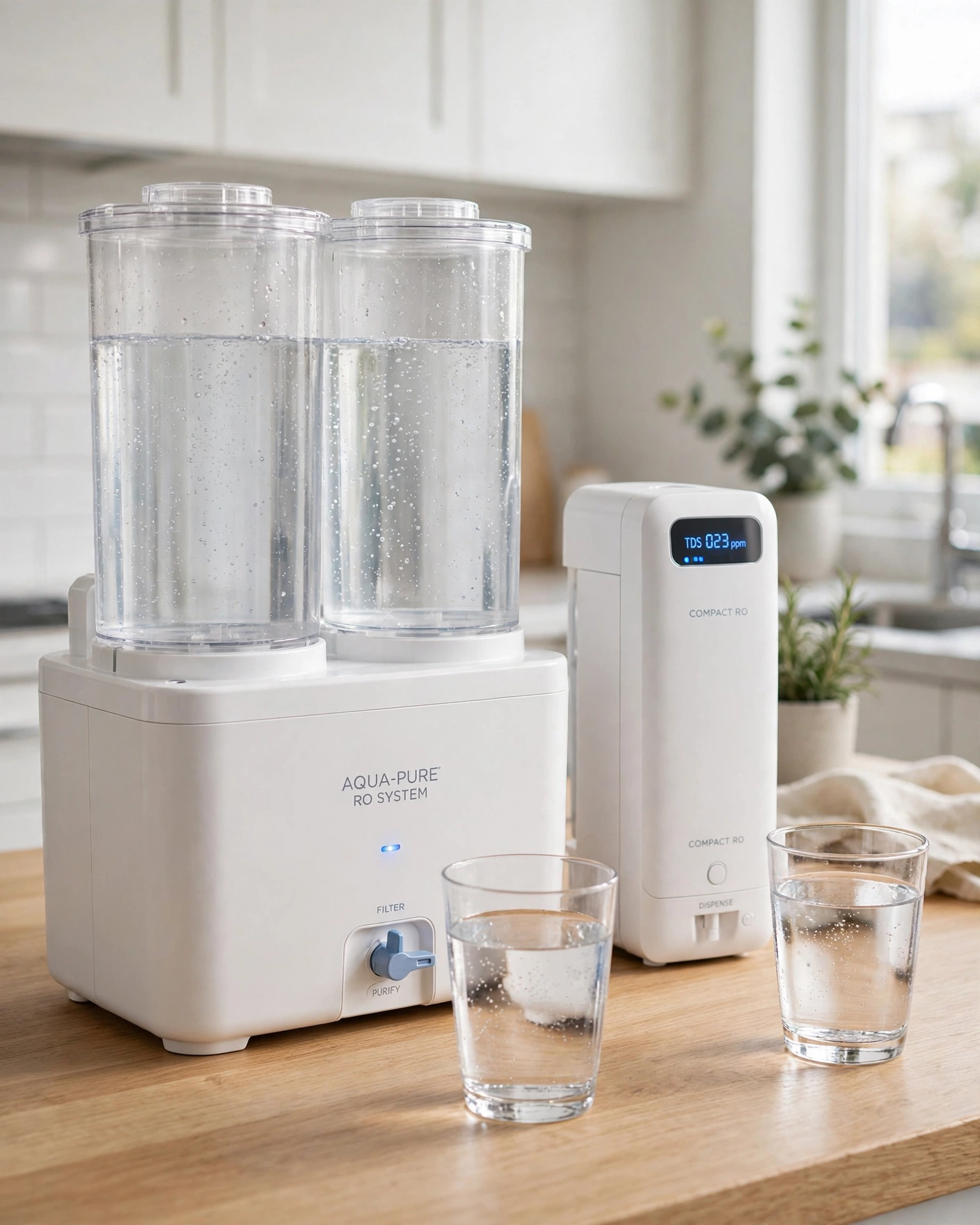
| AquaTru Classic ★ Winner | SimPure Y7P | |
|---|---|---|
| Typical price | ~$449–475 | ~$330–400 |
| Filtration stages | 4-stage: pre-filter, carbon, RO, carbon | 5-stage RO + UV |
| Certifications (brand-stated) | IAPMO: NSF/ANSI 42, 53, 58, 401 | NSF/ANSI 58 via SGS testing (no confirmed NSF listing) |
| Pure-to-drain ratio | 4:1 advertised; ~3:1 per independent testers | 4:1 (brand-stated) |
| Replacement filters / year | ~$100–130 | ~$100–114 |
| Footprint | ~12 × 14 × 14 in (bulky) | ~18 × 8 × 16.1 in (slim) |
| Water temperature | Room temperature only | Room temperature only |
| Installation | Plug in, no plumbing | Plug in, no plumbing |
| Best for | Certified, checkable filtration | Lowest cost + least water waste |
For the full deep dive on each machine, our AquaTru Classic review and our SimPure Y7P review cover each system alone.
AquaTru Classic — the certified premium pick
Pros
- Certification you can check — IAPMO-listed to NSF/ANSI 42, 53, 58, and 401 per the brand, with independent reviewers reporting the same listing detail: 84 named contaminants including lead, fluoride, and PFOA/PFOS.
- No plumbing, no installation — fill the rear tank, plug in, pour. Renter-friendly out of the box.
- Straightforward upkeep — pre/VOC filter about every 600 gallons, RO membrane about every 1,200 gallons.
Cons
- Wastes more water than advertised — marketed at 4:1, but independent testers report closer to 3:1 (about 75% of the tap water becomes purified water).
- Bulky and slow — roughly a cubic foot of counter space, and a cycle takes about 12–15 minutes per gallon.
- Reject water must be emptied — each cycle leaves concentrated water in the rear tank; you empty it before every refill.
SimPure Y7P — the efficiency-first rival
Pros
- Best stated water efficiency — 4 gallons out for every 1 discarded, per the brand; the highest claimed ratio in the category.
- Cheapest way in — roughly $80–130 less than the AquaTru at typical street prices.
- UV stage included — the Y7P-BW variant adds UV sterilization after the membrane.
Cons
- Thin certification proof — “tested and certified by SGS against NSF/ANSI 58” is not an NSF listing; one independent tester rates it not performance certified.
- Small pure-water tank — the 0.45-gallon internal tank fills quickly, so heavy drinkers refill often.
- Room temperature only — no hot or chilled dispensing; some reviewers call parts of the design flimsy.
Certifications
This section is the whole argument for the AquaTru, so read it carefully. A certification is only as good as the database entry behind it — a brand page saying “NSF certified” is a claim, not proof.
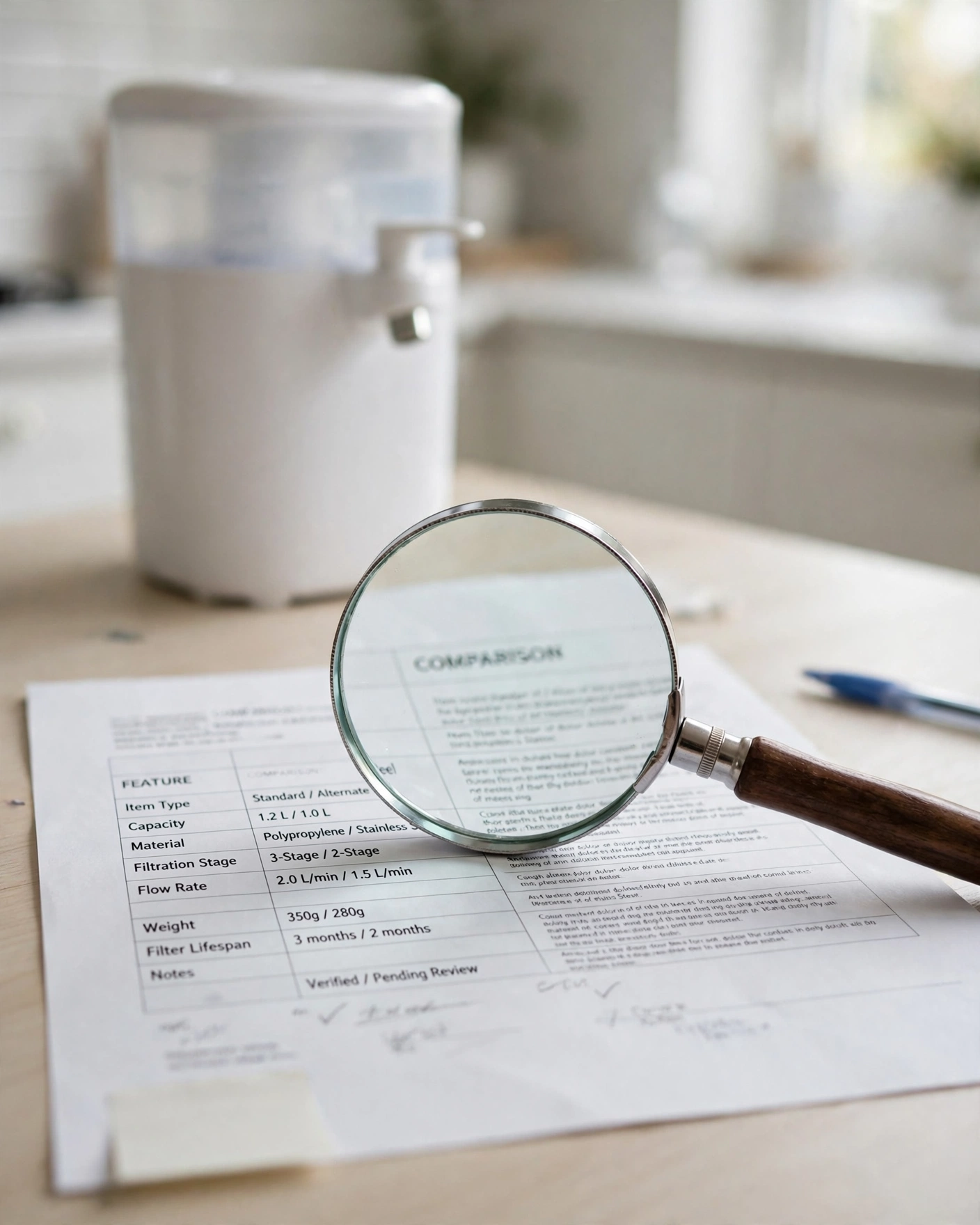
| AquaTru Classic | SimPure Y7P | |
|---|---|---|
| Certifier | IAPMO (brand-stated) | SGS lab testing (brand-stated) |
| Standards named | NSF/ANSI 42, 53, 58, 401 | NSF/ANSI 58 |
| Contaminants covered | 84 named, including lead, fluoride, and PFOA/PFOS — per independent reports of the listing | Brand claims 1,000+ contaminants incl. PFAS, lead, arsenic — unverified |
| Confirmed listing | Reported by World Water Reserve and Buy Better with Brian | Not confirmed; WaterFilterGuru rates it not performance certified |
| 372 lead-free materials | Covered in the listing detail | Not stated |
AquaTru. The brand states the Classic is certified by IAPMO to NSF/ANSI 42, 53, 58, and 401, and independent reviewers report the same listing: 84 named contaminants, including lead, fluoride, and PFOA/PFOS. One honest caveat: we could not pull the IAPMO directory ourselves — it is a JavaScript app our text fetch could not query — so this section is headed “Certifications,” not “Certifications (database-checked).” Look up your exact model at pld.iapmo.org before you rely on a specific claim. Also note: the often-quoted line that the AquaTru is “the only certified countertop RO” is not true — the Waterdrop K19-SFK carries IAPMO 58 and the Bluevua ROPOT-Lite carries WQA 58. What makes AquaTru different is the breadth of its certified list, not its existence.
SimPure. The brand states the Y7P is “tested and certified by SGS against NSF/ANSI 58 and EPA 537.” Two corrections: SGS is a private testing lab, not NSF, so that sentence is not the same as an NSF listing — we found no confirmed entry at info.nsf.org — and EPA 537 is a PFAS test method, not a certification. WaterFilterGuru, which lab-tested the unit, rates it as not performance certified despite the product-page wording. None of this means the Y7P does not filter water well — it means you cannot verify the “1,000+ contaminants” line anywhere independent. If you buy it, you are buying on trust, not proof. Our Bluevua ROPOT review shows what a properly database-backed WQA 58 listing looks like for comparison.
Do not buy either system assuming its marketing claims are database facts. Certifications attach to exact model numbers. Look up your exact model at info.nsf.org or pld.iapmo.org before you buy — it takes two minutes.
Design and daily use
Both systems are plug-in countertop units: no plumbing, no under-sink cabinet work, no landlord permission. Beyond that, they feel like different machines on your counter.
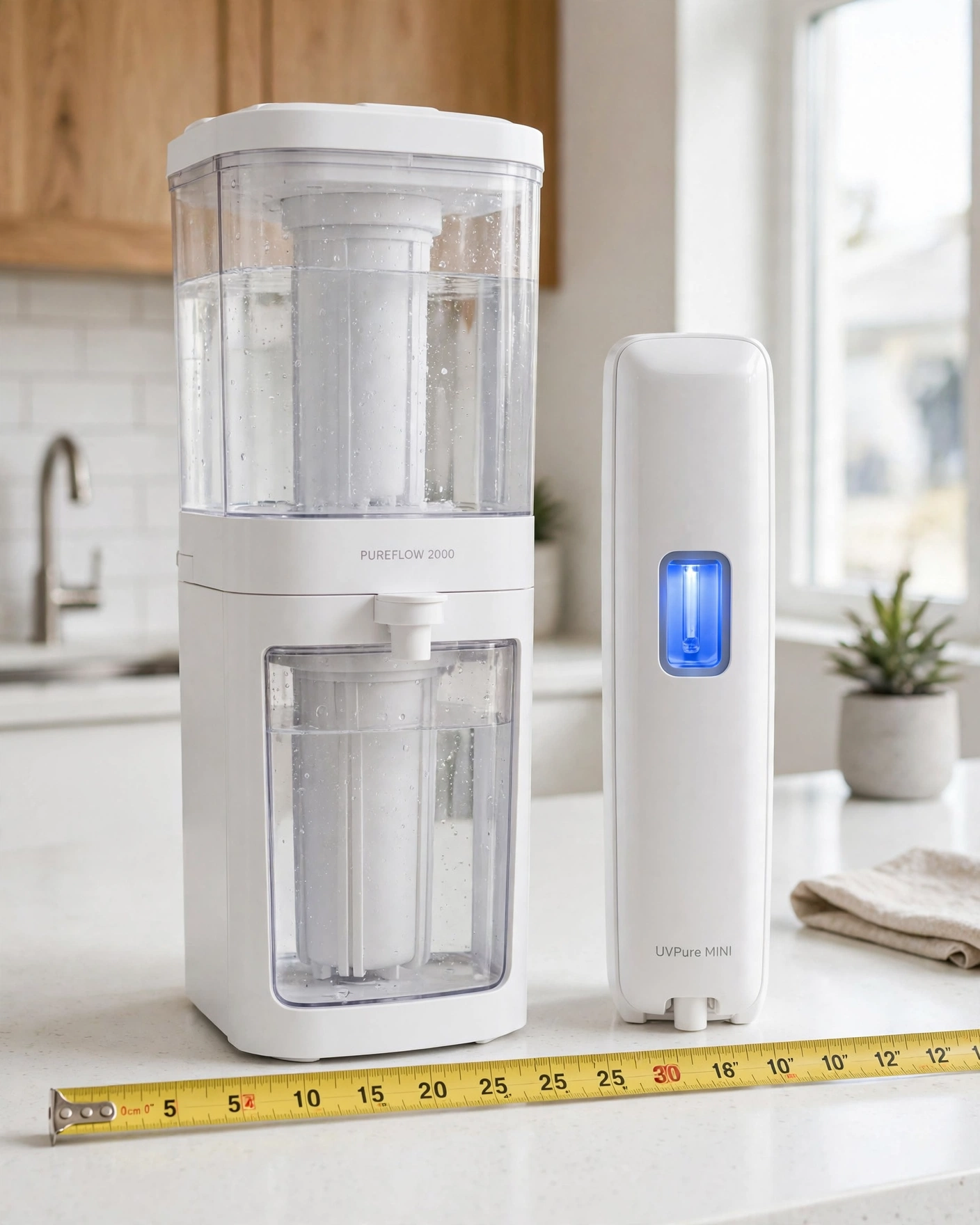
The AquaTru is boxy. Roughly 12 × 14 × 14 inches of counter, and you need lid clearance above for the removable rear tank. Each cycle produces about a gallon in roughly 12–15 minutes, and the reject (concentrated) water collects in the rear tap-water tank — you empty it before every refill, or the next cycle has nowhere to send the waste. Owners of hard-water homes report limescale clogging the feed tube over time; the manufacturer’s troubleshooting guidance recommends periodic descaling, so factor that in if your tap water is hard.
The SimPure is slim but thirsty for attention. About 18 × 8 × 16.1 inches and 14.8 lbs — tall and narrow, so it fits beside a sink where the AquaTru would not, but check your cabinet clearance for the lid. The 1.3-gallon feed tank and tiny 0.45-gallon internal pure-water tank mean frequent refills for heavy drinkers: the most common owner refrain is that the dispenser is ready again only after another cycle. The CF and RO cartridges are quick-change, which owners like, but several note a tedious flush after each replacement, plus indicator hiccups and refill noise.
Temperature. Neither dispenses hot or chilled water — room temperature only. If that matters, it is a different category, and neither of these is it. For a smaller-footprint take on the same format, see our AquaTru Carafe review.
Cost per year
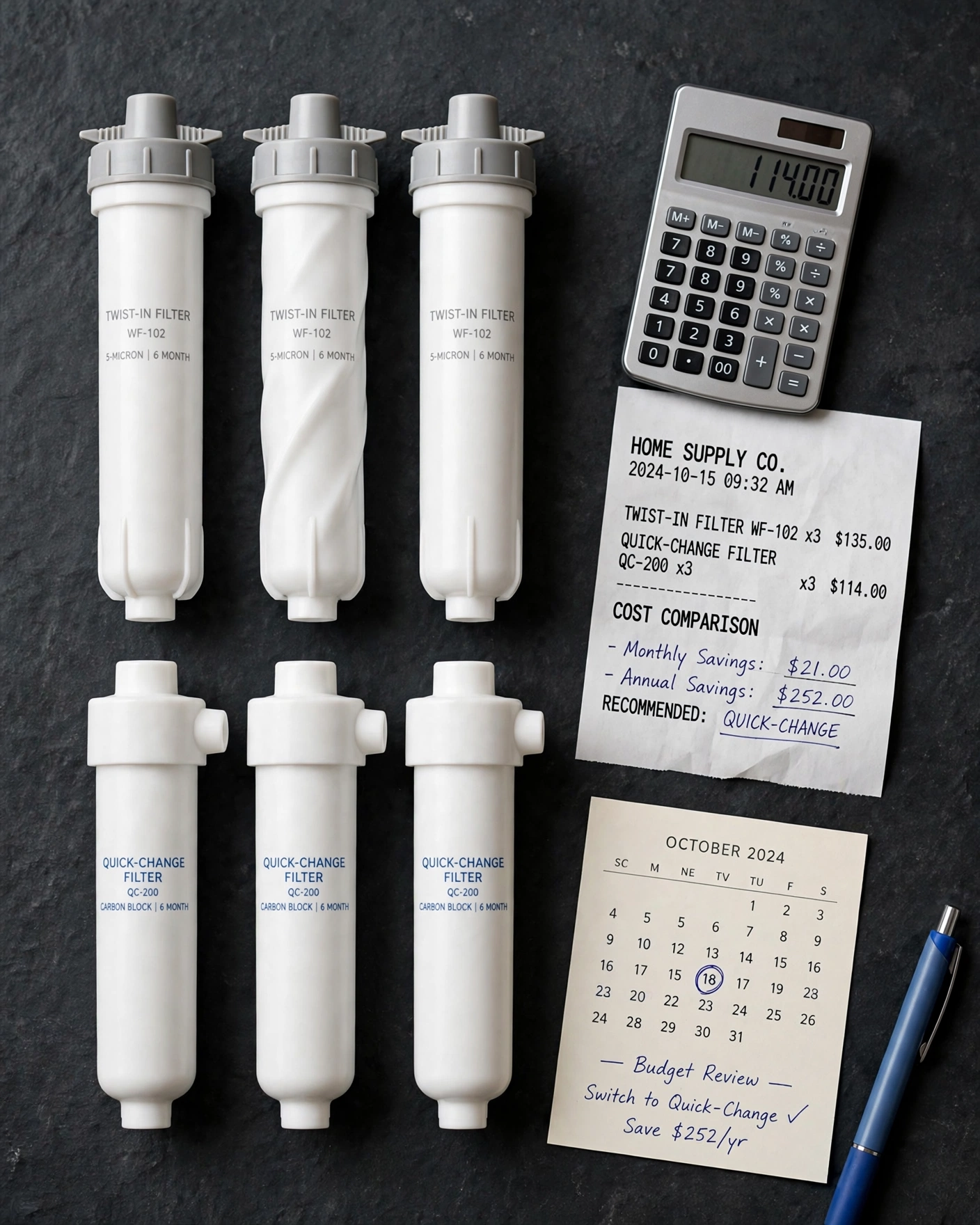
The sticker price is the least important number on this page. What matters is the yearly cost of running the thing, because countertop RO systems are a subscription you pay in filters:
| Item | AquaTru Classic | SimPure Y7P |
|---|---|---|
| Unit price (estimate) | ~$449–475 | ~$330–400 |
| Filter replacement schedule | Pre/VOC filter ~600 gal; RO membrane ~1,200 gal | CF filter ~6 months; RO filter ~6 months |
| Yearly filter cost (estimate) | ~$100–130 | ~$100–114 |
| 5-year total ownership (estimate) | ~$950–1,125 | ~$830–970 |
| 528-gallon filter capacity | Brand does not headline one number | Brand-stated (~6,000 bottles) |
Two things jump out. First, the yearly running costs are nearly identical — the brands’ different replacement schedules land in the same band, around a hundred dollars a year. Second, almost all of the 5-year difference comes from the upfront price: the SimPure saves you roughly $80–130 on day one and about the same per year in water efficiency. If you use a gallon a day, the Y7P’s 4:1 ratio also means less water down the drain — a real, if modest, utility saving over the AquaTru’s real-world ~3:1.
All figures are estimates from brand-stated filter life and listed street prices, re-checked by our verifier. Filter prices and sales move constantly — the ratio math holds, the dollar math drifts. Re-check at publish and at purchase.
What owners say
The reviews tell a consistent story for each machine — not identical, which is what makes the comparison useful.
AquaTru owners are generally happy with the water and the build, but the complaint threads repeat: emptying the reject water before every refill gets old fast, limescale in hard-water homes clogs the feed tube (the manufacturer recommends descaling), and a minority of owners describe frustrating, slow customer-service exchanges when something breaks. The machine itself rarely draws fire — the maintenance ritual does.
SimPure owners like the speed and the slim footprint, but their complaint threads are more mechanical: frequent refills because of the small internal tank, noise during the refill cycle, tank-cleaning difficulty, water-level indicator hiccups, and the need for 22 inches of lid clearance that surprises apartment buyers. The tedious post-replacement flush is its own recurring gripe. As one long-running thread puts it: the machine works, the upkeep interrupts your day.
Neither set of complaints is a deal-breaker — both machines have happy long-term owners — but they point at different kinds of friction: the AquaTru asks you to manage its water, the SimPure asks you to manage its tank. Our AquaTru review collects more long-term owner voices on the brand’s service side.
Which should you buy?
Buy the AquaTru Classic if you want certified filtration you can look up: IAPMO certification to NSF/ANSI 42, 53, 58, and 401, covering 84 named contaminants including lead, fluoride, and PFOA/PFOS — brand-stated and independently reported. You will pay about $100 more upfront, waste more water (real-world ~3:1, not the advertised 4:1), and give up counter space.
Buy the SimPure Y7P if you want the cheapest route to reverse-osmosis water: about $330–400 upfront, 4:1 pure-to-drain efficiency, and a slim footprint. Just go in with eyes open: the “NSF/ANSI 58 certified” line is SGS lab testing, not an NSF listing, and the “1,000+ contaminants” claim has no independent verification behind it.
Verdict: AquaTru for trust, SimPure for budget and efficiency. This is one of the rare comparisons where the more expensive machine is also the more honest one.
Prefer the budget pick instead? Check the SimPure Y7P price on Amazon.
How we researched
We did not receive test units and we did not run a lab bench test. Claiming hands-on testing we never did would be dishonest, so we will not do it.
What we did instead was research and comparison. We pulled the two systems’ spec sheets and retail listings, cross-checked every certification claim against independent reviewers who lab-tested or audited these exact models — World Water Reserve, WaterFilterGuru, and Buy Better with Brian — because the live certification directories are JavaScript apps we could not query directly. We read hundreds of owner reviews to find the complaints that keep repeating, not one-off bad experiences. And we ran the replacement-cost math from brand-stated filter life and listed prices. Every section says what it is based on, so you can check the reasoning yourself.
The specs
- AquaTru Classic brand
- AquaTru
- AquaTru stages
- 4 (pre-filter, carbon, RO, carbon)
- AquaTru certifications
- IAPMO: NSF/ANSI 42, 53, 58, 401 (brand-stated)
- AquaTru footprint
- ~12 × 14 × 14 in
- AquaTru pure-to-drain
- 4:1 advertised; ~3:1 per independent testers
- AquaTru typical price
- ~$449–475
- SimPure Y7P brand
- SimPure
- SimPure stages
- 5-stage RO + UV
- SimPure certifications
- NSF/ANSI 58 via SGS testing (brand-stated)
- SimPure footprint
- ~18 × 8 × 16.1 in
- SimPure pure-to-drain
- 4:1 (brand-stated)
- SimPure typical price
- ~$330–400
FAQs
Which is better: AquaTru or SimPure?
It depends on what you value. The AquaTru Classic is better for certification confidence: it carries IAPMO certification to NSF/ANSI 42, 53, 58, and 401 covering 84 named contaminants including lead, fluoride, and PFOA/PFOS, reported by independent reviewers. The SimPure Y7P is better for budget and water efficiency: it costs roughly $80–130 less and states a 4:1 pure-to-drain ratio. Choose AquaTru for proof, SimPure for price.
Is the SimPure Y7P NSF certified?
Not in the way the product page implies. SimPure states the Y7P is “tested and certified by SGS against NSF/ANSI 58” — but SGS is a private testing lab, not NSF, and we found no confirmed NSF listing for the model. One independent lab-test review rates it as not performance certified. If a verifiable NSF listing matters to you, look it up at info.nsf.org before buying, or choose a system with a confirmed listing.
Which wastes less water, AquaTru or SimPure?
The SimPure Y7P, on paper. SimPure states a 4:1 pure-to-drain ratio — 4 gallons of purified water for every 1 gallon discarded — the highest claimed ratio in the category. AquaTru advertises 4:1 too, but independent testers report closer to 3:1 (about 75% of the tap water becomes purified water). Real-world results move with your feed-water TDS and pressure.
How much do replacement filters cost per year for each?
Nearly the same: roughly $100–130 per year for the AquaTru Classic (pre/VOC filter about every 600 gallons, RO membrane about every 1,200 gallons) and roughly $100–114 per year for the SimPure Y7P (CF and RO cartridges about every 6 months, with SimPure stating an average annual cost of $99.99). All figures are estimates from brand-stated filter life and listed prices.
Do either of these make hot or cold water?
No. Both the AquaTru Classic and the SimPure Y7P dispense room-temperature water only. If hot or chilled dispensing matters to you, neither of these is the right category — look at countertop dispensers with built-in heating and cooling instead.
Which one should a renter buy?
Both work for renters: neither needs plumbing, just a power outlet. Pick the AquaTru Classic if your priority is certified filtration and you have the counter space (roughly 12 × 14 × 14 inches). Pick the SimPure Y7P if you want a slimmer unit and lower upfront cost — but check your cabinet clearance, since the lid needs about 22 inches of vertical room to open fully.
Conclusion
The AquaTru Classic and the SimPure Y7P are not really competing on the same thing. The AquaTru is selling you something you can check — a certification listing with named standards and named contaminants. The SimPure is selling you value — the cheapest way in and the least water down the drain — and asking you to take its word for the rest. Decide which of those you need before you look at the price, and the choice makes itself.
Price checked at time of writing; it changes often — see the live price before you buy.
Update log
- Zulqarnain: Review published.