
RPWFE Replacement (2026): Fit, Reset & Cost Guide
Guide
The dispenser on your GE fridge has slowed to a trickle — or a red “Replace Water Filter” light just came on and refuses to go away — and the part number on the old cartridge says RPWFE. The store shelf shows cartridges that look identical but cost half as much, and one listing warns the wrong filter can shut the dispenser down entirely. What actually makes the RPWFE special, and do you really have to pay for the genuine one?
Here is the short answer: the RPWFE is GE’s RFID-chip refrigerator filter — the direct successor to the older RPWF, and the “E” in the name is there for that embedded chip. It is a drop-in replacement for any GE fridge that lists the RPWF, but the chip-less RPWF will not work in a fridge that calls for the RPWFE. Genuine cartridges typically run about $55–75 each (estimates), with a manufacturer-rated life of 6 months or 170 gallons. The swap takes a few minutes with no tools — push-in, not twist — and with a genuine cartridge the indicator light resets itself. This guide covers which fridges it fits, genuine versus compatible, the exact reset steps, and the real yearly math.
Check Current PriceTable of Contents
Which GE fridges use the RPWFE

The RPWFE is an internal filter: it lives inside the fresh-food compartment, usually in the upper-right corner (on some models the upper-left or the left door), and feeds both the dispenser and the ice maker. If your GE fridge has an external filter on the back wall or behind the bottom grille instead, you need a different part number entirely.
The key relationship to get right is the one between RPWF and RPWFE, because the names differ by one letter and the compatibility is one-directional. The RPWFE is the successor to the RPWF, introduced around 2017 for newer GE French-door and side-by-side refrigerators (spanning GE, GE Profile, Café, and Monogram). The “E” stands for the embedded RFID chip: the newer cartridge carries the chip, the older RPWF does not. The RPWFE is backward compatible — it works in any fridge that lists the older RPWF — but the reverse is not true. Fridges built to expect the RPWFE will not accept the chip-less RPWF, because the fridge reads the chip to verify the cartridge, monitor filter life, and detect leaks.
- Brand
- GE Appliances
- Filter model
- RPWFE
- Type
- Internal refrigerator filter, push-in
- Rated life
- 6 months / 170 gallons (brand-stated)
- Certifications
- NSF/ANSI 42 & 53 (brand-stated per GE — not database-verified)
- Replaces
- RPWF (backward compatible; RPWF is NOT forward compatible)
- Typical genuine price
- ~$55–75 (estimate)
The fastest check is always the label on your old cartridge or the rating plate inside the fridge: if it says RPWFE or RPWF, this is your filter. If your fridge manual names the RPWF, you can order the newer RPWFE with confidence — that upgrade path is the one direction that always works. Samsung owners do the same model-number lookup in our Samsung DA29-00020B replacement guide, and LG owners in our LG LT1000P replacement guide — same process, different part number.
Genuine vs compatible RPWFE filters

Third-party RPWFE compatibles sell at noticeably lower prices, and many now include some kind of RFID chip. So what does the genuine cartridge actually buy you? With this filter the answer is less about filtration media and more about the chip handshake: newer GE fridges verify the RFID chip, and a cartridge without a recognized chip can fail to reset the replace-filter light, trigger error messages, or leave the dispenser refusing to work. That makes “compatible” a narrower category here than with most other fridge filters — for the RPWFE, compatible really means “compatible with a working chip,” and chip behavior on third-party cartridges is brand-stated, not GE-guaranteed.
Genuine RPWFE — pros
- Guaranteed chip function — the RFID handshake, filter-life monitoring, and leak detection all work the way the fridge expects.
- Brand-stated certifications — GE states NSF/ANSI 42 & 53 for the genuine cartridge (we have not independently verified these in the NSF public database; you can look the listing up yourself at info.nsf.org).
- Exact-fit housing — built to GE’s dimensions, so sealing and valve engagement are never a question.
Genuine RPWFE — cons
- Higher ongoing cost — roughly double the price of a chipped compatible, every six months.
- Counterfeits are common — a cartridge with no chip at all, or one sold far below market price from an unknown seller, is a red flag; buy from reputable sellers.
- No cheap escape hatch — unlike older filters, you cannot just drop in the cheaper chip-less RPWF sibling.
| Genuine GE RPWFE | Third-party RPWFE with chip | GE RPWF (older fridges only) | |
|---|---|---|---|
| Price per filter | ~$55–75 | ~$25–35 | ~$30–45 |
| RFID chip | Yes — guaranteed | Usually — brand-stated | No chip |
| Rated life | 6 months / 170 gal (brand-stated) | 6 months (claimed) | 6 months / 170 gal |
| Certification | 42 & 53 — brand-stated per GE | Varies — listing-stated only | Older brand-stated specs |
| Works in RPWFE fridges | Yes | Usually, if the chip is recognized | No — fridge rejects it |
| Best for | Guaranteed function | Budget rebuy with a stated chip | Older GE fridges that predate the chip |
About the price gap: the RPWFE is the RPWF’s successor with an added RFID chip for cartridge verification, filter-life tracking, and leak detection — same housing, same installation. You may see forum claims about exactly how much the chip itself costs GE to make; those figures are unverified, so we are not repeating them. Treat any specific cost breakdown of the chip as rumor.
The compatibility lists are the other trap: some compatible listings name long strings of refrigerator models, so verify your exact model number rather than trusting a model list alone. We ran the same genuine-vs-compatible analysis for Frigidaire’s filters in our WF3CB vs ULTRAWF comparison, where the chip question does not exist — and the brand-family faceoff continues in our ULTRAWF vs ULTRWF comparison.
How to replace it and reset the filter light

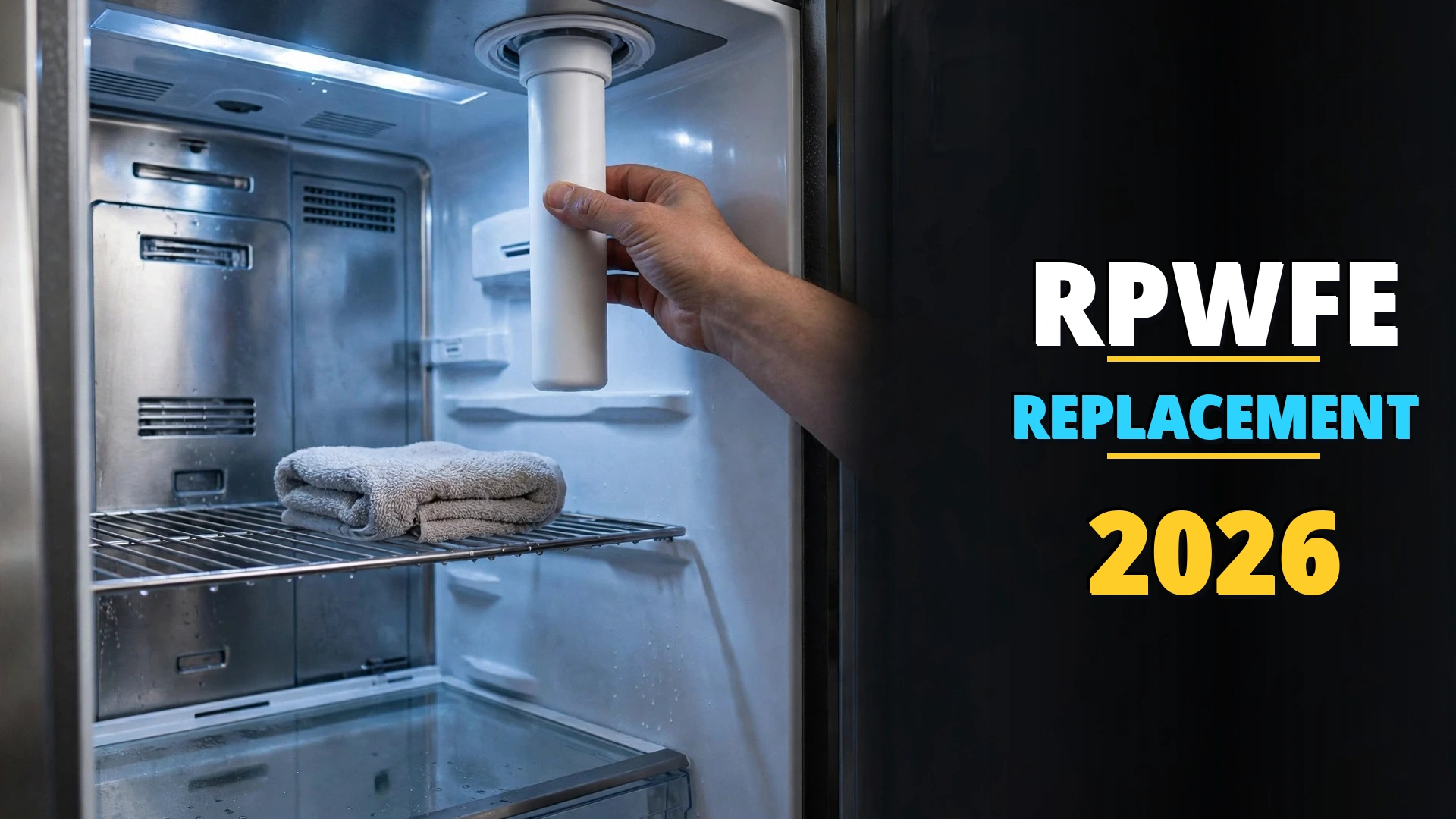
No tools needed, and the swap takes a few minutes. The RPWFE is a push-in cartridge — no quarter-turn like the older twist-in GE filters:
- Find the housing. Open the fresh-food compartment and look in the upper-right corner on most models — on some it is the upper-left or inside the left door. If you cannot spot it, your manual shows the exact location.
- Remove the old cartridge. Open the filter housing door and pull the old filter straight out — no twisting. The cartridge is keyed so it only comes out the right way. A little water dripping out is normal; put a towel underneath.
- Prep the new cartridge. Remove any protective caps or seals, and line the top of the new filter up with the housing, “FRONT” facing outward.
- Push it straight in. Firmly push the cartridge straight into the housing until it is fully seated — you will feel it lock. A filter that is not fully seated, and whose chip is not being read, is the most common cause of a filter light that will not clear after a swap.
- Close the housing door. Swing the filter cover back into place until it stops.
- Flush the dispenser. Run about 2 gallons through the cold water dispenser into a bucket before drinking. The first water may sputter and look cloudy — that is trapped air and harmless carbon fines from the new cartridge, and it clears as you flush.
- Reset the indicator light. With a genuine RPWFE, the chip usually tells the fridge to reset the “Replace Water Filter” reminder automatically — the reminder cannot be cleared manually when the chip handles it. If the light stays on anyway, the widely documented manual fallback is to press and hold the Water button on the dispenser panel for about 3 seconds, until a tone or the display confirms the reset. Panel layouts vary by model — your manual has the final word for your exact combination.
- Light will not reset? Remove the cartridge and push it in again firmly — a chip that is not being read is the most common cause — then try the button hold again. If you are using a third-party cartridge, an unrecognized chip is the likely culprit.
- Water shutoff: on most models you do not need to shut off the water supply — the housing has an auto-shutoff valve. It never hurts to know where your supply valve is, though.
The reset varies by brand: Samsung fridges use a different button sequence for the same job — our Samsung HAF-QIN replacement guide walks through the Samsung reset steps.
Cost per year: genuine vs compatible

The filter is rated at 6 months or 170 gallons, so a normal household buys two cartridges a year. Heavy dispenser and ice-maker users can hit the 170-gallon limit before the six months are up, so watch for slow flow as the practical signal. The yearly cost is just two times the per-cartridge price:
| Option | Price per cartridge | Cartridges per year | Estimated yearly cost |
|---|---|---|---|
| Genuine GE RPWFE (single) | ~$55–75 | 2 | ~$110–150 |
| Genuine GE RPWFE (multi-pack) | ~$50–65 each | 2 | ~$100–130 |
| Third-party RPWFE with chip | ~$25–35 | 2 | ~$50–70 |
The gap is real but narrower than it looks: genuine costs roughly $50–70 more per year than a chipped compatible. What the difference buys is certainty — the chip handshake works, the automatic light reset works, and you never troubleshoot a dispenser that went silent after a swap. Skip the chip-less bargain listings entirely: a cartridge without RFID does not belong in an RPWFE housing.
Conclusion
The RPWFE is a straightforward filter with one twist that matters: the RFID chip. It fits GE, GE Profile, Café, and Monogram fridges that list RPWFE or RPWF — remember that the compatibility runs one way, since the older chip-less RPWF cannot go back into a fridge that needs the chip. It swaps in minutes with a push-in install, usually resets the filter light itself, and runs roughly $110–150 a year for genuine cartridges or about $50–70 for a chipped compatible. Buy the genuine if you want the chip handshake and fit guaranteed — buy a chipped compatible only if you accept the trade-offs. And never put a chip-less cartridge in an RPWFE fridge: no chip, no reset, no water.
Update log
FAQs
How often should I replace the RPWFE?
Every 6 months or 170 gallons, whichever comes first — that is the manufacturer-rated life. Households with heavy dispenser or ice-maker use can hit the gallon limit early: slow flow or a taste change are the practical signals. The fridge’s indicator is a timer that reads the cartridge’s chip, not a water-quality sensor, so treat it as a reminder rather than a measurement.
Can I use an RPWF filter in a fridge that needs RPWFE?
No. The RPWFE is backward compatible — it works in fridges that call for the older RPWF — but the reverse is not true. The RPWF has no RFID chip, so a fridge that expects the RPWFE will not recognize it: the filter light may stay on, error messages can appear, and the dispenser may refuse to work. Only use the RPWF in older GE fridges that predate the chip.
What is the difference between the RPWF and RPWFE?
Size, shape, and installation are the same — the RPWFE is the RPWF’s direct successor. The difference is the embedded RFID chip in the RPWFE: the “E” in the name is there for the chip. It lets the fridge verify the cartridge is genuine, track filter life, and detect leaks. That chip is also why the RPWFE costs more and why the RPWF cannot be used in RPWFE fridges.
How do I reset the GE refrigerator filter light?
With a genuine RPWFE the light usually resets itself — the RFID chip tells the fridge a new cartridge is installed. If the light stays on, press and hold the Water button on the dispenser panel for about 3 seconds until a tone or the display confirms the reset. Button names and panel layouts vary by model, so your manual has the final word for your exact combination. If the reset still fails, remove and firmly reseat the cartridge — a chip that is not being read is the most common cause.
Will a third-party RPWFE filter work with the RFID chip?
Many third-party RPWFE compatibles are sold with a stated chip, and they generally work when the fridge recognizes that chip. But chip behavior on third-party cartridges is brand-stated, not GE-guaranteed — so a chip the fridge does not recognize can leave the filter light on or cause error messages. If the light will not reset after installing a third-party cartridge, a genuine RPWFE is the reliable fix.
Does the RPWFE remove lead?
According to GE, the genuine RPWFE carries brand-stated certifications to NSF/ANSI 42 and 53 — and lead reduction falls under the 53 claim. We have not independently verified these certifications in the NSF public database, so treat them as the manufacturer’s stated claims: you can look the listing up yourself at info.nsf.org before buying. If lead is your main concern, test your water first rather than relying on any filter claim alone.
Do I need to shut off the water to change the RPWFE?
Usually not. Most GE housings for this filter have an auto-shutoff valve that stops the water when the cartridge is removed. Your owner’s manual has the final word for your model, and it never hurts to know where your supply valve is before you start.
Why does my water look cloudy after installing a new RPWFE?
Cloudy or grey-looking water right after a swap is normal — it is trapped air and loose carbon fines from the new cartridge. Run about 2 gallons through the dispenser and it clears up. If the cloudiness persists after a full flush, remove and firmly reseat the cartridge to make sure it is fully locked in.