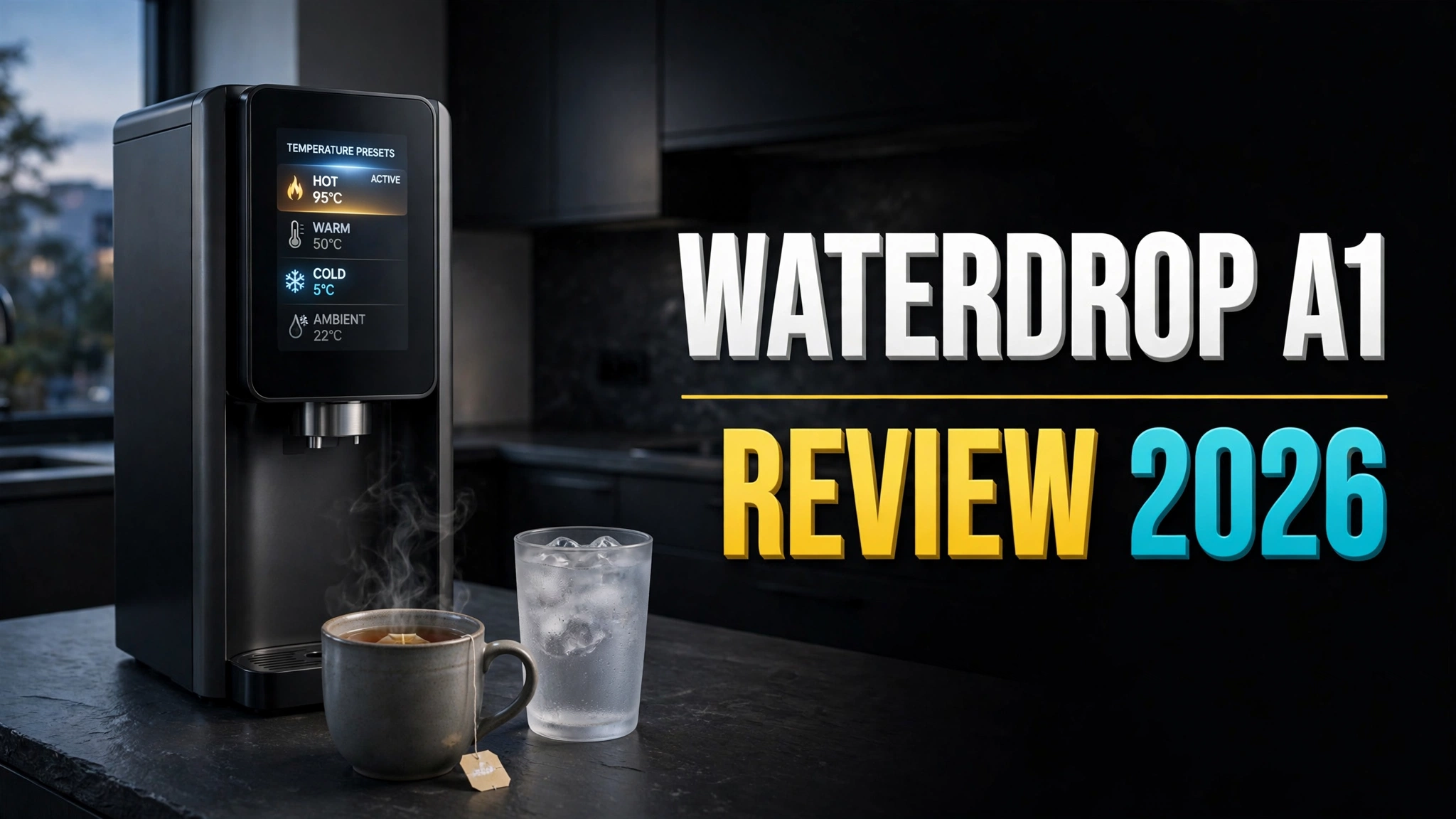

Waterdrop A1 Review (2026): Is It Worth 50?
★ HOT & COLD COUNTERTOP ROYou want reverse-osmosis water without drilling a hole in your countertop or booking a plumber — and it would be nice if that water came out hot for tea or ice-cold in seconds. The Waterdrop A1 promises exactly that: a plug-in countertop box that filters tap water through an RO membrane and dispenses it at whatever temperature you pick.
The short answer: the hot-and-cold convenience is good, and independent lab testing shows the A1 does the core RO job well — over 95% TDS reduction. But the price is steep at roughly $500–650 (estimate), the certification is narrower than the marketing suggests (NSF/ANSI 58 for TDS reduction only), the water runs acidic with no remineralization, and owners report it is loud and bulky. This review covers the certified facts, the lab numbers, the yearly filter math, and the recurring complaints.
Our scores
Table of Contents
Bottom line
The bottom line: buy the Waterdrop A1 if instant hot and cold purified water with zero installation is the feature you want — it dispenses at the temperature you pick, the OLED screen keeps you informed, and lab tests confirm solid RO performance. Skip it if you want deep certification coverage, remineralized water, or the cheapest countertop RO.
Verdict: a convenience appliance that filters well, priced like a luxury.
Price checked at time of writing; it changes often — see the live price before you buy.
Why you should trust this review
We did not receive a test unit and we did not run a lab bench test — claiming hands-on testing we never did would be dishonest. Instead we researched and compared: manufacturer spec sheets, the actual IAPMO certification listing, third-party lab results from an independent review site, recurring owner complaints, and replacement-cost math from listed filter life and prices.
How we researched
- Traced certifications to the certifier’s listing — the A1’s IAPMO listing is the source for the “NSF/ANSI 58, TDS reduction only” claim here. A contaminant the listing does not cover does not appear as a certified claim.
- Used published third-party lab data — an independent review sent pre- and post-filtration samples to a certified lab and published the results. We cite those figures as their data, not ours.
- Read owner reviews across retail listings — looking for recurring complaints mentioned by many owners over many months, not one-off bad experiences.
- Calculated yearly filter-cost math — from listed filter life and retail filter prices.
Pros and cons
Pros
- Instant hot and cold water — the brand states hot up to 203°F and cold down to 41°F in about 3 seconds, with temperature presets on the touch screen.
- No installation — plugs into a standard outlet and sits on the counter; no plumber, no drilled hole, no water line.
- Strong core RO performance in lab tests — independent lab data showed over 95% TDS reduction, with fluoride, uranium, copper, and strontium fully removed in the tested sample.
- Smart OLED screen — real-time TDS, temperature, and filter-change reminders, plus a child lock for the hot water.
- Decent 2:1 pure-to-drain ratio — one gallon wasted per two purified, far better than old 4:1 under-sink systems.
Cons
- Certified for TDS reduction only — the IAPMO listing covers NSF/ANSI 58 for TDS reduction, not the wider contaminant list in the marketing.
- No remineralization — lab tests showed pH dropping from 7.6 to 6.5; the water tastes flat and acidic next to remineralized RO water.
- Loud in daily use — owners repeatedly mention the noise; several rely on night mode to keep it tolerable.
- Big footprint, frequent refills — roughly mini-fridge sized at 18.3 × 7.8 × 17.1 inches, and the 136-ounce feed tank needs regular refilling with no water line.
- Premium price, short warranty — around $500–650 (estimate) with only a 1-year warranty.
Certifications (database-checked)
This is the section where the A1’s marketing and its paperwork part ways. Here is what the certifier’s listing actually says:
| Claim | What the listing actually says | What it means for you |
|---|---|---|
| NSF/ANSI 58 (RO systems) | IAPMO-certified — TDS reduction only | Certified to reduce total dissolved solids — not lead, fluoride, PFAS, or other specific contaminants. |
| NSF/ANSI 372 (lead-free) | Brand-stated, materials certification | Covers lead-free wetted materials — a construction standard, not a lead-removal claim. |
| “Removes 99% of harmful substances” | Marketing copy, not a certification | Lab tests did show strong reductions, but no certifier listing backs this sentence. |
The practical takeaway: treat the A1 as a well-built RO dispenser with a TDS-reduction certification — not as a certified lead, fluoride, or PFAS solution. Lab data measured strong reductions, but lab results are not certifications.
Design and usability
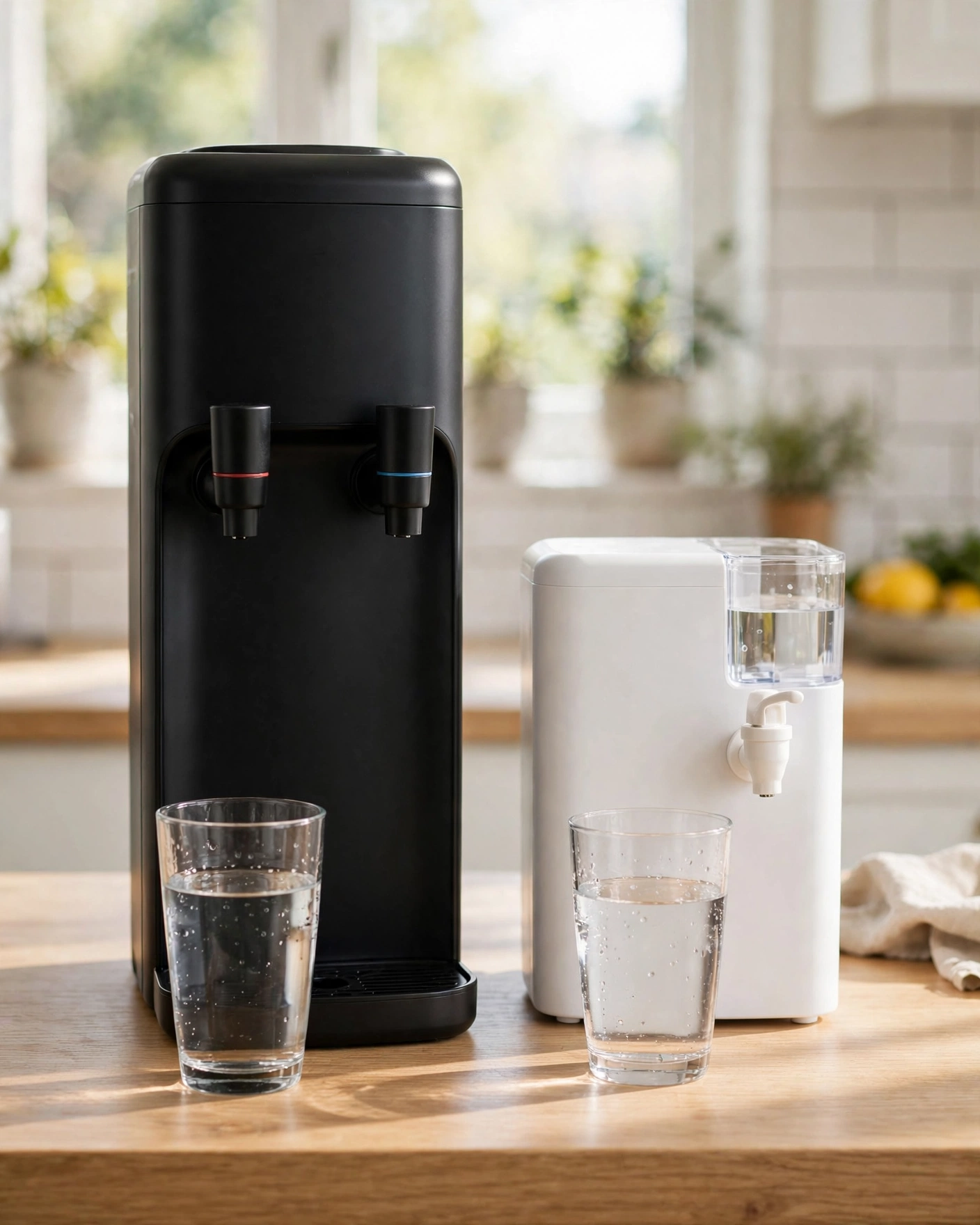
The A1 is built like a small appliance: a tall black-and-grey tower about 18.3 × 7.8 × 17.1 inches — roughly mini-fridge footprint — that lives on your counter next to an outlet. You pour tap water into the 136-ounce rear feed tank; the unit filters into internal tanks, including a separate 34-ounce cold-water tank (brand-stated).
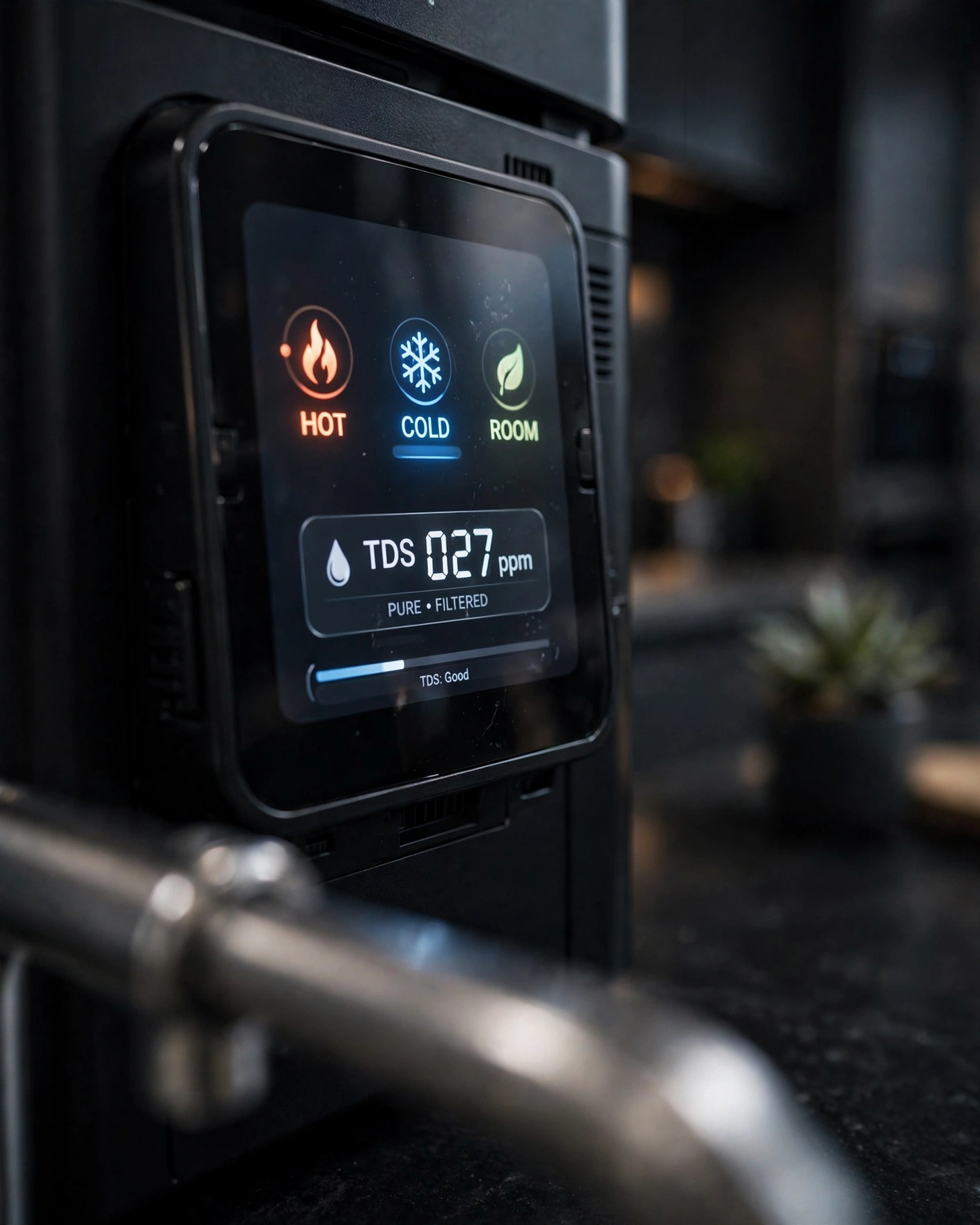
The interface is the best part. The OLED smart screen shows real-time TDS, the selected temperature, and filter-life reminders — plus a child lock on the hot-water button, which matters with kids since the brand states hot output up to 203°F. The brand states water dispenses in about 3 seconds once the unit is ready.

Two honest usability notes. First, filtration is slow: the independent review measured 0.042 gallons per minute — about 4 minutes 40 seconds per full tank — so the unit works best when you let it keep its internal tanks topped up. Second, the feed tank is manual: with no water line, you are carrying 136 ounces of tap water to the counter regularly, and owners say the tank is awkward to remove and reseat. If that sounds like a chore you will resent, our Waterdrop K19 review covers the brand’s cheaper countertop option.
Filter cost math
The sticker price matters less than the yearly cost of running it:

| Item | Figure |
|---|---|
| Unit (upfront) | ~$500–650 depending on retailer and bundle (estimate) |
| CF composite filter life | ~6 months (brand-stated) |
| RO membrane filter life | ~12 months (brand-stated) |
| Estimated yearly filter cost | ~$130 (independent review, 2025) |
| 5-year total cost of ownership (estimate) | ~$1,150–1,300 (unit + filters) |
The filter math itself is reasonable for the category: ~$130 a year is in line with other countertop RO systems. But the unit price dominates everything — at ~$500–650, the A1 costs roughly double its brand sibling K19-SFK with a similar yearly running cost. You pay the premium for hot/cold dispensing and the smart screen, not cheaper filtration. Some bundles include an extra CF filter in the box (check the listing — one buyer’s bundle filter went missing in shipping).
What owners complain about
Noise. The most repeated complaint: the A1 is loud when it runs — pumping, heating, and cooling all make themselves heard. Several owners say they use the night mode to make it tolerable.

Footprint and refills. At 18.3 × 7.8 × 17.1 inches, this is a countertop commitment — measure your under-cabinet clearance first. With no water line, the 136-ounce feed tank needs regular manual refilling; owners describe the tank as awkward to remove and reseat when full.
Flat, acidic taste. Lab data showed pH dropping from 7.6 to 6.5 with minerals stripped and nothing added back. Some owners love the clean taste; others call it flat. There is no remineralization stage and no way to add one — mineral drops or a separate alkaline pitcher are the only fix.
Slow filtering. The measured 0.042 GPM rate means nearly five minutes per full tank. The internal tanks buffer this, but drain the cold tank on a hot afternoon and you will wait.
None of these are hidden gotchas — they are the standard trade-offs of a feature-packed countertop appliance. But at this price, know them before the box arrives.
Waterdrop A1 vs rivals
The A1 competes with other countertop dispensers — here is how it stacks up against the four rivals buyers cross-shop most:
| Waterdrop A1 | SimPure Y7P | AquaTru Classic | Waterdrop K19-SFK | |
|---|---|---|---|---|
| Typical unit price | ~$500–650 | ~$330–400 | ~$449–475 | ~$249–380 |
| Hot & cold dispensing | Hot, cold + room temp | Room temp only | Room temp only | Hot drinks on demand |
| Certification depth | IAPMO NSF/ANSI 58 — TDS reduction only | NSF/ANSI 58 brand-stated, listing unconfirmed | IAPMO 42/53/58/401 — deepest list | NSF 42/53/58 brand-stated, listing unconfirmed |
| Yearly filter cost | ~$130 | ~$100 | Mid-range (4-filter set) | ~$79 |
| Pure-to-drain ratio | 2:1 | 4:1 | 4:1 advertised | Not published |
| Best for | Hot/cold on demand, no install | Budget dispenser, room temp | Certification-first buyers | Value pick with hot water |
The A1 wins on the hot-and-cold experience and loses on price and certification depth. The AquaTru Classic is the certification-first pick, the SimPure Y7P is the budget room-temperature dispenser, the AquaTru Carafe is the compact no-frills option, and the Waterdrop K19-SFK undercuts the A1 substantially while still offering hot water. If the temperature presets are why you are here, none of the four fully replaces the A1 — but if they are not, the A1 is the most expensive way to get RO water on your counter.
Who should buy it

Buy it if
- You want instant hot and cold purified water with no installation — tea, baby formula, and iced water from one box.
- You are a renter who cannot modify the kitchen but wants RO-level filtration.
- You like smart feedback — the TDS readout and filter reminders remove the guesswork.
Skip it if
- You want certified contaminant reduction beyond TDS — the AquaTru line carries far deeper IAPMO listings at a similar price.
- You want remineralized water — the A1 strips minerals and adds nothing back.
- You are price-sensitive — the K19-SFK and Y7P deliver countertop RO for hundreds less.
- Your counter is small or noise-sensitive — this is a big, audible appliance.
The specs
- Brand
- Waterdrop
- Model
- A1 (WD-A1)
- Type
- Countertop RO dispenser, plug-in
- Filtration
- 7-stage incl. RO membrane + UV (brand-stated)
- Temperatures
- Hot / cold / room temp presets (brand-stated)
- Hot water
- Up to 203°F (brand-stated)
- Cold water
- Down to 41°F (brand-stated)
- Feed tank
- 136 oz (brand-stated)
- Cold tank
- 34 oz (brand-stated)
- CF filter life
- ~6 months
- RO filter life
- ~12 months
- Pure-to-drain
- 2:1
- Dimensions
- 18.3 × 7.8 × 17.1 in
- Certifications
- IAPMO NSF/ANSI 58 (TDS reduction only)
- Warranty
- 1 year
- Typical price
- ~$500–650 (estimate)
FAQs
Is the Waterdrop A1 actually NSF certified?
Partially. The A1 is IAPMO-certified to NSF/ANSI 58, but only for TDS (total dissolved solids) reduction — not for lead, fluoride, PFAS, or other specific contaminants. Its NSF/ANSI 372 listing covers lead-free materials in construction, not lead removal. If a seller claims broad NSF certification, ask to see the actual listing.
Does the Waterdrop A1 remove fluoride?
In one independent lab test, fluoride went from 1.4 ppm to undetectable. But that is lab data from a single test sample, not a certification: the A1’s NSF/ANSI 58 listing covers TDS reduction only, so fluoride reduction is not a certified claim. If fluoride is your main concern, choose a product whose listing names fluoride explicitly.
How much do replacement filters cost, and how often do they need changing?
The A1 uses two filters: a CF composite filter rated for about 6 months and an RO membrane rated for about 12 months. The independent review put the annual cost at roughly $130 (2025 figures), and the OLED screen reminds you when each filter is due.
Is the hot water really instant?
Effectively, yes — once the unit has heated up. The brand states up to 203°F hot and 41°F cold dispenses in about 3 seconds via the presets (brand-stated figure). The very first cup after switching on or refilling takes longer.
Does the A1 add healthy minerals back into the water?
No. The A1 has no remineralization stage — lab testing showed pH dropping from 7.6 to 6.5 as minerals were stripped out, leaving very pure but flat-tasting, slightly acidic water. To add minerals back you would need mineral drops or a separate pitcher; there is no add-on filter for the A1.
How loud is the Waterdrop A1?
Louder than owners expect — pumping, heating, and cooling are all audible, and several owners rely on night mode. Worth weighing in an open-plan kitchen.
Do I need a plumber or a water line to install it?
No. The A1 is plug-in: fill the 136-ounce rear tank from your tap, plug it into a standard outlet, and it filters on demand. No plumbing, no drilled hole, no permanent modification — which is why renters buy it. The trade-off is manual refilling and counter space.
Conclusion
The Waterdrop A1 is a luxury convenience appliance that happens to filter water well. If instant hot and cold purified water is worth roughly $500–650 to you — and you accept the TDS-only certification, the mineral-free water, and the size and noise — it does that job well. If any of those caveats bother you, the same money buys deeper certification (AquaTru Classic) or the same countertop RO for much less (K19-SFK, SimPure Y7P).
Price checked at time of writing; it changes often — see the live price before you buy.
Update log
- Zulqarnain: Review published.