
Whole House Water Filter For Chlorine And Chloramine (2026): What the Evidence Says
Guide
You filled a glass from the tap and caught that faint swimming-pool smell. Maybe your utility’s annual report said the word “chloramine” instead of “chlorine” — and now you are wondering whether the whole-house filter you are shopping for actually handles both. Buy the wrong media and you get a thousand-dollar tank that fixes a problem you don’t have.
Here is the short answer: a carbon whole-house filter removes chlorine very effectively — that is the easy part. Chloramine is a different, tougher molecule, and standard carbon is much less effective against it; for chloramine you need catalytic carbon, a media made for the job. The certification that proves either claim is NSF/ANSI 42 — and knowing how to check it matters more than any marketing number. This guide walks through what the evidence actually says, based on published test data, the standard’s test conditions, and the carbon manufacturer’s own documentation.
Table of Contents
Does a Whole-House Filter Remove Chlorine and Chloramine?
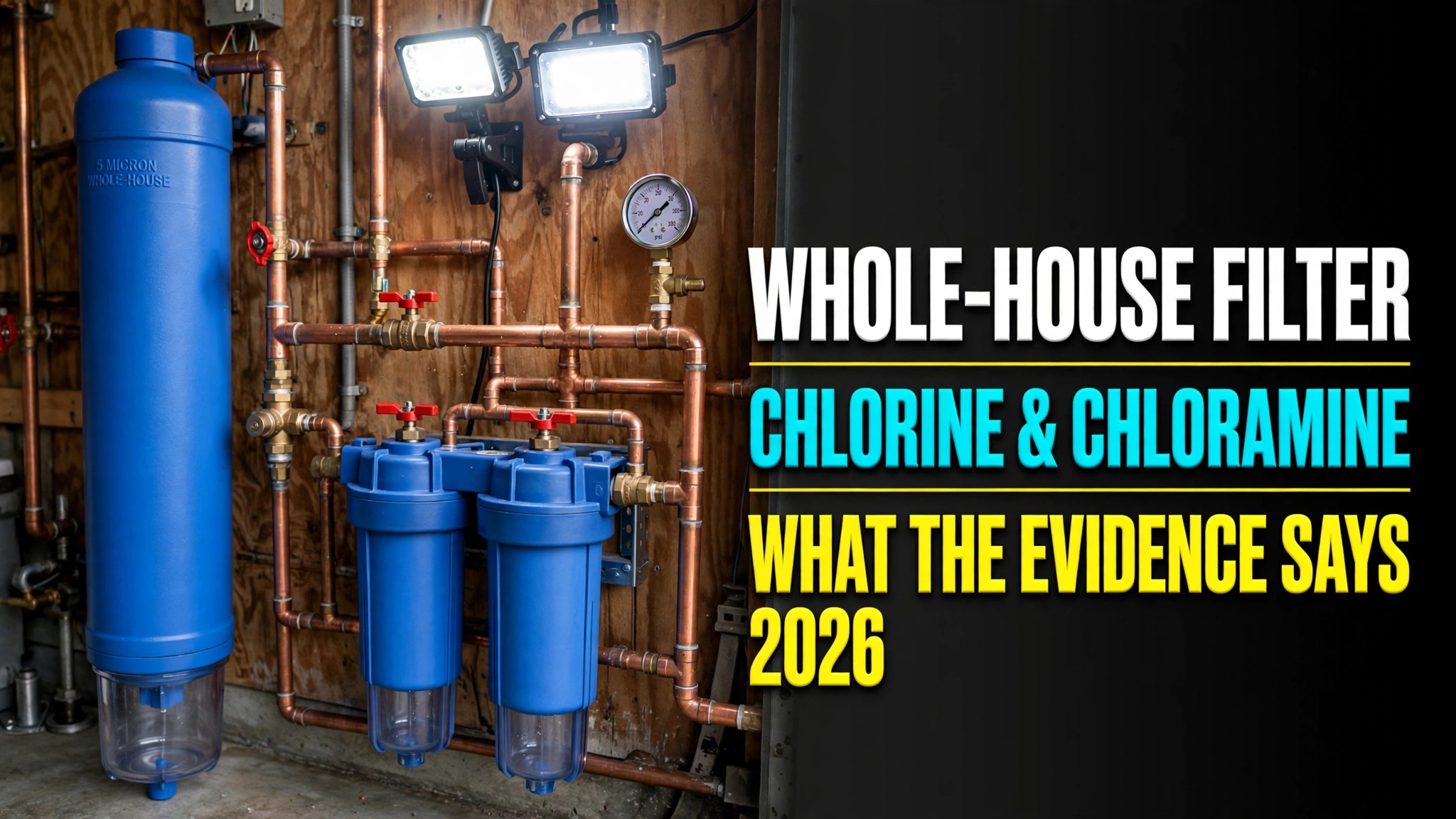
Chlorine: yes, and it is not close. Activated carbon has been the workhorse for chlorine removal for decades — the chlorine reacts with and is adsorbed by the carbon surface, and the pool smell disappears from every tap. The published numbers back this up. Aquasana’s Rhino whole-house system, for example, is independently tested to the NSF/ANSI 42 protocol to remove 97% of chlorine for 1,000,000 gallons or up to 10 years, per the brand’s own FAQ. That figure is brand-stated test data rather than a formal certification — an important distinction we cover in the certifications section — but it is far more evidence than most tank systems publish. (The standard Rhino pairs an activated-carbon tank with a copper-zinc KDF media tank that, per Aquasana, “aids in the reduction of chlorine” and inhibits bacteria and algae growth in the tank.)

Chloramine: only with the right media. Chloramine is chlorine plus ammonia — a weaker disinfectant than chlorine, but far more stable, which is exactly why utilities use it as a secondary disinfectant that survives the trip through miles of pipes. That stability is also why standard granular activated carbon struggles with it: the reaction is slow, so ordinary carbon beds let too much chloramine slip through at normal household flow rates. For chloramine you need catalytic carbon — carbon manufactured with catalytic surface properties that break chloramine down faster. Calgon Carbon, the company behind Centaur catalytic carbon, states on its own product page that Centaur decomposes chloramines in potable water faster than standard activated carbons.
The brand evidence lines up. Aquasana’s Rhino Chloramines model replaces the standard media with 100% catalytic carbon in both tanks, and the brand publishes independent test data: 83% chloramine reduction and 97% chlorine reduction for 1,000,000 gallons or up to 10 years, tested to the NSF/ANSI 42 protocol. Note what that tells you: the same company that claims 97% chlorine on its standard system built a different system for chloramine — because standard carbon is not the chloramine tool.
| Chlorine | Chloramine | |
|---|---|---|
| What it is | Free chlorine disinfectant | Chlorine + ammonia compound |
| Why utilities use it | Strong, fast disinfection | More stable; keeps working through long pipe runs |
| Standard carbon effectiveness | Very effective | Much less effective — not the right media |
| What actually works | Any carbon whole-house filter | Catalytic carbon whole-house system |
| Certification to look for | NSF/ANSI 42 chlorine claim | NSF/ANSI 42 with an explicit chloramine claim |
You cannot taste which one you have. Monochloramine — the form utilities use — is essentially odorless and tasteless at normal levels, so a glass of water tells you nothing. The reliable source is your utility’s annual water quality report (the Consumer Confidence Report), which every community water system must send out yearly; it names the disinfectant. Read it before you spend a dollar: the entire buying decision hinges on that one word.

Where carbon whole-house filters shine
- Chlorine taste and smell, gone — the best-documented thing carbon does, at every tap and in the shower.
- Contact time on your side — tanks hold cubic feet of media, far more than a cartridge, so the water spends real time in the carbon.
- Published test data exists — at least one major brand publishes independent NSF/ANSI 42 protocol results (97% chlorine) instead of asking for trust.
- Low maintenance — no cartridges to swap monthly; media is rated in gallons and years, not weeks.
Where they fall short
- Chloramine needs catalytic carbon — buy a standard-carbon system for a chloramine utility and you bought the wrong tool.
- No fluoride removal — carbon does not take fluoride out, whatever the brochure implies.
- Not a health-contaminant filter — lead, PFAS, and bacteria need different technology or certified point-of-use systems.
- Test data is rare — most tank systems publish no independent performance numbers at all; brand-stated data is the best you usually get.
What Certifications Actually Prove
Filter marketing throws standard numbers around like confetti. Here is what the numbers actually mean — because the wrong reading of a certification has cost buyers real money.
NSF/ANSI 42 is the one that covers chlorine and chloramine. It is an aesthetic-effects standard: taste, odor, and chlorine/chloramine reduction — not health protection. A system certified to NSF/ANSI 42 with a chloramine claim has been tested against a defined protocol: Health Canada’s guideline technical document on chloramines notes that certified systems must reduce an influent of 3.0 mg/L monochloramine (plus or minus 0.3) down to 0.5 mg/L or less. That is a concrete, checkable bar — roughly an 83%+ reduction under test conditions. When a brand says “independently tested to NSF/ANSI 42,” it means tested against that protocol; “certified to NSF/ANSI 42” means an accredited body listed the product. Both are meaningful, but they are not the same thing.

| Standard | What it proves | Relevance here |
|---|---|---|
| NSF/ANSI 42 | Aesthetic effects: chlorine, chloramine, taste, odor | The certification for chlorine/chloramine claims |
| NSF/ANSI 61 | Materials safety — the system doesn’t leach harmful substances | Proves the housing is safe, not that it filters anything |
| NSF/ANSI 53 | Health effects: lead, cysts, VOCs | Different job; chlorine filters don’t carry it |
| NSF/ANSI 401 | Emerging compounds: pharmaceuticals, some pesticides | Not a chlorine/chloramine standard |
Watch the 61 trap. The Aquasana Rhino’s tank is WQA-certified to NSF/ANSI 61 — that certifies the tank materials are safe for drinking-water contact, not that the system removes contaminants. The brand’s 97% chlorine and 83% chloramine figures are independent testing to the NSF/ANSI 42 protocol, not certifications. Both are worth something; neither is what the other claims to be.
A refuted claim to avoid: some third-party pages describe the Aquasana Rhino as “NSF 42/53/401” certified. Aquasana’s own certification page lists only NSF/ANSI 42 and 61 — no 53, no 401. We treat the broader claim as refuted and do not repeat it. Always check the listing yourself: search the brand and model on info.nsf.org (NSF’s public database) or the WQA product directory, and read exactly which contaminants the listing covers. A logo on a box is a claim; a database listing is the proof.
What the Science Says
Why chloramine is the hard one. Utilities are required to keep a disinfectant residual all the way through the distribution pipes, and chloramine earned its job by being stubborn: the EPA notes it has been used as a secondary disinfectant for roughly 90 years precisely because it stays stable over long distances where free chlorine fades. That same stability is what makes it hard to strip out at the tap. Standard activated carbon relies on relatively fast surface reactions; chloramine’s slower chemistry means much of it passes through a standard carbon bed at normal household flow rates. Catalytic carbon changes the kinetics — Calgon Carbon’s Centaur documentation describes it as decomposing chloramines faster than standard activated carbons, which is the entire scientific basis for chloramine-specific whole-house systems.

Contact time decides everything. A whole-house tank holding a cubic foot or more of carbon gives water far more media contact than a slim cartridge — which is why tank systems are the credible format for chloramine. But published numbers still come with fine print: one independent review of Aquasana’s published chloramine life-cycle data found individual samples ranging from about 69% to nearly 100% reduction across the media’s life. The headline 83% is an overall figure, not a promise for every gallon. Treat any single percentage as an average with real-world spread, and be skeptical of brands that publish no data at all — which is most of them.
Where the evidence stops. Two honest boundaries: carbon does not remove fluoride — that needs reverse osmosis or activated alumina, as we detail in our whole-house fluoride guide. And on PFAS (“forever chemicals”), carbon reduces some of them but no standard whole-house carbon tank we found is certified for PFAS reduction — the right framing is “reduces, not removes,” covered in depth in our whole-house PFAS guide. A chlorine/chloramine system is a taste-and-odor system; don’t buy it expecting health-contaminant protection it was never built for.
Better Options If a Whole-House Filter Isn’t the Answer
Sometimes the evidence points away from the product you came to buy. Here is how the scenarios break down:
- Your utility uses chloramine and you were eyeing a standard carbon system. Redirect to a catalytic-carbon model — standard carbon is the wrong media, and the price difference between the two system types is smaller than the cost of buying twice.
- You also need lead reduction. Carbon whole-house filters don’t certify for lead; that’s an NSF/ANSI 53 job, usually handled at the point of use. See our evidence guide on whole-house filters and lead before assuming one system does it all.
- Your real problem is hard water or scale. A filter doesn’t soften water — that’s a water softener’s job, a completely different technology. Our guide on filters vs softeners lays out which problem is which.
- You’re a renter or on a tight budget. A whole-house install isn’t your format. For chlorine taste alone, a simple point-of-use carbon cartridge does the job for a fraction of the cost — just know it won’t handle chloramine well either.

Before you order a tank system, do the unglamorous homework. These are heavy, freight-shipped units, and some sellers charge restocking fees on returns — check the return policy in writing before the truck arrives (we’ve documented one major brand’s policy in our SpringWell return policy guide). Confirm the rated media life in gallons, how media gets replaced (refill vs tank swap), and whether your peak household flow fits the system’s rated treatment flow. A system undersized for your home’s flow is a chloramine system that underperforms from day one.
- Chlorine removal
- Yes — standard activated carbon
- Chloramine removal
- Only with catalytic carbon
- Certification that covers it
- NSF/ANSI 42 (aesthetic)
- Verify listings at
- info.nsf.org (NSF database)
- NSF 42 chloramine test
- 3.0 mg/L down to 0.5 mg/L
- Published brand example
- 83% chloramine (brand-stated)
Conclusion
A whole-house water filter for chlorine is one of the safest bets in home filtration — carbon does that job thoroughly, and the published test data says so. A whole-house filter for chloramine is a different purchase that happens to look similar: it only works if the media is catalytic carbon, the claim sits under NSF/ANSI 42 with a chloramine listing you can verify, and the system is sized for your home’s flow. Get those three right and the evidence is on your side. Get the media wrong and you’ve bought an expensive chlorine filter for a chloramine problem.
FAQs
Will a standard whole-house carbon filter remove chloramine?
Not reliably. Standard granular activated carbon reacts with chloramine too slowly to keep up at normal household flow rates, so much of it passes through. Calgon Carbon’s own documentation for its Centaur catalytic carbon states that it decomposes chloramines faster than standard activated carbons. If your utility uses chloramine, buy a system built with catalytic carbon, not a standard carbon bed.
What certification should I look for on a chloramine filter?
NSF/ANSI 42 with an explicit chloramine reduction claim. That standard covers aesthetic effects including chloramine, and certified systems must reduce 3.0 mg/L of monochloramine down to 0.5 mg/L or less under test conditions. Don’t accept an NSF/ANSI 61 listing as proof of filtration — 61 covers materials safety only. Verify the exact listing on NSF’s public database at info.nsf.org before you buy.
How do I find out whether my city uses chlorine or chloramine?
Read your utility’s annual water quality report, also called the Consumer Confidence Report. Every community water system must publish one yearly, and it names the disinfectant used. Taste and smell can’t tell you — monochloramine is essentially odorless at normal levels. The report is the one document that decides which filter media you need.
Does a whole-house carbon filter remove fluoride?
No. Activated carbon — standard or catalytic — does not remove fluoride at any meaningful level. Fluoride reduction needs reverse osmosis or activated alumina treatment. If fluoride is on your list alongside chlorine or chloramine, a carbon whole-house system alone won’t cover it.
Can one whole-house system remove lead too?
Not with carbon alone. Lead reduction is certified under NSF/ANSI 53, a health-effects standard that chlorine-focused carbon systems don’t carry. Some whole-house systems pair carbon with other stages, but check the actual certification listing for lead — don’t assume a chlorine system handles it. Point-of-use filters certified to NSF/ANSI 53 are the more common answer for lead.
How long does catalytic carbon media last in a whole-house system?
It depends on the rated capacity and your water. Brands rate tank media in gallons and years — one major brand rates its catalytic carbon tanks at 1,000,000 gallons or up to 10 years (brand-stated). Real life varies with your chloramine levels and peak flow: higher levels and higher flow exhaust media faster. Ask the seller how media gets replaced — refill or tank swap — and what that costs before you buy.