Alexapure Pro vs Berkey (2026): Which Should You Buy?
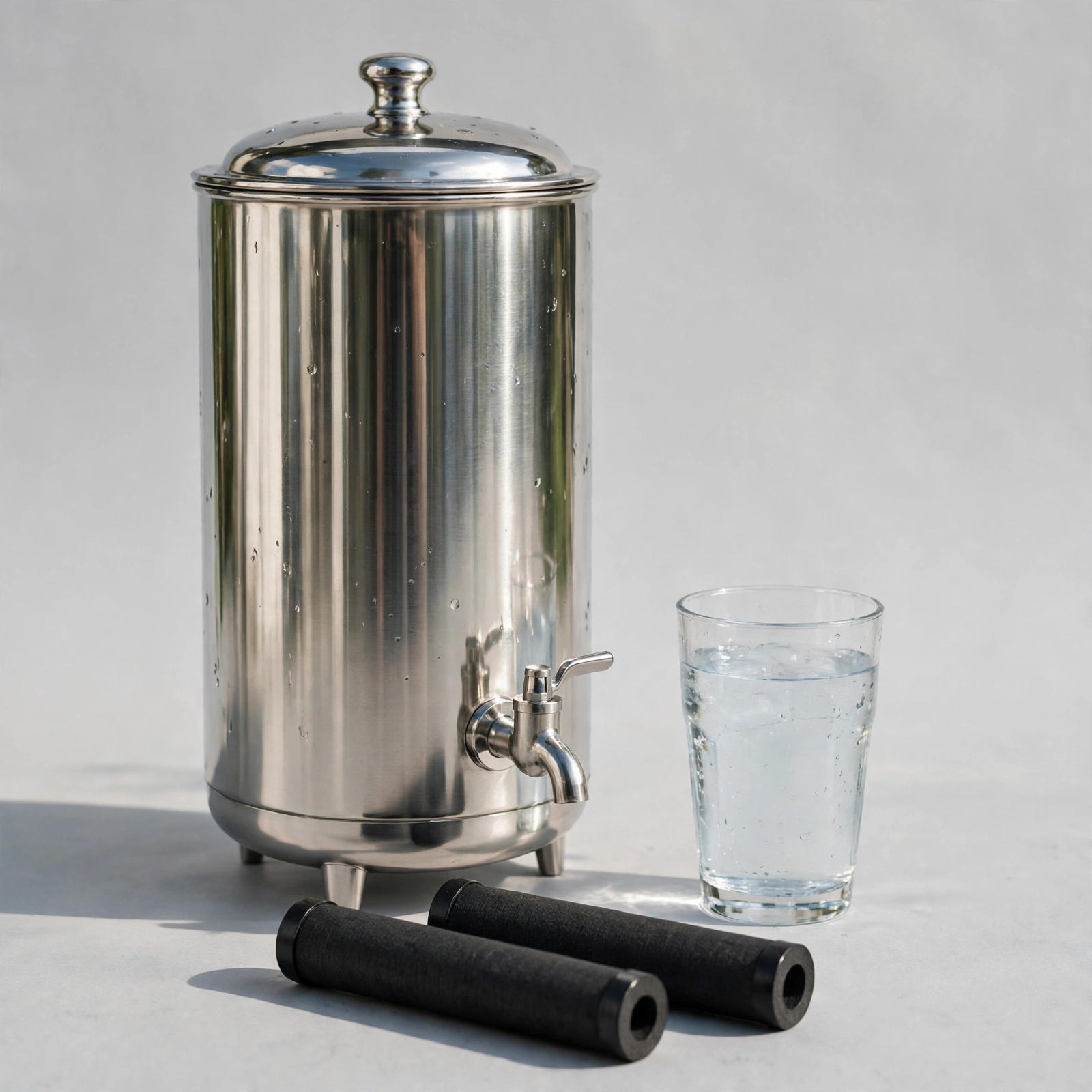
Same stainless silhouette, same 2.25 gallons, same off-grid promise — and an $87 price gap. The Alexapure Pro and the Big Berkey are the two gravity filters most buyers cross-shop, and on the surface they look interchangeable. They are not. One ships ready to filter fast; the other ships cheaper with a longer-rated single element and a fluoride claim that deserves a hard look.
Here is the short answer: the Big Berkey is the more complete system as shipped — two elements, roughly three times the flow, a lifetime housing warranty, and deeper published lab data. The Alexapure Pro is the better budget and preparedness buy — $280, in stock everywhere, with elements you can reorder today. Neither is NSF certified; both rely on lab reports. This head-to-head sits inside our gravity water filter coverage.
Gravity Block · Budget & Preparedness Pick
Alexapure Pro
~$250–300
Cheaper, in stock, 5,000 gallons per element — but ships with one element and filters slowly.
Black Berkey Elements · The Standard
Big Berkey
~$360–420
Two elements in the box, ~3.5 gal/hr flow, lifetime housing warranty, deeper published lab data.
Verdict: buy the Big Berkey if you want the system that works best the day it arrives; buy the Alexapure Pro if price and off-grid readiness matter more than flow. The Berkey’s win is about the complete package — elements, flow, warranty, documentation. The Alexapure’s case is value and availability, and it gets stronger the tighter your budget is.
Table of Contents
Side-by-side comparison
The headline numbers, drawn from each brand’s published data and retailer spec comparisons. The highlighted cell in each row wins that row — where the two are level, neither cell is highlighted.
| Spec | Alexapure Pro | Big Berkey |
|---|---|---|
| Capacity | 2.25 gal | 2.25 gal |
| Elements in the box | 1 | 2 ✓ |
| Element life (brand-rated) | 5,000 gal per element ✓ | 3,000 gal per element (6,000/pair) |
| Flow, as shipped | ~1 gal/hr | ~3.5 gal/hr ✓ |
| NSF/ANSI certification | None | None |
| Fluoride | Built-in claim — disputed (see certs) | PF-2 add-on elements |
| Housing warranty | 1-year limited | Lifetime ✓ |
| System price | ~$250–300 ✓ | ~$360–420 |
Alexapure Pro — the budget challenger

The Alexapure Pro is sold by My Patriot Supply, and its pitch is aimed squarely at Berkey: the same 2.25-gallon stainless format for about $280. Its gravity block element is rated by the brand at up to 5,000 gallons — more per element than a Black Berkey — and the brand markets built-in fluoride reduction from its aluminum-oxide media, a claim we examine honestly in the certifications section. Owners rate it well: around 4.8 stars across roughly 2,800 reviews at its main retailer. Our Alexapure Pro review covers its test data in depth.
The fine print matters, though. The Pro ships with one element, and one element filters at roughly a gallon an hour — a full chamber takes over two hours. A second element doubles the flow but costs about $120, which erases most of the price advantage. The housing warranty is one year, against Berkey’s lifetime coverage. And the system is not sold in California, a restriction tied to that state’s claims rules.
Pros
- ~$280. The cheapest way into a full-size stainless gravity system.
- 5,000 gallons per element (brand-rated) — the longest per-element rating here.
- In stock, elements included, at mainstream preparedness retailers.
- Strong owner ratings (~4.8 stars, ~2,800 reviews at My Patriot Supply).
Cons
- Ships with one element — ~1 gal/hr until you buy a second (~$120).
- Fluoride claim is disputed by independent testing (see below).
- One-year warranty and no California sales.
Big Berkey — the standard
The Big Berkey’s formula is unchanged for years: a 2.25-gallon stainless housing, two Black Berkey elements in the box (room for four), about 3.5 gallons an hour as shipped, and elements rated at 3,000 gallons each — 6,000 per pair. The housing is covered by a lifetime warranty against defects. Berkey also publishes more lab data than Alexapure, including PFAS reduction reports for its elements, which is why it remains the default recommendation in most gravity comparisons — including the dealer comparison we cite below, which sells Berkey and says so openly.
Its 2026 caveats are the ones from our Berkefeld comparison: no NSF/ANSI certification (brand-commissioned lab reports only), fluoride needs the PF-2 add-ons, and standalone Black Berkey elements are currently hard to source through authorized US dealers — a new system ships with its elements, so this bites at replacement time, years out, when Phoenix elements are the offered fallback (see our Phoenix element review). Our British Berkefeld vs Berkey head-to-head covers the certification angle in full.
Pros
- Complete as shipped: two elements, ~3.5 gal/hr, no add-on needed to start.
- Lifetime housing warranty.
- Deeper published lab data, including PFAS reports.
- 6,000 gallons per pair of elements.
Cons
- ~$360–420 — about $90–140 more than the Alexapure.
- No NSF/ANSI certification; fluoride needs PF-2 add-ons.
- Replacement-element supply is uncertain in the US right now.
Certifications (database-checked)
Neither system is NSF/ANSI certified. Alexapure’s product pages note its carbon is made from materials compliant with NSF/ANSI 61 — a materials-safety standard for what the media is made from, not a performance certification for what the filter removes. Its performance claims rest on independent lab results and internal data, per the brand’s own performance note. Berkey’s claims rest on laboratory reports the brand publishes. Both are “tested,” neither is “certified” — do not let either brand’s wording blur that.
The fluoride claim deserves its own paragraph. Alexapure markets built-in fluoride reduction as a headline advantage. Independent checks have not reproduced it: a Berkey retailer’s comparison (an interested party — weigh it accordingly) cites accredited-lab Tap Score testing in which fluoride measured higher after Alexapure filtration, and a separate meter test at about 17% reduction; the same retailer’s spec table lists fluoride as requiring an add-on for both systems. Until stronger independent data appears, treat built-in fluoride reduction as unproven — if fluoride is your main target, buy a system with dedicated fluoride media and published data, whichever brand it is.
Flow and fit: the element-count difference
The most practical difference in this comparison is not in the table’s headline rows — it is how many elements you own. Gravity flow scales with element count: the Berkey’s two elements deliver roughly 3.5 gal/hr, the Alexapure’s single element about 1 gal/hr. For a household filling the chamber twice a day, that is the difference between water always being ready and planning around the filter. Both housings accept up to four elements; bringing the Alexapure to two costs ~$120. Physically, the Alexapure stands taller assembled (about 23 inches vs the Berkey’s ~19.25), so measure your counter-to-cabinet clearance either way.
Cost per year
Using brand-rated lives and October 2026 street prices (estimates — they move constantly):
- Alexapure Pro: ~$280 to buy (one element). At 3 gallons a day, the 5,000-gallon element lasts ~4.5 years; a replacement is ~$120 → roughly $27/year in elements. Add the second element most households end up buying and year one is ~$400.
- Big Berkey: ~$367 to buy (two elements). The 6,000-gallon pair lasts ~5.5 years at 3 gallons a day; replacement pairs run ~$120–180 depending on element type → roughly $25–35/year in elements.
Long-run element costs are a wash. The real money question is year one: $280 for a slow-starting Alexapure, ~$400 for a two-element Alexapure, or ~$367 for a Berkey that is complete on day one.
What owners say
Alexapure owners praise value, taste, and emergency readiness — the preparedness community is its home turf. Complaints focus on slow flow with the single included element, the price of extra elements, and (from fluoride-focused buyers) results that did not match the marketing. Berkey owners praise speed, longevity and the warranty; their current complaints are about replacement-element availability and the lack of certification, as covered in our gravity filter roundup.
Which should you buy?
Pick the Big Berkey if…
You want the fastest, most complete system out of the box, your household drinks a lot of water, and you value the lifetime housing warranty and deeper published test data. It is the better daily-driver.
Pick the Alexapure Pro if…
Budget leads, you are buying for preparedness or a cabin/RV where a gallon an hour is fine, or Berkey’s element-supply situation makes you want a brand whose replacements are on the shelf today. Budget for a second element if more than two people will drink from it.
Buy neither if…
Certification is your deciding factor — neither has it. The NSF-certified-candle British Berkefeld beat the Berkey in our other head-to-head for exactly that reason, and it anchors our gravity coverage for certification-first buyers.
How we researched
We compared brand specifications and performance notes (including Alexapure’s own statement that its claims rest on independent lab results and internal data), retailer spec comparisons — including one published by an authorized Berkey retailer that discloses its interest — current pricing and availability at My Patriot Supply and Berkey dealers, and recurring owner feedback. The fluoride dispute is reported with its sources named, because the strongest claims against it come from an interested party. Prices are October 2026 estimates. We did not run lab tests.
FAQs
Is the Alexapure Pro NSF certified?
No. Alexapure notes its filter media is made from materials compliant with NSF/ANSI 61, which is a materials-safety standard — not a performance certification for contaminant removal. Its removal claims rest on independent lab results and the brand’s internal data. The Big Berkey is not NSF certified either; both systems are lab-tested rather than certified.
Does the Alexapure Pro really remove fluoride?
That claim is unproven. Alexapure markets built-in fluoride reduction, but independent checks cited by reviewers have measured far less reduction than claimed — in one accredited-lab test, fluoride measured higher after filtration. A major retailer’s spec table lists fluoride as requiring an add-on for both systems. If fluoride is your main concern, choose a filter with dedicated fluoride media and published test data.
Why is the Alexapure Pro slower than the Big Berkey?
Element count. The Alexapure Pro ships with one element and filters at roughly one gallon per hour; the Big Berkey ships with two elements and filters at roughly 3.5 gallons per hour. Both housings hold up to four elements — adding a second Alexapure element (about $120) roughly doubles its flow.
Which lasts longer, Alexapure or Berkey elements?
Per element, the Alexapure’s is rated higher: up to 5,000 gallons versus 3,000 for a Black Berkey element. Per system as shipped, they are close — one Alexapure element (5,000 gallons) versus the Berkey’s included pair (6,000 gallons). Both ratings are the brands’ own figures under controlled conditions.
Conclusion
Alexapure Pro vs Berkey is closer than the price gap suggests. The Berkey wins this head-to-head as the complete, faster, lifetime-warrantied system with deeper published data. The Alexapure wins the value argument and the availability argument, and for a cabin, an RV, or a tight budget it may be the smarter buy. What neither gives you is certification — if that is the point, skip both and look at the certified-candle British Berkefeld.
Price checked at time of writing; it changes often — see the live price before you buy.
Update log
- Zulqarnain: Review published.