
Does Reverse Osmosis Remove Fluoride (2026): What the Evidence Says
Guide
Few filter questions collect more contradictory answers than this one. Carbon brands say their pitchers leave fluoride in (as if that settles it), RO marketing promises near-total removal of everything, and forums argue both ways. The confusion exists because “water filter” covers technologies that treat fluoride completely differently — plain activated carbon barely touches it, while a reverse osmosis membrane rejects it as a matter of basic physics. This page separates the mechanism, the certification, and the real-world caveats.
The short answer: yes — reverse osmosis removes fluoride. An under-sink RO membrane rejects the large majority of fluoride in the feed water, at rates comparable to its overall salt rejection, and NSF/ANSI 58 is the standard under which RO systems are certified. What varies is the exact percentage in your kitchen, which depends on pressure, temperature, and the membrane’s condition — the details below. Ordinary carbon pitchers and fridge cartridges, by contrast, carry no fluoride claim at all.
Table of Contents
Does RO remove fluoride?
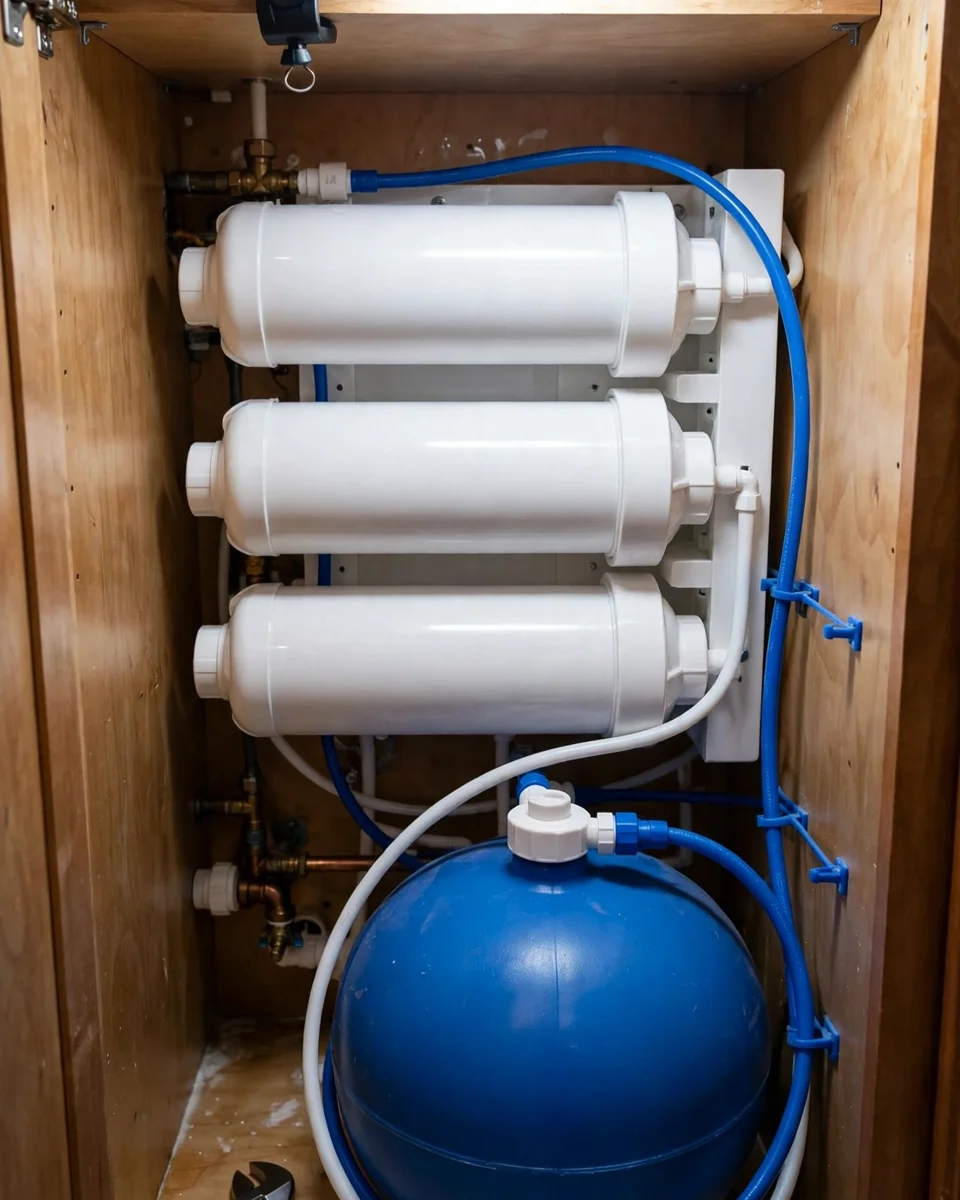
Yes — and the reason is mechanical, not chemical. A reverse osmosis system pushes tap water against a semipermeable membrane whose effective pores are fine enough to pass water molecules while holding back dissolved ions. Fluoride in drinking water exists as the fluoride ion, a dissolved solid like the sodium, calcium, and nitrate ions the membrane exists to reject. It cannot slip through with the water, so it leaves with the concentrated reject stream that goes to the drain. This is the same membrane physics whether the system sits under a sink or on a countertop — format changes convenience, not the separation.
Context for scale: US fluoridation targets about 0.7 mg/L fluoride in community water, and the EPA’s enforceable maximum is 4.0 mg/L. An RO membrane in good condition rejects fluoride at a rate broadly in line with its rated salt rejection — which for residential membranes is typically around 90% or better under rated test conditions — taking fluoridated tap water down to a small fraction of its starting level. The exact figure in a given home is a range, not a promise, and the science section explains what moves it.
What certifications prove

The RO standard is NSF/ANSI 58, which covers reverse osmosis drinking-water systems. Its baseline requirement is reduction of total dissolved solids (TDS) — the membrane performance test that everything else builds on. Beyond that baseline, a system can carry additional certified contaminant claims, and fluoride reduction is one of the optional claims a model may hold under NSF/ANSI 58. The practical move: before buying, check the specific model’s certified claim list in the NSF or IAPMO listings. If fluoride appears there, the system was tested for fluoride reduction under the standard’s conditions; if it does not, you are relying on the general membrane physics — sound, but unverified for that model.
Contrast that with the filters most people already own. Standard pitcher and refrigerator cartridges are carbon products certified, where certified at all, under NSF/ANSI 42 and 53 for taste, chlorine, and specific contaminants — fluoride is not among their claims, because plain carbon does not meaningfully adsorb it. “No claim” is the honest label, and any pitcher implying fluoride removal without an NSF/ANSI 58 listing behind it is leaning on words. The under-sink systems that carry the relevant certifications are compared in our best reverse osmosis system roundup.
What the science says

Membrane rejection is a rate, and rates have conditions. Four variables decide how much fluoride your system actually rejects. Feed pressure is the big one: membranes are rated at a specified pressure, and low household pressure lets a larger share of ions pass. Water temperature matters too — cold winter feed water thickens, output slows, and rejection can shift. Membrane age and condition set the ceiling over time; a membrane fouled by sediment or damaged by chlorine (which is why carbon pre-filters sit in front of it) rejects less each year. And system maintenance ties it together — spent pre-filters quietly tax the membrane on every glass.
You do not need a lab to watch this. The standard home check is a TDS meter on feed versus product water: the percentage drop is the system’s rejection rate, and when it falls below roughly 85–90%, the membrane is due for replacement. Fluoride tracks that overall rejection closely enough that a healthy TDS rejection is meaningful evidence your fluoride reduction is intact. One more rating caveat: a system’s nameplate output (its GPD figure) is a best-case lab rating — real-world daily output typically runs well below it, so treat capacity numbers as estimates when sizing a system, especially on low-pressure or cold-water homes.
Better options if RO is not the fit
RO is not the only route to lower fluoride, and it is not free of trade-offs: it also removes beneficial minerals along with everything else, produces a reject stream, and needs the under-sink space and a drain connection. If your only target is fluoride, the established alternatives are activated alumina media — a dedicated fluoride adsorbent used in purpose-built cartridges — and distillation, which leaves fluoride behind in the boiling chamber. Both are narrower tools than RO: they address fluoride specifically rather than the whole dissolved-solid spectrum. And if the mineral question is what is really holding you back, our comparison of RO water vs alkaline water covers remineralization and what actually changes in the glass. What does not belong on the list is a standard carbon pitcher or fridge filter — for fluoride, they are simply not the technology.
Conclusion
Reverse osmosis removes fluoride — that is settled membrane physics, backed by NSF/ANSI 58 certification for systems that carry the fluoride claim. Expect the large majority of fluoride to be rejected by a healthy membrane at decent pressure, verify your own system with a simple TDS rejection check, and replace the membrane when rejection slides. If fluoride is your only target and RO’s trade-offs do not suit your kitchen, activated alumina or distillation are the honest alternatives; a plain carbon pitcher is not one.
Update log
October 2026: Article published; certification framing per NSF/ANSI 58 (TDS baseline, fluoride as a listed optional claim). Real-world output figures are described as estimates relative to nameplate ratings; no brand-specific removal percentages are asserted.
FAQs
What percentage of fluoride does RO remove?
Under rated test conditions, residential RO membranes typically reject fluoride at rates comparable to their overall salt rejection — commonly around 90% or better. Your home figure varies with feed pressure, water temperature, and membrane condition, which is why a TDS rejection check on your own system is more useful than any single advertised percentage.
Does a Brita or fridge filter remove fluoride?
No — standard pitcher and refrigerator cartridges are carbon filters with no fluoride claim under NSF/ANSI 42/53, and plain activated carbon does not meaningfully adsorb fluoride. If fluoride reduction is the goal, the certified routes are reverse osmosis under NSF/ANSI 58, activated alumina media, or distillation.
How can I tell if my RO system is still removing fluoride?
Use a TDS meter: measure your tap water, then the RO product water, and calculate the percentage drop. That rejection rate is the standard proxy for membrane health, and fluoride rejection tracks it closely. When rejection falls below roughly 85–90%, replace the membrane — and make sure the pre-filters protecting it are on schedule too.
Does RO remove anything besides fluoride?
Yes — the membrane rejects most dissolved solids: sodium, calcium and magnesium (the hardness minerals), nitrate, and many others, which is why RO water tastes flat to some people and why remineralization cartridges exist. This broad rejection is the point of the technology; fluoride is simply one ion among many that cannot pass.
Is removing fluoride from drinking water safe?
That is a personal and dental-health decision rather than a filtration one. Fluoride is added to community water for dental health at about 0.7 mg/L, and the EPA’s enforceable limit is 4.0 mg/L. Filtration can lower your intake if that is your goal; questions about what level is right for your household belong with your dentist or clinician, who know your other fluoride sources.
Does countertop RO remove fluoride as well as under-sink RO?
Yes — the separation is the same membrane physics in both formats, and countertop systems can also be certified under NSF/ANSI 58. Differences are in capacity, speed, and convenience, not in whether the membrane rejects fluoride. Check the specific model’s certified claim list either way.