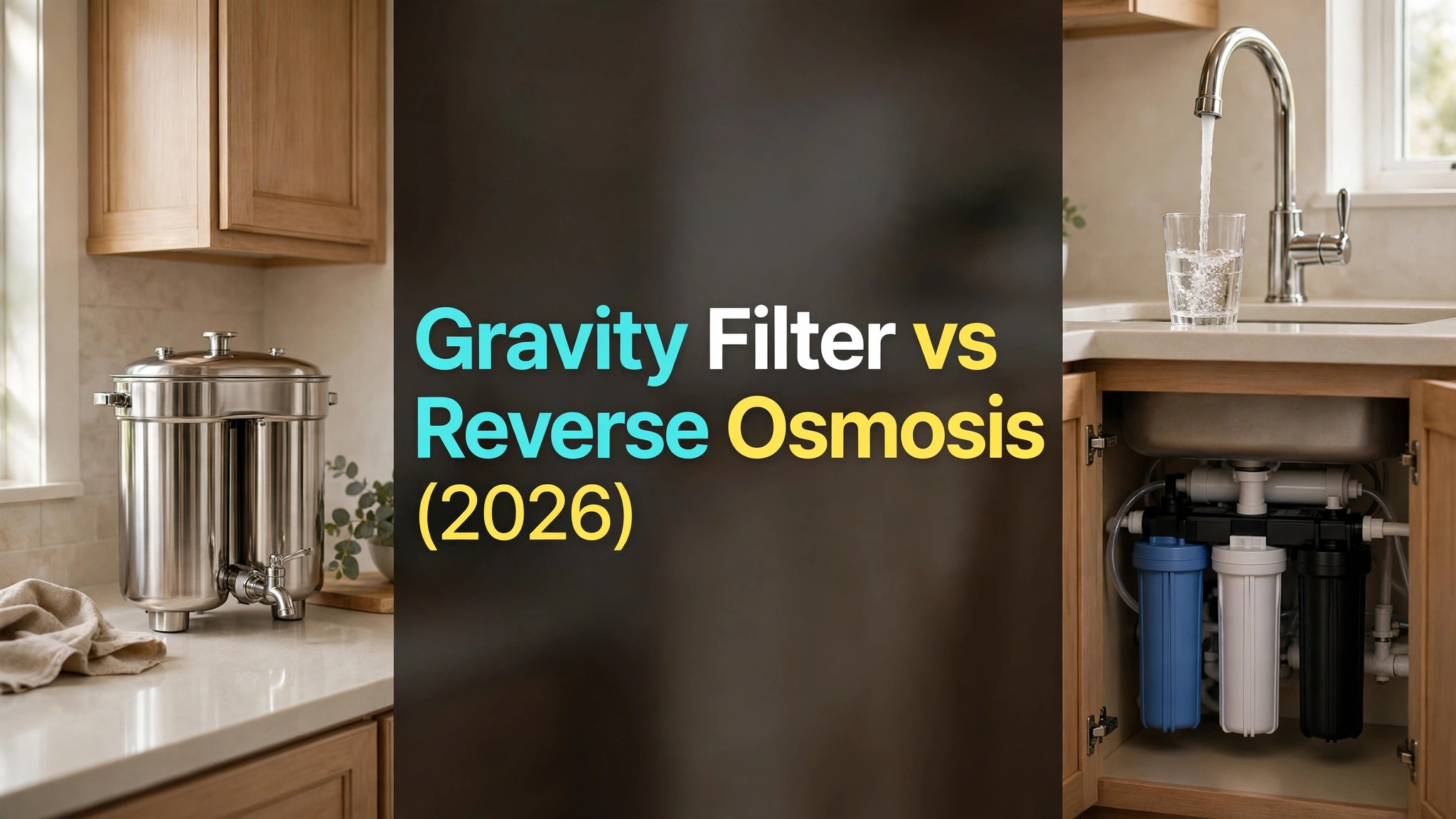

Gravity Filter vs Reverse Osmosis (2026)
Both of these sit in kitchens and both promise cleaner water, but they work on different principles and live in different worlds. A gravity filter is a pot, two chambers and patience — no power, no plumbing, no water pressure. Reverse osmosis is a membrane, a pump-free pressure system plumbed under your sink, and the deepest purification available at home. Choosing between them is really choosing which problem you have.
Here is the short answer: for everyday home drinking water, RO wins decisively — it removes 95–99% of dissolved solids including lead, PFAS, arsenic and nitrates, a class of contaminants gravity filters largely leave behind. For off-grid living, emergencies, rentals without plumbing access, or suspect water during an outage, gravity wins — it works when nothing else does, on water from almost any source. Depth versus independence: that is the whole comparison, and each side is genuinely better at its own game.
Deepest Home Purification · RO
Reverse Osmosis
~$190–230 per system
Removes dissolved contaminants gravity cannot touch — with certified, measurable performance.
Total Independence · Gravity
Gravity Filter
~$180–400 per system
Works with no power, pressure or plumbing — the emergency and off-grid champion.
Verdict: RO for the home you live in, gravity for the situations your home can’t handle. If your water comes from a tap and your worry is what’s dissolved in it, the membrane wins every time. If your water might come from a lake, a storage tank or a tap during a blackout, gravity is the only one of the two still working.
Table of Contents
Side-by-side comparison
Representative products: a British Berkefeld-class gravity system versus an iSpring RCC7-class under-sink RO.
| Gravity Filter | Reverse Osmosis | |
|---|---|---|
| Dissolved solids (TDS) removal | Minimal — not its mechanism | 95–99% |
| Lead / PFAS / arsenic / nitrates | Partial, element-dependent, often brand-claimed | Yes — membrane-grade removal |
| Chlorine, taste, sediment, cysts | Yes (certified candles excel at cysts) | Yes |
| Power / water pressure | None needed | Needs household pressure; some need a pump/outlet |
| Source water | Tap, rain, lake, stored — almost anything | Pressurized tap only |
| Speed | ~1–4 gal/hour, batch | On demand from tank / up to 800 GPD tankless |
| Waste water | None | ~1–4 gal per gallon purified (design-dependent) |
| System price | ~$180–400 | ~$190–230 (tanked); $400+ tankless |
| Running cost | ~$30–170/year by brand | ~$75/year |
Gravity filter — how it works

Fill the top chamber; water seeps through carbon-block elements or ceramic candles into the bottom chamber at one to four gallons an hour. That slowness is the mechanism — long contact time with the media — and also the lifestyle: gravity owners develop a fill-it-and-forget-it rhythm. What the media does well: chlorine, taste, sediment, and (with certified ceramic candles like Doulton’s) cysts and bacteria-sized particles. What it does not reliably do: strip dissolved solids. Salts, nitrates, arsenic and most dissolved metals pass through carbon and ceramic largely untouched, and PFAS/lead performance varies from “certified for some” to “brand-claimed” depending on the element. Gravity filtration is excellent filtration; it is not purification in the membrane sense.
Pros
- Works anywhere — off-grid, outages, camping, questionable sources.
- Zero waste water, zero utilities, zero plumbing.
- Certified options exist for cysts/emerging compounds (Berkefeld candles).
Cons
- Dissolved contaminants mostly pass — TDS barely changes.
- Slow and batch-based; a thirsty household refills daily.
- Counter space, permanently — it is furniture, not an appliance under a sink.
Reverse osmosis — how it works
Household water pressure forces water through a semipermeable membrane; dissolved material — the ions and molecules carbon cannot catch — is rejected to the drain. The result is 95–99% TDS reduction you can verify with a $15 meter, and with it, membrane-level reduction of lead, PFAS, arsenic, fluoride and nitrates. Systems like the iSpring RCC7 carry NSF/ANSI 58 certification for the whole system. The costs are infrastructure: a cold-water tap-in, a drain connection, a faucet hole, storage-tank or tankless space, and reject water (roughly 1–4 gallons per gallon purified depending on design, with modern tankless units at the efficient end). And it only drinks from a pressurized line — during an outage, an RO is furniture too. Our RO systems roundup ranks the current models, and RO vs alkaline covers the pH question owners always ask next.
Pros
- Deepest verified purification available at home — dissolved contaminants included.
- On-demand abundance — no batches, no waiting on drips.
- Cheap to run — ~$75/year, hidden under the sink.
Cons
- Needs pressure and plumbing — useless off-grid or in an outage.
- Wastes water at the drain by design.
- Strips minerals (remineralization is an add-on, taste-level concern).
Certifications
RO systems certify to NSF/ANSI 58 — a whole-system standard covering TDS reduction and the specific contaminant claims in each listing. Gravity has no single equivalent: certifications attach to elements (Doulton candles to 401/53; Phoenix to 42/372; Boroux to 42/401), and the biggest gravity name, Berkey, holds none at all. Read gravity claims element-by-element and standard-by-standard; the urn itself certifies nothing. This asymmetry — system-level proof versus element-level patches — is a fair summary of the whole comparison.
Compatibility & installation
Gravity: unbox, rinse/prime elements, set on a counter or stand, done in fifteen minutes — but reserve the counter space and the height (19–30 inches by model) forever. RO: a one-to-two-hour under-sink install (feed valve, drain saddle, faucet), or a plumber’s short visit; renters should look at countertop RO units or get written permission. Flow needs differ starkly: gravity households plan around batches (fill at night, draw all day), RO households never think about water quantity at all. Well owners note: RO wants 40+ psi and pre-treated iron/sediment; gravity tolerates far rougher input.
Cost per year
- RO (tanked, RCC7 class): ~$190–230 in + ~$75/year → five-year ≈ $565–605, at ~3–5¢ per gallon.
- Gravity: ~$180–400 in; consumables from ~$30/year (long-life carbon elements at brand ratings) to ~$170/year (ceramic candle rhythm) → five-year ≈ $330–1,250 depending on brand.
- The hidden line items: RO “wastes” water you pay for twice (supply + sewer) — typically a few dollars a month. Gravity wastes your counter and your minutes — which some owners price higher.
What owners say
RO owners talk like people who solved a problem permanently — the TDS reading is their trophy. Gravity owners talk like people who bought resilience — outage stories and off-grid trips are their trophies. The unhappy owners on both sides made the same mistake in mirror image: gravity buyers who needed lead or nitrate removal and discovered TDS unchanged, and RO buyers who expected it to work during a blackout. Both products keep their promises; the failures are mismatched expectations, which is what comparisons like this one are for.
Which should you buy?
Pick reverse osmosis if…
Your water is municipal or well water on a pressurized line and your concerns include lead, PFAS, arsenic, nitrates or general dissolved contamination. It is the strongest verified purification your money buys at home. Start with the RO roundup.
Pick a gravity filter if…
You live off-grid, prepare for outages, rent without install rights, draw from rain or surface sources, or your concerns are chlorine, taste and cysts rather than dissolved chemicals. Our Berkey alternatives and gravity roundup rank the current field.
Buy both if…
Serious preparedness households do exactly this: RO for daily purity, a gravity urn in the closet for the week the utilities fail. The two are complements pretending to be rivals.
How we researched
Removal figures are the documented class standards: 95–99% TDS rejection for RO membranes (NSF/ANSI 58 system certifications, e.g., iSpring RCC7), and element-level certifications for gravity (Doulton candle listings; brand ratings labeled as such). Prices are October 2026 street estimates. Owner patterns summarize retailer and forum themes across both categories. We did not run lab tests, and contaminant claims for gravity elements are stated only to the scope each element’s certification or brand data supports.
FAQs
Which removes more contaminants — gravity filter or reverse osmosis?
Reverse osmosis, by a wide and measurable margin. An RO membrane removes 95–99% of dissolved solids, including lead, PFAS, arsenic, fluoride and nitrates. Gravity filters excel at chlorine, taste, sediment and — with certified ceramic candles — cysts, but dissolved contaminants largely pass through carbon and ceramic media. If dissolved chemicals are the concern, RO is the answer; if the concern is chlorine, taste or off-grid capability, gravity does its job well.
Can a gravity filter make lake or rain water safe?
It can substantially improve it — that is gravity’s home turf. Certified ceramic candles reduce cysts and bacteria-sized particles, and carbon elements improve taste and chemical load. But no gravity filter guarantees virus removal or sterile water, and dissolved contamination is not its strength. For genuinely suspect sources, treat gravity output as greatly improved water, and add boiling or disinfection when the source is high-risk.
Does reverse osmosis work without electricity?
Classic tanked RO systems run on water pressure alone — no electricity — but they still need pressurized tap water, so a power outage that stops your well pump or municipal pressure stops the RO too. Tankless RO models need electricity for their pumps and displays. A gravity filter needs neither power nor pressure, which is why it is the default recommendation for outages and off-grid use.
Which is cheaper to run — gravity or RO?
It depends on the gravity brand. A tanked RO runs about $75 a year in filters and membranes. Gravity consumables range from roughly $30 a year (long-life carbon elements at brand gallon ratings) to about $170 a year (ceramic candles on a six-month rhythm). System prices overlap ($180–400 gravity; $190–600 RO), so five-year totals land in similar territory — the decision should turn on purification needs and independence, not cost.
Conclusion
Gravity filter vs reverse osmosis resolves the moment you name your scenario. Piped home, dissolved contaminants, maximum verified purity: reverse osmosis, and it is not close. No utilities, doubtful sources, emergency resilience, or a simple chlorine-and-taste brief on a budget of counter space: gravity, proudly. The households that understand both technologies often end up owning both — a membrane for the everyday, an urn for the day everything else stops.
Price checked at time of writing; it changes often — see the live price before you buy.
Update log
- Zulqarnain: Review published.