
Should You Test Your Water Before Buying a Filter? (2026)
Guide
Walk into any filter aisle — physical or online — and the pitch is the same: assume your water is full of problems and buy the system that promises to fix all of them. So people buy a softener for water that turns out to be barely hard, an RO system to cure a chlorine taste a $30 cartridge would have handled, or a pitcher for a lead concern no pitcher in the box was certified to touch. Filter regret is rarely about bad products. It is about buying the answer before anyone asked the water a question.
The short answer: yes — test first, in almost every case. Start free with your utility’s water quality report, add cheap home screening for the tuning numbers, and pay for a certified lab test only when a health decision or a big purchase depends on it. A week of measuring routinely saves hundreds on hardware — and it is the only way to know the filter you bought actually fixed anything.
Table of Contents
Quick verdict
Testing before buying is not homework for its own sake — it is how you avoid the three classic mistakes: over-buying (RO for a taste problem), under-buying (a taste filter for a lead problem), and wrong-target buying (a softener when the complaint was iron). The ladder is simple: report (free) → strips and meter (about $20) → certified lab (only when the decision is health or hundreds of dollars). Our best water test kits roundup covers the lab end of that ladder for city and well water alike.
What buying blind actually costs
Every filter technology has a list it handles and a list it ignores. Carbon ignores dissolved solids; RO ignores nothing dissolved but wastes water and cabinet space doing it; softeners swap minerals rather than removing contaminants; pitchers do a little of a few things. Buy without a measurement and you are matching your water to those lists by vibes. The predictable outcomes: an RO system idling under the sink of a home whose only issue was chloramine taste; a whole-house carbon tank installed to lower a TDS number carbon cannot move; a family reassured by a new pitcher while the actual lead source — their own pre-1986 solder — keeps leaching. None of those products failed. The diagnosis did. Testing is the diagnosis, and it is dramatically cheaper than any of the hardware.
Step 1: the free test you already own

If you are on a public supply, your utility is legally required to test your water constantly and publish the results in an annual Consumer Confidence Report — free online, usually searchable by zip code. It names what was detected, at what level, and how that compares with federal limits: lead and copper results, nitrate, disinfection byproducts, PFAS where monitored, hardness in many reports. Read it before spending a cent; for a large share of city households it answers the shopping question outright (“your water is fine; your issue is taste”) or names the one thing worth treating. Its limits are real but specific: it describes water at the treatment plant and in the mains, averaged over time — not what your own plumbing adds on the last fifty feet, which is exactly why step 3 exists for older homes. Well owners skip this step; their report is a lab panel, as our well water test kit guide explains.
Step 2: screen at home for the tuning numbers
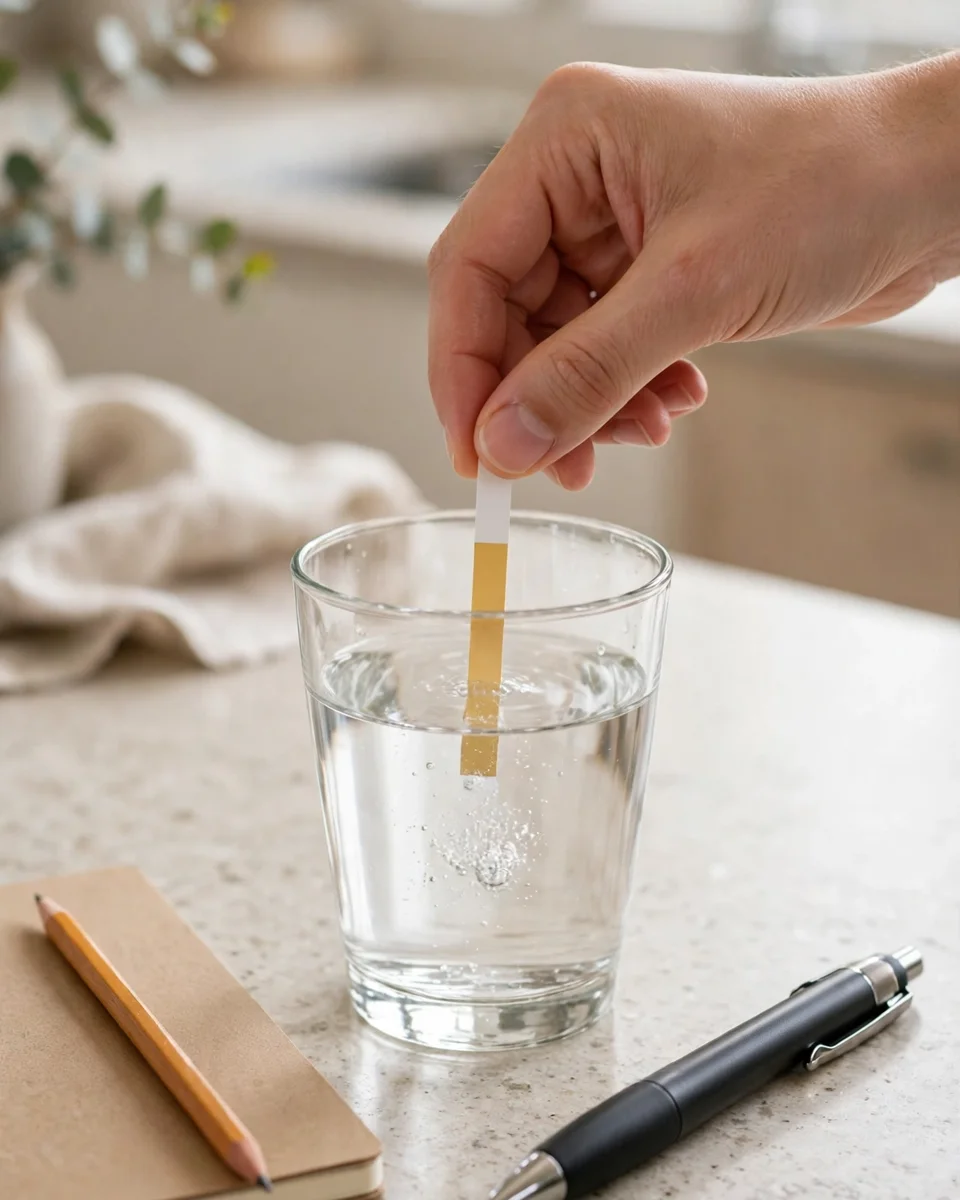
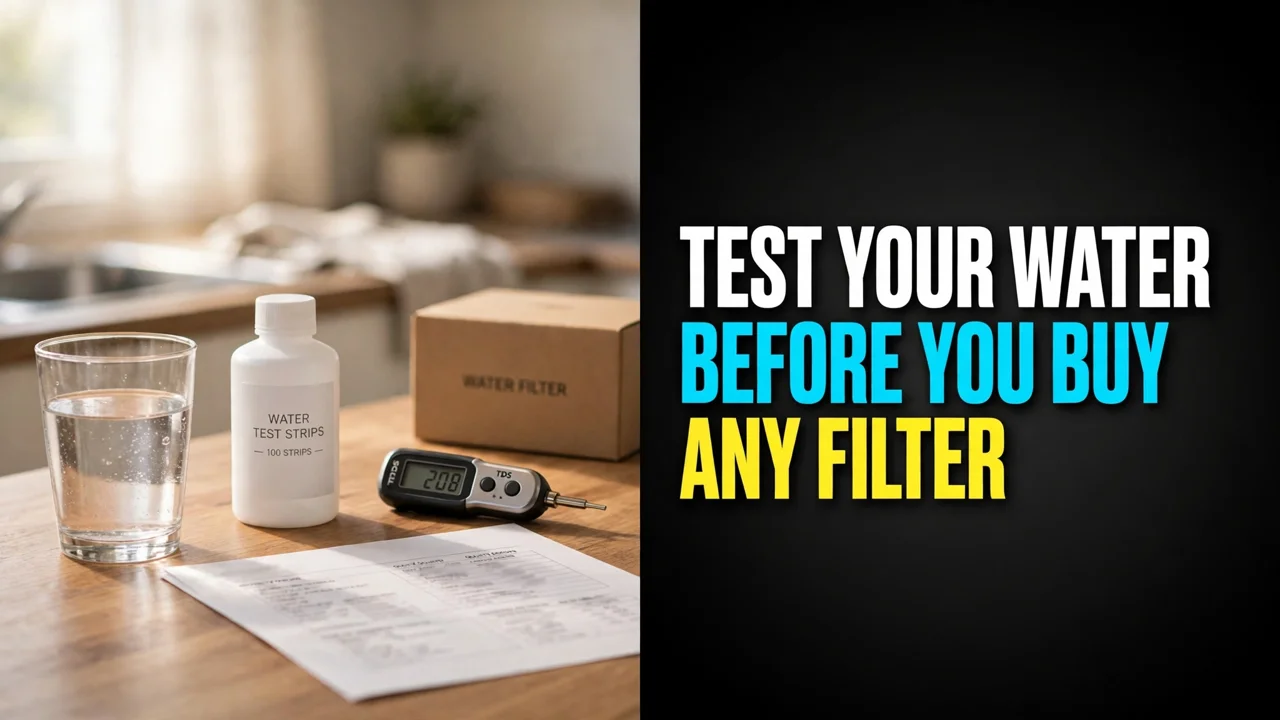
Twenty dollars of screening tools covers the numbers that most equipment decisions actually turn on. Hardness decides whether a softener is a necessity or a luxury — and what size. Chlorine or chloramine presence decides the carbon type and contact time you need. pH flags corrosive water that attacks plumbing (and adds metals you would then blame on the source). A TDS meter gives the baseline your future RO membrane will be judged against. Keep the roles straight, though: as our test strip accuracy guide details, strips sort water into bands — perfect for tuning, wrong tool for verdicts. The head-to-head in our test strips vs lab test comparison shows precisely which questions each method can and cannot settle.
Step 3: when the lab earns its fee
Escalate to a certified lab test — typically $100–400 depending on panel size, as 2026 estimates — when any of these hold: your home predates 1986 or sits on a lead service line and children live there; you are on a private well (the full panel is your annual baseline, not an upgrade); your report or geography raises PFAS or arsenic questions; a symptom (staining, odor, illness) has no explanation from steps 1 and 2; or you are about to spend serious money — a whole-house system, say — and want the sizing grounded in numbers rather than a sales visit. Note the pattern: the lab fee is justified by the size of the decision it informs. Our home test vs lab test guide breaks down turnaround and what a proper panel includes.
Matching results to filters
| What the test says | What actually fixes it | What people buy blind instead |
|---|---|---|
| Chlorine taste, everything else clean | Any carbon filter, sized to your flow | A full RO system (works, but triple the cost and upkeep) |
| Lead detected at the tap | NSF/ANSI 53-certified lead filter or RO; then plumbing fixes | A basic taste pitcher with no lead certification |
| Hardness 3 gpg (barely hard) | Nothing, or a small point-of-use softener | A whole-house softener plus years of salt |
| Nitrate above 10 mg/L (well) | RO or ion exchange at the drinking tap | A carbon whole-house tank (nitrate passes through) |
| High TDS, salty taste | RO — the only household tech that lowers TDS | More carbon, in bigger housings |
| Iron staining (well) | Oxidation/iron filtration, then softening | A softener alone, which fouls within a season |
Test-first buyers get
- A filter matched to a named problem, with a certification to check.
- A baseline number — so the filter’s performance can be verified after install.
- Smaller hardware: point-of-use where the problem lives, not whole-house by default.
- Evidence if a vendor’s claim does not survive your own tap.
Blind buyers get
- Whatever the best-marketed box promised, fitted to water nobody measured.
- No baseline — so “is it working?” stays a matter of taste and faith.
- Surprise upkeep: membranes, salt, and cartridges sized for problems they may not have.
- A second purchase later, when the first system misses the real issue.
Conclusion
Should you test your water before buying a filter? If the purchase costs more than the test — and nearly every real filter does — the answer is yes by arithmetic alone. The report is free, the screening is twenty dollars, and the lab is a fraction of a whole-house system. What you get for that patience is the only thing filter shopping actually needs: a named problem, a technology certified against it, and a baseline to prove the fix worked. Buy in that order and the filter aisle stops being a casino.
Update log
October 2026: Guide published; costs are 2026 estimates from current listings; regulatory reference points per EPA drinking-water standards and utility Consumer Confidence Report requirements.
FAQs
Is a water test really necessary for a simple pitcher filter?
For a $30 pitcher bought for taste, honestly, no — the free utility report is enough homework. Testing earns its keep as the purchase grows: under-sink systems, softeners, RO, and anything bought to address a health concern like lead or nitrate. Match the diligence to the dollars and the stakes.
What should I test for before buying a filter?
Start with what your utility report already shows, then the basics that drive equipment choice: hardness, pH, chlorine or chloramine, iron, and TDS. Add lead if your home or service line predates 1986, nitrate and bacteria for wells, and PFAS or arsenic where local data suggests them. A broad certified panel covers all of it in one sample.
Can I just use test strips and skip the lab?
For tuning numbers — hardness, chlorine, pH — strips are genuinely enough, and they are the right tool for sizing a softener. For health decisions they are not: their color bands are too coarse at the low levels where lead and nitrate decisions live, and they cannot detect bacteria or PFAS at all. Strips screen; labs decide.
How much does pre-purchase testing cost in total?
As 2026 estimates: $0 for the utility report, roughly $15–25 for strips plus a basic TDS meter, and $100–400 if you escalate to a certified lab panel. Set against the price of the wrong softener or RO system — plus a year of its cartridges — the full ladder usually pays for itself on the first avoided mistake.
My water tastes fine. Do I still need a test?
Taste detects chlorine and minerals; it is blind to the contaminants that matter most — lead, nitrate, PFAS, and bacteria are all tasteless at levels worth acting on. If your home is newer, on a monitored public supply, and the utility report is clean, you have effectively already tested. If any of those conditions fail, a lab panel buys certainty your palate cannot.
Should I test again after installing the filter?
Yes — that is the second half of the test-first bargain. A follow-up on filtered water verifies the system does what its certification promises, catches installation mistakes early, and sets the baseline for judging cartridge changes later. For RO, a TDS meter comparison takes a minute; for lead or PFAS, one confirmation lab sample is worth the fee.