Test Strips vs Lab Water Test (2026)
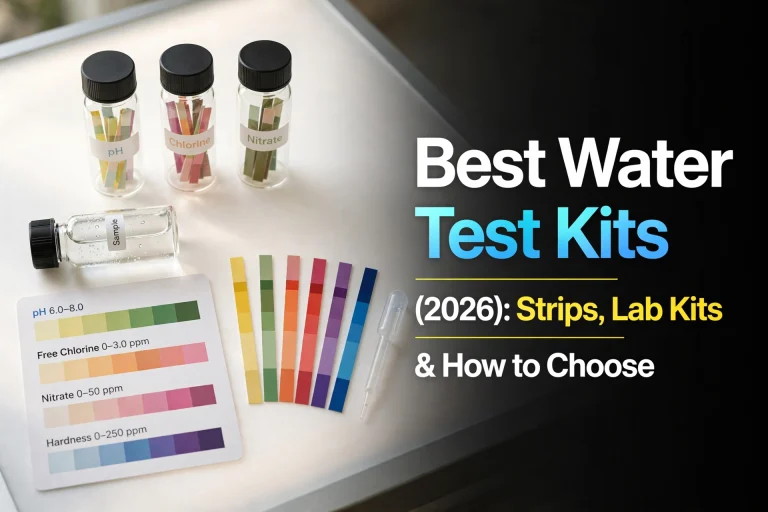
A test strip promises sixteen answers in sixty seconds for twenty cents. A lab test promises one answer in ten days for two hundred dollars. Both promises are honest — about different things. The strip tells you roughly where your water sits on a handful of scales, right now. The lab tells you exactly what is in it, in numbers that survive scrutiny. Most confusion in home water testing comes from asking one to do the other’s job.
Here is the short answer: strips are a monitoring instrument; the lab is a measuring instrument. For pH, hardness and chlorine trends, strips are genuinely useful and absurdly cheap. For anything with a health threshold — lead above all — strip readings are too coarse to clear or convict your water, and “lead pads” on multi-parameter strips are the most misleading squares in the industry. The lab wins every decision-grade question; strips win the weekly habit. This page drills into strips specifically; our home test vs lab comparison covers the wider DIY kit family.
For Any Real Answer · Lab
Lab Water Test
~$60–300 by panel
Measured concentrations with detection limits below health thresholds — the only verdict-grade result.
For Trends & Habits · Strips
Test Strips
~$0.15–0.25 per test
A minute, pennies, sixteen rough readings — brilliant for monitoring, barred from verdicts.
Verdict: strips for the dashboard, lab for the diagnosis. If a strip result would change what you do — remediate, buy a system, let a baby drink it — it has just promoted itself into a lab test. Everything else, the strip handles beautifully for two dimes.
Table of Contents
Side-by-side comparison
| Test Strips | Lab Test | |
|---|---|---|
| Time to result | ~1 minute | ~5–14 days |
| Cost per test | ~$0.15–0.25 | ~$60–300 per panel |
| Readout | Color between chart blocks | Number with units & detection limit |
| pH / hardness / chlorine | Useful trend accuracy | Precise |
| Nitrates | Rough band only | Precise — decision-grade |
| Lead | Misleadingly coarse | Precise to ~1 µg/L and below |
| Bacteria / PFAS | Not tested | Yes (culture / LC-MS panels) |
| Shelf life | Months; humidity-sensitive | Samples are fresh by protocol |
Test strips — parameter by parameter

Not all sixteen pads deserve equal trust. pH strips are respectable — the chemistry is simple and the scale forgiving. Hardness and chlorine read usefully in bands, perfect for “is the softener working” and “did the filter change anything.” Alkalinity is a fair trend indicator. Nitrate pads are rough — good enough to notice a big elevation, not to judge against the 10 mg/L standard. And the metals pads (lead, copper, iron) are where marketing outruns chemistry: a lead pad that resolves in bands around 5–15+ µg/L cannot tell you whether you are under the 15 µg/L action level with any confidence, and a “zero” color is not a measurement of zero. Read strips for the parameters where bands suffice, and the product is excellent value. Ask them for verdicts and they will happily fake them.
Pros
- Instant and nearly free — the only testing cheap enough to be a habit.
- Honest utility on pH, hardness, chlorine trends.
- No sampling protocol — dip, wait, read.
Cons
- Metals pads are verdict-grade theater — especially lead.
- Eye-read colors vary with light, timing and the reader.
- No bacteria, no PFAS, no defensibility.
Lab testing — parameter by parameter
The lab’s advantage compounds exactly where strips are weakest. Lead comes back as a number with a detection limit around a microgram per liter — fifteen times finer than the action level you are judging against. Nitrates resolve to tenths. Bacteria are cultured and counted by standardized methods. PFAS — utterly beyond strips — are measured in parts per trillion by mass spectrometry on dedicated panels (see our PFAS roundup). Even the humble parameters gain: a lab pH is a decimal, not a color. The price of all this is the familiar pair — money and days — plus sampling discipline: first-draw technique for lead, sterile bottles and deadlines for bacteria.
Pros
- Decision-grade on every parameter, including the dangerous ones.
- Defensible with buyers, landlords, officials and doctors.
- One panel covers 100+ analytes.
Cons
- $60–300 and 5–14 days.
- A snapshot, not a monitor — which is why strips survive alongside it.
Methods & standards
Strips are colorimetric pads: reagents that develop color in proportion to concentration, read by eye against printed blocks — the same chemistry family as lab colorimetry, minus the photometer, the calibration curve, the blanks and the analyst. Labs run standardized methods on calibrated instruments with quality-control samples in every batch; mail-in services like Tap Score and state labs operate under those disciplines, and their reports state methods and limits. A strip’s chart, by contrast, is a promise printed on a bottle. Use each accordingly.
How each is used
Strips: dip for the stated seconds, hold level, read at the stated moment (not “when you get to it” — colors keep developing), in daylight, and log the result; trends across weeks are the strip’s real output. Lab: choose the panel by your question, sample by the protocol — first-draw after 6+ hours of stagnation for lead, sterile and swift for bacteria — ship same day, read the report against the benchmarks it prints. Cross-using the disciplines is the classic error: a strip read casually is noise, and a lab sampled casually is expensive noise.
Cost per year
- Strips alone: a 100–150 strip bottle (~$15–25) covers a year of weekly dipping → ~$20/year.
- Lab alone: one broad panel → ~$165–265/year if repeated annually (less often for stable city water).
- The professional pattern: lab baseline + strips for the parameters that move (hardness after a softener, chlorine after a filter, seasonal nitrate watch on wells) → ~$50–90/year averaged, and every number that matters is a lab number.
What users say
Strip devotees — pool owners moonlighting in drinking water, softener tinkerers, aquarium crossovers — swear by the habit and post logs. Strip critics are usually people who asked a pad for a lead verdict and later met a lab report. Lab users report the same arc as in our wider comparison: impatience at the wait, relief at the decimal point. The overlap community — lab once, strips forever — is the happiest and, not coincidentally, the pattern this page recommends.
Which should you buy?
Pick strips if…
You are monitoring something understood: softener output, filter performance, seasonal well drift, a pitcher habit. Buy a reputable 16-in-1 bottle (SJ Wave / JNW class) from our roundup’s budget pick and log honestly.
Pick the lab if…
The question has a threshold and a consequence: lead in an old home, nitrates near a baby, PFAS in the news, a purchase or a dispute. No strip result — good or bad — should close those files.
Buy both if…
You own a well, a softener, or a filtration system — which is to say, you own water parameters that move. Lab for the map, strips for the weather.
How we researched
Per-parameter strip performance is characterized from the documented behavior of colorimetric pad chemistry and the strips’ own published resolution bands (the charts themselves concede the band widths this page criticizes), against laboratory method performance as documented by the mail-in and public labs’ published detection limits. Prices are October 2026 street estimates. We did not run split-sample experiments; no invented precision figures appear anywhere in this comparison.
FAQs
Are water test strips accurate enough for lead?
No. Lead test pads resolve in wide bands that straddle the 15 µg/L EPA action level, so a strip cannot reliably tell you whether your water is above or below the threshold that matters — and a reassuring color is not a measurement. Lead decisions (children in the home, remediation, filtration purchases) deserve a laboratory number from a first-draw sample, which resolves to about 1 µg/L or finer.
What are test strips actually good for?
Monitoring trends in the forgiving parameters: pH, hardness, chlorine and alkalinity, where a band reading answers real questions — is the softener still softening, did the new filter change the chlorine, is the well drifting this season. At roughly twenty cents a dip they are the cheapest water habit there is. Their failures begin where thresholds and health decisions begin.
How accurate are lab water tests compared to strips?
Orders of magnitude more precise. A lab reports concentrations from calibrated instruments running standardized methods — lead to ~1 µg/L, nitrates to tenths of a mg/L — with quality-control samples validating each batch. A strip reports which of several printed color blocks your pad most resembles. Both have roles; only one produces numbers you can compare against health standards with confidence.
My strip shows something worrying. What should I do?
Repeat the strip carefully first — correct dip time, read time, daylight — because technique explains many scares. If it persists, that result has done its job: escalate to a lab test targeted at the parameter (a lead panel, a nitrate number, a full panel if several flags wave). Do not remediate, buy systems, or relax permanently on a strip’s say-so in either direction.
Conclusion
Test strips vs lab testing ends in a division of labor, not a winner’s podium. Strips are the finest monitoring tool twenty cents can buy — instant, broad, and truthful about trends in the parameters where bands suffice. The lab is the only measuring instrument in the conversation — slow, expensive, and exact where exactness is the difference between reassurance and a guess. Dip weekly if you like; decide never on a dip.
Price checked at time of writing; it changes often — see the live price before you buy.
Update log
- Zulqarnain: Review published.