Shower Filter vs Whole-House Filter (2026)
Chlorine in your shower is the complaint — but does fixing it take a $35 cartridge on the showerhead or a $1,000 tank on your main line? Both products treat the same water. They differ in where they sit, what else they treat, how long their media lasts, and who is allowed to install them.
Here is the short answer: a shower filter is the right buy when the shower is the only place the water bothers you — five minutes, no plumber, renter-safe. A whole-house filter is the right buy when chlorine, sediment or taste bother you at every tap — it treats the kitchen, the bath, the laundry and the water heater’s feed in one installation, and its carbon media lasts years instead of months. Homeowners with a whole-home complaint should skip straight to the tank; everyone else starts at the showerhead. Our companion comparison, shower filter vs water softener, covers the hardness side of the family.
For Homeowners · Every Tap
Whole-House Filter
~$900–1,500 installed
One installation treats every shower, tap and appliance — with media that lasts 5+ years.
For Renters & Single Complaints
Shower Filter
~$35–80
The same chlorine fix at one shower, for about 4% of the price and none of the plumbing.
Verdict: coverage decides it. One problem shower → the $35 filter wins on value so completely it is not a contest. A house-wide chlorine, sediment or taste problem → the whole-house system wins because five shower filters still leave the kitchen, bath and laundry untreated. Choose by how much of your home the complaint touches.
Table of Contents
Side-by-side comparison
Representative products: an AquaBliss-class shower filter versus a SpringWell-class whole-house carbon system.
| Shower Filter | Whole-House Filter | |
|---|---|---|
| Coverage | One shower | Every tap, bath, shower, appliance |
| Treats | Chlorine (some chloramine) at the shower | Chlorine, chloramine*, sediment, taste/odor house-wide |
| Media life | ~3–6 months per cartridge | ~5–10 years per carbon tank (brand-rated) |
| Price | ~$35–80 | ~$900–1,500 installed |
| Running cost | ~$40–60/year | ~$30–60/year averaged (pre-filter + media) |
| Install | 5 minutes, hand-tight | Plumber or confident DIY, main line |
| Renters | Yes | No |
*Chloramine needs catalytic carbon; confirm your system’s media before assuming chloramine coverage.
Shower filter — the point-of-use fix

The shower filter’s pitch is focus: all of its media serves one showerhead, so a $35 cartridge delivers chlorine reduction where you stand in the water for ten minutes a day. Installation is genuinely five minutes and fully reversible, which is why it is the only option in this comparison open to renters. The weaknesses are structural: every other outlet in the home gets untreated water (fill a bath for the kids and you are back to tap water), cartridges exhaust in months, and at shower flow rates contact time is short, so chloramine reduction in budget models is limited. Pick from the certified end of the market where you can — our shower filter roundup names the NSF/ANSI 177 models.
Pros
- ~$35 and five minutes to a chlorine-free shower.
- Renter-safe and fully reversible.
- Zero plumbing risk — nothing to leak but a threaded joint.
Cons
- One shower only — every other tap untreated.
- Cartridges every 3–6 months, forever, per shower.
Whole-house filter — the point-of-entry fix
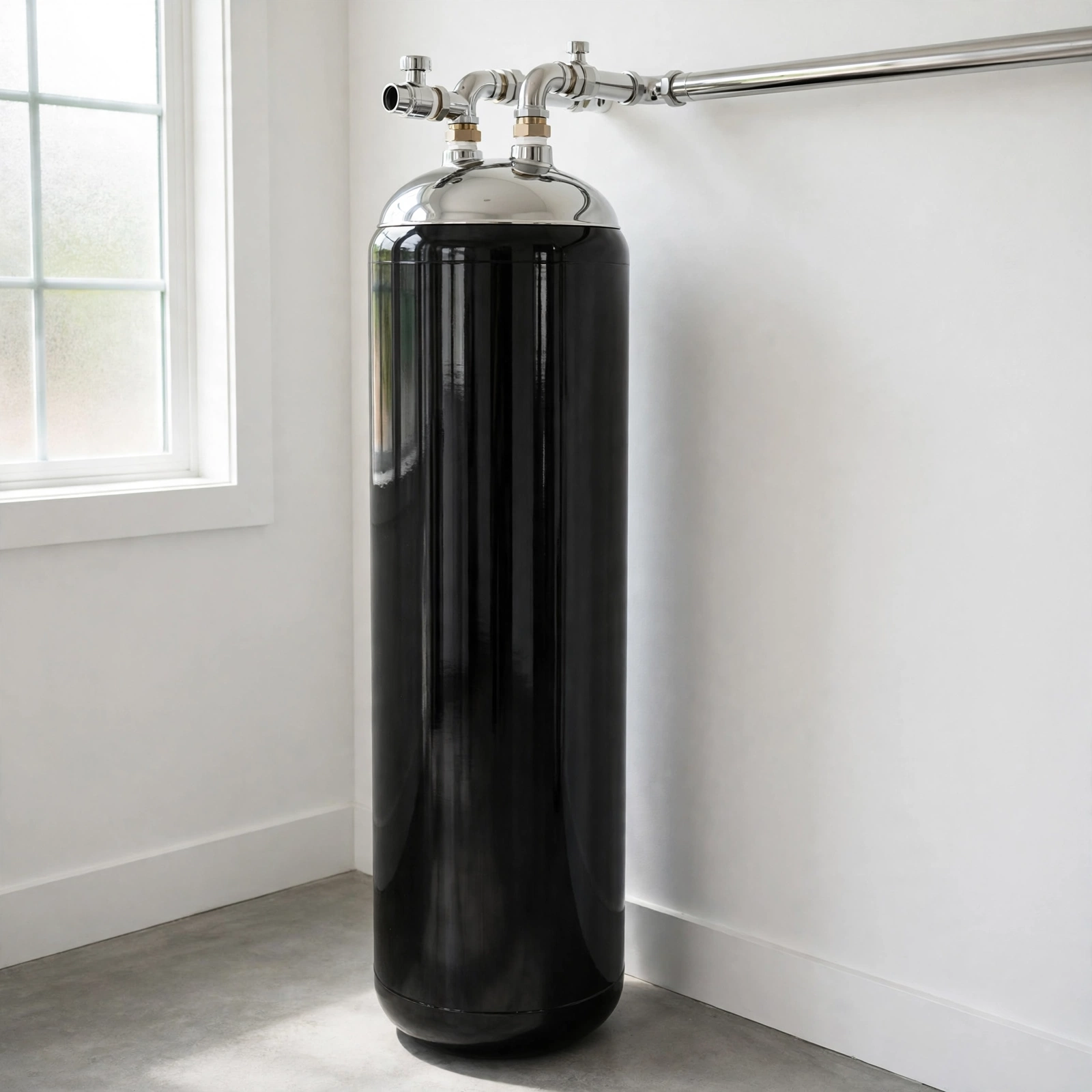
A whole-house carbon system (SpringWell CF-class, ~$900–1,200 before installation) sits on the main line and treats everything: chlorine and sediment gone at the kitchen tap, the bath, the laundry and every shower; water-heater and appliance feeds included. The big carbon tank’s media is brand-rated for five to ten years, so the running-cost story flips the shower filter’s: expensive day one, cheap decade. What it does not do — in carbon-only form — is soften water or remove dissolved contaminants like lead or PFAS to drinking-water standards; those remain point-of-use jobs (an under-sink RO’s, specifically). It also demands a home you own, a main-line location with a drain nearby, and a plumber’s visit or a brave DIY weekend. Whole-house owners who also want softening look at combo filter/softener systems — the territory of our softener comparison.
Pros
- Every outlet treated — showers, baths, kitchen, laundry, appliances.
- Media lasts years — the lowest hassle-per-year in home filtration.
- Protects the plumbing ecosystem — chlorine degrades rubber seals and gaskets over time.
Cons
- ~$900–1,500 installed and a permanent plumbing change.
- Not a purifier — no lead/PFAS-grade removal, no softening in carbon form.
- Owners only, with space at the main line required.
Certifications & standards
Shower filters certify to NSF/ANSI 177 (free chlorine reduction) — held by only a few models. Whole-house systems reference NSF/ANSI 42 for their carbon media’s chlorine and taste claims, though whole-system certification varies by brand and many sell on media certification plus third-party test data instead. Either way, the same discipline applies as everywhere in filtration: a certifier and a standard number you can look up beat a badge you cannot. One caution unique to this comparison — a whole-house carbon tank is not certified as a drinking-water purifier, and should not be asked to be one.
Compatibility & installation
Shower filter: universal 1/2-inch shower-arm thread, hand tools not required, ten minutes including the flush. Whole-house: needs the main water line (usually near the water heater or where the line enters), a bypass loop in the install, space for a tank roughly 4–5 feet tall, and sizing by flow (a family home wants a system rated around 10–15 GPM so showers and laundry can run together without pressure sag). Well owners add a sediment pre-filter almost by default. If your home has PEX, a confident DIY install is realistic; copper usually means a plumber.
Cost per year
- Shower filter: ~$35–80 in, then ~$40–60/year per shower in cartridges. Three showers = ~$120–180/year — the whole-house math starts calling.
- Whole-house carbon: ~$900–1,500 installed; pre-filter cartridges ~$30–50/year; carbon media replacement every 5–10 years (~$300–500) → five-year ≈ $1,200–1,900, or ~$240–380/year all-in for the whole home.
- Per-outlet lens: a house with 6+ outlets pays roughly $40–60 per outlet per year for the tank — suddenly comparable to one shower filter, while covering everything.
What owners say
Shower-filter owners are happy exactly as long as the shower was the whole complaint; the recurring disappointment is discovering the bath and kitchen still taste of the pool. Whole-house owners describe a quieter satisfaction — “the whole house just smells less like a swimming pool” — plus relief at forgetting filtration exists for years at a stretch. Multi-shower households are the crossover story: the second or third shower filter is usually the purchase that precedes a whole-house install within a year.
Which should you buy?
Pick the shower filter if…
You rent, your complaint lives in one shower, or you want to test whether chlorine is really your problem for $35 before committing to anything. Certified picks are in our roundup.
Pick the whole-house filter if…
You own the home, chlorine or sediment bothers you at multiple outlets, you fill baths, or several showers would each need filters. One install ends the complaint everywhere and amortizes to shower-filter money per outlet.
Buy neither if…
Your real target is drinking-water contaminants (lead, PFAS) — that is an under-sink RO’s job, not either product here — or hardness, which is a softener’s. Match the machine to the contaminant, not to the room.
How we researched
Treatment scopes follow the documented technologies: point-of-use chlorine media for shower filters (NSF/ANSI 177 scope) and point-of-entry activated/catalytic carbon for whole-house systems (NSF/ANSI 42 media claims), with the chloramine-needs-catalytic-carbon caveat stated in the table. Prices are October 2026 street estimates (AquaBliss-class ~$35–40; SpringWell-class systems ~$900–1,200 before installation). Media-life figures are brand ratings. We did not run lab tests.
FAQs
Is a whole-house filter better than a shower filter?
Better at coverage, not at the shower itself. A whole-house carbon system treats chlorine at every outlet — showers, baths, kitchen, laundry — with media that lasts years, for roughly $900–1,500 installed. A shower filter treats one shower for about $35 in five minutes. If the shower is your only complaint, the shower filter delivers the same in-shower result for a small fraction of the cost; if the complaint is house-wide, only the whole-house system actually solves it.
Does a whole-house filter remove the need for a shower filter?
For chlorine, yes — water reaching the shower has already been treated at the main line, so a shower filter adds little (some owners keep one purely as fresh-media insurance, but it is redundant). What a whole-house carbon system does not replace is drinking-water purification: lead and PFAS-grade removal still belongs to a point-of-use system like an under-sink RO at the kitchen tap.
How long does a whole-house filter last compared to shower cartridges?
Years instead of months. A whole-house carbon tank’s media is typically brand-rated for five to ten years (with a small sediment pre-filter changed once or twice a year), while a shower filter cartridge lasts roughly three to six months before its chlorine reduction fades. That media life is the core of the whole-house value case despite the much higher upfront price.
Can renters install a whole-house filter?
Realistically, no. A whole-house system cuts into the main water line — a permanent plumbing modification that needs the property owner’s permission and usually a plumber. Renters’ options are point-of-use: a shower filter on the shower arm (hand-tight, removable without a trace) and countertop or under-sink units for drinking water.
Conclusion
Shower filter vs whole-house filter is a question of square footage. The $35 cartridge owns the single shower completely; the $1,000 tank owns the whole map — every tap, bath and appliance, for years per media change. Renters and single-complaint households should never overspend here; homeowners with a house-wide chlorine problem should never underspend. Diagnose the footprint of your complaint and the answer buys itself.
Price checked at time of writing; it changes often — see the live price before you buy.
Update log
- Zulqarnain: Review published.