
Do Water Pitchers Remove Microplastics (2026): What the Evidence Says
Guide
Microplastics turned up everywhere researchers looked — bottled water, tap water, even remote wells — and the pitcher on your counter suddenly looks like it should have an answer. Product pages are happy to imply one. But “removes microplastics” is a claim with a specific evidence standard behind it, and most pitcher marketing never goes near that standard. So what does the evidence actually support?
The short answer: yes, physically — a pitcher filter cannot help catching the larger microplastic particles that reach it, because capture here is simple sieving, not chemistry. The certified version of the claim is narrower: only cartridges carrying an NSF/ANSI 401 listing have been independently tested for microplastic reduction, and most mainstream pitcher cartridges do not carry one. Below that certification line, expect partial, size-dependent capture — good for grit-sized particles, silent on the smallest fragments and fibers.
Table of Contents
Quick verdict
If your pitcher cartridge lists NSF/ANSI 401, its microplastic reduction has been tested by an accredited certifier — that is a claim you can rely on as far as it goes. If it does not, the honest statement is “some capture, unquantified”: the filter media will trap particles larger than its pore passages, which covers visible grit and larger fragments, while the tiniest particles — the ones that dominate most counts in studies — may pass straight through with the water.
Does a pitcher remove microplastics?
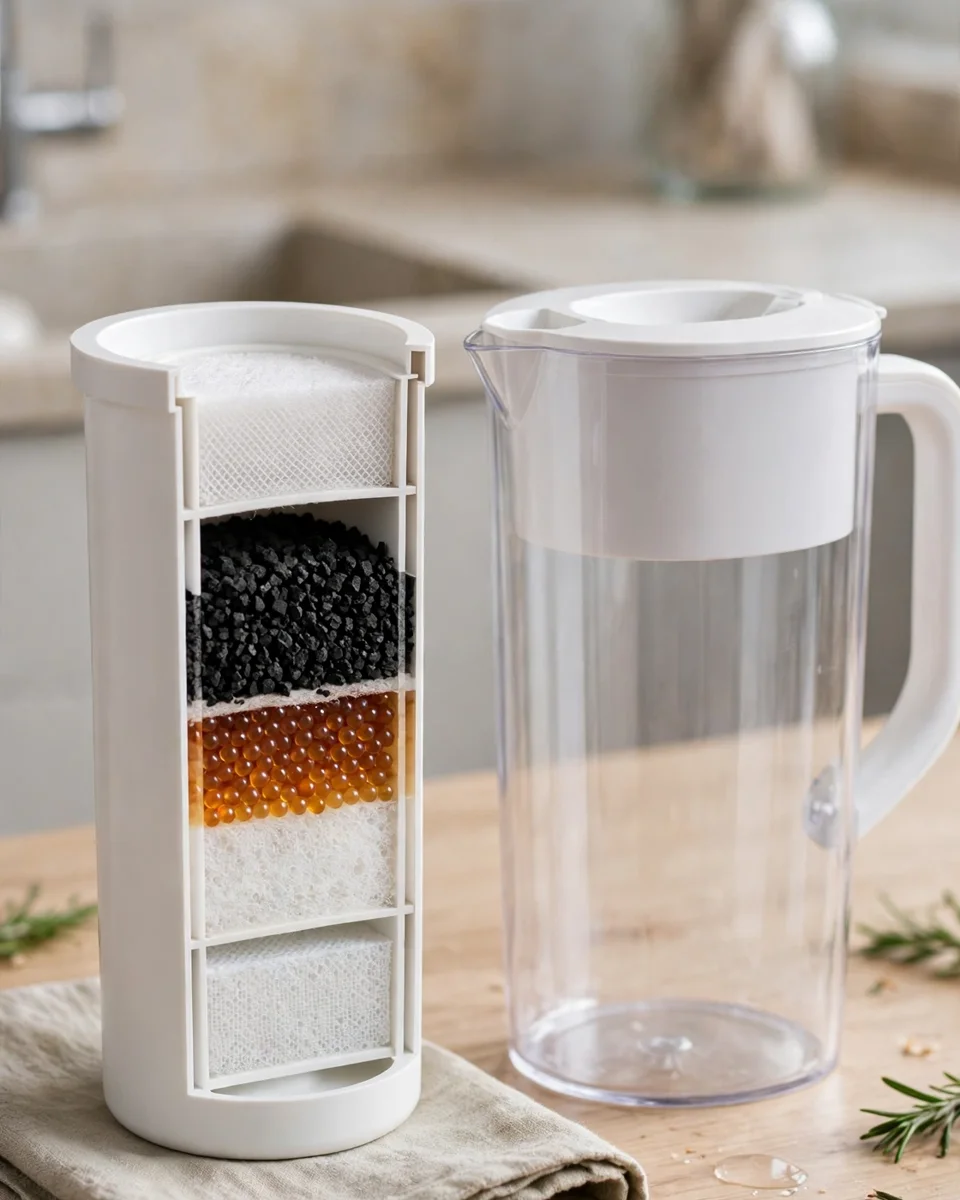
Start with what a microplastic is: a plastic particle under 5 millimeters, ranging down through the micrometer scale to fragments and synthetic fibers a fraction of a hair’s width. A pitcher cartridge is a bed of carbon granules and mesh that water percolates through by gravity. Anything in filtration that works by size exclusion obeys one rule — particles bigger than the passages get stuck, particles smaller than the passages keep moving. Carbon beds are not precision membranes; their passages vary, which is why capture from an uncertified cartridge is real but ragged: excellent for the coarse end of the size range, unreliable at the fine end. This is also why two honest statements coexist in the debate: “pitchers remove microplastics” (they demonstrably strain out larger particles) and “pitchers are not proven against microplastics” (nobody has certified the full size range for most models). Both are describing the same bed of carbon from different ends of the particle scale.
What certifications prove
The certification written for exactly this question is NSF/ANSI 401, the standard for emerging contaminants — and microplastics sit inside its scope, tested with particles in the micrometer range. A 401 listing means an accredited certifier ran the cartridge against a standardized challenge and verified the reduction, at a stated capacity. That is the line between evidence and implication. Note what the neighboring standards do not say: NSF/ANSI 42 covers taste, odor and chlorine; 53 covers health contaminants like lead — neither tests particle capture at microplastic sizes, so a cartridge can be legitimately “NSF certified” and carry zero microplastic evidence. When we compared models for our best water filter pitcher roundup, that distinction — certified for what — mattered more than the word “certified” itself. And brand claims deserve the same care everywhere on this site: to take the example already established in our guides, PUR lists its RF-3375 faucet cartridge as NSF/ANSI 42/53/401 — a listing you can check, which is precisely the standard a microplastics claim should be held to.
What the science says
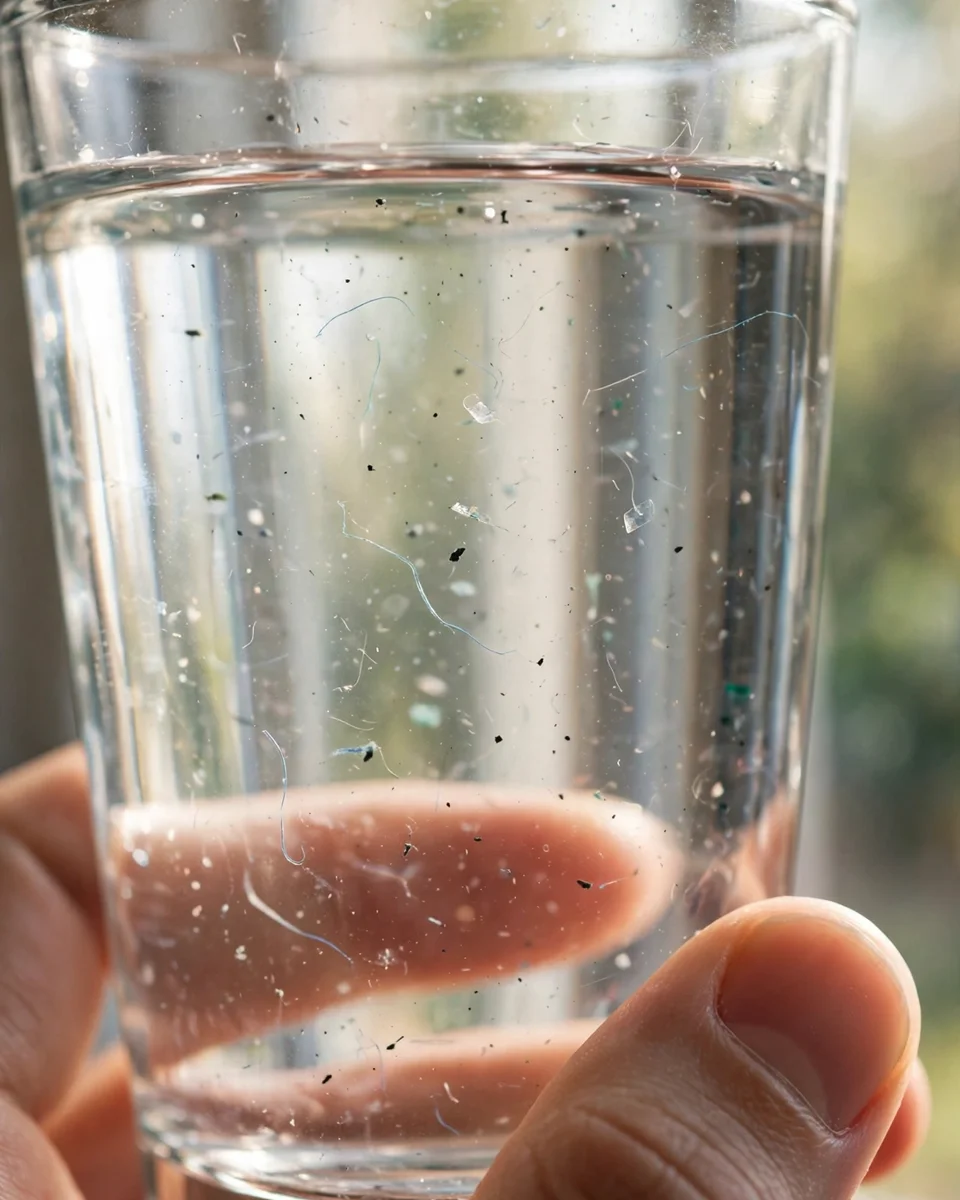
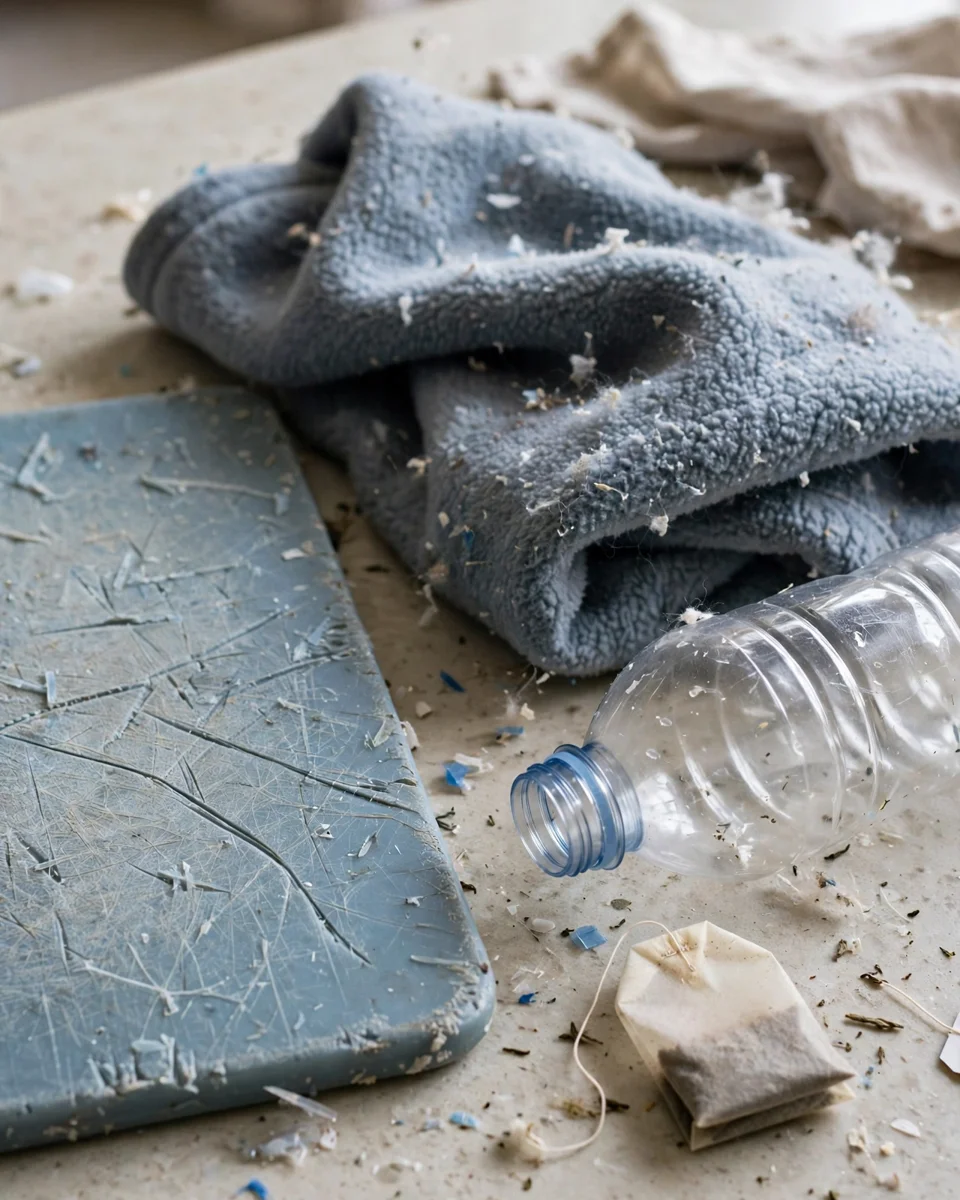
The research picture, stated carefully: studies of tap water in many countries consistently find microplastic particles, with counts dominated by small fibers and fragments; treatment plants remove a large share of the larger particles before water ever reaches a home; and point-of-use filtration studies generally find that finer filtration captures more, with membrane systems at the top of the range. What the literature does not provide is a tidy percentage you can pin on a specific grocery-store pitcher cartridge — which is exactly why the certification route exists. Two honest cautions follow. First, detection is not the same as dose: health research on microplastics is active and unsettled, and no drinking-water limit for microplastics exists to test against, so any brand implying a health threshold is inventing it. Second, exposure at home is not only about the tap: particles shed from cutting boards, synthetic clothing, bottles and tea bags reach food and air as well, so filtration is one lever among several, not a sealed door.
Better options if microplastics are the priority
Stronger capture, in order
- A pitcher or faucet cartridge with a current NSF/ANSI 401 listing — the only pitcher-class claim with independent test evidence behind it; verify the model on the certifier’s database before buying.
- Under-sink carbon blocks rated at sub-micron sizes — denser media, finer passages, better fine-particle capture than gravity pitcher beds.
- Reverse osmosis — a membrane with pores orders of magnitude smaller than microplastics; physical capture at this level is not a close call. Well owners weighing the same question will find the trade-offs laid out in our pitcher for well water guide.
Weak evidence, whatever the box says
- Any cartridge whose only certifications are NSF/ANSI 42 or 53 being sold with microplastic language — the standards do not test it.
- Percentage claims (“removes 99% of microplastics”) with no standard named — 99% of which sizes, under whose test, is the whole question.
- Letting a cartridge run months past its rated life — a loaded, channeling bed is at its worst exactly where capture is mechanical.
Conclusion
Do water pitchers remove microplastics? The physically honest answer is: the bigger ones, yes, inevitably — and the smaller ones, only as far as the individual cartridge’s media and certification allow. NSF/ANSI 401 is the evidence standard for this claim, and it is the first thing to check on any model that raises the subject. Everything else is a straining effect with real but unmeasured limits — worth having, not worth over-trusting, and no substitute for a membrane if microplastics are the contaminant you actually lose sleep over.
Update log
October 2026: Article published; certification framing per NSF/ANSI 401 scope (emerging contaminants, incl. microplastics). No removal percentage is asserted for any specific pitcher model.
FAQs
Does a Brita pitcher remove microplastics?
Physically, its carbon bed will strain out larger particles, as any filter bed does. The evidence question is certification: check the specific cartridge for an NSF/ANSI 401 listing, which is the standard that actually tests microplastic reduction. A cartridge certified only to NSF/ANSI 42 (taste and chlorine) carries no tested microplastic claim, whatever the marketing around it suggests.
What does NSF/ANSI 401 actually cover?
NSF/ANSI 401 is the standard for emerging contaminants — compounds and particles that treatment science has flagged before formal drinking-water limits exist. Its scope includes microplastics, tested as a reduction claim with standardized particles. A current 401 listing on the exact cartridge model is the strongest evidence a pitcher-class product can offer on this question.
Are microplastics in tap water dangerous?
They are consistently detected, and research into health effects is active — but as of 2026 there is no drinking-water limit for microplastics and no settled dose-response picture for the levels found in tap water. That uncertainty cuts both ways: it does not justify panic, and it does not justify brands implying proven health thresholds. Reducing exposure where it is cheap and verified is a reasonable, proportionate response.
Does boiling water remove microplastics?
Boiling does not destroy plastic particles — but interestingly, studies of hard water found that boiling can cause a share of microplastics to bind into limescale that precipitates out, especially when the water is then filtered or the scale is left behind. It is a partial, water-dependent effect demonstrated in research, not a treatment method to rely on by itself.
Which removes more microplastics: a pitcher or reverse osmosis?
Reverse osmosis, and it is not close. RO membranes have pores around a ten-thousandth of a micrometer — far below the microplastic size range — so capture is essentially complete on physical grounds. A pitcher bed is a loose sieve by comparison: genuinely useful for larger particles, partial at the fine end, and only quantified at all when the cartridge carries NSF/ANSI 401.
Do microplastics come from the pitcher itself?
A fair question, since the pitcher is plastic. Studies have found that plastic containers can shed small numbers of particles into water, particularly when old, scratched, or heat-stressed. Keeping a pitcher out of heat and sun, replacing worn vessels, and considering a glass or stainless reservoir are sensible habits; the net effect of filtering still favors the filter for the larger particle load arriving from the tap.