Are Water Test Strips Accurate? (2026)
Guide
Sixteen tests on one little strip, results in a minute, a few cents per dip — water test strips sound like the perfect shortcut. Then the pad turns a shade that sits between two colors on the chart, and the obvious question arrives: how much can you actually trust this? The answer is not “they work” or “they’re junk.” It is that strips are accurate at a specific job — sorting water into broad ranges — and quietly incapable of a different one: measuring low levels precisely enough to make health decisions on.
The short answer: for chlorine, pH, hardness, and spotting big changes, strips are accurate enough and genuinely useful. For anything where the decision line sits at a low level — lead near the EPA action level, nitrates near the limit, PFAS at parts per trillion — a strip’s color blocks are simply too coarse to give a trustworthy yes or no. That is a scale problem, not a quality problem, and it applies to the best strips as much as the cheapest.
Table of Contents
Quick verdict
Trust a strip to tell you roughly where you are: chlorine present or gone, pH low or high, hardness soft or hard, a filter working or exhausted. Do not trust it to tell you exactly how much — and never let it be the final word on a safety decision. For decisions, the tool is a certified lab analysis; our strips vs lab comparison shows how the two methods stack up test for test, and the best water test kits roundup covers the lab kits worth mailing.
How strips actually work
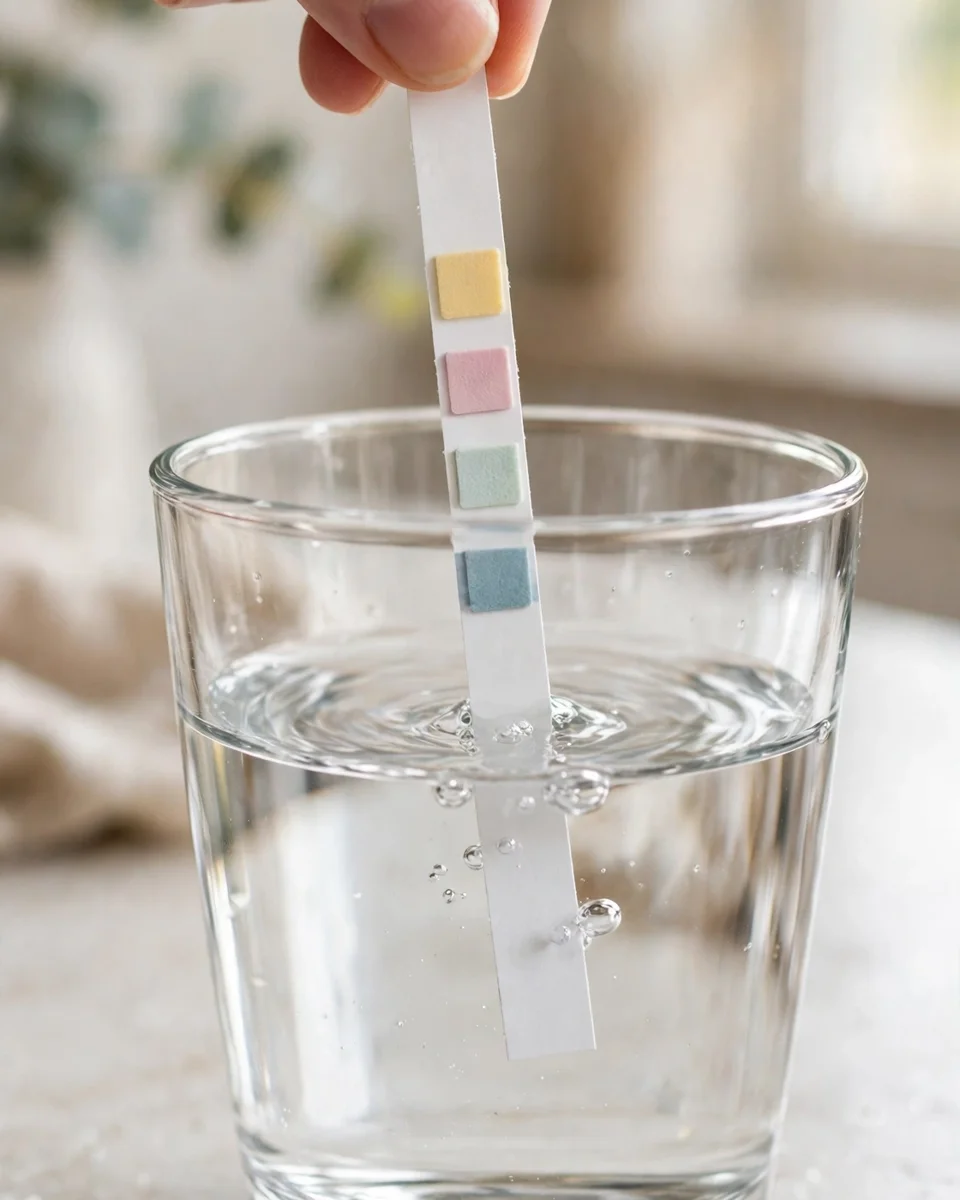
Each pad on a strip carries a dried reagent. Wet it, and the reagent reacts with whatever it is designed to detect — chlorine, nitrate, a metal — and changes color in proportion to how much is there. You hold the pad against the printed chart and pick the closest block. Notice what the method never does: it never produces a number. It produces a color match, judged by your eye, under your kitchen light, inside a read window of a few seconds before the reaction keeps developing and the color drifts. Everything about strip accuracy follows from those three facts.
The real accuracy limit: band width
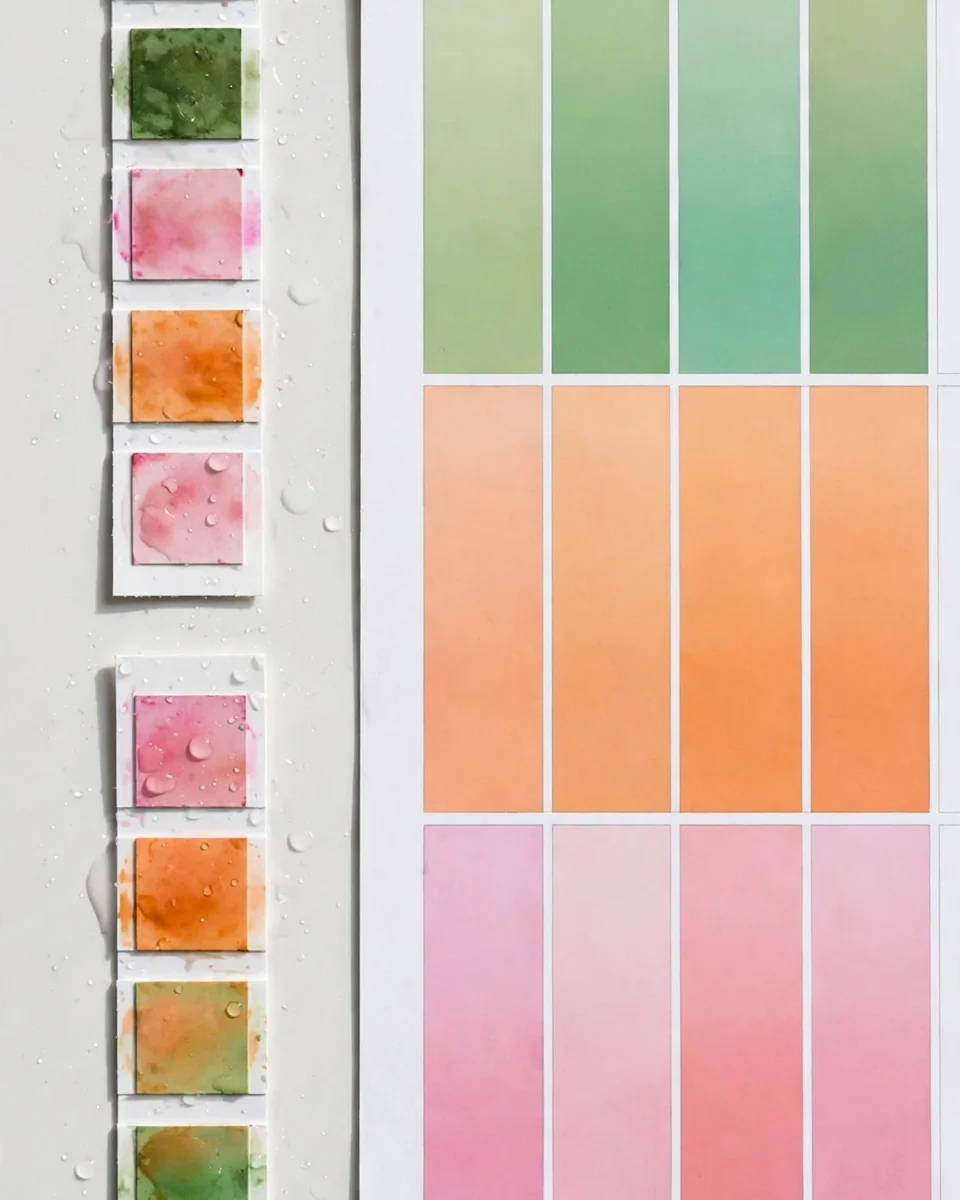
Strips are semi-quantitative: they sort results into bands, and the honest precision of any strip is about plus or minus one band. Whether that is good enough depends entirely on how wide the bands are compared with the level you care about.
Chlorine and pH: bands are fine-grained relative to the decision. Chlorine blocks stepping 0 – 0.5 – 1 – 3 mg/L tell you clearly whether chlorine is present and roughly how much; pH blocks in half-unit steps are plenty for filter and softener decisions. Strips shine here.
Lead: the EPA action level is 15 µg/L, tightening to 10 µg/L under the 2024 Lead and Copper Rule improvements. Typical strip kits grade lead in wide steps whose lowest band starts around that same territory — so a strip cannot distinguish 8 from 14 µg/L, and “no color change” can sit uncomfortably close to the action level. For a yes/no at that scale, the resolution simply is not there.
PFAS: the federal limits for PFOA and PFOS are 4.0 parts per trillion. Strip chemistry works in parts per million and billion — a million times coarser. No dip-and-read strip resolves parts per trillion; PFAS is a laboratory measurement, full stop.
Nitrates: the federal limit is 10 mg/L (as nitrogen). Common strip scales step 0 – 10 – 25 – 50 in wide jumps, so the reading that matters most — “just over or just under 10” — lands exactly where the bands are vaguest. Good for spotting a gross problem in well water, not for clearing it.
What strips measure well
Used inside their limits, strips earn their drawer space. Chlorine checks confirm a carbon filter still works (chlorine breaking through means the cartridge is spent). pH and hardness bands guide softener settings and flag corrosive water. A quick multi-pad dip after a filter change, a move, or a plumbing repair catches gross changes — a sudden iron jump, a nitrate spike after flooding — that tell you a real test is worth ordering. And because strips cost cents, they are the only practical way to watch trends: the same kit, read the same way monthly, shows direction even when the absolute number is fuzzy. For dissolved-solids trends specifically, a pocket TDS meter does the same job with a real number — see what TDS means for what that number can and cannot say.
Mistakes that make strips lie
Habits that keep strips honest
- Check the expiry date — reagents fade, and old strips read low.
- Close the bottle immediately; humidity is the silent killer of pads.
- Read at the stated time (often 15–60 seconds), not “when you get to it.”
- Compare in neutral daylight, holding the pad beside — not over — the chart.
- Dip and remove as directed; don’t swish unless the instructions say so.
Habits that wreck the reading
- Touching the pads with wet or dirty fingers.
- Reading late: colors keep developing and drift a band or more high.
- Judging color under warm yellow kitchen lighting.
- Trusting a strip stored for a year in a steamy bathroom cabinet.
- Making a health decision from a single dip of a single strip.
When a strip is enough — and when to send a lab sample

The dividing line is the consequence of being wrong. Strip away: filter maintenance, pool and spa balance, taste troubleshooting, renters doing a first sniff test, anyone checking whether a known problem got better or worse. Go to a lab when the result drives a decision: a home with young children and old plumbing (lead), a private well that has never had a full panel, PFAS questions near a known contamination source, a real-estate transaction, or symptoms you are trying to explain. A certified lab reports actual concentrations with detection limits far below the action levels — the resolution strips structurally cannot offer. Our home test vs lab test guide breaks down costs and turnaround, and test before you buy a filter explains why this order — measure first, shop second — saves money as well as worry.
Conclusion
Water test strips are accurate the way a fuel gauge is accurate: trustworthy about the range you are in, useless as a precise measure. For chlorine, pH, hardness, and change-spotting they are fast, cheap, and good enough. The moment the question involves a low safety threshold — lead at 15 µg/L, PFAS at 4 parts per trillion — the color bands are wider than the decision you are trying to make, and the honest tool is a lab. Use strips for screening and trends; use a lab for verdicts.
Update log
October 2026: Accuracy analysis published; EPA figures per the Lead and Copper Rule (action level 15 µg/L, 10 µg/L under the 2024 improvements) and the 2024 PFAS drinking-water standards.
FAQs
Can test strips detect lead in drinking water?
Some kits include a lead pad, but treat it as a coarse screen, not a verdict. The EPA action level is 15 µg/L — 10 µg/L under the 2024 rule improvements — and typical strip scales step too widely at that low end to separate “safely below” from “just under the line.” If lead is the question, especially with children in the home, order a certified lab test and act on its number.
Are water test strips as accurate as a lab test?
No — they are different instruments. A strip sorts a result into a color band with a precision of roughly plus or minus one band; a certified lab measures an actual concentration using calibrated equipment, with detection limits far below regulatory thresholds. Strips win on speed and cost; labs win on every measure of accuracy.
Why did my strip give a different result the second time?
Small differences between dips are normal for a band-based method: reading a few seconds late, warmer light, a wetter pad, or a strip from a bottle that sat open can each shift the apparent color by a band. If two readings disagree on something important, that disagreement is itself the answer — the question needs a more precise method.
Do test strips expire?
Yes. The reagents degrade with time, heat, and humidity, and expired or moisture-damaged strips typically read low — the dangerous direction, since problems look smaller than they are. Respect the printed date, keep the bottle sealed and dry, and replace a kit that has lived in a steamy bathroom.
Can a test strip check for PFAS or bacteria?
Not meaningfully. PFAS limits sit at parts per trillion — far below anything color chemistry on a paper pad can resolve — and bacteria testing needs incubation and culture or enzyme methods, not a dip pad. Both belong to laboratories; a strip claiming either should be read as marketing, not measurement.
What are test strips actually good for, then?
Plenty: confirming chlorine removal after a filter change, checking pH and hardness for softener settings, screening well water for sudden changes, maintaining pools and spas, and watching trends month to month with the same kit. They are the cheapest early-warning system in water care — as long as verdicts get escalated to a lab.