Best RO System For Apartment (2026): Top Picks
★ TOP APARTMENT RO PICKYou want reverse-osmosis-quality water, but you rent. The classic under-sink RO system needs a hole drilled in the sink deck for its faucet and a saddle clamp on the drain pipe — two plumbing modifications your lease almost certainly forbids, and both good ways to lose a security deposit. Meanwhile your kitchen counter is barely big enough for a cutting board, so whatever you buy has to earn its square footage.
Here is the short answer: in an apartment, the systems that work are the ones that touch nothing. Gravity-fed dispensers sit on the counter like a coffee maker — no plumbing, no power, no landlord conversation. Plug-in countertop RO units need only an outlet. We researched and compared three systems that fit apartment life: a premium stainless gravity system for the best overall experience, a budget gravity system with the strongest certification paperwork of the bunch, and one true under-sink RO for the rare apartment where the landlord actually says yes. Below: how they compare, what they cost to run, and which one fits your kitchen.
Our scores — best overall
Table of Contents
Quick picks: top 3
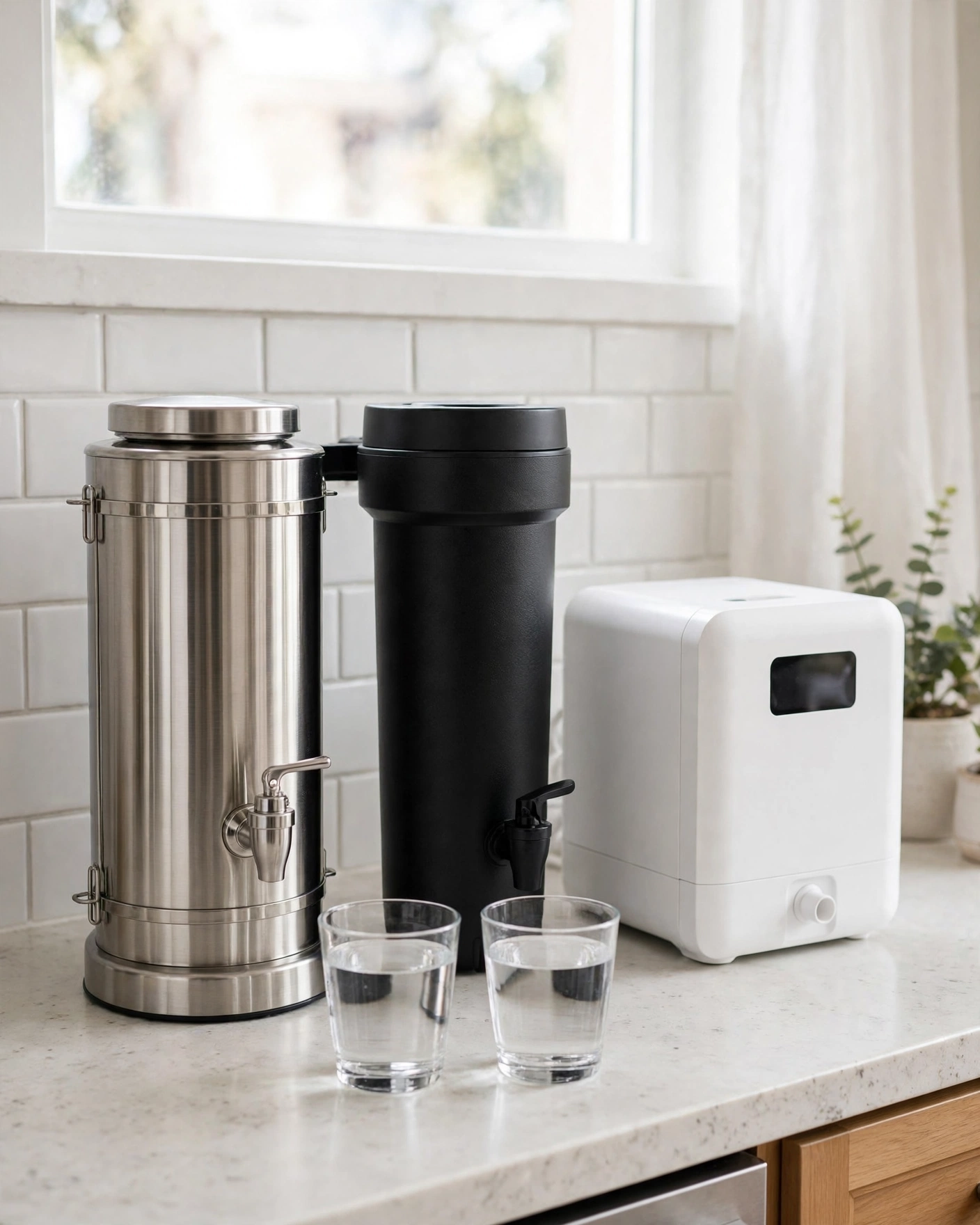
Best overall — Boroux Legacy 3-gal (~$300–350, estimate). A stainless steel gravity system that needs no plumbing, no power, and no landlord permission. The most apartment-proof pick here, with brand-stated WQA certification to NSF/ANSI 42, 401, and 372.
Best budget — ProOne Big+ 3-gal (~$180–220, estimate). The cheapest way into the roundup and, on paper, the strongest certification list: ProOne states IAPMO certification to NSF/ANSI 42, 53, 401, and 372. Same zero-installation gravity design, smaller hit to the wallet.
Best for specific needs — SimPure UV RO system (~$300–450, estimate). The only true reverse-osmosis unit in this lineup, with a UV stage and brand-stated testing to NSF/ANSI 58. The catch: it installs under the sink, so it only works if your lease — or your landlord — allows it.
Price checked at time of writing; it changes often — see the live price before you buy.
How we researched
We did not receive test units and we did not run lab tests. Claiming hands-on testing we never did would be dishonest, so here is exactly what we did instead:
- Compared spec sheets for all three systems — capacity, dimensions, filter type, stated certifications, and replacement-part pricing from current retail listings.
- Checked certification claims against brand-published materials — every “certified to” statement below is what the brand itself claims. We did not verify these listings in the public NSF, WQA, or IAPMO databases before writing, so treat each one as a brand claim and confirm the current listing before you buy.
- Read owner reviews for recurring complaints — the same problem mentioned by many owners over many months, not one-off bad experiences. Footprint regret and slow gravity flow came up the most.
- Ran replacement-cost math — from listed element and cartridge prices and brand-stated replacement intervals, so the “cheap” system does not surprise you later.
Best overall: Boroux Legacy 3-gal

The Boroux Legacy is the system we would put in an apartment kitchen without hesitation. It is a stainless steel gravity-fed dispenser: you pour tap water into the top chamber, it drips through the filter elements into the lower chamber, and you draw drinking water from the spigot. No drilling, no drain connection, no power cord — it sits on the counter like a coffee maker and moves with you when the lease ends.
On certifications, Boroux states WQA certification to NSF/ANSI 42 (aesthetic effects like chlorine taste and odor), NSF/ANSI 401 (emerging contaminants), and NSF/ANSI 372. That last number deserves a plain-English note: 372 certifies lead-free materials — it is about what the product is made of, not a claim that the filter removes lead from your water. Do not let any listing blur that line.
The honest trade-offs are the ones all gravity systems share. Flow is slow — you fill it and wait, so most owners keep it topped up and treat it like a water pitcher with a 3-gallon reservoir. And it is tall: you need clearance above the unit to lift the top chamber off for refilling, which is the single most common apartment regret we found (more on measuring in the buying guide). But for a renter who wants better water with zero installation risk, this is the most complete package of the three.
Pros
- Zero installation — no plumbing, no power, no landlord permission needed.
- Stainless steel build — no plastic reservoir, easy to wipe down.
- Brand-stated WQA certification to NSF/ANSI 42, 401, and 372.
- Moves with you — pack it up on moving day like any other appliance.
Cons
- Gravity is slow — plan ahead; it filters on its own schedule, not yours.
- Tall footprint — needs under-cabinet clearance for refilling.
- Highest upfront price of the three picks (~$300–350, estimate).
If you want to see every no-drill option beyond these three picks, our no-installation water filter roundup covers the wider field.
Price checked at time of writing; it changes often — see the live price before you buy.
Best budget: ProOne Big+ 3-gal

The ProOne Big+ is the value play: the same zero-installation gravity concept as our top pick, at roughly half the upfront price (~$180–220, estimate). And on paper it carries the strongest certification list in this roundup — ProOne states IAPMO certification to NSF/ANSI 42, 53, 401, and 372. The number that matters most there is 53: that is the health-effects standard, the one that covers contaminants with actual health implications, as opposed to the aesthetic standards that cover taste and odor.
As with every certification claim on this page, that list is what the brand states — we did not verify it in the IAPMO database before writing, so confirm the current listing yourself before you buy. The pattern to watch for across the industry is brands implying more than the listing supports; the listing itself is the truth.
In daily use it behaves like any gravity system: fill the top, wait for the drip, draw from the spigot. The 3-gallon capacity suits one to two people; a family will be refilling often. Owner complaints cluster around the familiar gravity themes — slow flow when the elements are new and the same height-clearance issue under low cabinets. None of it is unique to ProOne, and at this price the value math is hard to argue with.
Pros
- Lowest upfront price of the three (~$180–220, estimate).
- Strongest brand-stated certification list — IAPMO 42/53/372/401 per the brand, including the health-effects standard 53.
- Zero installation — countertop gravity, renter-safe.
- Simple maintenance — swap elements, no tools beyond what is in the box.
Cons
- Certification is brand-stated — we could not verify the IAPMO listing in a public database before writing.
- Slow gravity flow — same physics as every gravity filter.
- 3 gallons means frequent refills for larger households.
Renters comparing options should also see our renter-focused water filter guide, which covers the lease-friendly category in full.
Price checked at time of writing; it changes often — see the live price before you buy.
Best for specific needs: SimPure UV RO system
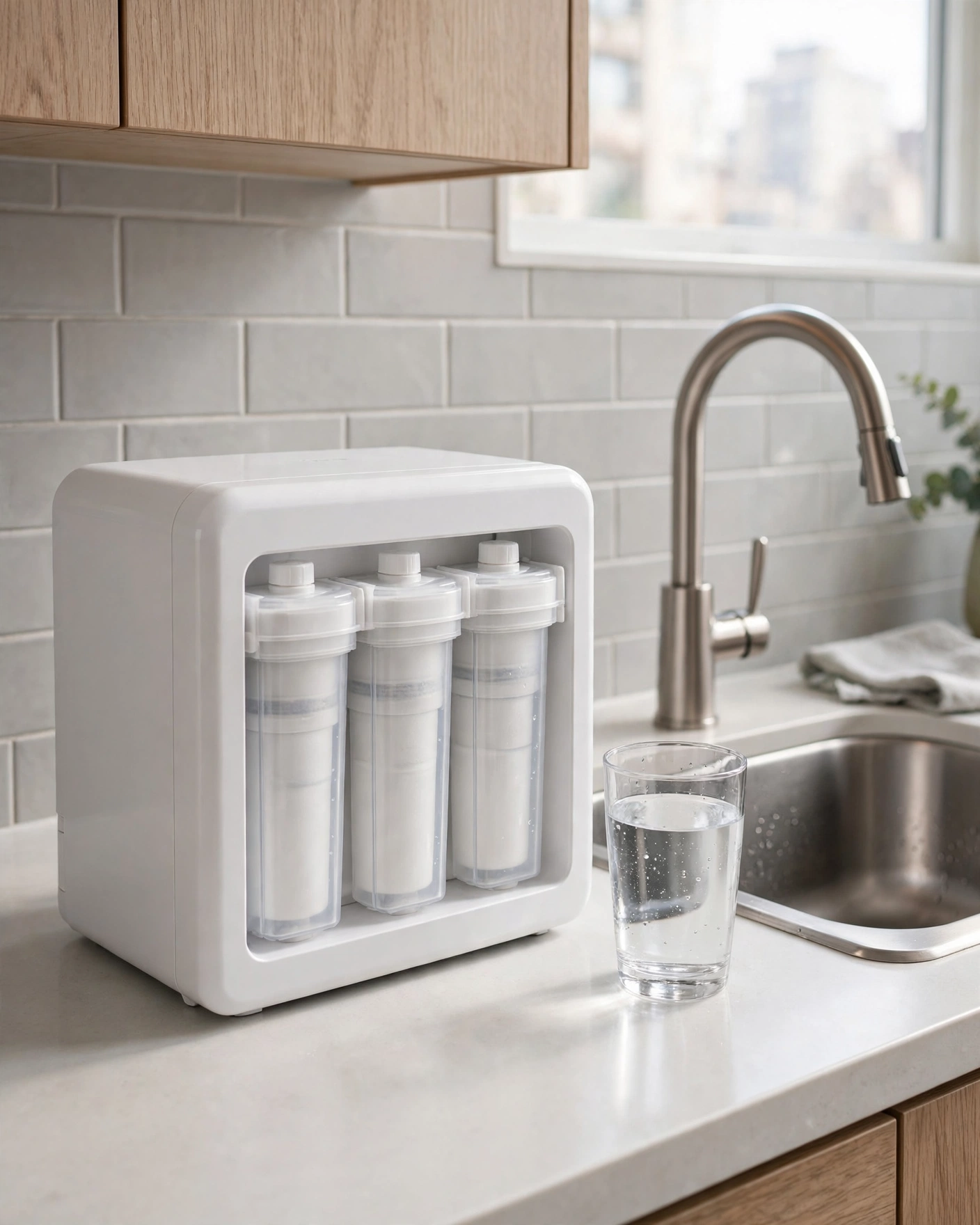
This is the odd one out, deliberately. The SimPure UV RO system is the only true reverse osmosis unit among our three picks: water is pushed through a semipermeable membrane, with a UV stage in the chain, and SimPure states the system is tested to NSF/ANSI 58 — the standard written specifically for reverse osmosis drinking-water systems. If your goal is the widest contaminant reduction available in a home system, RO is the technology, and this is the RO pick.
The catch is installation. This is an under-sink system: it needs a dedicated faucet (which means a hole in the sink deck or countertop) and a drain connection for the reject water. Both are plumbing modifications, and in a rental both typically need written landlord permission. If you own your apartment or your landlord has explicitly approved it, this is the strongest filtration of the three. If not, it is a non-starter — and that is exactly why it sits in the “specific needs” slot rather than the top spot.
Owner feedback on SimPure’s RO units centers on two themes: strong water quality once installed, and the reality that under-sink installs take longer than the marketing suggests — especially the drain saddle and faucet hole for first-timers. Budget an afternoon, read the manual twice, and keep the landlord’s permission in writing.
Pros
- True reverse osmosis — membrane filtration plus UV stage.
- Brand-stated NSF/ANSI 58 testing — the RO-specific standard.
- Tankless design — compact under the sink, no bulky storage tank.
- Widest reduction technology of the three picks.
Cons
- Needs under-sink installation — faucet hole and drain connection; landlord permission required in rentals.
- Highest price range (~$300–450, estimate).
- Produces drain water — RO sends reject water down the drain by design.
If you have ruled out under-sink installation entirely, compare dedicated plug-in options in our countertop reverse osmosis roundup instead.
Price checked at time of writing; it changes often — see the live price before you buy.
Side-by-side comparison
| Boroux Legacy 3-gal | ProOne Big+ 3-gal | SimPure UV RO system | |
|---|---|---|---|
| Type | Gravity-fed | Gravity-fed | Tankless reverse osmosis + UV |
| Installation | None — countertop | None — countertop | Under-sink (faucet + drain) |
| Landlord approval needed? | No | No | Yes, in rentals |
| Brand-stated certifications | WQA: NSF/ANSI 42, 401, 372 | IAPMO: NSF/ANSI 42, 53, 401, 372 | Tested to NSF/ANSI 58 |
| Upfront price (estimate) | ~$300–350 | ~$180–220 | ~$300–450 |
| Wastewater | None | None | Yes — RO reject water |
| Power needed | No | No | Yes |
| Best for | Best overall apartment pick | Best budget | Strongest filtration, if install allowed |
Certification rows reflect brand-stated claims, not listings we verified in a public certifier database. NSF/ANSI 372 covers lead-free materials (not lead removal); NSF/ANSI 58 is the reverse-osmosis standard; NSF/ANSI 53 is the health-effects standard. Confirm current listings before you buy.
Apartment buying guide: what actually matters

Apply the landlord test first. If a system needs a drill, a wrench on the plumbing, or a hole anywhere, it is not an apartment filter unless your landlord has approved it in writing. Gravity systems and plug-in countertop units pass this test automatically; under-sink RO does not.
Measure your footprint — twice. The number-one owner regret we found is buying a system that does not fit the kitchen. Gravity units are tall, and you need extra clearance above to lift the top chamber for refilling. Measure counter depth, width, and the distance to the underside of your wall cabinets before ordering. A tape measure now beats a return later.
Respect the physics of flow. Gravity filters are slow by design; RO systems are faster but send water to the drain. Neither is “better” in the abstract — the question is which trade-off fits your routine. If you drink a lot of water through the day, a 3-gallon gravity reservoir needs topping up; plan for it.
Power and plumbing are the real filters. Narrow every option by two questions: does it need an outlet, and does it touch the plumbing? In most apartments the winners are the systems that answer “no” to both. If you move frequently, add a third question: can one person carry it down the stairs? Our portable RO roundup is built around exactly that scenario.
Ignore what does not matter here. Gallons-per-day ratings are sized for houses, not apartments. Smart faucets and app monitoring are nice but irrelevant to water quality. And remineralization or alkaline stages are about taste preference — treat them as flavor features, never as health claims.
Do not buy the brand, buy the listing. The most famous countertop RO name in the category is AquaTru — if you are wondering whether the hype survives scrutiny, our Is AquaTru Worth It guide breaks it down. Whatever brand you choose, the certification listing in a public database is the only claim that counts; marketing copy is not evidence.
Replacement cost math

The sticker price is the least important number on this page. Filters are a subscription you pay in replacement parts, so the honest comparison is first-year total: the system plus whatever you will replace in year one.
| Boroux Legacy | ProOne Big+ | SimPure UV RO | |
|---|---|---|---|
| Upfront (estimate) | ~$300–350 | ~$180–220 | ~$300–450 |
| What you replace | Filter element set | Filter element set | Pre-filters + RO membrane |
| Typical cadence | Roughly yearly per brand guidance | Roughly yearly per brand guidance | Pre-filters more often; membrane lasts years (category-typical) |
| Cost driver | Element set price | Element set price | Membrane replacement cost |
Two patterns matter. First, gravity systems have the simplest math: one element set, roughly once a year per brand guidance, and no other consumables — check the current element price at checkout and you have your number. Second, RO systems look cheaper per gallon over time but carry the most expensive single replacement part (the membrane), and pre-filters need changing more often. Neither is a trap; the trap is buying on upfront price alone and discovering the subscription later. All figures above are estimates — confirm current part prices before you commit.
FAQs
Can I install a reverse osmosis system in a rental apartment?
Usually not the under-sink kind. Most under-sink RO systems need a hole drilled for the faucet and a drain-saddle connection on the waste pipe — both count as plumbing modifications, and most leases forbid them without written landlord permission. Countertop RO units and gravity-fed systems need neither, so they are the renter-safe options. When in doubt, ask your landlord before you buy.
Is a gravity filter the same as reverse osmosis?
No. A gravity filter drips water through carbon and ceramic elements; a reverse osmosis system pushes water through a semipermeable membrane, and NSF/ANSI 58 is the standard written specifically for RO systems. They are different technologies with different reduction profiles. In an apartment, gravity is the zero-installation option and countertop RO is the closest thing to true RO without plumbing work.
How much counter space does a gravity filter actually need?
Plan on about a square foot of counter, plus headroom. The part owners regret most is height: you need clearance above the unit to lift the upper chamber off for refilling, and many apartment kitchens have low wall cabinets. Measure your counter-to-cabinet distance before ordering — a tape measure now beats a return later.
Do these systems remove fluoride?
We could not verify a fluoride-reduction claim for any of the three picks in a public certifier database, so we are not publishing one. Some brands sell add-on fluoride elements with their own marketing claims — treat those as brand statements and check the current listing carefully. A simple water test tells you whether fluoride is even the problem you need to solve.
Do countertop and gravity systems waste water?
Gravity systems waste none — every drop you pour in eventually drips through. RO systems send some water to the drain as part of the process; the exact ratio varies by model, so check the spec sheet of the unit you are considering rather than trusting a category average.
Should I test my water before buying a filter?
Yes — it is the cheapest step in this whole process. A basic strip test covers chlorine, hardness, and pH; a lab test is the way to check for lead or PFAS. One caution: a TDS meter reading alone does not tell you whether water is safe — it only measures total dissolved solids, not which ones.
Conclusion
Apartment water filtration is a constraint problem, not a technology problem — and the constraint is your lease. If you want the best experience with zero installation risk, the Boroux Legacy is the pick: stainless, no plumbing, no power, moves with you. If the budget is tight, the ProOne Big+ gets you the same zero-installation concept with the strongest certification paperwork of the three for roughly half the upfront price. And if your landlord has approved an under-sink install, the SimPure UV RO gives you true reverse osmosis — the widest-reduction technology here. Measure your counter, check your lease, run the replacement math, and the choice makes itself.
Price checked at time of writing; it changes often — see the live price before you buy.
Update log
- Zulqarnain: Review published.