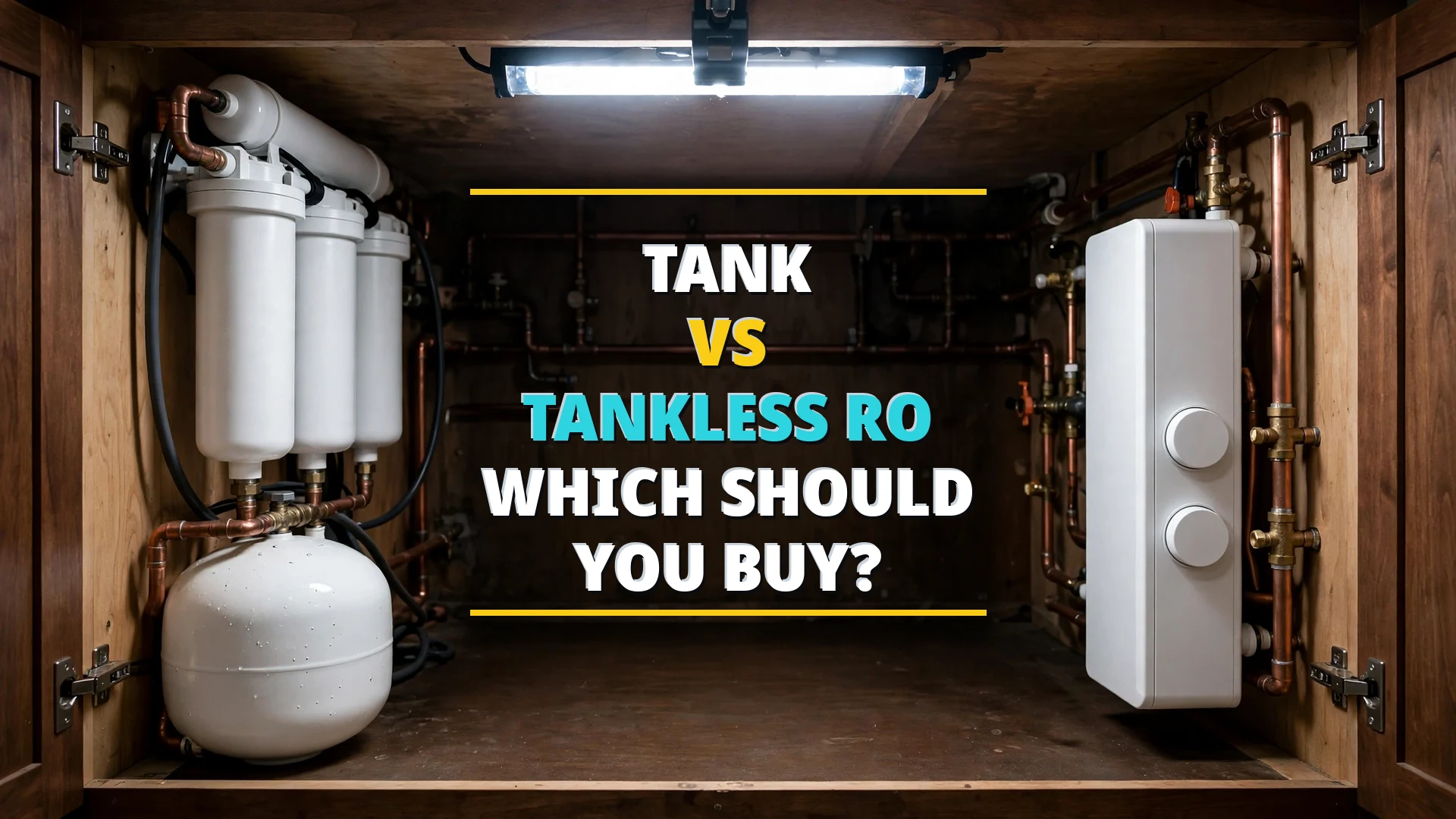

Tank vs Tankless RO (2026): Which Should You Buy?
You are comparing two under-sink RO systems and the prices make no sense. One is a classic five-stage unit with a big round storage tank, around $200. The other is a slim tankless box with a smart faucet, $500 to nearly $1,000. Same promise — clean water from your own tap — wildly different prices and wildly different footprints. Which one actually belongs in your kitchen?
Here is the short answer: the tank system is the budget workhorse — no outlet needed, silent, cheapest to run. Tankless buys back your cabinet space, gives you fresher water on demand, and fills pots faster, at a higher price and a faint pump hum. This comparison breaks down the real differences — space, flow, wastewater, TDS creep, certifications, five-year cost — with two solid tank picks and two tankless picks.
The budget workhorse
Tank RO
~$180–230
The cheapest way into RO — silent, no outlet needed, and roughly a third of the tankless five-year cost.
Our top tankless pick
Waterdrop G3P800
~$849–999
Fresh-filtered water on demand and up to ~75% of cabinet space saved — 94.8% TDS rejection in lab testing.
The bottom line: buy a tank system if you want the cheapest way into reverse osmosis, have no outlet under the sink, or want silence — the iSpring RCC7 and APEC ROES-50 (both around $180–230) have done this job for years. Buy tankless if your cabinet is cramped and you want fresher water: the Waterdrop G3P600 (around $429–539) is the value pick, the G3P800 (around $849–999) the top performer with 94.8% TDS rejection in lab testing.
Verdict: tank wins on price and simplicity; tankless wins on space, freshness, and speed. Your cabinet and your budget decide.
Price checked at time of writing; it changes often — see the live price before you buy.
Our scores — tankless top pick (Waterdrop G3P800)
Table of Contents
Side-by-side comparison
First, the two categories head to head:
| Traditional tank RO | Tankless RO ★ Winner | |
|---|---|---|
| Under-sink space | Bulky — tank eats ~half the cabinet | Compact — saves up to ~75% of space |
| First-glass flow | Instant while charged, then slow refill | Consistent on-demand flow (~0.6 GPM on top models) |
| Water freshness | Can sit for hours/days; sanitize tank yearly | Filtered fresh at the tap |
| Wastewater ratio | Older units ~3–4:1; newer tank models better | Typically ~0.5–2:1; 2.2:1 measured on large draws |
| TDS creep | Diluted by the tank — stable first glass | First draw spikes; flush a few seconds |
| Noise / power | Silent, no outlet needed | Soft pump hum (~46 dB), needs an outlet |
| Typical upfront price | ~$180–230 | ~$429–999 |
| Yearly filter cost (est.) | ~$50–90 | ~$100–180 |
| Best for | Budgets, rentals, no-outlet cabinets | Small cabinets, high daily use, tech features |
Now the five systems themselves:
| iSpring RCC7 | APEC ROES-50 | Waterdrop G3P600 | Waterdrop G3P800 | SpringWell CF1 | |
|---|---|---|---|---|---|
| Type | Tank, 5-stage, 75 GPD | Tank, 5-stage | Tankless, 600 GPD | Tankless, 800 GPD | Whole-house (not RO) |
| Price (est.) | ~$180–230 | ~$180–230 | ~$429–539 | ~$849–999 | ~$1,000–1,200 |
| Certifications (brand-stated) | NSF/ANSI 58 (brand-stated) | WQA Gold Seal (brand-stated) | Not published by brand | IAPMO: NSF/ANSI 42, 53, 58 + NSF 372 (per independent lab review) | None — lifetime warranty instead |
| Needs power | No | No | Yes | Yes | No |
| Standout | The RO demand king — huge owner base | Cheapest RO to run (~$75/yr, estimate) | Best-value tankless per BOS Water | Top lab score among tankless units (9.21) | Treats all taps, not RO-level purity |
| Best for | Maximum value tank RO | Lowest running cost | Affordable tankless | Best-performing tankless | Whole-home chlorine/taste, not RO |
On the SpringWell CF1: it is a whole-house system, not an under-sink RO — it cannot match RO purity for lead or fluoride. It belongs here only if your goal is better water at every tap. Our best reverse osmosis system roundup ranks the under-sink RO field in full.
How they actually differ
Both types force tap water through a semipermeable membrane — typically around 0.0001 microns — that rejects dissolved solids like lead and fluoride. The purification principle is identical; everything else differs:
Space
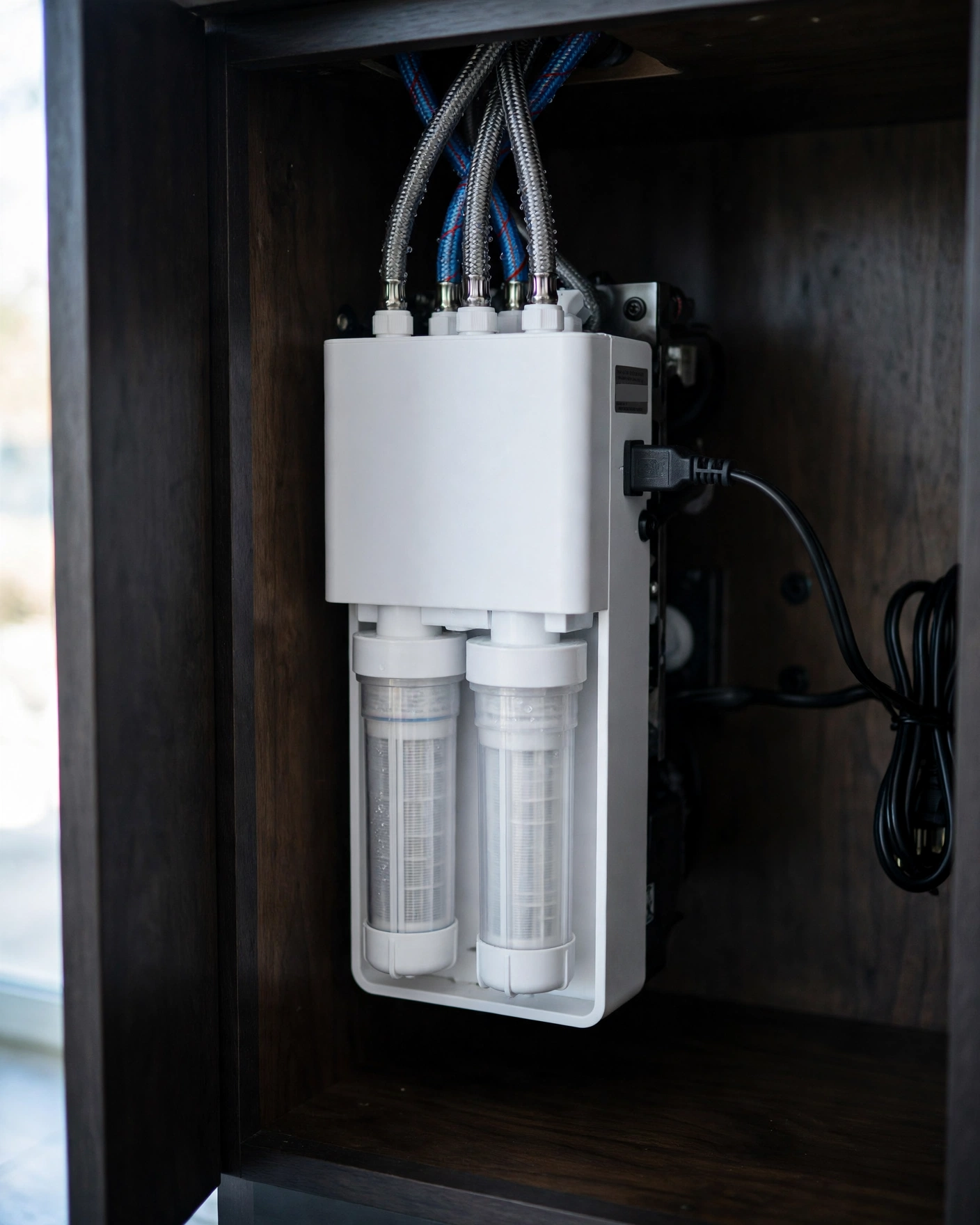
A traditional RO setup eats half your under-sink cabinet: the filter manifold plus a 3-to-4-gallon pressurized tank. Tankless units are roughly shoebox-sized (about 16 x 6 x 18 inches is typical) and can save up to 75% of the space. In a cramped cabinet, that alone can decide the contest.

Flow and refill behavior
A charged tank fills a glass in a second or two — then slows to the membrane’s trickle while it refills. Real-world output sits well below the printed GPD rating (a “100 GPD” membrane often delivers around 45 in practice), so back-to-back cooking and drinking water use can outrun a tank system. Tankless units filter on demand with no refill wait: the G3P800 filled 12 ounces in about 9 seconds in independent lab testing, roughly 0.62 gallons per minute.
Water freshness
Tankless filters at the moment you open the tap, so the water is always fresh. Tank water can sit for hours or days — it tastes stale after a vacation, and the tank interior needs periodic sanitizing.
Wastewater
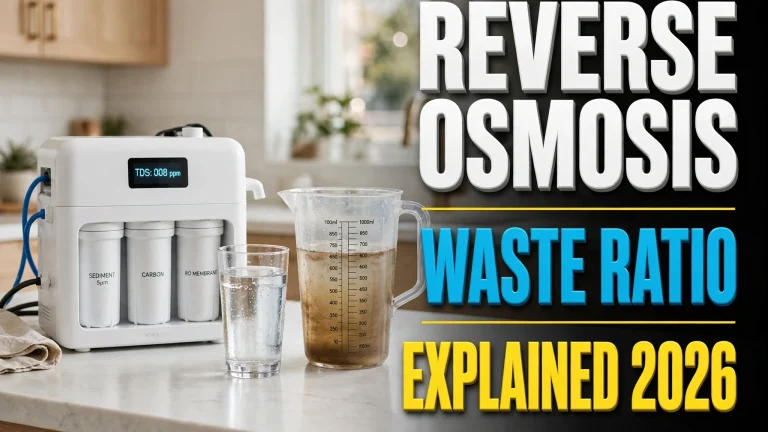
All RO rejects some water to the drain — that is how the membrane stays clean. Older tank systems can send 3–4 gallons down the drain for every gallon of drinking water produced. Modern tankless units are much more efficient, typically in the 0.5–2:1 range; lab testing on the G3P800 showed a pure-to-drain ratio improving from 1.5:1 on small draws to about 2.2:1 on a 64-ounce draw. At 1–2 gallons of drinking water a day, the absolute waste is small on either design.
TDS creep
When any RO system sits idle, dissolved solids slowly migrate across the membrane, so the first ounces of the next draw test higher in TDS — “TDS creep.” It hits tankless hardest because no tank dilutes that first slug. Good designs manage it with automatic flush cycles: the G3P800 showed only 33 ppm of creep in lab testing, the best measured on a tankless unit. The free fix: run the faucet a few seconds first thing in the morning.
Noise, power, and maintenance
Tank systems are silent and need no outlet — they run on water pressure alone. Tankless systems need a booster pump, hence an outlet and a soft hum while filtering: about 46 decibels at one foot, roughly a quiet conversation at arm’s length.
Tank: swap prefilters on schedule, the membrane every 2–3 years, and sanitize the tank yearly — the maintenance chore owners most often skip. Tankless: tool-free quick-change cartridges with no sanitizing ritual, but pricier sets. The G3P800’s filters run about 11 cents a gallon in lab estimates, with electricity under a dollar a year.
Why you should trust this comparison
We did not receive test units and we did not run lab bench tests. Claiming hands-on testing we never did would be dishonest, so we will not do it.
Instead we researched and compared: manufacturer spec sheets and prices, certification claims checked against NSF/ANSI standard numbers, independent lab testing from Water Filter Guru for the tankless top pick, recurring owner complaints, and yearly cost math from filter life and replacement prices. Every number is labeled as a spec, lab result, or estimate.
Certifications
The certification that matters for reverse osmosis is NSF/ANSI 58 — the standard written specifically for RO. A brand claiming “NSF certified” without naming the standard has told you very little: 42 covers taste and chlorine, 53 covers health-effect contaminants like lead, 372 covers lead-free materials. Shop by standard number, not by the word “certified.”
Where our five systems stand:
- iSpring RCC7 — iSpring states NSF/ANSI 58 certification. Confirm the current listing in the public NSF database at info.nsf.org before you buy; brand listings can lapse.
- APEC ROES-50 — APEC states WQA Gold Seal certification. Same advice: verify in the WQA product listings.
- Waterdrop G3P600 — Waterdrop does not publish third-party certification for this model that we could confirm. Treat it as unverified on the certification front.
- Waterdrop G3P800 — the strongest documented case: lab reporting cites IAPMO certification to NSF/ANSI 42, 53, 58 plus NSF 372, and the same lab test measured TDS dropping from 656 ppm to 34 ppm — a 94.8% rejection rate.
- SpringWell CF1 — no third-party certification; SpringWell leans on its lifetime warranty instead.
Certification covers only the contaminants in the database entry, under the certifier’s test conditions — it does not promise your tap water’s specific problems are solved. A lab report on your water matters most. If you want minerals back after RO strips them, our RO remineralization guide covers that side.
Cost per year
Forget the sticker price — what matters is the five-year cost, because an RO system is a subscription you pay in cartridges:
| iSpring RCC7 | APEC ROES-50 | Waterdrop G3P600 | Waterdrop G3P800 | |
|---|---|---|---|---|
| Upfront (est.) | ~$180–230 | ~$180–230 | ~$429–539 | ~$849–999 |
| Yearly filter cost (est.) | ~$50–90 | ~$75 | ~$100–150 | ~$120–180 |
| Membrane (every ~2–3 yrs) | ~$30–50 | ~$30–50 | Included in cartridge set | Included in cartridge set |
| Electricity | None | None | Small (~$1/yr) | Small (~$1/yr) |
| 5-year total (est.) | ~$500–750 | ~$600–700 | ~$1,000–1,400 | ~$1,500–2,000 |
Tank systems cost roughly a half to a third of the tankless options over five years — there is no configuration where tankless wins on pure cost. The premium buys cabinet space, fresher water, faster filling, and tool-free cartridge swaps. If cost decides it, our budget RO picks stay in tank territory — that is where the value is.
Owner voices
No quotes are invented here — these are the complaints that repeat across owner reviews and forums for each type.

What tank owners complain about
- Slow recovery after heavy use. The tank delivers a glass or two fast, then the trickle. Families filling pots back-to-back learn to plan around refill time.
- Stale taste after idle periods. Water that sat in the tank over a vacation tastes flat until a full tank cycles through.
- The tank itself. A 3–4 gallon tank dominates small cabinets, and yearly sanitizing is the maintenance chore owners most often skip — then wonder why the water tastes off.
- Wastewater on older designs. Decade-old systems still run the classic 3–4:1 waste ratio; modern tank systems are better, but the reputation sticks.
- Hard water kills membranes fast. Sediment and hardness clog prefilters and shorten membrane life below the rated schedule — on well water, the number-one cost surprise. Our well water RO guide covers pre-treatment.
What tankless owners complain about
- The pump hum. Around 46 dB is objectively quiet, but at 6 a.m. in a silent house you will hear it.
- First-glass TDS spike. Owners with a TDS meter see the creep number and worry. It is real and measured — and gone after a few seconds of flushing — but it bothers data-minded buyers.
- Error codes and smart-faucet quirks. The electronic layer adds failure modes tanks never had: filter-life sensors that misfire, smart faucet displays that need resets.
- Filter-set sticker shock. Quick-change sets are convenient but cost roughly double a tank system’s yearly filter bill — fine if you bought the tech, painful if you bought for savings.
- The outlet requirement. No outlet under the sink can mean an electrician visit — a hidden install cost the listing never mentions.
Which should you buy?
Tank: buy it if
- Your budget is under $250 — this is where the value lives.
- No outlet under the sink — and no electrician in your plans.
- You want silence — tank systems make none.
- It is a rental — cheap, simple, and easy to take with you.
Tank: skip it if
- Your cabinet is already full — the tank will not fit comfortably.
- Your household burns through water — back-to-back use outruns the tank.
- You hate maintenance rituals — tank sanitizing is on you.
Tankless: buy it if
- Cabinet space is the binding constraint in your kitchen.
- You want fresh-filtered water every single time, no stale-tank taste.
- You fill pots and bottles often and hate waiting on a refill.
- You like the extras — TDS readouts, leak detection, quick-change cartridges.
Tankless: skip it if
- You want the cheapest 5-year cost — tank wins, no contest.
- There is no outlet under the sink and adding one costs real money.
- You are noise-sensitive in a very quiet home.
The picks: for tank, the iSpring RCC7 (~$180–230), the proven demand king, and the APEC ROES-50 (~$180–230), the cheapest to run at roughly $75 a year in filters (estimate). For tankless, the Waterdrop G3P600 (~$429–539) is the affordable entry and the G3P800 (~$849–999) the top performer. Still weighing the premium? Our tankless worth-it guide goes deeper.
The specs
Top pick — Waterdrop G3P800 (independent lab figures where noted):
- Type
- Tankless, 800 GPD
- TDS rejection
- 94.8% (656 → 34 ppm, lab)
- TDS creep
- 33 ppm (best measured, lab)
- Flow rate
- ~0.62 GPM (12 oz / 9.14 s, lab)
- Pure-to-drain ratio
- 1.5:1–2.2:1 (lab)
- Certifications
- IAPMO: NSF/ANSI 42, 53, 58 + NSF 372 (per lab review)
- Noise
- ~46.2 dB at 1 ft (lab)
- Filter cost
- ~$0.11/gal (lab estimate)
- Electricity
- Under ~$1/yr
- Price (est.)
- ~$849–999
FAQs
Is tankless RO water fresher than tank RO water?
Yes. A tankless system filters the moment you open the tap, so every glass is freshly filtered. Tank water can sit for hours or days and tastes stale after idle periods like vacations — that freshness gap is a main reason buyers pay the tankless premium.
Does tankless RO waste less water than a tank system?
Modern tankless units beat older tank systems on efficiency: traditional tank setups can reject 3–4 gallons per gallon produced, while modern tankless units run 0.5–2:1 — lab testing on the G3P800 measured 1.5:1 on small draws, improving to 2.2:1 on larger draws. At 1–2 gallons of drinking water a day, absolute waste is small on either design.
What is TDS creep, and should I worry about it?
TDS creep is the rise in dissolved solids in the first ounces after an RO system sits idle — solids migrate across the resting membrane. It hits tankless hardest, since no stored water dilutes that first slug. In practice it is minor: the best tankless units show about 33 ppm of creep in lab testing, flushed by running the faucet a few seconds first thing in the morning. It is not a health concern at these levels.
Does a tank RO system need electricity?
No. Traditional tank RO runs on incoming water pressure alone — silent, no outlet. Tankless needs a booster pump, which means an outlet under the sink and a soft hum while filtering. No outlet is the most common reason a tankless install turns into an electrician visit.
Which costs less over five years — tank or tankless?
Tank, by a wide margin. A tank system like the iSpring RCC7 or APEC ROES-50 runs roughly $500–750 over five years including filters, versus $1,000–1,400 for a mid-range tankless and $1,500–2,000 for a top model. The tankless premium buys cabinet space, freshness, and convenience — not savings.
Do I need a plumber to install an RO system?
Usually not. Most under-sink RO systems are DIY installs in the 1–2 hour range with basic hand tools. Tankless adds one requirement: a nearby outlet — and that is the part that may need an electrician.
Conclusion
Both filter through the same membrane principle — the question is which trade-offs fit your kitchen. Tank is the cheapest, simplest, silent path to RO water: the iSpring RCC7 and APEC ROES-50 do the job for around $200 plus a few dollars a month in filters. Tankless is space-saving, always-fresh, and faster at two to four times the five-year cost: the G3P600 is the sensible entry, the G3P800 the top performer. Measure your cabinet, check for an outlet, be honest about your budget — and the answer picks itself.
Price checked at time of writing; it changes often — see the live price before you buy.
Update log
- Zulqarnain: Review published.